Question: Why is the article titled, Attitude Is Everything? Do you think attitude is everything? Explain what is coming to your mind as you are answering
 Why is the article titled, Attitude Is Everything? Do you think attitude is everything? Explain what is coming to your mind as you are answering this question?
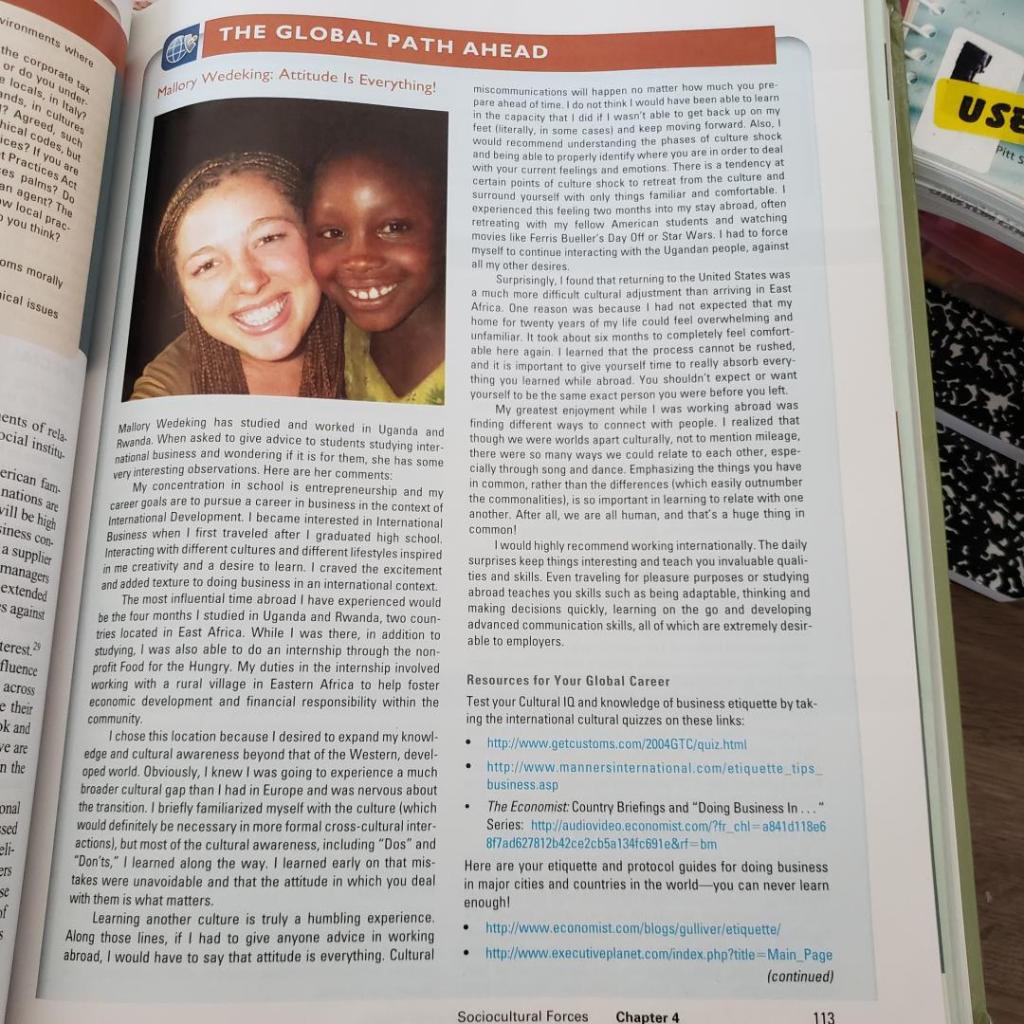
THE GLOBAL PATH AHEAD vironments where the corporate tax or do you under locals, in Italy ands, in cultures *2 Agreed, such hical codes.com Mallory Wedeking: Attitude Is Everything! USE Pitts ices? ces palms? an Pranare actices Act Do agent? The w local prac you think? oms morally aical issues miscommunications will happen no matter how much you pre pare ahead of time. I do not think I would have been able to leam in the capacity that I did it I wasn't able to get back up on my teet (literally, in some cases) and keep moving forward. Also, would recommend understanding the phases of culture shock and being able to properly identify where you are in order to deal with your current feelings and emotions. There is a tendency at certain points of culture shock to retreat from the culture and Surround yourself with only things familiar and comfortable 1 experienced this feeling two months into my stay abroad, often retreating with my fellow American students and watching movies like Ferris Bueller's Day Off or Star Wars, I had to force myself to continue interacting with the Ugandan people, against all my other desires. Surprisingly, I found that returning to the United States was a much more difficult cultural adjustment than arriving in East Africa. One reason was because I had not expected that my home for twenty years of my life could feel overwhelming and unfamiliar. It took about six months to completely feel comfort able here again. I learned that the process cannot be rushed, and it is important to give yourself time to really absorb every thing you learned while abroad. You shouldn't expect or want yourself to be the same exact person you were before you left. My greatest enjoyment while I was working abroad was finding different ways to connect with people. I realized that though we were worlds apart culturally, not to mention mileage, there were so many ways we could relate to each other, espe- cially through song and dance. Emphasizing the things you have in common, rather than the differences (which easily outnumber the commonalities), is so important in learning to relate with one another. After all, we are all human, and that's a huge thing in Common! I would highly recommend working internationally. The daily surprises keep things interesting and teach you invaluable quali ties and skills. Even traveling for pleasure purposes or studying abroad teaches you skills such as being adaptable, thinking and making decisions quickly, learning on the go and developing advanced communication skills, all of which are extremely desir- able to employers ents of rela ocial institu- My concentration in erican fam nations are will be high iness con a supplier managers extended es against terest 29 fluence across their ok and Mallory Wedeking has studied and worked in Uganda and Awanda. When asked to give advice to students studying inter- national business and wondering if it is for them, she has some very interesting observations. Here are her comments in school is entrepreneurship and my mals are to pursu career goals are to pursue career in business in the context of international Development. I became interest interested in International Business when I first traveled after I graduated high school Interacting with different cultures and different lifestyles inspired creativity and a desire to learn. I craved the excitement and added texture to doing business in an international context. The most influential time abroad I have experienced would be the four months I studied in Uganda and Rwanda, two coun- tries located in East Africa. While I was there, in addition to studying. I was also able to do an internship through the non- profit Food for the Hungry. My duties in the internship involved working with a rural village in Eastern Africa to help foster economic development and financial responsibility within the community I chose this location because I desired to expand my knowl- edge and cultural awareness beyond that of the Western, devel. oped world. Obviously, I knew I was going to experience a much broader cultural gap than I had in Europe and was nervous about the transition. I briefly familiarized myself with the culture (which would definitely be necessary in more formal cross-cultural inter- actions), but most of the cultural awareness, including "Dos" and "Don'ts," I learned along the way. I learned early on that mis- takes were unavoidable and that the attitude in which you deal with them is what matters. Learning another culture is truly a humbling experience, Along those lines, if I had to give anyone advice in working abroad, I would have to say that attitude is everything. Cultural ve are n the onal sed eli- Resources for Your Global Career Test your Cultural IQ and knowledge of business etiquette by tak- ing the international cultural quizzes on these links: http://www.getcustoms.com/2004GTC/quiz.html http://www.mannersinternational.com/etiquette_tips business asp The Economist: Country Briefings and "Doing Business In..." Series: http://audiovideo.economist.com/?fr_chl=a84101186 8f7ad627812642ce2cb5a134fc691e&rf=bm Here are your etiquette and protocol guides for doing business in major cities and countries in the world you can never learn enough! http://www.economist.com/blogs/gulliver/etiquette/ http://www.executiveplanet.com/index.php?title=Main Page (continued) of 5 Sociocultural Forces Chapter 4 113









 Study Help