



Question: Will rate! When you go to work, you likely have the expectation that somebody will be there to tell you what to do. You will,
Will rate! 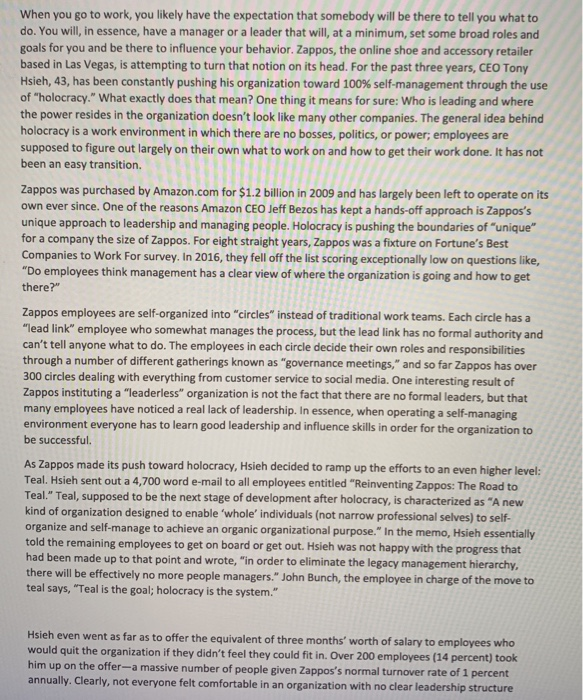
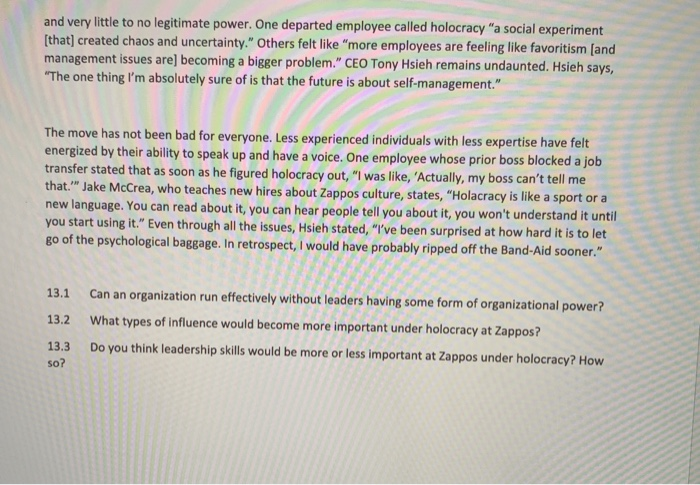
When you go to work, you likely have the expectation that somebody will be there to tell you what to do. You will, in essence, have a manager or a leader that will, at a minimum, set some broad roles and goals for you and be there to influence your behavior. Zappos, the online shoe and accessory retailer based in Las Vegas, is attempting to turn that notion on its head. For the past three years, CEO Tony Hsieh, 43, has been constantly pushing his organization toward 100% self-management through the use of "holocracy." What exactly does that mean? One thing it means for sure: Who is leading and where the power resides in the organization doesn't look like many other companies. The general idea behind holocracy is a work environment in which there are no bosses, politics, or power; employees are supposed to figure out largely on their own what to work on and how to get their work done. It has not been an easy transition Zappos was purchased by Amazon.com for $1.2 billion in 2009 and has largely been left to operate on its own ever since. One of the reasons Amazon CEO Jeff Bezos has kept a hands-off approach is Zappos's unique approach to leadership and managing people. Holocracy is pushing the boundaries of "unique" for a company the size of Zappos. For eight straight years, Zappos was a fixture on Fortune's Best Companies to Work For survey. In 2016, they fell off the list scoring exceptionally low on questions like, "Do employees think management has a clear view of where the organization is going and how to get there?" Zappos employees are self-organized into "circles" instead of traditional work teams. Each circle has a "lead link" employee who somewhat manages the process, but the lead link has no formal authority and can't tell anyone what to do. The employees in each circle decide their own roles and responsibilities through a number of different gatherings known as "governance meetings," and so far Zappos has over 300 circles dealing with everything from customer service to social media. One interesting result of Zappos instituting a "leaderless" organization is not the fact that there are no formal leaders, but that many employees have noticed a real lack of leadership. In essence, when operating a self-managing environment everyone has to learn good leadership and influence skills in order for the organization to be successful As Zappos made its push toward holocracy, Hsieh decided to ramp up the efforts to an even higher level: Teal. Hsieh sent out a 4,700 word e-mail to all employees entitled "Reinventing Zappos: The Road to Teal." Teal, supposed to be the next stage of development after holocracy, is characterized as "A new kind of organization designed to enable 'whole' individuals (not narrow professional selves) to self- organize and self-manage to achieve an organic organizational purpose." In the memo, Hsieh essentially told the remaining employees to get on board or get out. Hsieh was not happy with the progress that had been made up to that point and wrote, "in order to eliminate the legacy management hierarchy, there will be effectively no more people managers." John Bunch, the employee in charge of the move to teal says, "Teal is the goal; holocracy is the system." Hsieh even went as far as to offer the equivalent of three months' worth of salary to employees who would quit the organization if they didn't feel they could fit in. Over 200 employees (14 percent) took him up on the offer-a massive number of people given Zappos's normal turnover rate of 1 percent annually. Clearly, not everyone felt comfortable in an organization with no clear leadership structure and very little to no legitimate power. One departed employee called holocracy "a social experiment [that] created chaos and uncertainty." Others felt like "more employees are feeling like favoritism (and management issues are becoming a bigger problem." CEO Tony Hsieh remains undaunted. Hsieh says, "The one thing I'm absolutely sure of is that the future is about self-management." The move has not been bad for everyone. Less experienced individuals with less expertise have felt energized by their ability to speak up and have a voice. One employee whose prior boss blocked a job transfer stated that as soon as he figured holocracy out, "I was like, 'Actually, my boss can't tell me that."" Jake McCrea, who teaches new hires about Zappos culture, states, "Holacracy is like a sport or a new language. You can read about it, you can hear people tell you about it, you won't understand it until you start using it." Even through all the issues, Hsieh stated, "I've been surprised at how hard it is to let go of the psychological baggage. In retrospect, I would have probably ripped off the Band-Aid sooner." 13.1 13.2 Can an organization run effectively without leaders having some form of organizational power? What types of influence would become more important under holocracy at Zappos? Do you think leadership skills would be more or less important at Zappos under holocracy? How 13.3 so Step by Step Solution
There are 3 Steps involved in it
1 Expert Approved Answer
Step: 1 Unlock

Question Has Been Solved by an Expert!
Get step-by-step solutions from verified subject matter experts
Step: 2 Unlock
Step: 3 Unlock