







Question: Write a MatLab code for the following prompt. There should be four plots when done, one for D vs 1/T, one for semilogx, one for
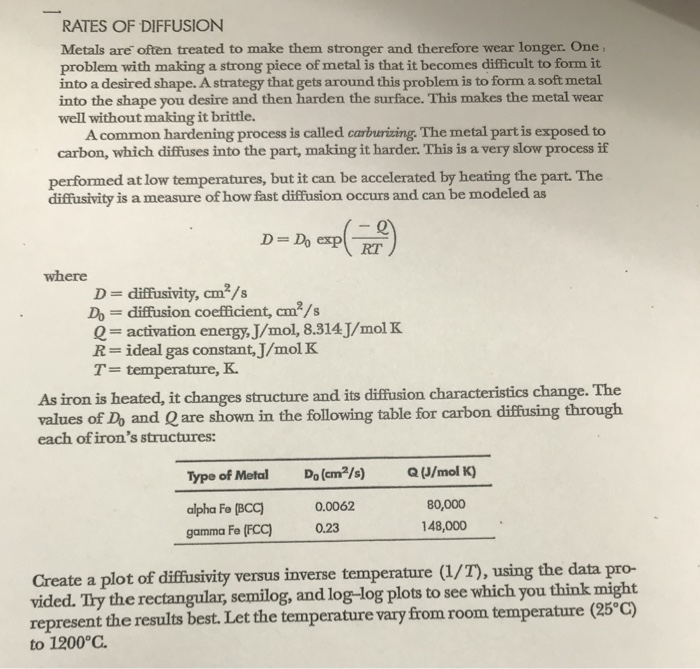
RATES OF DIFFUSION Metals are often treated to make them stronger and therefore wear longer. One problem with making a strong piece of metal is that it becomes difficult to form it into a desired shape. A strategy that gets around this problem is to form a soft metal into the shape you desire and then harden the surface. This makes the metal wear well without making it brittle A common hardening process is called carburizing. The metal part is exposed to carbon, which diffuses into the part, making it harder. This is a very slow process if performed at low temperatures, but it can be accelerated by heating the part. The diffusivity is a measure of how fast diffusion occurs and can be modeled as 0 D = Db exp(-RT where D diffusivity, cm2/s Do diffusion coefficient, cm2/s e- activation energy,J/mol, 8.314 J/mol K R = ideal gas constant, J/mol K T= temperature, K As iron is heated, it changes structure and its diffusion characteristics change. The values of Do and Qare shown in the following table for carbon diffusing through each of iron's structures: Type of Metal Do (em2/s) QJ/mol K) alpha Fo [BCO) gamma Fe (FCC) 0.23 80,000 148,000 0.0062 Create a plot of diffusivity versus inverse temperature (1/T), using the data pro- vided. Try the rectangular, semilog, and log-log plots to see which you think might represent the results best. Let the temperature vary from room temperature (25 C) to 1200 C
Step by Step Solution
There are 3 Steps involved in it

Get step-by-step solutions from verified subject matter experts
 Study Help