



Question: Write a Persuasive speech...pls Topic: Students should be encouraged to do social work 1.Write a Topic name 2. Audience 3. General purpose 4. Specific purpose
Write a Persuasive speech...pls
Topic: Students should be encouraged to do social work
1.Write a Topic name 2. Audience 3. General purpose 4. Specific purpose 5. Thesis( it should be 1 sentence with 3 specific points)
Introduction : A. Attention Getter(make it interesting) B. Reason to Listen. C. Thesis Statements D. Credibility Statement. E. Preview of main points. F. Transition(3 parts details pls if possible)
Conclusion- A. Review of Main points B. Restate Thesis C. Closure.
I will gave you a sample to help to you...
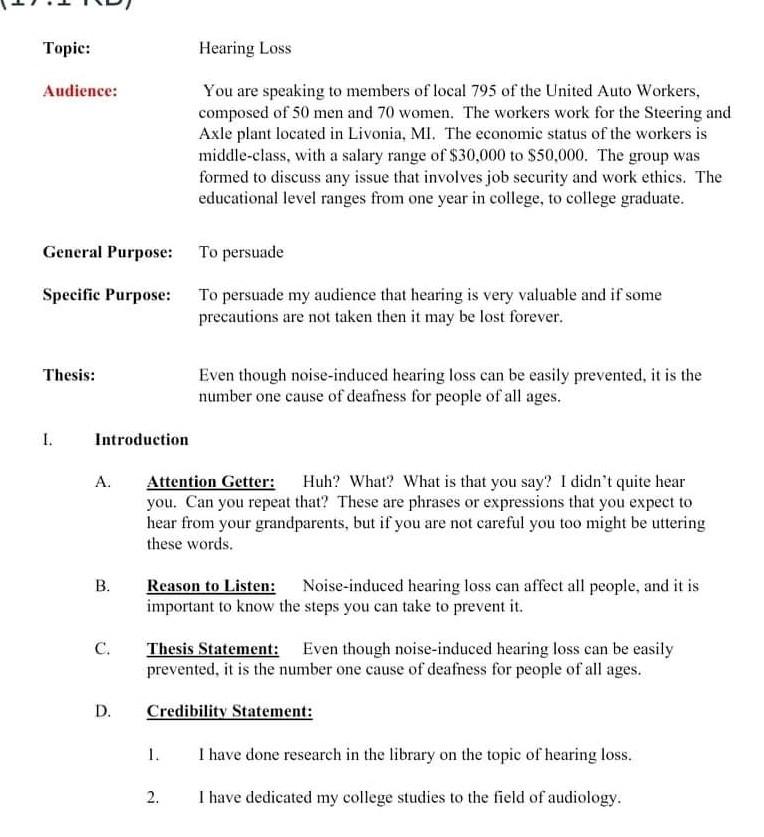
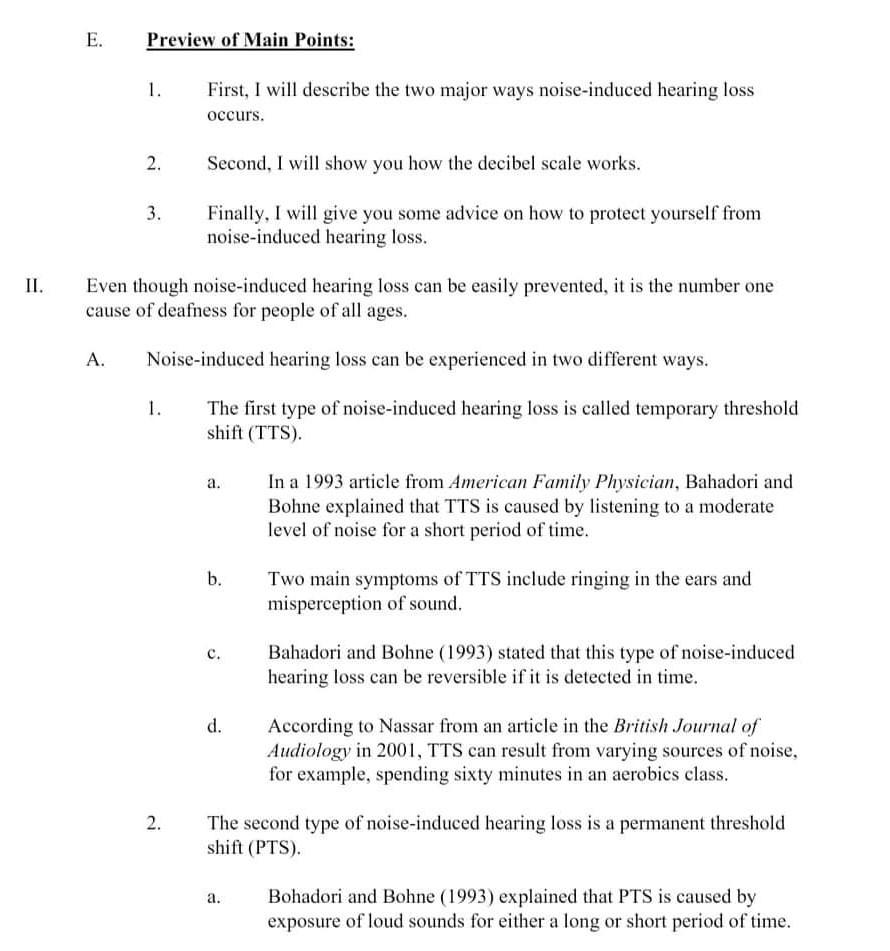
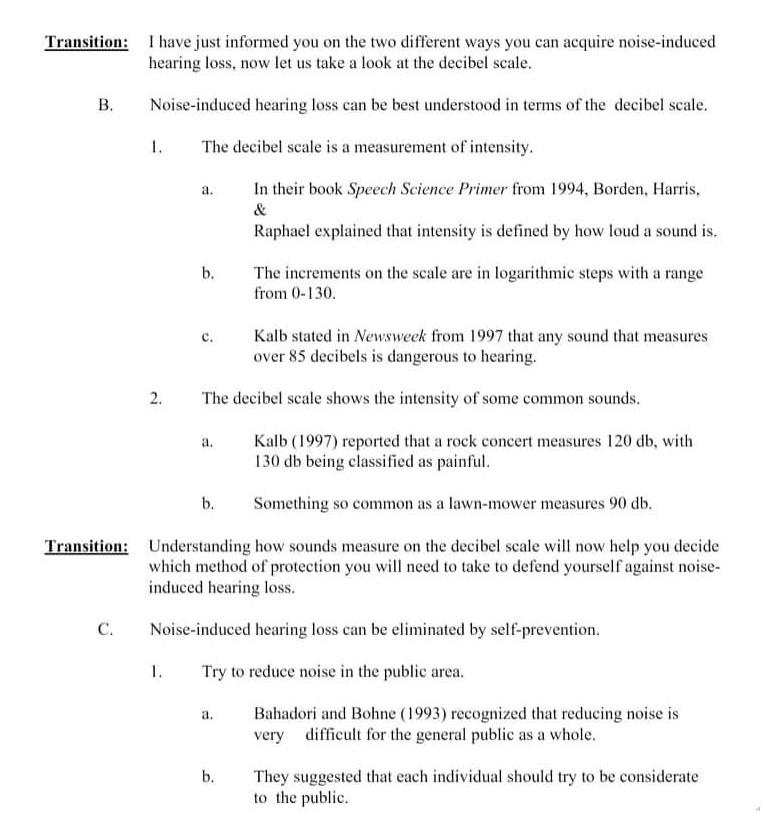
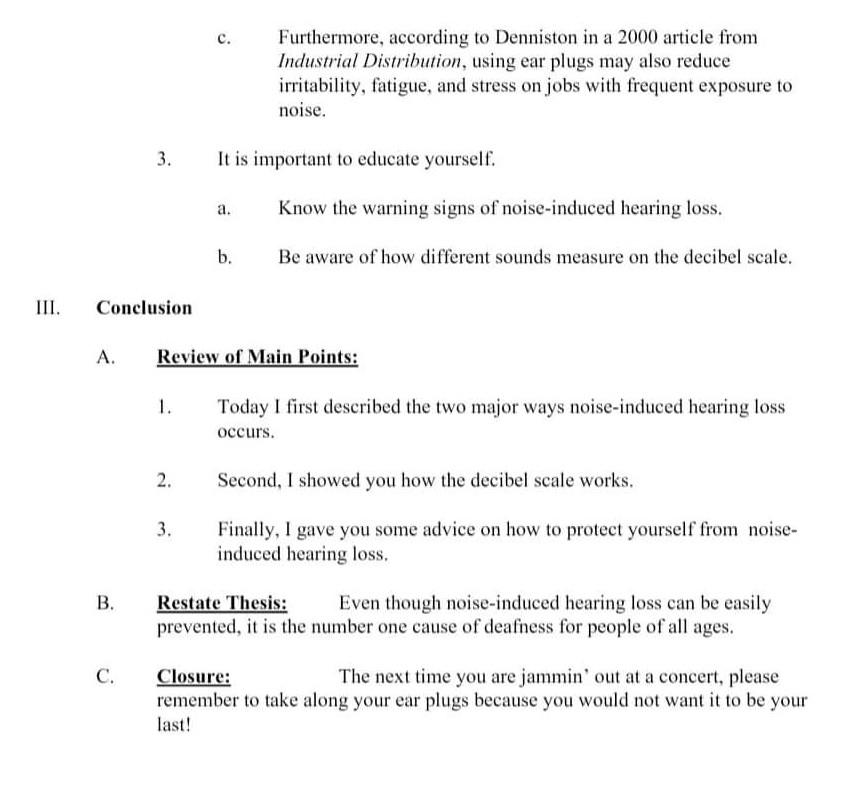
please follow these images format I hope you will understand. I will gave vote. I need ASAP these answers it really helpful for me.
Topic: Hearing Loss Audience: You are speaking to members of local 795 of the United Auto Workers, composed of 50 men and 70 women. The workers work for the Steering and Axle plant located in Livonia, MI. The economic status of the workers is middle-class, with a salary range of $30,000 to $50,000. The group was formed to discuss any issue that involves job security and work ethics. The educational level ranges from one year in college, to college graduate. General Purpose: To persuade Specific Purpose: To persuade my audience that hearing is very valuable and if some precautions are not taken then it may be lost forever. Thesis: Even though noise-induced hearing loss can be easily prevented, it is the number one cause of deafness for people of all ages. 1. Introduction A. Attention Getter: Huh? What? What is that you say? I didn't quite hear you. Can you repeat that? These are phrases or expressions that you expect to hear from your grandparents, but if you are not careful you too might be uttering these words. B. Reason to Listen: Noise-induced hearing loss can affect all people, and it is important to know the steps you can take to prevent it. C. Thesis Statement: Even though noise-induced hearing loss can be easily prevented, it is the number one cause of deafness for people of all ages. Credibility Statement: D. 1. I have done research in the library on the topic of hearing loss. 2. I have dedicated my college studies to the field of audiology. E. Preview of Main Points: 1. First, I will describe the two major ways noise-induced hearing loss occurs. 2. Second, I will show you how the decibel scale works. 3. Finally, I will give you some advice on how to protect yourself from noise-induced hearing loss. II. Even though noise-induced hearing loss can be easily prevented, it is the number one cause of deafness for people of all ages. A. Noise-induced hearing loss can be experienced in two different ways. 1. The first type of noise-induced hearing loss is called temporary threshold shift (TTS). a. In a 1993 article from American Family Physician, Bahadori and Bohne explained that TTS is caused by listening to a moderate level of noise for a short period of time. b. Two main symptoms of TTS include ringing in the ears and misperception of sound, c. Bahadori and Bohne (1993) stated that this type of noise-induced hearing loss can be reversible if it is detected in time. d. According to Nassar from an article in the British Journal of Audiology in 2001, TTS can result from varying sources of noise, for example, spending sixty minutes in an aerobics class. 2. The second type of noise-induced hearing loss is a permanent threshold shift (PTS). a. Bohadori and Bohne (1993) explained that PTS is caused by exposure of loud sounds for either a long or short period of time. Transition: I have just informed you on the two different ways you can acquire noise-induced hearing loss, now let us take a look at the decibel scale. Noise-induced hearing loss can be best understood in terms of the decibel scale. B. 1. a. The decibel scale is a measurement of intensity. In their book Speech Science Primer from 1994, Borden. Harris. & Raphael explained that intensity is defined by how loud a sound is. b. The increments on the scale are in logarithmic steps with a range from 0-130. Kalb stated in Newsweek from 1997 that any sound that measures over 85 decibels is dangerous to hearing. The decibel scale shows the intensity of some common sounds. 2 2. a. Kalb (1997) reported that a rock concert measures 120 db, with 130 db being classified as painful. b. Something so common as a lawn-mower measures 90 db. Transition: Understanding how sounds measure on the decibel scale will now help you decide which method of protection you will need to take to defend yourself against noise- induced hearing loss. C. Noise-induced hearing loss can be eliminated by self-prevention. 1. Try to reduce noise in the public area. a. Bahadori and Bohne (1993) recognized that reducing noise is very difficult for the general public as a whole. b. They suggested that each individual should try to be considerate to the public. c. Furthermore, according to Denniston in a 2000 article from Industrial Distribution, using ear plugs may also reduce irritability, fatigue, and stress on jobs with frequent exposure to noise. 3. It is important to educate yourself. a. Know the warning signs of noise-induced hearing loss. b. Be aware of how different sounds measure on the decibel scale. III. Conclusion A. Review of Main Points: 1. Today I first described the two major ways noise-induced hearing loss occurs. 2. Second, I showed you how the decibel scale works. 3. Finally, I gave you some advice on how to protect yourself from noise- induced hearing loss, B. Restate Thesis: Even though noise-induced hearing loss can be easily prevented, it is the number one cause of deafness for people of all ages. C. Closure: The next time you are jammin' out at a concert, please remember to take along your ear plugs because you would not want it to be your lastStep by Step Solution
There are 3 Steps involved in it

Get step-by-step solutions from verified subject matter experts