Question: Write arguments and counter-arguments separately for the exercise given. Sometimes Yelling is for Everyone's Good COUNTERPOINT POINT Y nger is discussed throughout this chapter for
Write arguments and counter-arguments separately for the exercise given.
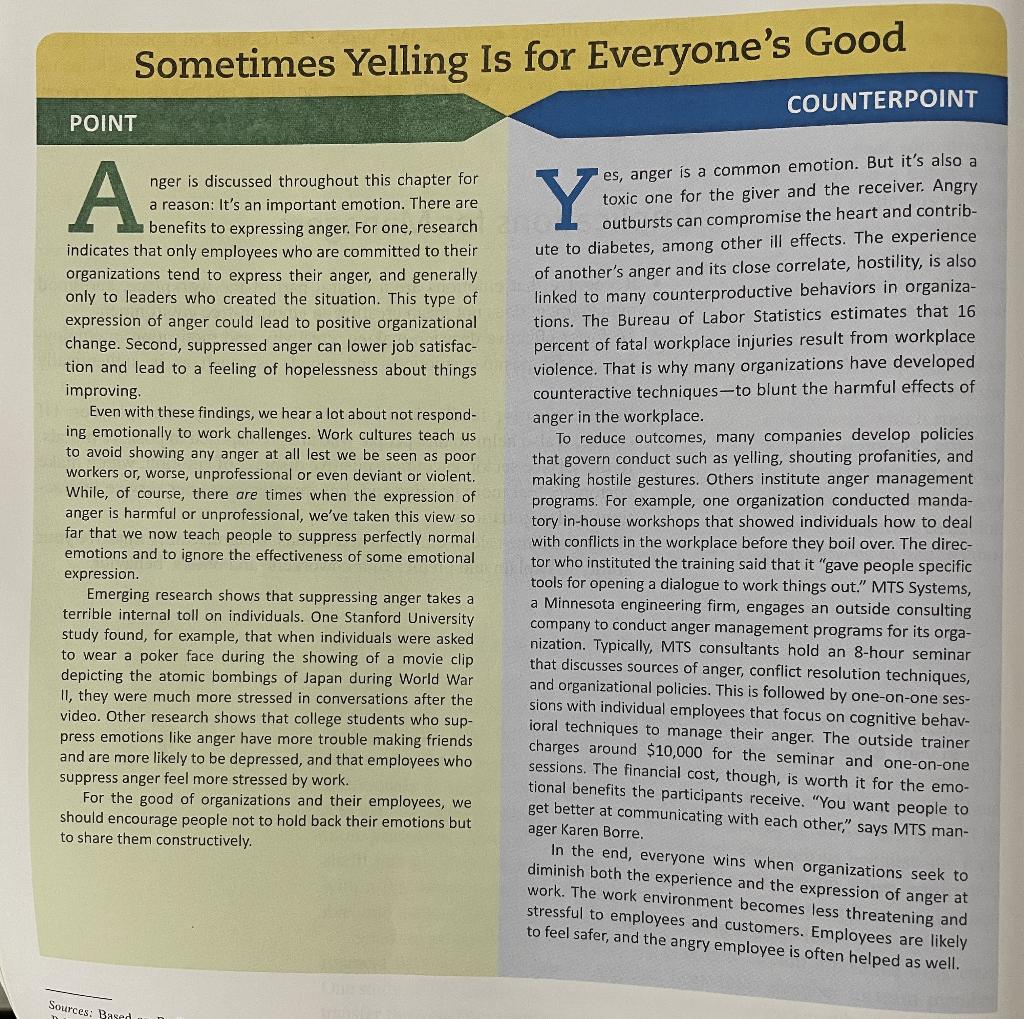
Sometimes Yelling is for Everyone's Good COUNTERPOINT POINT Y nger is discussed throughout this chapter for a reason: It's an important emotion. There are benefits to expressing anger. For one, research indicates that only employees who are committed to their organizations tend to express their anger, and generally only to leaders who created the situation. This type of expression of anger could lead to positive organizational change. Second, suppressed anger can lower job satisfac- tion and lead to a feeling of hopelessness about things improving Even with these findings, we hear a lot about not respond- ing emotionally to work challenges. Work cultures teach us to avoid showing any anger at all lest we be seen as poor workers or, worse, unprofessional or even deviant or violent. While, of course, there are times when the expression of anger is harmful or unprofessional, we've taken this view so far that we now teach people to suppress perfectly normal emotions and to ignore the effectiveness of some emotional expression. Emerging research shows that suppressing anger takes a terrible internal toll on individuals. One Stanford University study found, for example, that when individuals were asked to wear a poker face during the showing of a movie clip depicting the atomic bombings of Japan during World War 11, they were much more stressed in conversations after the video. Other research shows that college students who sup- press emotions like anger have more trouble making friends and are more likely to be depressed, and that employees who suppress anger feel more stressed by work. For the good of organizations and their employees, we should encourage people not to hold back their emotions but to share them constructively. es, anger is a common emotion. But it's also a toxic one for the giver and the receiver. Angry outbursts can compromise the heart and contrib- ute to diabetes, among other ill effects. The experience of another's anger and its close correlate, hostility, is also linked to many counterproductive behaviors in organiza- tions. The Bureau of Labor Statistics estimates that 16 percent of fatal workplace injuries result from workplace violence. That is why many organizations have developed counteractive techniques-to blunt the harmful effects of anger in the workplace. To reduce outcomes, many companies develop policies that govern conduct such as yelling, shouting profanities, and making hostile gestures. Others institute anger management programs. For example, one organization conducted manda- tory in-house workshops that showed individuals how to deal with conflicts in the workplace before they boil over. The direc- tor who instituted the training said that it "gave people specific tools for opening a dialogue to work things out." MTS Systems, a Minnesota engineering firm, engages an outside consulting company to conduct anger management programs for its orga- nization. Typically, MTS consultants hold an 8-hour seminar that discusses sources of anger, conflict resolution techniques, and organizational policies. This is followed by one-on-one ses- sions with individual employees that focus on cognitive behav- ioral techniques to manage their anger. The outside trainer charges around $10,000 for the seminar and one-on-one sessions. The financial cost, though, is worth it for the emo- tional benefits the participants receive. "You want people to get better at communicating with each other," says MTS man- ager Karen Borre. In the end, everyone wins when organizations seek to diminish both the experience and the expression of anger at work. The work environment becomes less threatening and stressful to employees and customers. Employees are likely to feel safer, and the angry employee is often helped as well. Sources: Based









 Study Help