







Question: A boundary layer is formed on the surface of the aerofoil presented in Task 2, a) By assuming a complete turbulent flow around the
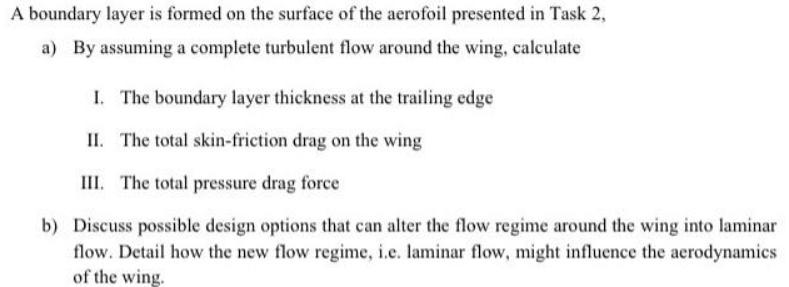
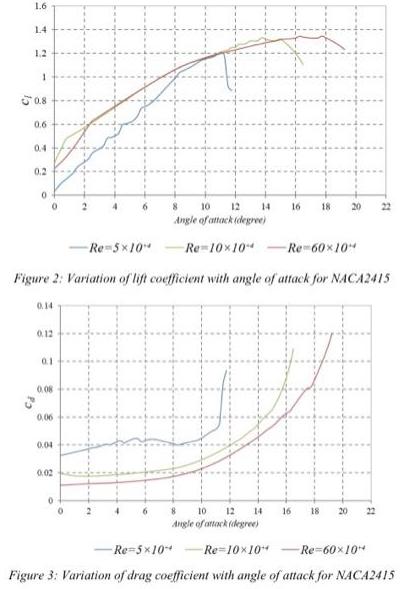
A boundary layer is formed on the surface of the aerofoil presented in Task 2, a) By assuming a complete turbulent flow around the wing, calculate I. The boundary layer thickness at the trailing edge II. The total skin-friction drag on the wing III. The total pressure drag force b) Discuss possible design options that can alter the flow regime around the wing into laminar flow. Detail how the new flow regime, i.e. laminar flow, might influence the aerodynamics of the wing. 1.6 1.4 1.2 1 0.8 0.6 0.4 0.2 P 0 0 8 10 12 14 Angle of attack (degree) Re 1010 Figure 2: Variation of lift coefficient with angle of attack for NACA2415 0.14 0.12 0.1 0.08 0,06 0:04 0.02 0 6 -Re-510 4 16. 6 16 18 Re-6010 8 10 12 14 Angle of attack (degree) -Re=5*10** Re=10*10** Re-60x10 Figure 3: Variation of drag coefficient with angle of attack for NACA2415 18 20 22 20 22
Step by Step Solution
3.45 Rating (161 Votes )
There are 3 Steps involved in it
To tackle this problem we will address each part one by one a Assumptions Complete turbulent flow around the wing I Boundary Layer Thickness at the Tr... View full answer

Get step-by-step solutions from verified subject matter experts
 Study Help