







Question: You have engineered a protease to catalytically break the backbone amine bond of a peptide ( histidine - alanine - glutamine ) substrate. The substrate
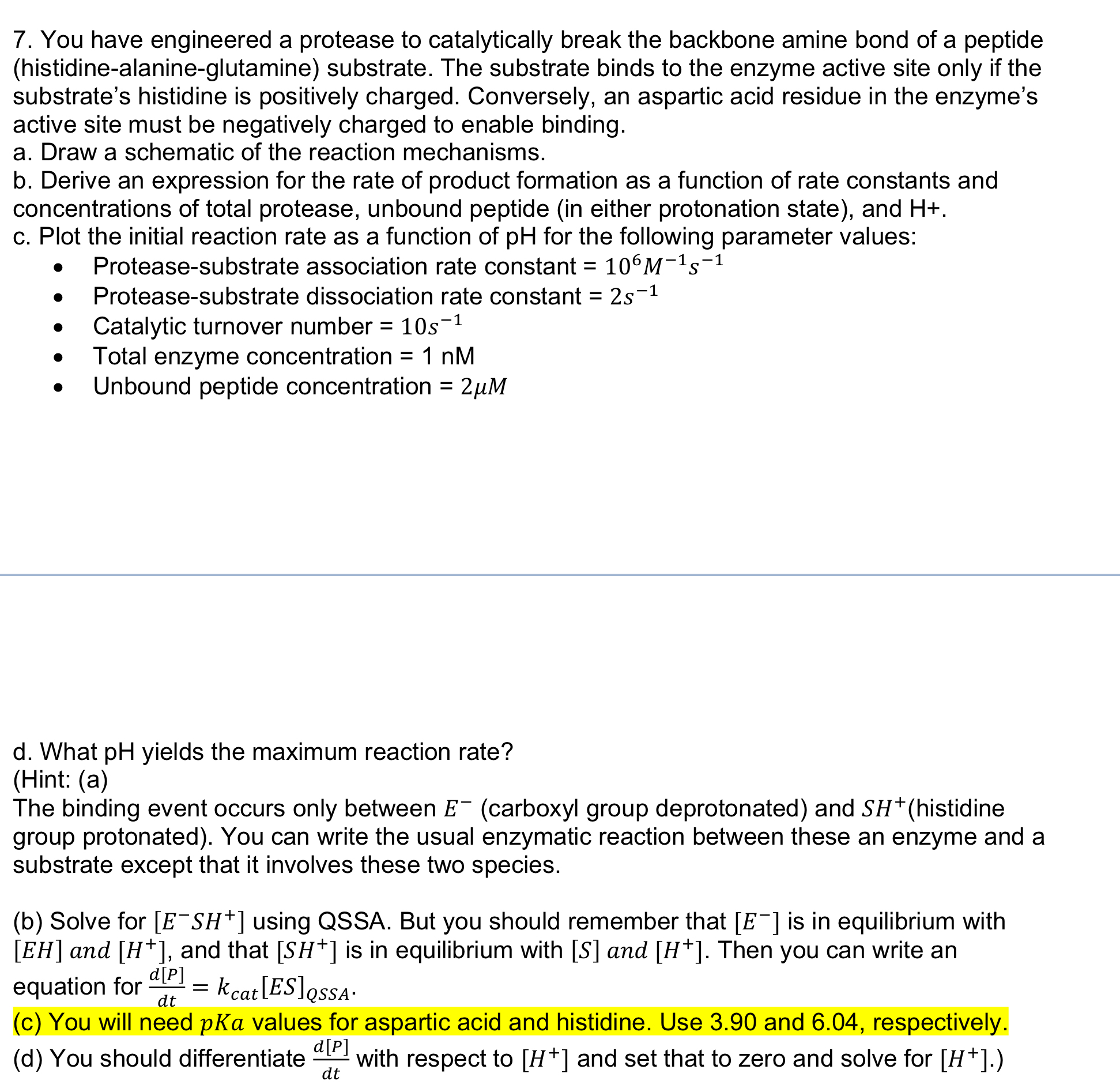
You have engineered a protease to catalytically break the backbone amine bond of a peptide histidinealanineglutamine substrate. The substrate binds to the enzyme active site only if the substrate's histidine is positively charged. Conversely, an aspartic acid residue in the enzyme's active site must be negatively charged to enable binding.
a Draw a schematic of the reaction mechanisms.
b Derive an expression for the rate of product formation as a function of rate constants and concentrations of total protease, unbound peptide in either protonation state and
c Plot the initial reaction rate as a function of for the following parameter values:
Proteasesubstrate association rate constant
Proteasesubstrate dissociation rate constant
Catalytic turnover number
Total enzyme concentration
Unbound peptide concentration
d What yields the maximum reaction rate?
Hint: a
The binding event occurs only between carboxyl group deprotonated and histidine group protonated You can write the usual enzymatic reaction between these an enzyme and a substrate except that it involves these two species.
b Solve for using QSSA. But you should remember that is in equilibrium with and and that is in equilibrium with and Then you can write an equation for
c You will need pKa values for aspartic acid and histidine. Use and respectively.
d You should differentiate with respect to and set that to zero and solve for
Step by Step Solution
There are 3 Steps involved in it
1 Expert Approved Answer
Step: 1 Unlock

Question Has Been Solved by an Expert!
Get step-by-step solutions from verified subject matter experts
Step: 2 Unlock
Step: 3 Unlock
 Study Help