Question: You may not use sed, awk, find, grep, Python, perl, or any other programming language, scripting language, or other tools. Only use bash shell. U:
You may not use sed, awk, find, grep, Python, perl, or any other programming language, scripting language, or other tools. Only use bash shell.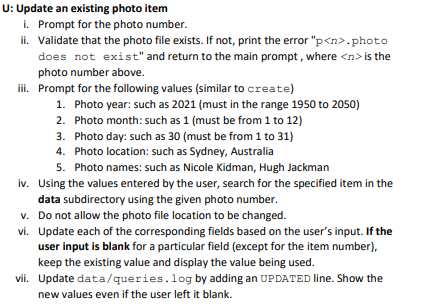
U: Update an existing photo item i. Prompt for the photo number. ii. Validate that the photo file exists. If not, print the error "p.photo does not exist" and return to the main prompt, where is the photo number above. ili. Prompt for the following values (similar to create) 1. Photo year: such as 2021 (must in the range 1950 to 2050) 2. Photo month: such as 1 (must be from 1 to 12) 3. Photo day: such as 30 (must be from 1 to 31) 4. Photo location: such as Sydney, Australia 5. Photo names: such as Nicole Kidman, Hugh Jackman iv. Using the values entered by the user, search for the specified item in the data subdirectory using the given photo number. v. Do not allow the photo file location to be changed. vi. Update each of the corresponding fields based on the user's input. If the user input is blank for a particular field (except for the item number), keep the existing value and display the value being used. vii. Update data/queries.log by adding an UPDATED line. Show the new values even if the user left it blank. U: Update an existing photo item i. Prompt for the photo number. ii. Validate that the photo file exists. If not, print the error "p.photo does not exist" and return to the main prompt, where is the photo number above. ili. Prompt for the following values (similar to create) 1. Photo year: such as 2021 (must in the range 1950 to 2050) 2. Photo month: such as 1 (must be from 1 to 12) 3. Photo day: such as 30 (must be from 1 to 31) 4. Photo location: such as Sydney, Australia 5. Photo names: such as Nicole Kidman, Hugh Jackman iv. Using the values entered by the user, search for the specified item in the data subdirectory using the given photo number. v. Do not allow the photo file location to be changed. vi. Update each of the corresponding fields based on the user's input. If the user input is blank for a particular field (except for the item number), keep the existing value and display the value being used. vii. Update data/queries.log by adding an UPDATED line. Show the new values even if the user left it blank









 Study Help