Question: Your company is considering deploying a chatbot, a virtual customer assistant, to initially handle customer service calls and, only when necessary, route callers to human
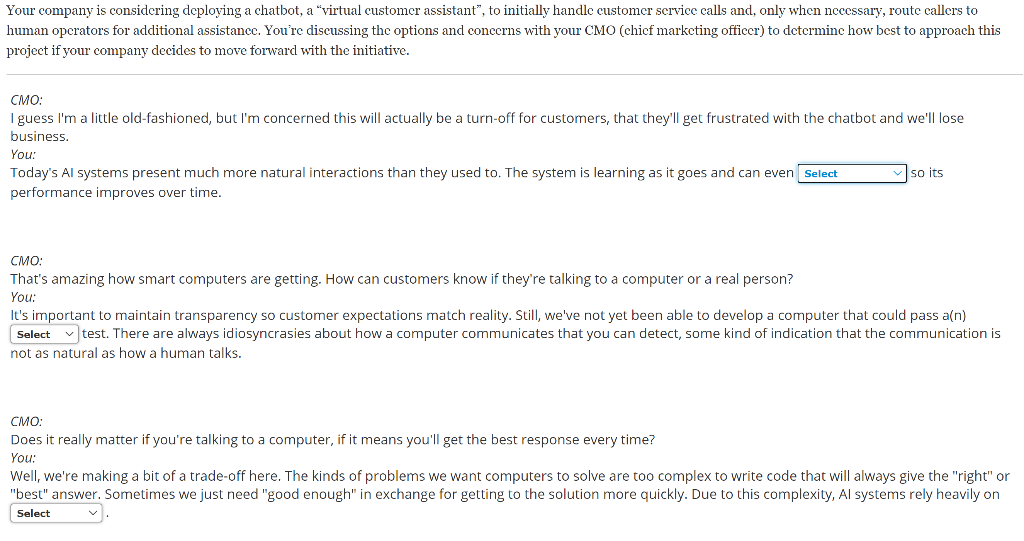
Your company is considering deploying a chatbot, a "virtual customer assistant, to initially handle customer service calls and, only when necessary, route callers to human operators for additional assistance. You're discussing the options and concerns with your CMO (chief markcting officer) to determinc how best to approach this project if your company decides to move forward with the initiative. CMO: I guess I'm a little old-fashioned, but I'm concerned this will actually be a turn-off for customers, that they'll get frustrated with the chatbot and we'll lose business. You: Today's Al systems present much more natural interactions than they used to. The system is learning as it goes and can even Select so its performance improves over time. CMO: That's amazing how smart computers are getting. How can customers know if they're talking to a computer or a real person? You: It's important to maintain transparency so customer expectations match reality. Still, we've not yet been able to develop a computer that could pass a(n) Select test. There are always idiosyncrasies about how a computer communicates that you can detect, some kind of indication that the communication is not as natural as how a human talks. : Does it really matter if you're talking to a computer, if it means you'll get the best response every time? You: Well, we're making a bit of a trade-off here. The kinds of problems we want computers to solve are too complex to write code that will always give the "right" or "best" answer. Sometimes we just need "good enough" in exchange for getting to the solution more quickly. Due to this complexity, Al systems rely heavily on Select Your company is considering deploying a chatbot, a "virtual customer assistant, to initially handle customer service calls and, only when necessary, route callers to human operators for additional assistance. You're discussing the options and concerns with your CMO (chief markcting officer) to determinc how best to approach this project if your company decides to move forward with the initiative. CMO: I guess I'm a little old-fashioned, but I'm concerned this will actually be a turn-off for customers, that they'll get frustrated with the chatbot and we'll lose business. You: Today's Al systems present much more natural interactions than they used to. The system is learning as it goes and can even Select so its performance improves over time. CMO: That's amazing how smart computers are getting. How can customers know if they're talking to a computer or a real person? You: It's important to maintain transparency so customer expectations match reality. Still, we've not yet been able to develop a computer that could pass a(n) Select test. There are always idiosyncrasies about how a computer communicates that you can detect, some kind of indication that the communication is not as natural as how a human talks. : Does it really matter if you're talking to a computer, if it means you'll get the best response every time? You: Well, we're making a bit of a trade-off here. The kinds of problems we want computers to solve are too complex to write code that will always give the "right" or "best" answer. Sometimes we just need "good enough" in exchange for getting to the solution more quickly. Due to this complexity, Al systems rely heavily on Select









 Study Help