







Question: Your task is to develop a strategy to market White Appliances microwave ovens in India. Include target market(s), microwave oven features, price(s), promotion, and distribution
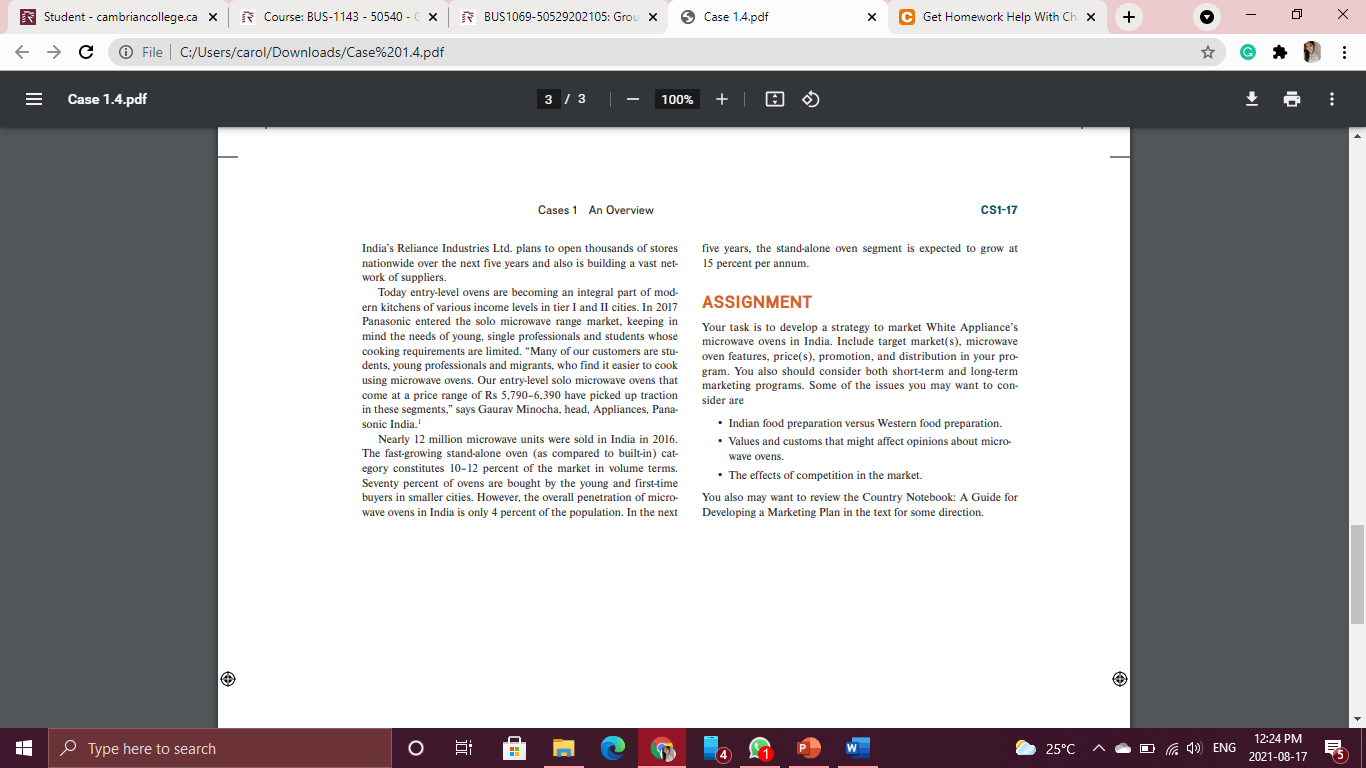
Your task is to develop a strategy to market White Appliances microwave ovens in India. Include target market(s), microwave oven features, price(s), promotion, and distribution in your program.
You also should consider both short-term and long-term marketing programs. Some of the issues you may want to consider are
Indian food preparation versus Western food preparation.
Values and customs that might affect opinions about microwave ovens
The effects of competition in the market.
You also may want to review the Country Notebook: A Guide for Developing a Marketing Plan in the text for some direction.
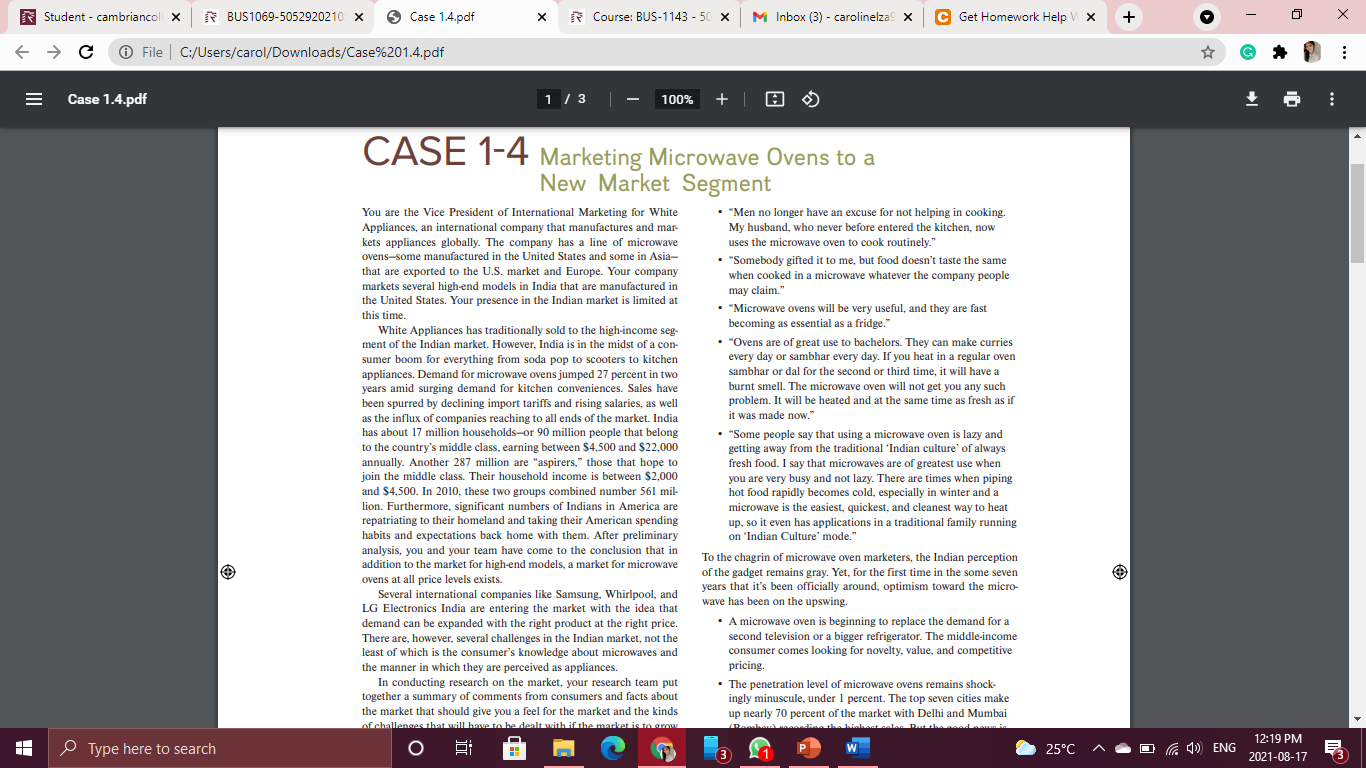
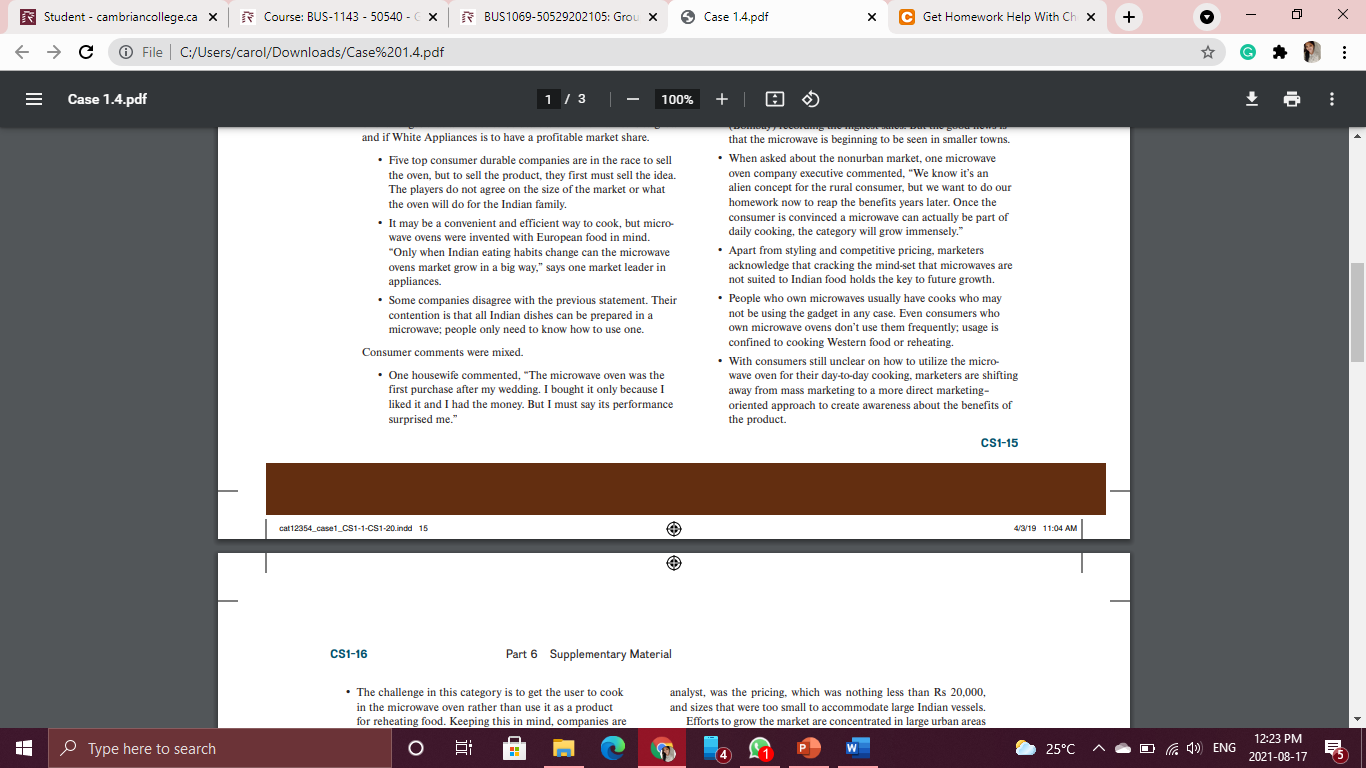
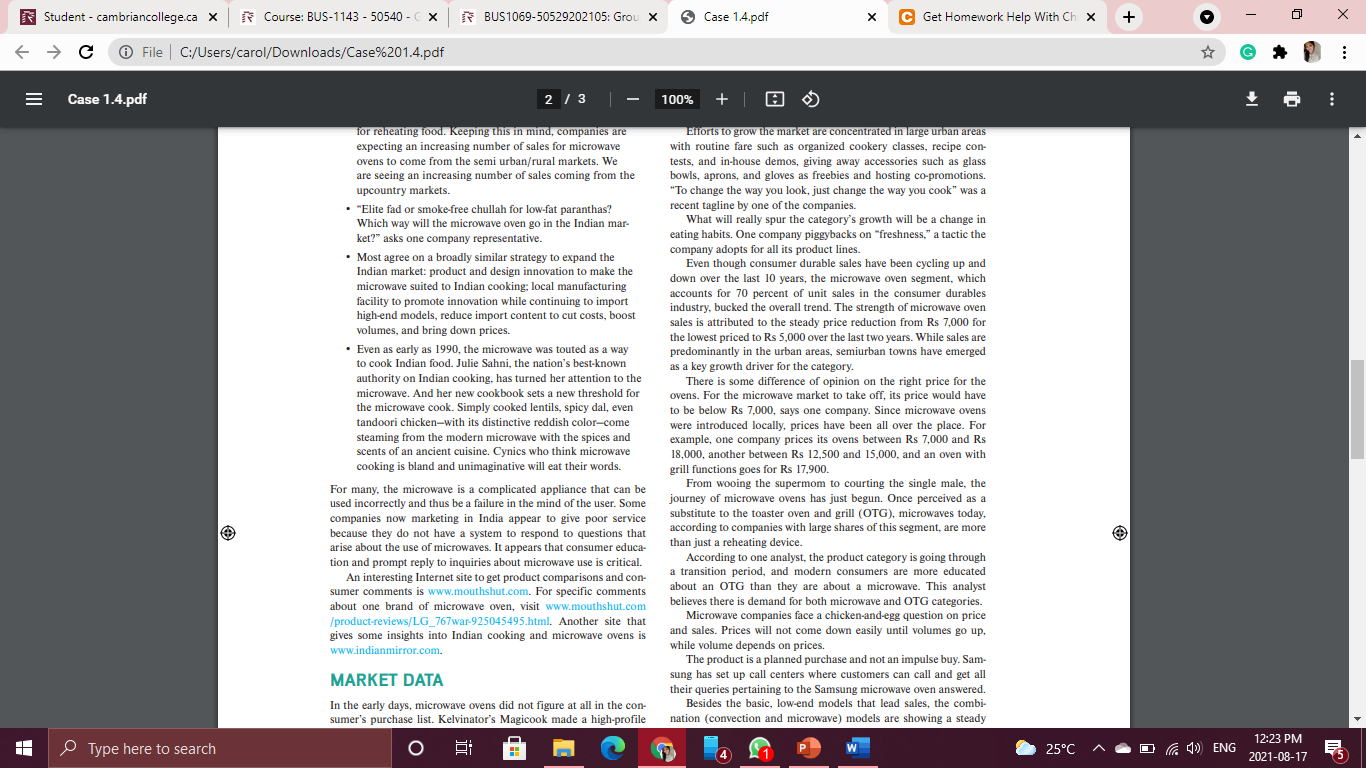
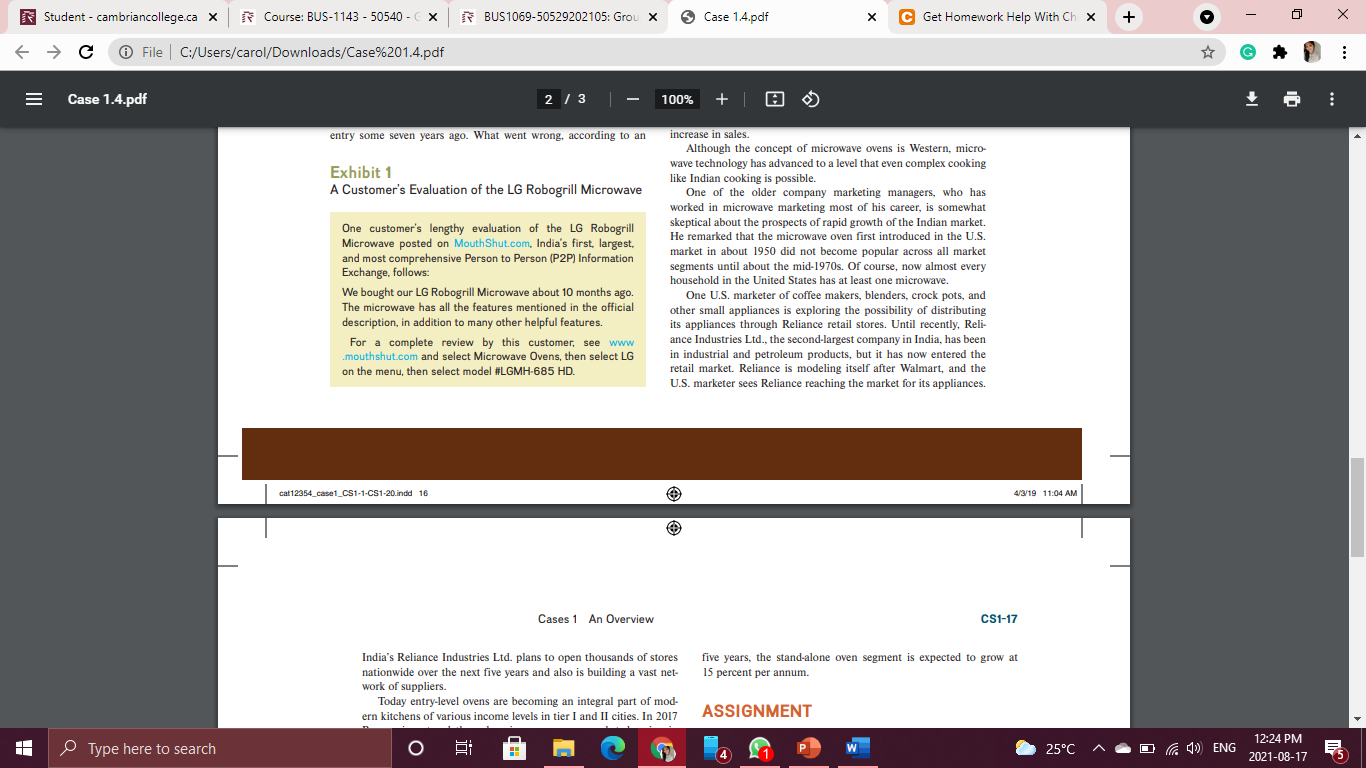
Student - cambriancol x A BUS1069-5052920210 X Case 1.4.pdf Course: BUS-1143-50 X M Inbox (3) - carolinelza x Get Homework Help fe O File C:/Users/carol/Downloads/Case%201.4.pdf : Case 1.4.pdf 1 / 3 100% + : CASE 1-4 Marketing Microwave Ovens to a New Market Segment "Men no longer have an excuse for not helping in cooking. My husband, who never before entered the kitchen, now uses the microwave oven to cook routinely." "Somebody gifted it to me, but food doesn't taste the same when cooked in a microwave whatever the company people may claim. You are the Vice President of International Marketing for White Appliances, an international company that manufactures and mar- kets appliances globally. The company has a line of microwave ovens-some manufactured in the United States and some in Asia- that are exported to the U.S. market and Europe. Your company markets several high-end models in India that are manufactured in the United States. Your presence in the Indian market is limited at this time. White Appliances has traditionally sold to the high-income seg- ment of the Indian market. However, India is in the midst of a con- sumer boom for everything from soda pop to scooters to kitchen appliances. Demand for microwave ovens jumped 27 percent in two years amid surging demand for kitchen conveniences. Sales have been spurred by declining import tariffs and rising salaries, as well as the influx of companies reaching to all ends of the market. India has about 17 million households-or 90 million people that belong to the country's middle class, earning between $4,500 and $22,000 nually. Another 287 "aspirers," those that hope to join the middle class. Their household income is between $2,000 and $4,500. In 2010, these two groups combined number 561 mil- lion. Furthermore, significant numbers of Indians in America are repatriating to their homeland and taking their American spending habits and expectations back home with them. After preliminary analysis, you and your team have come to the conclusion that in addition to the market for high-end models, a market for microwave ovens at all price levels exists. Several international companies like Samsung, Whirlpool, and LG Electronics India are entering the market with the idea that demand can be expanded with the right product at the right price. There are, however, several challenges in the Indian market, not the least of which is the consumer's knowledge about microwaves and the manner which they are perceived as appliances. In conducting research on the market, your research team put together a summary of comments from consumers and facts about the market that should give you a feel for the market and the kinds of challenges that will have to be dealt with if the market is to grow H: "Microwave ovens will be very useful, and they are fast becoming as essential as a fridge." "Ovens are of great use to bachelors. They can make curries every day or sambhar every day. If you heat in a regular oven sambhar or dal for the second or third time, it will have a burnt smell. The microwave oven will not get you any such problem. It will be heated and at the same time as fresh as if it was made now." "Some people say that using a microwave oven is lazy and getting away from the traditional "Indian culture of always fresh food. I say that microwaves are of greatest use when you are very busy and not lazy. There are times when piping hot food rapidly becomes cold, especially in winter and a microwave is the easiest, quickest, and cleanest way to heat up, so it even has applications in a traditional family running on 'Indian Culture' mode." To the chagrin of microwave oven marketers, the Indian perception of the gadget remains gray. Yet, for the first time in the some seven years that it's been officially around, optimism toward the micro- wave has been on the upswing. A microwave oven is beginning to replace the demand for a second television or a bigger refrigerator. The middle-income consumer comes looking for novelty, value, and competitive pricing. The penetration level of microwave ovens remains shock- ingly minuscule, under 1 percent. The top seven cities make up nearly 70 percent of the market with Delhi and Mumbai Type here to search o 25C DC A) ENG 12:19 PM 2021-08-17 Student-cambriancollege.ca X Course: BUS-1143 - 50540 - X F BUS1069-50529202105: Grou X Case 1.4.pdf C Get Homework Help With Ch x E C File C:/Users/carol/Downloads/Case%201.4.pdf : Case 1.4.pdf 1 / 3 100% + : and if White Appliances is to have a profitable market share. Five top consumer durable companies are in the race to sell the oven, but to sell the product, they first must sell the idea. The players do not agree on the size of the market or what the oven will do for the Indian family. . It may be a convenient and efficient way to cook, but micro- wave ovens were invented with European food in mind. "Only when Indian eating habits change can the microwave ovens market grow in a big way," says one market leader in appliances. Some companies disagree with the previous statement. Their contention is th all Indian dishes can be prepared in a microwave, people only need to know how to use one. that the microwave is beginning to be seen in smaller towns. When asked about the nonurban market, one microwave oven company executive commented, "We know it's an alien concept for the rural consumer, but we want to do our homework now to reap the benefits years later. Once the consumer is convinced a microwave can actually be part of daily cooking, the category will grow immensely." . Apart from styling and competitive pricing, marketers acknowledge that cracking the mind-set that microwaves are not suited to Indian food holds the key to future growth. People who own microwaves usually have cooks who may be using g the gadget in any case. Even consumers who own microwave ovens don't use them frequently, usage is confined to cooking Western food or reheating. With consumers still unclear on how to utilize the micro- wave oven for their day-to-day cooking, marketers are shifting away from mass marketing to a more direct marketing- oriented approach to create awareness about the benefits of the product. CS1-15 Consumer comments were mixed. One housewife commented, "The microwave oven was the first purchase after my wedding. I bought it only because I liked it and I had the money. But I must say its performance surprised me." cat12354_case1 CS1-1-CS1-20.indd 15 4/3/19 11:04 AM CS1-16 Part 6 Supplementary Material The challenge in this category is to get the user to cook in the microwave oven rather than use it as a product for reheating food. Keeping this in mind, companies are analyst, was the pricing, which was nothing less than Rs 20,000, and sizes that were too small to accommodate large Indian vessels. Efforts to grow the market are concentrated in large urban areas Type here to search HR PL 25C D) ENG 12:23 PM 2021-08-17 Student-cambriancollege.ca X Course: BUS-1143 - 50540 - X F BUS1069-50529202105: Grou X Case 1.4.pdf C Get Homework Help With Ch x E C File C:/Users/carol/Downloads/Case%201.4.pdf : Case 1.4.pdf 2 / 3 100% + for reheating food. Keeping this in mind, companies are expecting an increasing number of sales for microwave ovens to come from the semi urban/rural markets. We are seeing an increasing number of sales coming from the upcountry markets. "Elite fad or smoke-free chullah for low-fat paranthas? Which way will the microwave oven go in the Indian mar ket?" asks one one company representative. . Most agree on a broadly similar strategy to expand the Indian market: product and design innovation to make the microwave suited to Indian cooking: local manufacturing facility to promote innovation while continuing to import high-end models, reduce import content to cut costs, boost volumes, and bring down prices. Even as early as 1990, the microwave was touted as a way to cook Indian food. Julie Sahni, the nation's best-known authority on Indian cooking, has turned her attention to the microwave. And her new cookbook sets a new threshold for the microwave cook. Simply cooked lentils, spicy dal, even tandoori chicken-with its distinctive reddish color-come steaming from the modern microwave with the spices and scents of an ancient cuisine. Cynics who think microwave cooking is bland and unimaginative will eat their words. For many, the microwave is a complicated appliance that can be used incorrectly and thus be a failure in the mind of the user. Some companies now marketing in India appear to give poor service because they do not have a system to respond to questions that arise about the use of microwaves. It appears that consumer educa- tion and prompt reply to inquiries about microwave use is critical. An interesting Internet site to get product comparisons and con- sumer comments is www.mouthshut.com. For specific comments about one brand of microwave oven, visit www.mouthshut.com /product-reviews/LG_767 war-925045495.html. Another site that gives some insights into Indian cooking and microwave ovens is www.indianmirror.com. Efforts to grow the market are concentrated in large urban areas with routine fare such as organized cookery classes, recipe con- tests, and in-house demos, giving away accessories such as glass bowls, aprons, and gloves as freebies and hosting co-promotions. "To change the way you look, just change the way you cook" was a recent tagline by one of the companies. What will really spur the category's growth will be a change in eating habits. One company piggybacks on "freshness," a tactic the company adopts for all its product lines. Even though consumer durable sales have been cycling up and down over the last 10 years, the microwave oven segment, which accounts for 70 percent of unit sales in the consumer durables industry, bucked the overall trend. The strength of microwave oven sales is attributed to the steady price reduction from Rs 7,000 for the lowest priced to Rs 5,000 over the last two years. While sales are predominantly in the urban areas, semiurban towns have emerged as a key growth driver for the category. There is some difference of opinion on the right price for the ovens. For the microwave market to take off, its price would have to be below Rs 7,000, says one company. Since microwave ovens were introduced locally, prices have been all over the place. For example, one company prices its ovens between Rs 7,000 and Rs 18,000, another between Rs 12,500 and 15,000, and an oven with grill functions goes for Rs 17,900. From wooing the supermom to courting the single male, the journey of microwave ovens has just begun. Once perceived as a substitute to the toaster oven and grill (OTG), microwaves today, according to companies with large shares of this segment, are more than just a reheating device. According to one analyst, the product category is going through a transition period, and modern consumers are more educated about an OTG than they are about a microwave. This analyst believes there is demand for both microwave and OTG categories. Microwave companies face a chicken-and-egg question on price and sales. Prices will not come down easily until volumes go up, while volume depends on prices. The product is a planned purchase and not an impulse buy. Sam- sung has set up call centers where customers can call and get all their queries pertaining to the Samsung microwave oven answered. Besides the basic, low-end models that lead sales, the combi- nation (convection and microwave) models are showing a steady MARKET DATA In the early days, microwave ovens did not figure at all in the con- sumer's purchase list. Kelvinator's Magicook made a high-profile Type here to search 25C D) ENG 12:23 PM 2021-08-17 Student-cambriancollege.ca X Course: BUS-1143 - 50540 - X F BUS1069-50529202105: Grou X Case 1.4.pdf C Get Homework Help With Ch E C File C:/Users/carol/Downloads/Case%201.4.pdf : Case 1.4.pdf 2 / 3 100% + entry some seven years ago. What went wrong, according to an Exhibit 1 A Customer's Evaluation of the LG Robogrill Microwave One customer's lengthy evaluation of the LG Robogrill Microwave posted on Mouth Shut.com. India's first, largest, and most comprehensive Person to Person (P2P) Information Exchange, follows: We bought our LG Robogrill Microwave about 10 months ago The microwave has all the features mentioned in the official description, in addition to many other helpful features. For a complete review by this customer, see www .mouth shut.com and select Microwave Ovens, then select LG on the menu, then select model #LGMH-685 HD. increase sales. Although the concept of microwave ovens is Western, micro- wave technology has advanced to a level that even complex cooking like Indian cooking is possible. One of the older company marketing managers, who has worked in microwave marketing most of his career, is somewhat skeptical about the prospects of rapid growth of the Indian market. He remarked that the microwave oven first introduced in the U.S. market in about 1950 did not become popular across all market segments until about the mid-1970s. Of course, now almost every household in the United States has at least one microwave. One U.S. marketer of coffee makers, blenders, crock pots, and other small appliances is exploring the possibility of distributing its appliances through Reliance retail stores. Until recently, Reli- ance Industries Ltd., the second-largest company in India, has been in industrial and petroleum products, but it has now entered the retail market. Reliance is modeling itself after Walmart, and the U.S. marketer sees Reliance reaching the market for its appliances. cat12354_case1_CS1-1-CS1-20.indd 16 4/3/19 11:04 AM Cases 1 An Overview CS1-17 five years, the stand-alone oven segment is expected to grow at 15 percent per annum. India's Reliance Industries Ltd. plans to open thousands of stores nationwide over the next five years and also is building a vast net- work of suppliers. Today entry-level ovens are becoming an integral part of mod- ern kitchens of various income levels in tier I and II cities. In 2017 ASSIGNMENT Type here to search O ! 25C D) ENG 12:24 PM 2021-08-17 Student-cambriancollege.ca X Course: BUS-1143 - 50540 - X F BUS1069-50529202105: Grou X Case 1.4.pdf C Get Homework Help With Ch C File C:/Users/carol/Downloads/Case%201.4.pdf : Case 1.4.pdf 3 / 3 100% + Cases 1 An Overview CS1-17 five years, the stand-alone oven segment is expected to grow at 15 percent per annum. India's Reliance Industries Ltd. plans to open thousands of stores nationwide over the next five years and also is building a vast net- work of suppliers. Today entry-level ovens are becoming an integral part of mod- ern kitchens of various income levels in tier I and II cities. In 2017 Panasonic entered the solo microwave range market, keeping in mind the needs of young, single professionals and students whose cooking requirements are limited. "Many of our customers are stu- dents, young professionals and migrants, who find it easier to cook using microwave ovens. Our entry-level solo microwave ovens that come at a price range of Rs 5,790-6,390 have picked up traction in these segments," says Gaurav Minocha, head, Appliances, Pana- sonic India.' Nearly 12 million microwave units were sold in India in 2016. The fast-growing stand-alone oven (as compared to built-in) cat- egory constitutes 10-12 percent of the market in volume terms. Seventy percent of ovens are bought by the young and first-time buyers in smaller cities. However, the overall penetration of micro- wave ovens in India is only 4 percent of the population. In the next ASSIGNMENT Your task is to develop a strategy to market White Appliance's microwave ovens in India. Include target market(s), microwave oven features, price(s), promotion, and distribution in your pro- gram. You also should consider both short-term and long-term marketing programs. Some of the issues you may want to con- sider are . Indian food preparation versus Western food preparation. Values and customs that might affect opinions about micro- wave ovens. The effects of competition in the market. You also may want to review the Country Notebook: A Guide for Developing a Marketing Plan in the text for some direction. Type here to search O T 25C Dla ENG 12:24 PM 2021-08-17 Student - cambriancol x A BUS1069-5052920210 X Case 1.4.pdf Course: BUS-1143-50 X M Inbox (3) - carolinelza x Get Homework Help fe O File C:/Users/carol/Downloads/Case%201.4.pdf : Case 1.4.pdf 1 / 3 100% + : CASE 1-4 Marketing Microwave Ovens to a New Market Segment "Men no longer have an excuse for not helping in cooking. My husband, who never before entered the kitchen, now uses the microwave oven to cook routinely." "Somebody gifted it to me, but food doesn't taste the same when cooked in a microwave whatever the company people may claim. You are the Vice President of International Marketing for White Appliances, an international company that manufactures and mar- kets appliances globally. The company has a line of microwave ovens-some manufactured in the United States and some in Asia- that are exported to the U.S. market and Europe. Your company markets several high-end models in India that are manufactured in the United States. Your presence in the Indian market is limited at this time. White Appliances has traditionally sold to the high-income seg- ment of the Indian market. However, India is in the midst of a con- sumer boom for everything from soda pop to scooters to kitchen appliances. Demand for microwave ovens jumped 27 percent in two years amid surging demand for kitchen conveniences. Sales have been spurred by declining import tariffs and rising salaries, as well as the influx of companies reaching to all ends of the market. India has about 17 million households-or 90 million people that belong to the country's middle class, earning between $4,500 and $22,000 nually. Another 287 "aspirers," those that hope to join the middle class. Their household income is between $2,000 and $4,500. In 2010, these two groups combined number 561 mil- lion. Furthermore, significant numbers of Indians in America are repatriating to their homeland and taking their American spending habits and expectations back home with them. After preliminary analysis, you and your team have come to the conclusion that in addition to the market for high-end models, a market for microwave ovens at all price levels exists. Several international companies like Samsung, Whirlpool, and LG Electronics India are entering the market with the idea that demand can be expanded with the right product at the right price. There are, however, several challenges in the Indian market, not the least of which is the consumer's knowledge about microwaves and the manner which they are perceived as appliances. In conducting research on the market, your research team put together a summary of comments from consumers and facts about the market that should give you a feel for the market and the kinds of challenges that will have to be dealt with if the market is to grow H: "Microwave ovens will be very useful, and they are fast becoming as essential as a fridge." "Ovens are of great use to bachelors. They can make curries every day or sambhar every day. If you heat in a regular oven sambhar or dal for the second or third time, it will have a burnt smell. The microwave oven will not get you any such problem. It will be heated and at the same time as fresh as if it was made now." "Some people say that using a microwave oven is lazy and getting away from the traditional "Indian culture of always fresh food. I say that microwaves are of greatest use when you are very busy and not lazy. There are times when piping hot food rapidly becomes cold, especially in winter and a microwave is the easiest, quickest, and cleanest way to heat up, so it even has applications in a traditional family running on 'Indian Culture' mode." To the chagrin of microwave oven marketers, the Indian perception of the gadget remains gray. Yet, for the first time in the some seven years that it's been officially around, optimism toward the micro- wave has been on the upswing. A microwave oven is beginning to replace the demand for a second television or a bigger refrigerator. The middle-income consumer comes looking for novelty, value, and competitive pricing. The penetration level of microwave ovens remains shock- ingly minuscule, under 1 percent. The top seven cities make up nearly 70 percent of the market with Delhi and Mumbai Type here to search o 25C DC A) ENG 12:19 PM 2021-08-17 Student-cambriancollege.ca X Course: BUS-1143 - 50540 - X F BUS1069-50529202105: Grou X Case 1.4.pdf C Get Homework Help With Ch x E C File C:/Users/carol/Downloads/Case%201.4.pdf : Case 1.4.pdf 1 / 3 100% + : and if White Appliances is to have a profitable market share. Five top consumer durable companies are in the race to sell the oven, but to sell the product, they first must sell the idea. The players do not agree on the size of the market or what the oven will do for the Indian family. . It may be a convenient and efficient way to cook, but micro- wave ovens were invented with European food in mind. "Only when Indian eating habits change can the microwave ovens market grow in a big way," says one market leader in appliances. Some companies disagree with the previous statement. Their contention is th all Indian dishes can be prepared in a microwave, people only need to know how to use one. that the microwave is beginning to be seen in smaller towns. When asked about the nonurban market, one microwave oven company executive commented, "We know it's an alien concept for the rural consumer, but we want to do our homework now to reap the benefits years later. Once the consumer is convinced a microwave can actually be part of daily cooking, the category will grow immensely." . Apart from styling and competitive pricing, marketers acknowledge that cracking the mind-set that microwaves are not suited to Indian food holds the key to future growth. People who own microwaves usually have cooks who may be using g the gadget in any case. Even consumers who own microwave ovens don't use them frequently, usage is confined to cooking Western food or reheating. With consumers still unclear on how to utilize the micro- wave oven for their day-to-day cooking, marketers are shifting away from mass marketing to a more direct marketing- oriented approach to create awareness about the benefits of the product. CS1-15 Consumer comments were mixed. One housewife commented, "The microwave oven was the first purchase after my wedding. I bought it only because I liked it and I had the money. But I must say its performance surprised me." cat12354_case1 CS1-1-CS1-20.indd 15 4/3/19 11:04 AM CS1-16 Part 6 Supplementary Material The challenge in this category is to get the user to cook in the microwave oven rather than use it as a product for reheating food. Keeping this in mind, companies are analyst, was the pricing, which was nothing less than Rs 20,000, and sizes that were too small to accommodate large Indian vessels. Efforts to grow the market are concentrated in large urban areas Type here to search HR PL 25C D) ENG 12:23 PM 2021-08-17 Student-cambriancollege.ca X Course: BUS-1143 - 50540 - X F BUS1069-50529202105: Grou X Case 1.4.pdf C Get Homework Help With Ch x E C File C:/Users/carol/Downloads/Case%201.4.pdf : Case 1.4.pdf 2 / 3 100% + for reheating food. Keeping this in mind, companies are expecting an increasing number of sales for microwave ovens to come from the semi urban/rural markets. We are seeing an increasing number of sales coming from the upcountry markets. "Elite fad or smoke-free chullah for low-fat paranthas? Which way will the microwave oven go in the Indian mar ket?" asks one one company representative. . Most agree on a broadly similar strategy to expand the Indian market: product and design innovation to make the microwave suited to Indian cooking: local manufacturing facility to promote innovation while continuing to import high-end models, reduce import content to cut costs, boost volumes, and bring down prices. Even as early as 1990, the microwave was touted as a way to cook Indian food. Julie Sahni, the nation's best-known authority on Indian cooking, has turned her attention to the microwave. And her new cookbook sets a new threshold for the microwave cook. Simply cooked lentils, spicy dal, even tandoori chicken-with its distinctive reddish color-come steaming from the modern microwave with the spices and scents of an ancient cuisine. Cynics who think microwave cooking is bland and unimaginative will eat their words. For many, the microwave is a complicated appliance that can be used incorrectly and thus be a failure in the mind of the user. Some companies now marketing in India appear to give poor service because they do not have a system to respond to questions that arise about the use of microwaves. It appears that consumer educa- tion and prompt reply to inquiries about microwave use is critical. An interesting Internet site to get product comparisons and con- sumer comments is www.mouthshut.com. For specific comments about one brand of microwave oven, visit www.mouthshut.com /product-reviews/LG_767 war-925045495.html. Another site that gives some insights into Indian cooking and microwave ovens is www.indianmirror.com. Efforts to grow the market are concentrated in large urban areas with routine fare such as organized cookery classes, recipe con- tests, and in-house demos, giving away accessories such as glass bowls, aprons, and gloves as freebies and hosting co-promotions. "To change the way you look, just change the way you cook" was a recent tagline by one of the companies. What will really spur the category's growth will be a change in eating habits. One company piggybacks on "freshness," a tactic the company adopts for all its product lines. Even though consumer durable sales have been cycling up and down over the last 10 years, the microwave oven segment, which accounts for 70 percent of unit sales in the consumer durables industry, bucked the overall trend. The strength of microwave oven sales is attributed to the steady price reduction from Rs 7,000 for the lowest priced to Rs 5,000 over the last two years. While sales are predominantly in the urban areas, semiurban towns have emerged as a key growth driver for the category. There is some difference of opinion on the right price for the ovens. For the microwave market to take off, its price would have to be below Rs 7,000, says one company. Since microwave ovens were introduced locally, prices have been all over the place. For example, one company prices its ovens between Rs 7,000 and Rs 18,000, another between Rs 12,500 and 15,000, and an oven with grill functions goes for Rs 17,900. From wooing the supermom to courting the single male, the journey of microwave ovens has just begun. Once perceived as a substitute to the toaster oven and grill (OTG), microwaves today, according to companies with large shares of this segment, are more than just a reheating device. According to one analyst, the product category is going through a transition period, and modern consumers are more educated about an OTG than they are about a microwave. This analyst believes there is demand for both microwave and OTG categories. Microwave companies face a chicken-and-egg question on price and sales. Prices will not come down easily until volumes go up, while volume depends on prices. The product is a planned purchase and not an impulse buy. Sam- sung has set up call centers where customers can call and get all their queries pertaining to the Samsung microwave oven answered. Besides the basic, low-end models that lead sales, the combi- nation (convection and microwave) models are showing a steady MARKET DATA In the early days, microwave ovens did not figure at all in the con- sumer's purchase list. Kelvinator's Magicook made a high-profile Type here to search 25C D) ENG 12:23 PM 2021-08-17 Student-cambriancollege.ca X Course: BUS-1143 - 50540 - X F BUS1069-50529202105: Grou X Case 1.4.pdf C Get Homework Help With Ch E C File C:/Users/carol/Downloads/Case%201.4.pdf : Case 1.4.pdf 2 / 3 100% + entry some seven years ago. What went wrong, according to an Exhibit 1 A Customer's Evaluation of the LG Robogrill Microwave One customer's lengthy evaluation of the LG Robogrill Microwave posted on Mouth Shut.com. India's first, largest, and most comprehensive Person to Person (P2P) Information Exchange, follows: We bought our LG Robogrill Microwave about 10 months ago The microwave has all the features mentioned in the official description, in addition to many other helpful features. For a complete review by this customer, see www .mouth shut.com and select Microwave Ovens, then select LG on the menu, then select model #LGMH-685 HD. increase sales. Although the concept of microwave ovens is Western, micro- wave technology has advanced to a level that even complex cooking like Indian cooking is possible. One of the older company marketing managers, who has worked in microwave marketing most of his career, is somewhat skeptical about the prospects of rapid growth of the Indian market. He remarked that the microwave oven first introduced in the U.S. market in about 1950 did not become popular across all market segments until about the mid-1970s. Of course, now almost every household in the United States has at least one microwave. One U.S. marketer of coffee makers, blenders, crock pots, and other small appliances is exploring the possibility of distributing its appliances through Reliance retail stores. Until recently, Reli- ance Industries Ltd., the second-largest company in India, has been in industrial and petroleum products, but it has now entered the retail market. Reliance is modeling itself after Walmart, and the U.S. marketer sees Reliance reaching the market for its appliances. cat12354_case1_CS1-1-CS1-20.indd 16 4/3/19 11:04 AM Cases 1 An Overview CS1-17 five years, the stand-alone oven segment is expected to grow at 15 percent per annum. India's Reliance Industries Ltd. plans to open thousands of stores nationwide over the next five years and also is building a vast net- work of suppliers. Today entry-level ovens are becoming an integral part of mod- ern kitchens of various income levels in tier I and II cities. In 2017 ASSIGNMENT Type here to search O ! 25C D) ENG 12:24 PM 2021-08-17 Student-cambriancollege.ca X Course: BUS-1143 - 50540 - X F BUS1069-50529202105: Grou X Case 1.4.pdf C Get Homework Help With Ch C File C:/Users/carol/Downloads/Case%201.4.pdf : Case 1.4.pdf 3 / 3 100% + Cases 1 An Overview CS1-17 five years, the stand-alone oven segment is expected to grow at 15 percent per annum. India's Reliance Industries Ltd. plans to open thousands of stores nationwide over the next five years and also is building a vast net- work of suppliers. Today entry-level ovens are becoming an integral part of mod- ern kitchens of various income levels in tier I and II cities. In 2017 Panasonic entered the solo microwave range market, keeping in mind the needs of young, single professionals and students whose cooking requirements are limited. "Many of our customers are stu- dents, young professionals and migrants, who find it easier to cook using microwave ovens. Our entry-level solo microwave ovens that come at a price range of Rs 5,790-6,390 have picked up traction in these segments," says Gaurav Minocha, head, Appliances, Pana- sonic India.' Nearly 12 million microwave units were sold in India in 2016. The fast-growing stand-alone oven (as compared to built-in) cat- egory constitutes 10-12 percent of the market in volume terms. Seventy percent of ovens are bought by the young and first-time buyers in smaller cities. However, the overall penetration of micro- wave ovens in India is only 4 percent of the population. In the next ASSIGNMENT Your task is to develop a strategy to market White Appliance's microwave ovens in India. Include target market(s), microwave oven features, price(s), promotion, and distribution in your pro- gram. You also should consider both short-term and long-term marketing programs. Some of the issues you may want to con- sider are . Indian food preparation versus Western food preparation. Values and customs that might affect opinions about micro- wave ovens. The effects of competition in the market. You also may want to review the Country Notebook: A Guide for Developing a Marketing Plan in the text for some direction. Type here to search O T 25C Dla ENG 12:24 PM 2021-08-17Step by Step Solution
There are 3 Steps involved in it
1 Expert Approved Answer
Step: 1 Unlock

Question Has Been Solved by an Expert!
Get step-by-step solutions from verified subject matter experts
Step: 2 Unlock
Step: 3 Unlock
 Study Help