New Semester
Started
Get
50% OFF
Study Help!
--h --m --s
Claim Now
Question Answers
Textbooks
Find textbooks, questions and answers
Oops, something went wrong!
Change your search query and then try again
S
Books
FREE
Study Help
Expert Questions
Accounting
General Management
Mathematics
Finance
Organizational Behaviour
Law
Physics
Operating System
Management Leadership
Sociology
Programming
Marketing
Database
Computer Network
Economics
Textbooks Solutions
Accounting
Managerial Accounting
Management Leadership
Cost Accounting
Statistics
Business Law
Corporate Finance
Finance
Economics
Auditing
Tutors
Online Tutors
Find a Tutor
Hire a Tutor
Become a Tutor
AI Tutor
AI Study Planner
NEW
Sell Books
Search
Search
Sign In
Register
study help
sciences
complete physics for cambridge igcse rg
Complete Physics For Cambridge IGCSE RG 3rd Edition Stephen Pople - Solutions
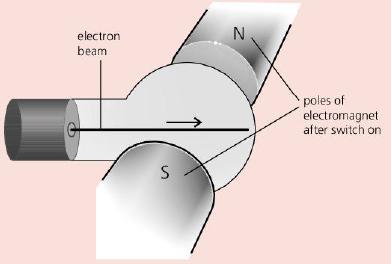
A deflection tube is placed between the poles of an electromagnet. A beam of electrons navels through the tube in the direction shown in the diagram.a. Which of the following statements most accurately describes what happens to the beam when the electromagnet is switched on?A It is deflected (bent)
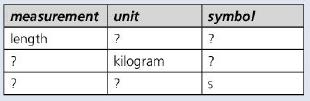
Copy and complete the table shown below: measurement unit symbol length kilogram ?
Write down the number ofA. mg in 1 gB. g in 1 kgC. mg in 1 kgD. mm in 4kmE. cm in 5 km
Write down the values of a. 300 cm, in m b. 500 g, in kg c. 1500 m, in km d. 250 ms, in s e. 0.5 s, in ms f. 0.75 km, in m g. 2.5 kg, in g h. 0.8 In, in mm
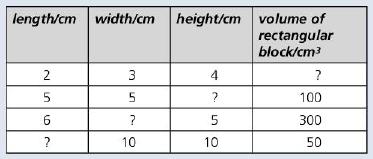
The volume of a rectangular block can be calculated using this equation:volume = length x width X height Using this information, copy and complete the table below. height/cm volume of rectangular block/cm? length/cm width/cm 2 3 4 ? 100 6 300 10 10 50
In each of the following pairs, which quantity is the larger? a. 2 km or 2500 m? b. 2 m or 1500 mm? c. 2 tonnes or 3000 kg? d. 2 litres or 300 cm3?
Which of the following statements is/are correct? A. One milligram equals one million grams. B. One thousand milligrams equals one gram. C. One million milligrams equals one gram. D. One million milligrams equals one kilogram.
Which of the above are a. units of mass? b. Units of length c. Units of volume? d. Units of time? e. Units of density?
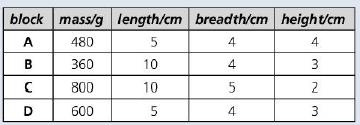
Which block is made of the densest material? block mass/g length/cm breadth/cm height/cm A 480 5 4 4 B 360 10 4 3 800 10 2 D 600 4 3
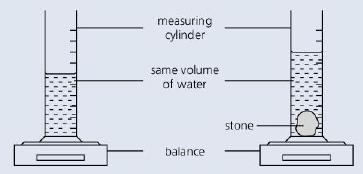
The mass of a measuring cylinder and its contents are measured before and after putting a stone in it. Which of the following could you calculate using measurements taken from the apparatus above? A. The density of the liquid only B. The density of the stone only C. The
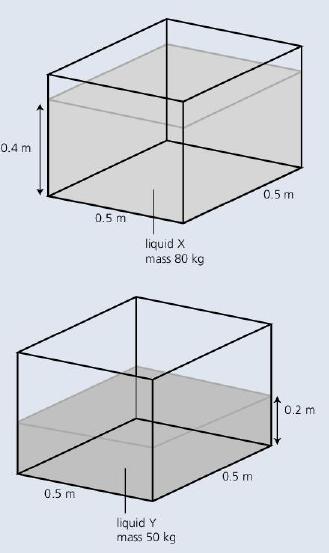
A plastic bag filled with air has a volume of 0.008 m3. When air in the bag is squeezed into a rigid container, the mass of the container (with air) increases from 0.02 kg to 0.03 kg. Use the formula density = mass/volume to calculate the density of the air in the bag. 0.4 m 0.5 m 0.5 m
Use the table of data on page 17 (Spread 1.04) to answer the following: a. Which of the solids or liquids in the table will float in water? Give a reason for your answer. b. Which of the solids or liquids in the table will float in petrol?
The table shows the density of various substances.SubstanceDensity/g/cm3Copper8.9Iron7.9Kerosene0.87Mercury13.6Water1.0Consider the following statements:A. 1 cm3 of mercury has a greater mace than 1 cm3 of any other substance in this table - true or false?B. 1 cm3 of water has a smaller mass than 1
A student decides to measure the period of a pendulum (the period is the time taken for one complete swing). Using a stopwatch, he finds that eight complete swings take 7.4 seconds. With his calculator, he then uses this data to work out the time for one swing. The number shown on his calculator is
a. Write down, in words, the equation connecting speed, distance and time.b. A car travels at a steady speed of 20 m/s. Calculate the distance travelled in 5 s.
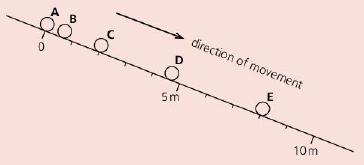
The diagram shows the positions of a ball as it rolled down a track. The ball took 0.5 s to roll from one position to the next. For example, it rolled from A to B in 0.5 s and from B to C in 0.5 s and so on.a. Write down:i. The distance travelled by the ball from A to E;ii. The time taken by the
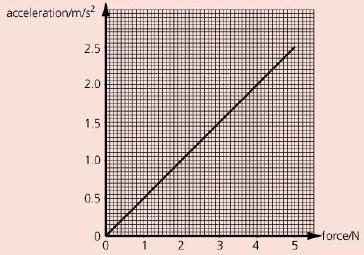
A student measures the acceleration of a trolley using the apparatus above. The light sensors are connected to a computer which is programmed to calculate the acceleration. The results obtained are shown on the acceleration-force graph.a. i Describe how changing the force affects the
a. Sketch a velocity-time graph for a car moving with uniform acceleration from 5 m/s to 25 m/s in 15 seconds. b. Use the sketch graph to find values for i the acceleration, ii the total distance travelled during acceleration. Show clearly at each stage how you used the graph.
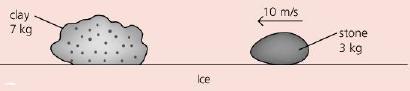
A stone of mass 3 kg is sliding across a frozen pond at a speed of 10 m/s when it collides head on with a lump of clay of mass 7 kg. The stone sticks to the clay and the two slide on together across the ice in the same direction as before. Calculate the following (assume that there is no friction
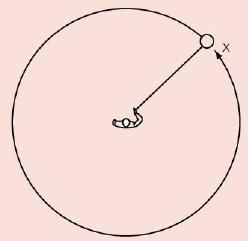
In the diagram below, someone is swinging a ball round on the end of a piece of string.a. What name is given to the force needed to make the ball move in a circle? b. Copy and complete the diagram to show where the ball will travel if the string breaks when the ball is at point X.c. Planets
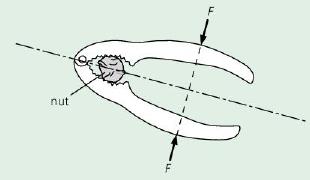
The diagram shows a pair of nutcrackers. Forces F are applied to the handles of the nutcrackers.a. The forces on the nut are bigger than F. Explain this.b. The nut does not crack. State two changes that could be made to crack the nut. nut F.
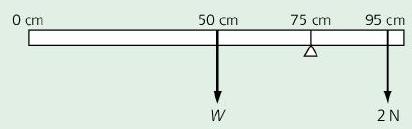
The diagram below shows a uniform metre rule, weight W, pivoted at the 75 cm mark and balanced by a force of 2 N acting at the 95 cm mark.a. Calculate the moment of the 2 N force about the pivot.b. Use the principle of moments to calculate the value of W in N. O cm 50 cm 75 cm 95 cm W 2N
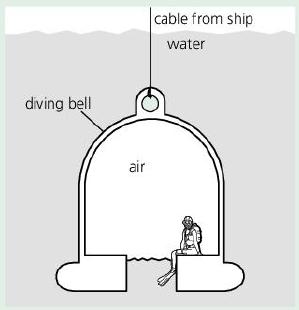
The diving bell below contains trapped air at the same pressure as the water outside. At the surface, air pressure is 100 kPa. As the bell descends, the pressure on it increases by 100 kPa for every 10 m of depth. a. What is the pressure on the diver at depths of 0 m, 10m, 20m and 30m?b. At
A car has a mass of 900 kg. It accelerates from rest at a rate of 1.2 m/s2.a. Calculate the time taken to reach a velocity of 30 m/s.b. Calculate the force required to accelerate the car at a rate of 1.2 m/s2.c. Even with the engine working at full power, the car's acceleration decreases as the car
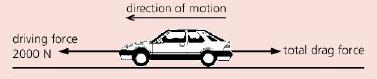
The diagram below shows some of the forces acting on a car of mass 800 kg.a. State the size of the total drag force when the car is travelling at constant speed.b. The driving force is increased to 3200 N. i. Find the resultant force on the car at this instant.ii. Write down, in words, the
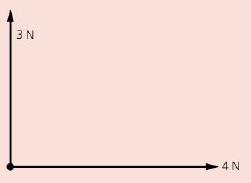
a. Using a scale drawing (for example, on graph paper), find the resultant of the forces above.b. Draw diagrams to show how, by changing the direction of one of the forces, it is possible to produce a resultant of i 7 N ii 1 N. 3 N 4N
This question is about SPEED and ACCELERATION. A cycle (nick is 500 metres lung. A cyclist completes 10 laps (that is, he rides completely round the track 10 times). a. How many kilometres has the cyclist travelled?b. On average it took the cyclist 50 seconds to complete one lap (that is, to
This question is about FORCE and ACCELERATION. The driver of a car moving at 20 m/s along a straight level road applies the brakes. The car decelerates at a steady rate of 5 m/s2.a. How long does it take the car to stop?b. What kind of force slows the car down?c. Where is this force applied?d. The
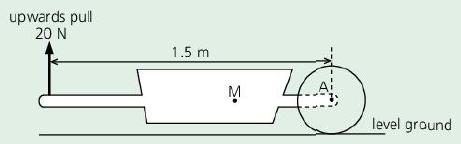
The figure shows an empty wheelbarrow which weight 80 N.The operator pulls upwards on the handles with a force of 20 N to keep the handles horizontal.The point marked M is the centre of mass of the wheelbarrow.a. Copy the figure and draw arrows to show the other two vertical forces that act on the
The following results were obtained when a spring was stretched.a. Use the results to plot a graph of length of spring against load.b. Use the graph to find thei. unloaded length of the spring,ii. extension produced by a 7.0 N load,iii. load required to increase the length of the spring by 5.0 cm.
a. A glass window pane covers an area of 0.6 m2. The force exerted by air pressure on the outside of the glass window pane is 60000 N. Calculate the pressure of the air. Write down the formula that you use and show your working.b. Explain why the window does not break under this force.
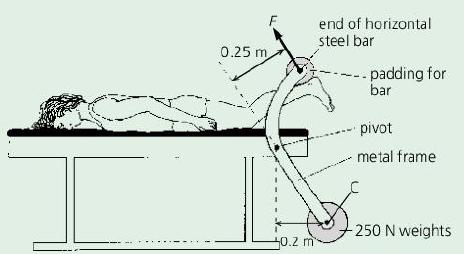
A fitness enthusiast is trying to strengthen his calf muscles. He uses the exercise machine below. His heels apply a force to the padded bar. This lifts the heavy weights.a. The centre of mass of the weights is at C. Draw a diagram to show where and in which direction the force of gravity acts
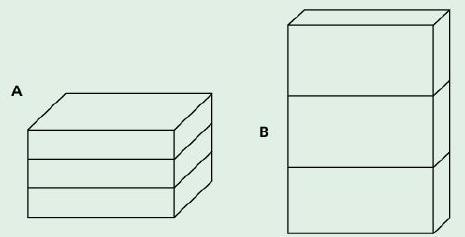
Three concrete blocks can be stacked in two different ways as shown below.a.Copy and complete the paragraph below using a phrase from the boxes above. Each phrase may be used once, more than once or not at all. The force of stack A on the ground is the force of stack B. The pressure on the ground
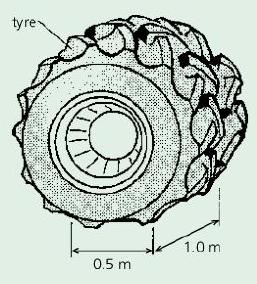
The figure shows a tyre used on a large earth-moving vehicle.a. When the vehicle is loaded, the area of each tyre in contact with the ground is a rectangle of sides 1.0 m and 0.5 m. i. Calculate the area in m2 of contact of one tyre with the ground. ii. The vehicle has four of these
A rectangular storage tank has a base measuring 3 m by 2 m. The tank is filled with water to a depth of 2 m. The density of the water is 1000 kg/m3, and g is 10 N/kg. Draw a diagram of the tank with the water in it, and mark all the dimensions on your drawing. Then calculate the following:a. The
a. State which of the above change shape when their stored energy is transferred. b. Describe how the energy from a rotating flywheel can be transferred to moving parts of a child's toy.Wound up springBatteries connected to motorsRotating flywheelStretched rubber bands
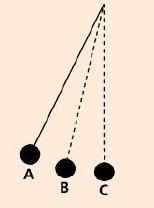
The diagram below shows a pendulum which was released from position A.a. What form(s) of did the pendulum have ati A, ii B, iii C?b. Eventually the pendulum would stop moving. Explain what has happened to the initial energy of the pendulum. A B C
A type of toy catapult consists of a movable plunger which has a spring attached as shown above. The handle was pulled down to fully compress the spring and on release the metal ball of mass O. 1 kg (weight 1 N) was projected 0.75 m vertically. a. i What type of energy is stored in a
a. Name four renewable energy sources that are used to generate electricity.b. One advantage of using renewable sources to generate electricity is that there are no fuel costs. Give another advantage and one disadvantage of using renewable energy.c. The fuel costs for nuclear energy' are low. State
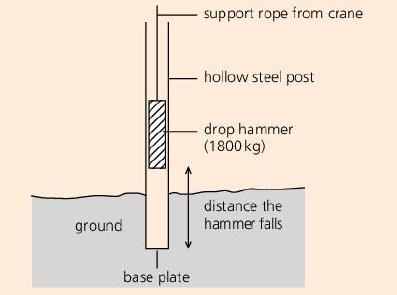
A drop hammer is used to drive a hollow steel post into the ground. The hammer is placed inside the post by a crane. The crane lifts the hammer and then drops it so that it falls onto the baseplate of the post.The hammer has a mass of 1800 kg. Its velocity is 5 m/s just before it hi is the post.a.
A crate of mass 300 kg is raised by an electric motor through a height of 60 m in 45 s. Calculate:a. The weight of the crane (g = 10 N/kg)b. The useful work done.c. The useful power of the motord. The efficiency of the motor, if it takes a power of 5000 W from its electricity supply.
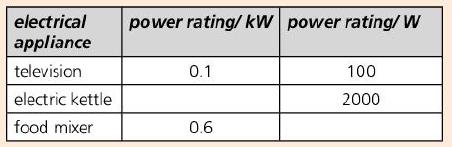
The table above shows the power rating of three electrical appliances.a. Copy the table and fill in the blank spaces.b. State which appliance transfers the least amount of energy per second.c. State which appliance converts electrical energy into heat and kinetic energy. electrical power rating/ kW
a. Explain what you understand by the phrase non-renewable energy resources.b. Explain why most non-renewable energy resources are burned.c. Name a non-renewable energy resource which is not burned.
a. The chemical energy stored in a fossil fuel produces heat when the fuel is burned. Describe how this heat energy is then used to produce electricity at a power station.b. Identify and compare the financial and environment costs of generating electricity using fossil fuels and wind.
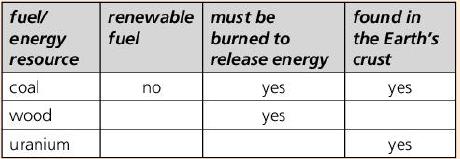
a. The table above shows that coal is not a renewable fuel. It releases energy when burned and is found in the Earth's crust. Copy and complete the table for the other fuels/ energy resources named.b. i. Explain how fossil fuels were produced.ii. State two reasons why we should use less fossil
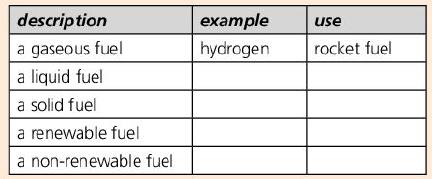
a. Most of the energy available on Earth comes, or has come, from the Sun. Some energy resources on Earth store the Sun's energy from millions of years ago. Name one of these resources.b. Copy and complete the sentence below to say what a fuel does.A fuel is a material which supplies _________.
a. Copy and complete the following sentences about household electrical devices. Use words from the list below. Each word may be used once, more than once or not at all.chemical electrical heat kinetic light soundi. In an iron, electrical energy is transferred into mainly _______ energy.ii. In a
Explain in terms of molecules:a. The process of evaporationb. Why the pressure of the air inside a car tyre increases when the car is driven at high speed.
Which of the following describes particles in a solid at room temperature?A. Close together and stationary.B. Close together and vibrating.C. Close together and moving around at random.D. Far apart and moving at random.
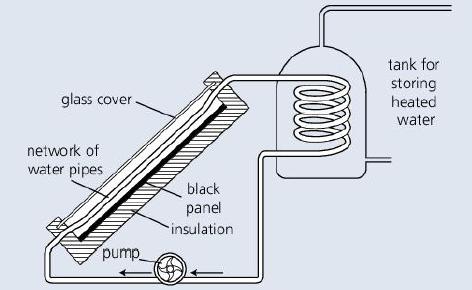
In sunny countries, some houses have a solar heater on the roof. It warms up water for the house. The diagram below shows a typical arrangement.a. Why is the panel in the solar heater black?b. Why is there an insulating layer behind the panel?c. How does the water in the tank get heated?d. On
The scale of a mercury-in-glass thermometer is linear. One such thermometer has a scale extending from —10 °C to 110°C. The length of that scale is 240 mm.a. What is meant by the statement that the scale is linear?b. Calculate the distance moved by the end of the mercury thread when the
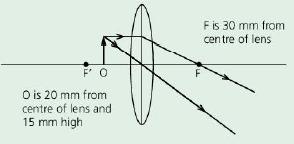
The diagram shows an object 0 placed in front of a convex (converging) lens and the passage of two rays from the top of the object through the lens.a. Copy and complete the diagram (using the dimensions given) to show where the image is formed.b. State two properties of the image.c. Use the
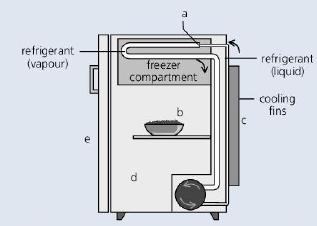
The diagram on the next page shows a refrigerator. In and around a refrigerator, heat is transferred by conduction, by convection, and by evaporation. Decide which process is mainly responsible for the heat transfer in each of the examples listed at the top of the next page.a. Heat is absorbed as
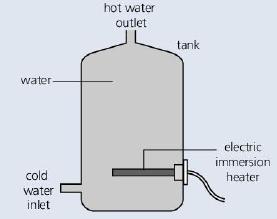
The diagram below shows a hot water storage tank. The water is heated by an electric immersion heater at the bottom.a. How could heat loss from the tank be reduced? What materials would be suitable for the job?b. Why is the heater placed at the bottom of the tank rather than the top?c. The heater
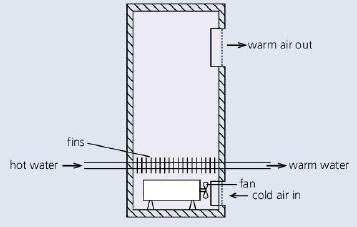
The diagram below shows a type of heater used in some schools.Hot water is pumped from the boiler into pipes inside the heater. Fins are attached to those pipes. Cold air is drawn into the base of the heater by an electric fan.a. Why are fins attached to the pipes inside the heater?b. 600 kg of
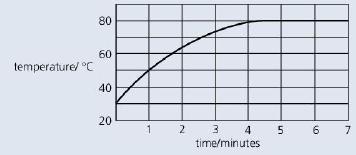
The graph below shows how the temperature of some liquid in a beaker changed as it was heated until it was boiling.a. What was the boiling point of the liquid?b. State and explain what difference, if any, there would be in the final temperature if the liquid was heated more strongly. c State one
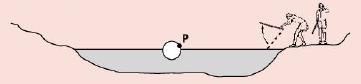
Kim and Sam are playing with a ball in the park. Unfortunately the ball finishes up in the middle of a pond, out of reach.Kim thinks that hitting the water with a stick will make waves that will push the ball to the other side.a. Which two of these words best describe the waves that are created on
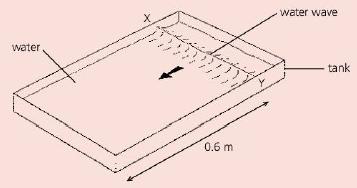
a. The wave in the shallow tank of water shown in the figure moves at 0.08 m/s towards the left.How long does it take for the wave to return to the position 3CY, but moving to the right?b. A man is cutting down a tree with an axe. He hears the echo of the impact of the axe hitting the tree after
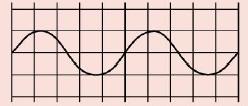
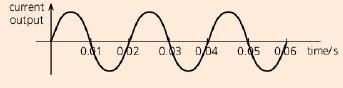
The figure shows an oscilloscope trace for a sound wave produced by a loudspeaker.a. Copy the figure and draw the trace for a louder sound of the same pitch.b. It takes 1/50th of a second (0.02 s) for the whole trace to be produced.i. Show that the frequency of the sound produced by the loudspeaker
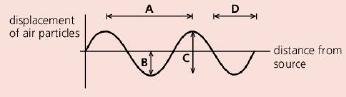
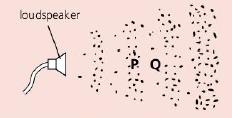
a. A sound wave travelling through air can be represented as shown in the diagram.Which distance, A, B, C, or D, represents:i. one wavelength? ii. The amplitude of the wave?b. The cone of a loudspeaker is vibrating. The diagram shows how the air particles are spread out in front of the cone at
a. The first diagram on the next page shows a wave. Copy the diagram and mark the amplitude, and label it A.i. State the number of cycles (‘wavelengths’) shown in the diagram.ii. This complete wave was produced in 0.15 s. Calculate the period (time for one wave).iv. Use the equation frequency
A light polystyrene ball is shown hanging very close to a loudspeaker. The loudspeaker gives out a sound of low frequency and the ball is seen to vibrate.a. Explain how the sound from the loudspeaker causes the ball to move as described.b. Explain what will happen to the motion of the cone of the
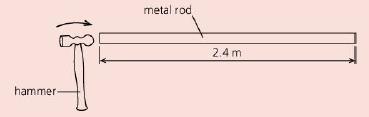
The figure shows a metal rod, 2.4 m long, being struck a sharp blow at one end using a light hammer. The time interval between the impact of the hammer and the arrival of the sound wave at the other end of the rod is measured electronically.Four measurements of the time interval are 0.44 ms, 0.50
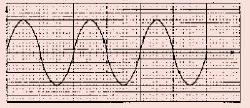
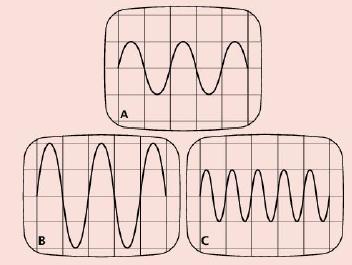
A microphone is connected to an oscilloscope. When different sounds, A, B, and C, are made, these are the waveforms seen on the screen:a. Comparing sounds A and B, how would they sound different?b. Comparing sounds A and C, how would they sound different?c. Which sound has the highest amplitude?d.
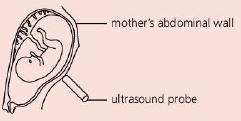
Ultrasound waves are high frequency longitudinal waves. X-rays are high frequency transverse waves.a. Explain the difference between transverse and longitudinal waves.b. The diagram shows an ultrasound probe used to obtain an image of an unborn baby.Give two reasons why ultrasound and not X-rays
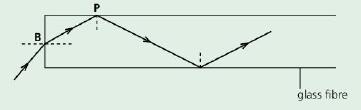
The diagram shows a light signal travelling through an optical fibre made of glass.a. State two changes that happen to the light when it passes from air into the glass fibre at B.b. Explain why the light follows the path shown after hitting the wall of the fibre at P. P B glass fibre
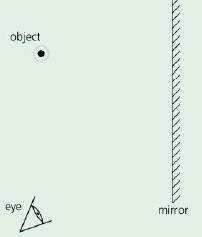
In the diagram above an object (a small bulb) has been placed in front of a plane mirror.a. Copy the diagram. Mark in the position of the image.b. On your diagram, draw a single ray from the object that reflects from the mirror and goes into the eye. Include a dotted line to show where, to the eye,
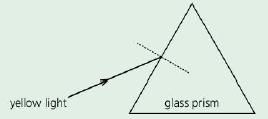
a. Copy the diagram and draw the path of the ray of yellow light as it passes through and comes out of the glass prism.b. What do we call this effect?c. State why light changes direction when it enters a glass prism. yellow light" glass prism
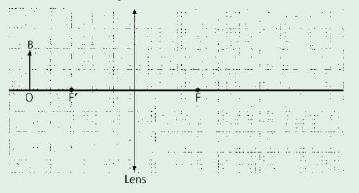
The figure shows an object OB of height 2 cm in front of a converging lens. The principal foci of the lens are labelled F and F. An image of OB will be formed to the right of the lens.a. Copy the figure and draw two rays from the top of the object B which pass through the lens and go to the
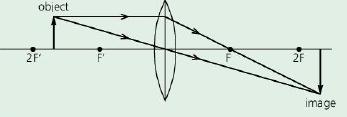
The diagram shows a converging lens forming a real image of an illuminated object. State two things that happen to the image when the object is moved towards F'. object 2F F' 2F image
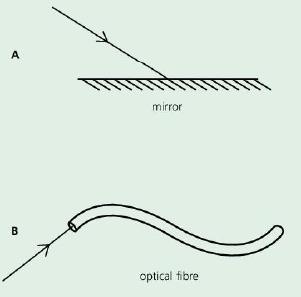
In the diagrams above, rays of light strike a mirror and one end of an optical fibre.a. Copy and complete the diagrams to show what will happen to each of the rays.b. Which diagram shows an example of total internal reflection?c. Give two practical uses of optical fibres.d. The light in each ray is
A ray of light, in air, strikes one side of a rectangular glass block. The refractive index of the glass is 1.5.a. Draw a diagram to show the direction the ray will take in the glass if the angle of incidence is 0°.b. Draw a diagram to show the approximate direction the ray will take in the glass
Light and gamma rays are both examples of electromagnetic radiation.a. Name three other types of electromagnetic radiation.b. State two differences between light and gamma rays. The speed of light is 3 x 10⁸ m/s. Calculate the frequency of yellow light of wavelength 6 x 10⁻⁷ m.
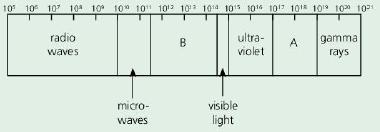
The diagram shows the main regions of the electromagnetic spectrum. The numbers show the frequencies of the waves measured in hertz (Hz).a. Name the regionsi. Aii. B.b. i. Write down, in words, the equation connecting wave speed, wavelength, and wave frequency.ii. Calculate the frequency of the
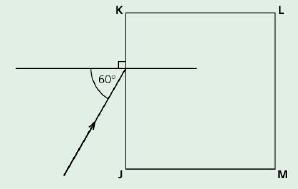
The figure shows a square block of glass JKLM with a ray of light incident on side JK at an angle of incidence of 60°. The refractive index of the glass is 1.50.a. Calculate the angle of refraction of the ray. b Calculate the critical angle for a ray of light in this glass.c. Explain why the
a. When a balloon is rubbed in your hair, the balloon becomes negatively charged.i. Explain how the balloon becomes negatively charged.ii. State what you know about the size and sign of the charge left on your hair.b. The negatively charged balloon is brought up to the surface of a ceiling. The
Read the following passage carefully before answering the questions. Spraying crops with insecticides has become more efficient. A portable high voltage generator gives the drops of liquid insecticide a small positive charge. This makes the liquid break up into smaller drops and causes the spray to
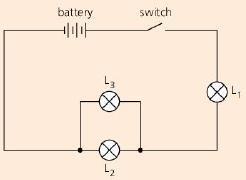
The circuit shows a battery connected to a switch and three identical lamps, L1, L2 and L3.a. Copy the diagram and add:i. An arrow to show the conventional current direction in the circuit when the switch is closed.ii. A voltmeter V, to measure the voltage across L1iii. A switch, labelled S, that
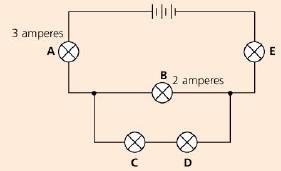
The circuit diagram shows a battery connected to five lamps. The currents in lamps A and B are shows. Write down the current flowing ina. lamp C,b. lamp E. 3 amperes A B 2 amperes D
a. How much energy is transferred by a battery of e.m.f. 4.5 V when 1.0 C of charge passes through it?b. How much power is developed in a battery of e.m.f. 4.5 V when a current of 1.0 A is passing through it?
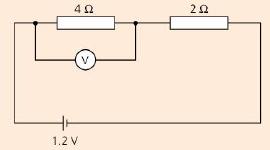
The diagram shows a circuit which contains two resistors.Calculatea. The total resistance of the two resistors in series, (Ω)b. The current flowing in the cell, (A)c. The current flowing in the 4Ω resistor, (A)d. The reading of the voltmeter, (V)e. The power produced in the 4Ω resistor. (W) 1.2 V
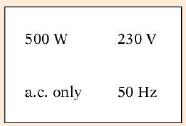
A small electric hairdryer has an outer case made of plastic. The following information is printed on the case:a. Explain the meaning of these terms:i a.c. onlyii. 50 Hzb. The hairdryer does not have an earth wire. Instead, it is double insulated. Explain what this means.c. What current does the
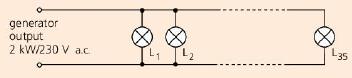
A small generator is labelled as having an output of 2 kW, 230 V a.c. (at constant frequency). It is used to provide emergency lighting for a large building in the event of a breakdown of the mains supply. The circuit is shown below.There are 30 light fittings on the circuit, each with a 230 V, 28
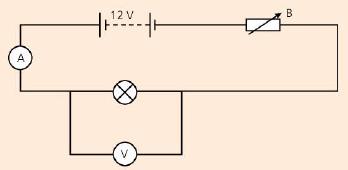
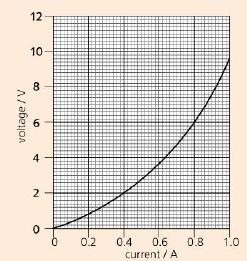
A student investigates how the current in a lamp varies with the voltage (p.d.) across it. She uses the circuit shown below.a. Three of the components are labelled, A, V, and B. Write down what each one is.b. Describe how the student should early out the experiment. From her results, the
A small electric heater takes a power of 60 W from a 12 V supply.a. What is the current in the heater?b. What is the resistance of the heater?c. How much charge (in C) passes through the heater in 20 seconds?d. How much energy (in J) is transformed by the heater in 20 seconds?
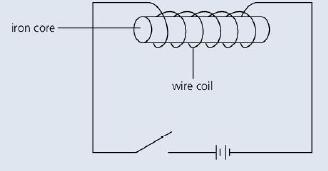
An electromagnet is made by winding wire around an iron core.The diagram shows an electromagnet connected to a circuit.a. State two ways of making the strength of the electromagnet weaker.b. Explain why the core is made of iron instead of steel. iron core wire coil
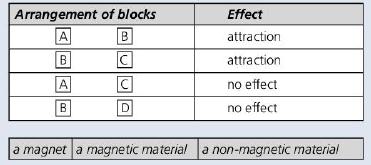
A, B, C and D are small blocks of different materials. The table below shows what happens when two of the blocks are placed near one another.Use one of the phrases in the above boxes to describe the magnetic property of each block. Each phrase may be used once, more than once or not at all.a. Block
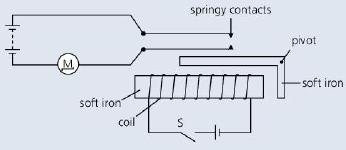
The figure below shows a circuit, which includes an electrical relay, used to switch on a motor M.Explain, in detail, how closing switch S causes the motor M to start. springy contacts pivot M. soft iron soft iron coil T.
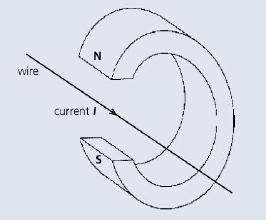
The diagram shows a long wire placed between the poles of a magnet. When current I flows in the wire, a force acts on the wire causing it to move.a. Use Fleming's left-hand rule to find the direction of the force on the wire. Copy the diagram and show the direction of the force on your copy with an
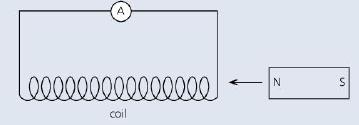
The diagram below shows a permanent magnet being moved towards a coil whose ends are connected to a sensitive ammeter. As the magnet approaches, the ammeter needle gives a small deflection to the left.a. State what you would expect the ammeter to show if, in turn,i. The magnet was pulled away from
a. The chemical energy stored in a fossil fuel produces heat energy when the fuel is burned. Describe how this heat energy is then used to produce electrical energy at a power station.b. Power stations use transformers to increase the voltage to very high values before transmitting it to all parts
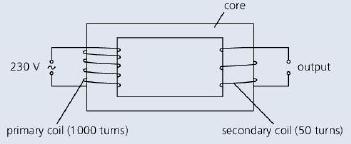
The diagram shows a simple transformer.The transformer is a step-down transformer.a. What is a step-down transformer?b. How can you tell from the diagram that this is a step-down transformer?c. Calculate the output voltage of this transformer.d. Explain why transformers are used when power needs to
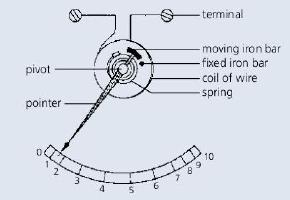
The diagram shows the main pans of one type of ammeter. There are two short iron bars inside a coil of insulated wire. One bar is fixed and cannot move and the other is on the end of a pivoted pointer. The diagram shows the ammeter in use and measuring a current of 1.5 amperes (A).a. How much
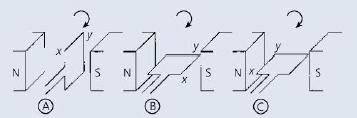
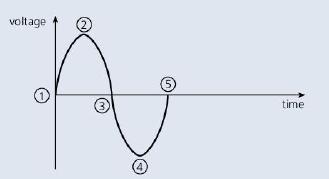
a. When a coil rotates in a magnetic field, an alternating voltage is produced. Explain how the voltage is produced.b. The diagrams A B and C show three positions of a coil as it rotates clockwise in a magnetic field produced by two poles. The graph below shows how the voltage produced changes as
Showing 100 - 200
of 194
1
2
Step by Step Answers

 Get 50% OFF
Claim Now
Get 50% OFF
Claim Now