New Semester
Started
Get
50% OFF
Study Help!
--h --m --s
Claim Now
Question Answers
Textbooks
Find textbooks, questions and answers
Oops, something went wrong!
Change your search query and then try again
S
Books
FREE
Study Help
Expert Questions
Accounting
General Management
Mathematics
Finance
Organizational Behaviour
Law
Physics
Operating System
Management Leadership
Sociology
Programming
Marketing
Database
Computer Network
Economics
Textbooks Solutions
Accounting
Managerial Accounting
Management Leadership
Cost Accounting
Statistics
Business Law
Corporate Finance
Finance
Economics
Auditing
Tutors
Online Tutors
Find a Tutor
Hire a Tutor
Become a Tutor
AI Tutor
AI Study Planner
NEW
Sell Books
Search
Search
Sign In
Register
study help
sciences
human biology
Human Biology 11th Edition Cecie Starr, Beverly McMillan - Solutions
Which oocyte stage is ovulated? What happens to it if it encounters a sperm cell there? What happens if it does not meet up with sperm?
Fertilization ________.a. Unites the nuclei of a sperm and egg cellb. Forms a zygote that has chromosomes of both parentsc. Usually occurs in an oviductd. All of the abovee. A and b but not c
Bone remodeling has all of the following functions except _______.a. Helps maintain homeostasis in blood level of calciumb. Replaces “old” bone with fresh bone tissuec. Exchanges collagen with elastin fibers for flexibilityd. Strengthens bones subjected to mechanical stress
Muscle fibers shorten when _______ slides over _______.a. Myosin, actinb. Actin, myosin c. Myoglobin, actind. Myosin, sarcomeres
The _______ is the basic unit of muscle contraction.a. Myofibrilb. Sarcomerec. Muscle fiberd. Myosin filament
Skeletal muscle contraction requires _______.a. Calcium ionsb. ATPc. Arrival of a nerve impulsed. All of the above
Nerve impulses first stimulate a skeletal muscle fiber at _______.a. T tubulesb. Sarcomeresc. Neuromuscular junctionsd. Actin binding sites
A motor unit is _______.a. A single muscle fiberb. A single sarcomerec. A muscle twitchd. A motor neuron and the fibers it synapses with
Muscle fatigue _______.a. Occurs when ATP runs outb. May be caused by oxygen debtc. Is a state in which a muscle can no longer contractd. All of the above
Muscle tone is _______.a. The same as muscle tensionb. A steady, low-level state of contractionc. Not present when a muscle is relaxedd. All of the above
In the pulmonary circuit, the heart’s _______ half pumps _______ blood to capillary beds inside the lungs; then _______ blood flows to the heart.a. Left; deoxygenated; oxygenatedb. Right; deoxygenated; oxygenatedc. Left; oxygenated; deoxygenatedd. Right; oxygenated; deoxygenated
After you eat, blood passing through the GI tract travels through the to a capillary bed in the _______.a. Aorta; liverb. Hepatic portal vein; liverc. Hepatic vein; spleend. Renal arteries; kidneys
The cardiac pacemaker _______.a. Sets the normal rate of heartbeatb. Is the same as the AV nodec. Establishes resting blood pressured. All of these are correct
Blood pressure is _______.a. Generated by heart contractionsb. Exerted against vessel wallsc. Healthiest when it is under 120/80d. All of these are correct
Blood pressure is highest in _______ and lowest in _______.a. Arteries; veinsb. Arteries; relaxed atriac. Arteries; ventriclesd. Arterioles; veins
_______ contraction drives blood through the systemic and pulmonary circuits; outside the heart, blood pressure is highest in the _______.a. Atrial; ventriclesb. Atrial; atriac. Ventricular; arteriesd. Ventricular; aorta
The______ produces red blood cells, which transport ______ and some ______.a. Liver; oxygen; mineral ionsb. Liver; oxygen; carbon dioxidec. Bone marrow; oxygen; hormonesd. Bone marrow; oxygen; carbon dioxide
In the lungs, the main factor in boosting the tendency of hemoglobin to bind with and hold oxygen is ______.a. Temperatureb. The amount of O2 relative toc. Acidity (pH)d. All are equally the amount of CO2 in plasma important
Complement proteins function in defense by _______.a. Neutralizing toxinsb. Enhancing resident bacteriac. Promoting inflammationd. Forming pores that cause pathogens to disintegratee. Both a and bf. Both c and d
_______ are molecules that lymphocytes recognize as foreign and that elicit an immune response.a. Interleukinsb. Antibodiesc. Immunoglobulinsd. Antigense. Histamines
Another term for antibodies is _______; there are_______ classes of these molecules.a. B cells; threeb. Immunoglobulins; threec. B cells; fived. Immunoglobulins; five
Antibody-mediated responses work best against _______.a. Pathogens inside cellsb. Pathogens outside cellsc. Toxinsd. Both b and ce. All are correct
Cell-mediated responses work best against _______.a. Pathogens inside cellsb. Pathogens outside cellsc. Toxinsd. Both b and ce. All are correct
The ability to develop a secondary immune response is based on _______.a. Memory cellsb. Circulating antibodies T cellsc. Plasma cellsd. Effector cytotoxice. Mast cells
The most common antigens are _______.a. Nucleotidesb. Triglyceridesc. Steroidsd. Proteins
Underwater, we humans can’t compete with whales and other air-breathing marine mammals, which can stay submerged for extended periods. At the beach one day you meet a surfer who tells you that special training could allow her to swim underwater without breathing for an entire hour. From what you
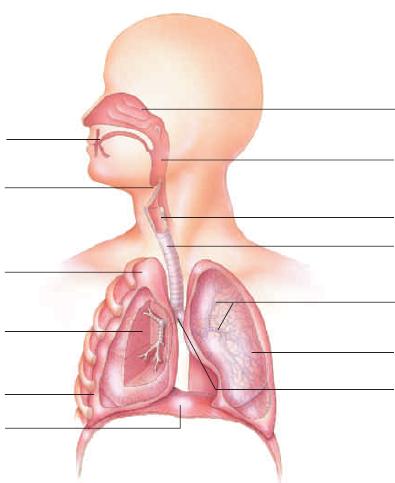
In the diagram below, label the parts of the respiratory system and the structures that enclose some of its parts.
A partial pressure gradient of oxygen exists between _______.a. Air and lungsb. Lungs and metabolically active tissuesc. Air at sea level and air at high altitudesd. All of the above
Cases of accidental carbon monoxide poisoning occur when someone builds a charcoal fire in an enclosed area. Assuming help arrives in time, what would be the most effective treatment: placing the victim outdoors in fresh air or administering pure oxygen? Explain your answer.
What is the difference between respiration and aerobic cellular respiration?
The _______is an airway that connects the nose and mouth with the _______.a. Oral cavity; larynxb. Pharynx; tracheac. Trachea; pharynxd. Pharynx; larynx
Skin divers sometimes purposely hyperventilate. Doing so doesn’t increase the oxygen available to tissues. It does raise blood pH (making it more alkaline), and it decreases the blood level of carbon dioxide. Based on your reading in this chapter, how is hyperventilation likely to affect the
Explain what a partial pressure gradient is and how such gradients figure in gas exchange.
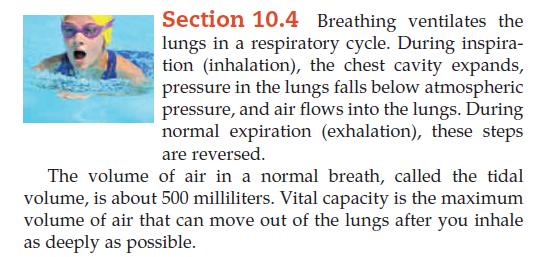
When you sneeze, abdominal muscles abruptly contract, pushing your diaphragm upward. Given the discussion of the respiratory cycle in Section 10.4, why does this change expel air out your nose? Section 10.4 Breathing ventilates the lungs in a respiratory cycle. During inspira- tion (inhalation),
Oxygen in air must diffuse across _______ to enter the blood.a. Pleural sacsb. Alveolar sacsc. A moist respiratory surfaced. Both b and c
What is oxyhemoglobin? Where does it form?
Each lung encloses a _______.a. Diaphragmb. Bronchial treec. Pleural sacd. Both b and c
What drives oxygen from the air spaces in alveoli, through tissue fluid, and across capillary epithelium? What drives carbon dioxide in the opposite direction?
Gas exchange occurs at the_______.a. Two bronchib. Pleural sacsc. Alveolid. Both b and c
The red blood cell enzyme carbonic anhydrase contains the metal zinc. We obtain zinc in food, especially red meat and some seafoods. A zinc deficiency doesn’t reduce the number of red blood cells, but it does reduce the amount of carbon dioxide released into the blood. Explain why this effect
How does hemoglobin help maintain the oxygen partial pressure gradient during gas transport in the body?
Breathing _______.a. Ventilates the lungsb. Draws air into airwaysc. Expels air from airwaysd. Causes reversals in pressure gradientse. All of the above
What reactions enhance the transport of carbon dioxide throughout the body? How is carbon dioxide moved out of the body?
After oxygen diffuses into_______ lung capillaries, it also diffuses into and binds with _______.a. Tissue fluid; red blood cellsb. Tissue fluid; carbon dioxidec. Red blood cells; hemoglobind. Red blood cells; carbon dioxide
How do nerve impulses from the brain regulate ventilation of the lungs? How are the rate and depth of breathing controlled?
Due to its partial pressure gradient, carbon dioxide diffuses from cells into tissue fluid and into the _______; in the lungs, carbon dioxide diffuses into the _______.a. Alveoli; bronchiolesb. Bloodstream; bronchiolesc. Alveoli; bloodstreamd. Bloodstream; alveoli
Why does your breathing rate increase when you exercise? What happens to your heart rate at the same time—and why?
Most carbon dioxide in the blood is in the form of _______.a. Carbon dioxideb. Carbon monoxidec. Carbonic acidd. Bicarbonate
Hemoglobin performs which of the following respiratory functions?a. Transports oxygenb. Transports some carbon dioxidec. Acts as a buffer to help maintain blood pHd. All of the above
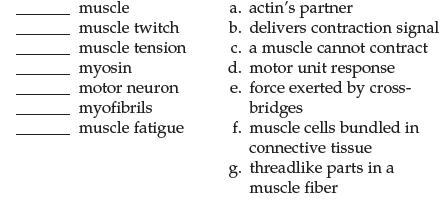
Match the M words with their defining feature. muscle muscle twitch muscle tension myosin motor neuron myofibrils muscle fatigue a. actin's partner b. delivers contraction signal c. a muscle cannot contract d. motor unit response e. force exerted by cross- bridges f. muscle cells bundled
What is meant by biological evolution?
What are the two types of bone tissue, and how are they different?
Name the two main divisions of the skeleton.
_______is a type of connective tissue;_______ form(s) in it.a. An osteon; collagenb. Bone marrow; blood cellsc. Bone; an osteocyted. A sinus; bone marrow
How does a tendon differ from a ligament?
Mineralization of bone tissue requires _______.a. Calcium ionsb. Osteoclastsc. Elastind. All of the above
What are intervertebral disks made of and what is their function?
The axial skeleton consists of the _______, while the appendicular skeleton consists of the _______.
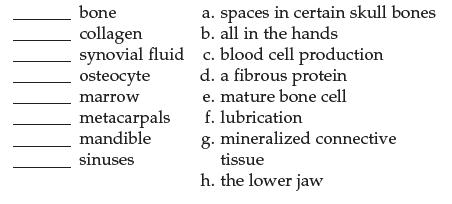
Match the terms and definitions. bone collagen synovial fluid osteocyte marrow metacarpals mandible sinuses a. spaces in certain skull bones b. all in the hands c. blood cell production d. a fibrous protein e. mature bone cell f. lubrication g. mineralized connective tissue h. the lower jaw
What is the defining feature of a synovial joint?
Ligaments are important components of the skeletal system because they _______.
In a general sense, how do skeletal muscles produce movement?
The _______and _______ systems work together to move the body and specific body parts.
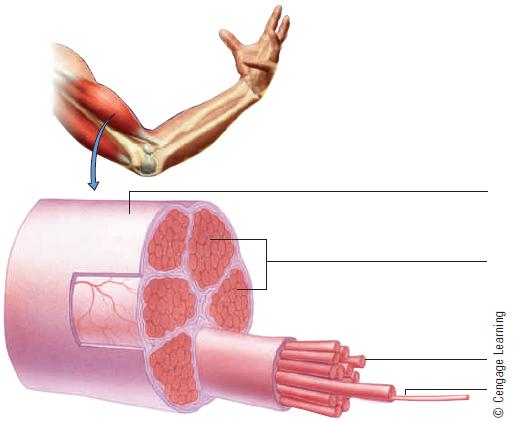
In the diagram below, label the fine structure of a muscle, down to one of its myofibrils. Identify the basic unit of contraction in a myofibril. C) Cengage Learning
Growth hormone, or GH, is used medically to spur growth in children who are unusually short because they have a GH deficiency. However, it is useless for a short but otherwise normal 25-year-old to request GH treatment in order to grow taller. Why?
The three types of muscle tissue are _______, _______, and _______.
If bleached human bones found lying in the desert were carefully examined, would osteons be present? How about osteocytes and a marrow cavity?
How do actin and myosin interact in a sarcomere to bring about muscle contraction? What roles do ATP and calcium play?
For young women, the recommended daily allowance (RDA) of calcium is 1,000 milligrams. For a 60-year-old woman, however, the RDA is 1,200 milligrams a day. What might happen to an older woman’s bones without the larger amount?
How does a muscle fiber incur an oxygen debt?
The anterior cruciate ligament (ACL) helps stabilize the knee joint. It is easily injured by hyperextension of the knee. How would you have to move your lower leg to cause a hyperextension injury?
What is the function of the sarcoplasmic reticulum in muscle cell contraction?
Explain why (a) calcium ions and (b) ACh are vital for muscle contraction.
What is a motor unit? Why does a rapid series of muscle twitches yield a stronger overall contraction than a single twitch?
What are the structural and functional differences between “slow” and “fast” muscle?
List the functions of the cardiovascular system.
Cells obtain nutrients from and deposit waste into _______.a. Bloodb. Lymph vesselsc. Each otherd. Both a and b
A patient suffering from hypertension may receive drugs that decrease the heart’s output, dilate arterioles, or increase urine production. In each case, how would the drug treatment help relieve hypertension?
Define a “heartbeat,” giving the sequence of events that make it up.
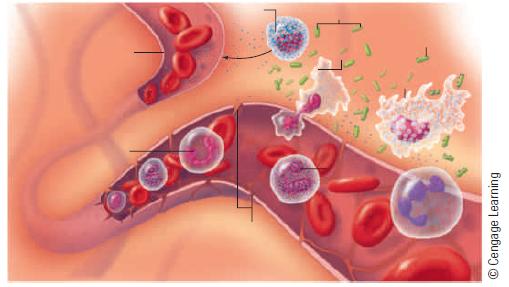
While you’re jogging in the surf, your toes land on a jellyfish. Soon the bottoms of your toes are swollen, red, and warm to the touch. Using the following diagram as a guide, describe how these signs of inflammation came about. Cengage Learning
Which of the following statements about red blood cells is false?a. They live about 120 days before being replaced.b. They lack a nucleus and other organelles when they are mature.c. They are replaced when the hormone EPO stimulates stem cells in bone marrow.d. They are replaced as part of a
_______ are barriers to pathogens at body surfaces.a. Intact skin and mucous membranesb. Tears, saliva, and gastric fluidc. Resident bacteriad. All are correct
New research suggests a link between some microbes that normally live in the body and seemingly unrelated major illnesses. The gum disease called periodontitis itself is not life-threatening, for instance, but it is a fairly good predictor for heart attacks. Bacteria that cause gum disease can
Distinguish betweena. Neutrophil and macrophageb. Cytotoxic T cell and natural killer cellc. Effector cell and memory celld. Antigen and antibody
Given what you now know about how foreign invaders trigger immune responses, explain why mutated forms of viruses, which have altered surface proteins, pose a monitoring problem for a person’s memory cells.
What is the difference between innate immunity and adaptive immunity?
Researchers have been trying to develop a way to get the immune system to accept foreign tissue as “self.” Can you think of some clinical applications for such a development?
What is the difference between an allergy and an autoimmune response?
Elena developed chicken pox when she was in kindergarten. Later in life, when her children developed chicken pox, she stayed healthy even though she was exposed to countless virus particles each day. Explain why.
By the 1790s when English physician Edward Jenner (right) was treating patients, people all over the world had been trying to protect themselves against the scourge of smallpox for centuries. Jenner observed that people who caught cowpox, a similar but less virulent disease, never got smallpox, and
Tears are part of the body’s defensive arsenal. What defense category do they fall into, and why?
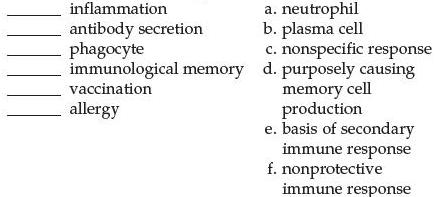
Match the immunity concepts: inflammation antibody secretion phagocyte immunological memory vaccination allergy a. neutrophil b. plasma cell c. nonspecific response d. purposely causing memory cell production e. basis of secondary immune response f. nonprotective immune response
Which of the following is not a feature of a scientific theory?a. It begins as a hypothesis.b. It eventually is accepted as absolute truth.c. It requires critical thinking.d. It is not accepted as a theory until it has been tested repeatedly.
A scientific approach to explaining some aspect of the natural world includes all of the following except ________ .a. A hypothesisb. Testingc. Faith-based viewsd. Systematic observations
A controlled experiment should have all the following features except ________ .a. A control groupb. A test subjectc. A variabled. Many testable predictions
A related set of hypotheses that collectively explain some aspect of the natural world makes up a scientific ________ .a. Predictionb. Testc. Theoryd. Authoritye. Observation
The diagram below depicts the concept of ________.a. Evolutionb. Reproductionc. Levels of organizationd. Energy transfers in the living world
A carbon atom can form up to ________ bonds with other atoms.a. Fourb. Sixc. Eightd. Sixteen
All of the following except ________ are building blocks or energy sources in cells.a. Fatty acidsb. Simple sugarsc. Lipidsd. Amino acidse. Nucleotides
________ a class of proteins, make metabolic reactions proceed much faster than they would on their own.a. Nucleic acidsb. Amino acidsc. Fatty acidsd. Enzymes
Showing 300 - 400
of 513
1
2
3
4
5
6
Step by Step Answers

 Get 50% OFF
Claim Now
Get 50% OFF
Claim Now