New Semester
Started
Get
50% OFF
Study Help!
--h --m --s
Claim Now
Question Answers
Textbooks
Find textbooks, questions and answers
Oops, something went wrong!
Change your search query and then try again
S
Books
FREE
Study Help
Expert Questions
Accounting
General Management
Mathematics
Finance
Organizational Behaviour
Law
Physics
Operating System
Management Leadership
Sociology
Programming
Marketing
Database
Computer Network
Economics
Textbooks Solutions
Accounting
Managerial Accounting
Management Leadership
Cost Accounting
Statistics
Business Law
Corporate Finance
Finance
Economics
Auditing
Tutors
Online Tutors
Find a Tutor
Hire a Tutor
Become a Tutor
AI Tutor
AI Study Planner
NEW
Sell Books
Search
Search
Sign In
Register
study help
sciences
physics 11th edition
Physics 11th Edition John D. Cutnell, Kenneth W. Johnson, David Young, Shane Stadler - Solutions
A copper pipe with an outer radius of 0.013 m runs from an outdoor wall faucet into the interior of a house. The temperature of the faucet is 4.0 °C, and the temperature of the pipe, at 3.0 m from the faucet, is 25 °C. In fifteen minutes, the pipe conducts a total of 270 J of heat to the outdoor
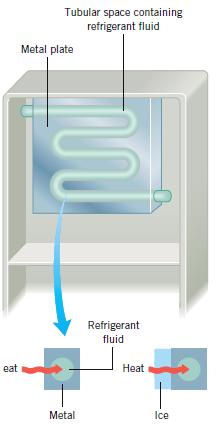
Review Conceptual Example 5 before attempting this problem. To illustrate the effect of ice on the aluminum cooling plate, consider the drawing shown here and the data that it contains. Ignore any limitations due to significant figures.Conceptual Example 5In a refrigerator, heat is removed by a
The heat conducted through a bar depends on which of the following?A. The coefficient of linear expansionB. The thermal conductivityC. The specific heat capacityD. The length of the barE. The cross-sectional area of the bar(a) A, B, and D(b) A, C, and D(c) B, C, D, and E(d) B, D, and E(e) C, D, and
You and your team are testing a device that is to be submerged in the cold waters of Antarctica. It is designed to rotate a small wheel at a very precise rate. One component of the device consists of a steel wheel (diameter Dsteel = 3.0000 cm at T = 78.400 °F) and a large aluminum wheel that
You and your team are given the task of constructing a crude thermometer that covers a temperature range from 0 °C to 60 °C. You have at your disposal an aluminum rod of length L0 = 2.00 m (at T = 0 °C) and diameter D = 0.50 cm, and a broken clock that is missing its hour hand, and its longer
When 4200 J of heat are added to a 0.15-m-long silver bar, its length increases by 4.3 × 10⁻³ m. What is the mass of the bar?
An aluminum can is filled to the brim with a liquid. The can and the liquid are heated so their temperatures change by the same amount. The can’s initial volume at 5 °C is 3.5 × 10⁻⁴ m3. The coefficient of volume expansion for aluminum is 69 × 10−6 (C°)−1. When the can and the liquid
Multiple-Concept Example 4 reviews the concepts that are involved in this problem. A ruler is accurate when the temperature is 25 °C. When the temperature drops to −14 °C, the ruler shrinks and no longer measures distances accurately. However, the ruler can be made to read correctly if a force
A commonly used method of fastening one part to another part is called “shrink fitting.” A steel rod has a diameter of 2.0026 cm, and a flat plate contains a hole whose diameter is 2.0000 cm. The rod is cooled so that it just fits into the hole. When the rod warms up, the enormous thermal
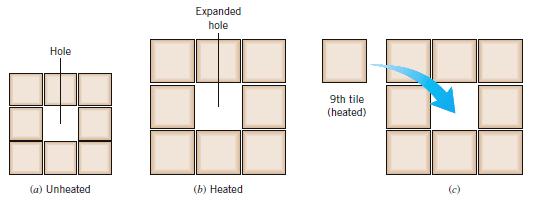
Conceptual Example 5 provides background for this problem. A hole is drilled through a copper plate whose temperature is 11 °C.(a) When the temperature of the plate is increased, will the radius of the hole be larger or smaller than the radius at 11 °C? Why?(b) When the plate is heated to 110
Which one of the following statements correctly describes the Celsius and the Kelvin temperature scales?(a) The size of the degree on the Celsius scale is larger than that on the Kelvin scale by a factor of 9/5.(b) Both scales assign the same temperature to the ice point, but they assign different
A hydraulic press is used to compress a spring that will then be used to project a 25.0-kg steel ball. The system is similar, but smaller in scale, to the car jack illustrated in Figure 11.14. In this case, the smaller cylinder has a diameter of d1 = 0.75 cm and has a manually operated plunger. The
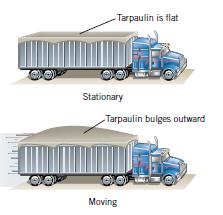
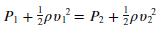
Review Conceptual Example 14 before attempting this problem. The truck in that example is traveling at 27 m/s. The density of air is 1.29 kg/m3. By how much does the pressure inside the cargo area beneath the tarpaulin exceed the outside pressure?Conceptual Example 14A tarpaulin is a piece of
You and your exploration team are stuck on a steep slope in the Andes Mountains in Argentina. A deadly winter storm is approaching and you must get down the mountain before the storm hits. Your path leads you around an extremely slippery, horizontal curve with a diameter of 90 m and banked at an
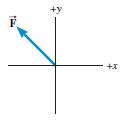
Consider the force F(vector) shown in the drawing. This force acts on an object that can move along the positive or negative x axis, or along the positive or negative y axis. The work done by this force is positive when the displacement of the object is along the _______ axis or along the
A person is riding on a Ferris wheel. When the wheel makes one complete turn, the net work done on the person by the gravitational force ____________.(a) Is positive(b) Is negative(c) Is zero(d) Depends on how fast the wheel moves(e) Depends on the diameter of the wheel
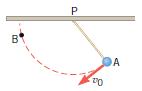
A ball is fixed to the end of a string, which is attached to the ceiling at point P. As the drawing shows, the ball is projected downward at A with the launch speed υ0. Traveling on a circular path, the ball comes to a halt at point B. What enables the ball to reach point B, which is above point
A small lead ball, attached to a 0.75-m rope, is being whirled in a circle that lies in the vertical plane. The ball is whirled at a constant rate of three revolutions per second and is released on the upward part of the circular motion when it is 1.5 m above the ground. The ball travels straight
While exploring an elaborate tunnel system, you and your team get lost and find yourselves at the bottom of a 450-m vertical shaft. Suspended from a thick rope (near the floor) is a large rectangular bucket that looks like it had been used to transport tools and debris up and down the tunnel.
You are in a sledding contest where you start at a height of 40.0 m above the bottom of a valley and slide down a hill that makes an angle of 25.0° with respect to the horizontal. When you reach the valley, you immediately climb a second hill that makes an angle of 15.0° with respect to the
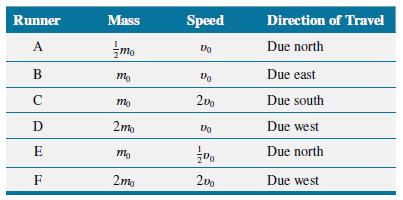
Six runners have the mass (in multiples of m0), speed (in multiples of υ0), and direction of travel that are indicated in the table. Which two runners have identical momenta?(a) B and C(b) A and C(c) C and D(d) A and E(e) D and F Runner Mass Speed Direction of Travel A Due north B Due east C 20o
Refer to Conceptual Example 3 as an aid in understanding this problem. A hockey goalie is standing on ice. Another player fires a puck (m = 0.17 kg) at the goalie with a velocity of +65 m/s.(a) If the goalie catches the puck with his glove in a time of 5.0 × 10‒3 s, what is the average force
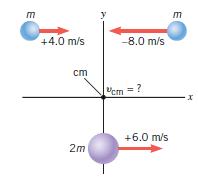
The drawing shows three particles that are moving with different velocities. Two of the particles have mass m, and the third has a mass 2m. At the instant shown, the center of mass (cm) of the three particles is at the coordinate origin. What is the velocity υcm (magnitude and direction) of the
A basketball (m = 0.60 kg) is dropped from rest. Just before striking the floor, the ball has a momentum whose magnitude is 3.1 kg · m/s. At what height was the basketball dropped?
A 0.015-kg bullet is fired straight up at a falling wooden block that has a mass of 1.8 kg. The bullet has a speed of 810 m/s when it strikes the block. The block originally was dropped from rest from the top of a building and has been falling for a time t when the collision with the bullet occurs.
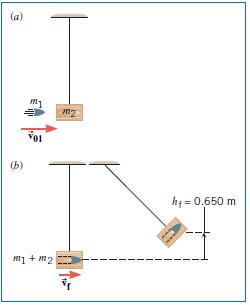
Consult Multiple-Concept Example 8 for background pertinent to this problem. A 2.50-g bullet, traveling at a speed of 425 m/s, strikes the wooden block of a ballistic pendulum, such as that in Figure 7.12. The block has a mass of 215 g.(a) Find the speed of the bullet–block combination
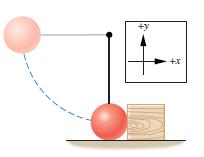
A ball is attached to one end of a wire, the other end being fastened to the ceiling. The wire is held horizontal, and the ball is released from rest (see the drawing). It swings downward and strikes a block initially at rest on a horizontal frictionless surface. Air resistance is negligible, and
You and your crew must dock your 25000 kg spaceship at Spaceport Alpha, which is orbiting Mars. In the process, Alpha’s control tower has requested that you ram another vessel, a freight ship of mass 16500 kg, latch onto it, and use your combined momentum to bring it into dock. The freight ship
The moon is 3.85 × 10⁸ m from the earth and has a diameter of 3.48 × 10⁶ m. You have a pea (diameter = 0.50 cm) and a dime (diameter = 1.8 cm). You close one eye and hold each object at arm’s length (71 cm) between your open eye and the moon. Which objects, if any, completely cover your view of
The radius of the circle traced out by the second hand on a clock is 6.00 cm. In a time t the tip of the second hand moves through an arc length of 24.0 cm. Determine the value of t in seconds.
A rotating wheel has a constant angular acceleration. It has an angular velocity of 5.0 rad/s at time t = 0 s, and 3.0 s later has an angular velocity of 9.0 rad/s. What is the angular displacement of the wheel during the 3.0-s interval?(a) 15 rad(b) 21 rad(c) 27 rad(d) There is not enough
The radius of each wheel on a bicycle is 0.400 m. The bicycle travels a distance of 3.0 km. Assuming that the wheels do not slip, how many revolutions does each wheel make?(a) 1.2 × 10³ revolutions(b) 2.4 × 10² revolutions(c) 6.0 × 10³ revolutions(d) 8.4 × 10‒4 revolutions(e) Since the time
A wind turbine is initially spinning at a constant angular speed. As the wind’s strength gradually increases, the turbine experiences a constant angular acceleration of 0.140 rad/s2. After making 2870 revolutions, its angular speed is 137 rad/s.(a) What is the initial angular velocity of the
A ball of radius 0.200 m rolls with a constant linear speed of 3.60 m/s along a horizontal table. The ball rolls off the edge and falls a vertical distance of 2.10 m before hitting the floor. What is the angular displacement of the ball while the ball is in the air?
As part of a criminal investigation, you need to determine how much of a bullet’s energy is dissipated by a 0.500-inch piece of plywood. You construct a device that consists of three disks that are separated by a distance d = 0.950 m and rotate on a common axis. The bullet is fired through the
Three rubber wheels are mounted on axles so that their outer edges make tight contact with each other and their centers are on a line. The wheel on the far left axle is connected to a motor that rotates it at 25.0 rpm, and drives the wheel in contact with it on its right, which, in turn, drives the
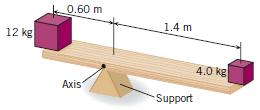
Two blocks are placed at the ends of a horizontal massless board, as in the drawing. The board is kept from rotating and rests on a support that serves as an axis of rotation. The moment of inertia of this system relative to the axis is 12 kg · m2. Determine the magnitude of the angular
Under what condition(s) is the angular momentum of a rotating body, such as a spinning ice skater, conserved?(a) Each external force acting on the body must be zero. (b) Each external force and each external torque acting on the body must be zero.(c) Each external force may be nonzero, but the
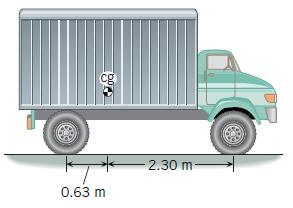
Conceptual Example 7 provides useful background for this problem. Workers have loaded a delivery truck in such a way that its center of gravity is only slightly forward of the rear axle, as shown in the drawing. The mass of the truck and its contents is 7460 kg. Find the magnitudes of the forces
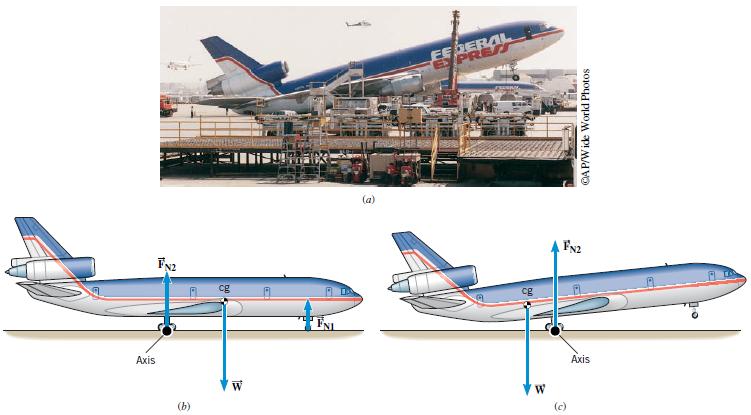
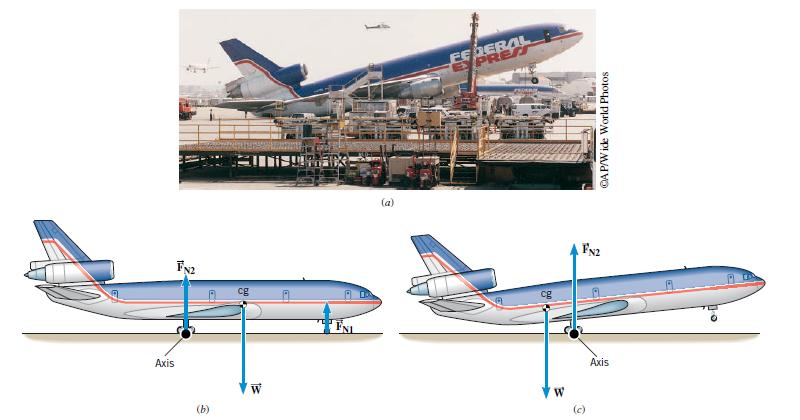
Review Conceptual Example 7 as background material for this problem. A jet transport has a weight of 1.00 × 10⁶ N and is at rest on the runway. The two rear wheels are 15.0 m behind the front wheel, and the plane’s center of gravity is 12.6 m behind the front wheel. Determine the normal force
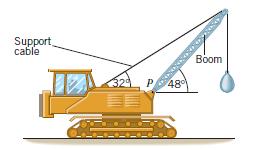
A wrecking ball (weight = 4800 N) is supported by a boom, which may be assumed to be uniform and has a weight of 3600 N. As the drawing shows, a support cable runs from the top of the boom to the tractor. The angle between the support cable and the horizontal is 32°, and the angle between the boom
Two thin rods of length L are rotating with the same angular speed ω (in rad/s) about axes that pass perpendicularly through one end. Rod A is massless but has a particle of mass 0.66 kg attached to its free end. Rod B has a mass of 0.66 kg, which is distributed uniformly along its length.The
Conceptual Example 13 provides useful background for this problem. A playground carousel is free to rotate about its center on frictionless bearings, and air resistance is negligible. The carousel itself (without riders) has a moment of inertia of 125 kg · m2. When one person is standing on the
Review Conceptual Example 7 before starting this problem. A uniform plank of length 5.0 m and weight 225 N rests horizontally on two supports, with 1.1 m of the plank hanging over the right support (see the drawing). To what distance x can a person who weighs 450 N walk on the overhanging part of
Rumor has it that a company has been smuggling gold out of the country using sealed, cylindrical barrels with hollow walls. They pour molten gold into the hollows, and then fill the remainder of the barrel’s internal volume with packing peanuts. The total mass of the gold-walled barrel was
You and your friends plan to roll down a hill on the inside of 600-pound tractor tire (diameter D = 1.80 m). The hill is inclined at an angle of 25.0° and you initially plan to start from a distance L = 100 m up the hill, but decide to first check whether it will be safe.(a) Assuming the masses of
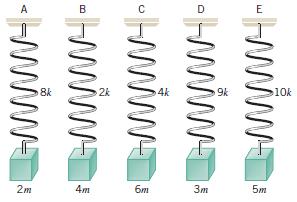
An object on a spring is oscillating in simple harmonic motion. Suddenly, friction appears and causes the energy of the system to be dissipated. The system now exhibits ______.(a) Driven harmonic motion(b) Hooke’slaw type of motion(c) Damped harmonic motion 10k 4m 6m 3m 5m
A material has a shear modulus of 5.0 × 10⁹ N/m2. A shear stress of 8.5 × 10⁶ N/m2 is applied to a piece of the material. What is the resulting shear strain?
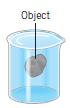
A beaker is filled to the brim with water. A solid object of mass 3.00 kg is lowered into the beaker so that the object is fully submerged in the water (see the drawing). During this process, 2.00 kg of water flows over the rim and out of the beaker. What is the buoyant force that acts on the
A 0.60-kg metal sphere oscillates at the end of a vertical spring. As the spring stretches from 0.12 to 0.23 m (relative to its unstrained length), the speed of the sphere decreases from 5.70 to 4.80 m/s. What is the spring constant of the spring?
A 6.8-kg bowling ball is attached to the end of a nylon cord with a cross sectional area of 3.4 × 10⁻⁵ m2. The other end of the cord is fixed to the ceiling. When the bowling ball is pulled to one side and released from rest, it swings downward in a circular arc. At the instant it reaches its
The femur is a bone in the leg whose minimum cross-sectional area is about 4.0 × 10⁻⁴ m2. A compressional force in excess of 6.8 × 10⁴ N will fracture this bone.(a) Find the maximum stress that this bone can withstand. (b) What is the strain that exists under a maximum-stress condition?
You are running from pirates on a tropical island somewhere in the Caribbean. You have somehow become separated from the rest of your group and now find yourself on the edge of a cliff with your pursuers less than 10 minutes behind you. According to a sign posted on the guardrail at the cliff ’s
You are given the task of opening an antiquated “light lock,” which is unlocked by shining red light pulses of a certain frequency for a long duration of time into a light sensor on the lock. You are given a red laser pointer, a spring of unstretched length L = 15.0 cm and spring constant k =
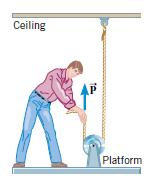
A man is standing on a platform that is connected to a pulley arrangement, as the drawing shows. By pulling upward on the rope with a force P(vector) the man can raise the platform and himself. The total mass of the man plus the platform is 94.0 kg. What pulling force should the man apply to create
Review Conceptual Example 5 before beginning this problem. You are traveling in a convertible with the top down. The car is moving at a constant velocity of 25 m/s, due east along flat ground. You throw a tomato straight upward at a speed of 11 m/s. How far has the car moved when you get a chance
A projectile is launched from ground level at an angle of 12.0° above the horizontal. It returns to ground level. To what value should the launch angle be adjusted, without changing the launch speed, so that the range doubles?
You are launching water balloons at a rival team using a large slingshot. The other team is set up on the opposite side of a flat-topped building that is 30.0 ft tall and 50.0 ft wide. Your reconnaissance team has reported that the opposition is set up 10.0 m from the wall of the building. Your
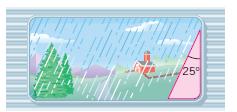
A person looking out the window of a stationary train notices that raindrops are falling vertically down at a speed of 5.0 m/s relative to the ground. When the train moves at a constant velocity, the raindrops make an angle of 25° when they move past the window, as the drawing shows. How fast is
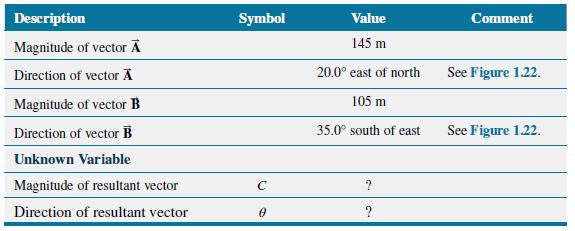
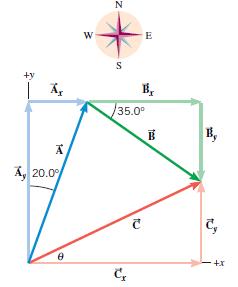
Multiple-Concept Example 9 deals with the concepts that are important in this problem. A grasshopper makes four jumps. The displacement vectors are (1) 27.0 cm, due west; (2) 23.0 cm, 35.0° south of west; (3) 28.0 cm, 55.0° south of east; and (4) 35.0 cm, 63.0° north of east. Find the magnitude
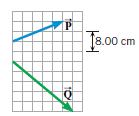
Given the vectors P(vector) and Q(vector) shown on the grid, sketch and calculate the magnitudes of the vectors(a) M(vector) = P(vector) + Q(vector)(b) K(vector) = 2P(vector) − Q(vector).Use the tail-to-head method and express the magnitudes in centimeters with the aid of the grid
Vector A(vector) has a magnitude of 12.3 units and points due west. Vector B(vector) points due north.(a) What is the magnitude of B(vector) if A(vector) + B(vector) has a magnitude of 15.0 units?(b) What is the direction of A(vector) + B(vector) relative to due
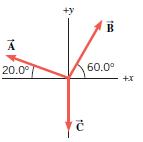
The three displacement vectors in the drawing have magnitudes of A = 5.00 m, B = 5.00 m, and C = 4.00 m. Find the resultant (magnitude and directional angle) of the three vectors by means of the component method. Express the directional angle as an angle above the positive or negative x axis. +y
Multiple-Concept Example 9 reviews the concepts that play a role in this problem. Two forces are applied to a tree stump to pull it out of the ground. Force FA(vector) has a magnitude of 2240 newtons and points 34.0° south of east, while force FB(vector) has a magnitude of 3160 newtons and
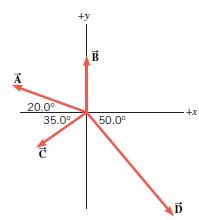
Multiple-Concept Example 9 provides background pertinent to this problem. The magnitudes of the four displacement vectors shown in the drawing are A = 16.0 m, B = 11.0 m, C = 12.0 m, and D = 26.0 m. Determine the magnitude and directional angle for the resultant that occurs when these vectors are
You and your team are exploring a river in South America when you come to the bottom of a tall waterfall. You estimate the cliff over which the water flows to be about 100 feet tall. You have to choose between climbing the cliff or backtracking and taking another route, but climbing the cliff would
Your South American expedition splits into two groups: one that stays at home base, and yours that goes off to set up a sensor that will monitor precipitation, temperature, and sunlight through the upcoming winter. The sensor must link up to a central communications system at base camp that
Review Conceptual Example 6 as background for this problem. A car is traveling to the left, which is the negative direction. The direction of travel remains the same throughout this problem. The car’s initial speed is 27.0 m/s, and during a 5.0-s interval, it changes to a final speed of(a) 29.0
(a) What is the magnitude of the average acceleration of a skier who, starting from rest, reaches a speed of 8.0 m/s when going down a slope for 5.0 s?(b) How far does the skier travel in this time?
A car is traveling at a constant speed of 33 m/s on a highway. At the instant this car passes an entrance ramp, a second car enters the highway from the ramp. The second car starts from rest and has a constant acceleration. What acceleration must it maintain, so that the two cars meet for the first
A hot-air balloon is rising upward with a constant speed of 2.50 m/s. When the balloon is 3.00 m above the ground, the balloonist accidentally drops a compass over the side of the balloon. How much time elapses before the compass hits the ground?
A diver springs upward with an initial speed of 1.8 m/s from a 3.0-m board.(a) Find the velocity with which he strikes the water. When the diver reaches the water, his displacement is y = −3.0 m (measured from the board), assuming that the downward direction is chosen as the negative
Consult Multiple-Concept Example 5 in preparation for this problem. The velocity of a diver just before hitting the water is −10.1 m/s, where the minus sign indicates that her motion is directly downward. What is her displacement during the last 1.20 s of the dive?
A golf ball is dropped from rest from a height of 9.50 m. It hits the pavement, then bounces back up, rising just 5.70 m before falling back down again. A boy then catches the ball on the way down when it is 1.20 m above the pavement. Ignoring air resistance, calculate the total amount of time that
On your flight out of South America your cargo plane emergency-lands on a deserted island somewhere in the South Pacific. Because it was a beach landing, the pilot skids the plane on its belly rather than lowering the landing gear. The landing is rough: an initial vertical drop followed by an
Two balls are thrown from the top of a building, as in the drawing. Ball 1 is thrown straight down, and ball 2 is thrown with the same speed, but upward at an angle θ with respect to the horizontal. Consider the motion of the balls after they are released. Which one of the following statements is
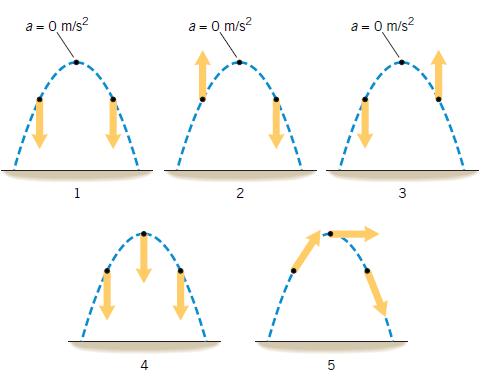
Each drawing shows three points along the path of a projectile, one on its way up, one at the top, and one on its way down. The launch point is on the left in each drawing. Which drawing correctly represents the acceleration a(vector) of the projectile at these three points?(a) 1(b) 2(c) 3(d) 4(e)
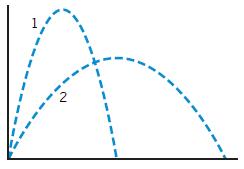
Two objects are fired into the air, and the drawing shows the projectile motions. Projectile 1 reaches the greater height, but projectile 2 has the greater range. Which one is in the air for the greater amount of time?(a) Projectile 1, because it travels higher than projectile 2.(b) Projectile 2,
Consult Multiple-Concept Example 4 for background before beginning this problem. Suppose the water at the top of Niagara Falls has a horizontal speed of 2.7 m/s just before it cascades over the edge of the falls. At what vertical distance below the edge does the velocity vector of the water point
A projectile is launched from and returns to ground level, as the figure shows. There is no air resistance. The horizontal range of the projectile is measured to be R = 175 m, and the horizontal component of the launch velocity is υ0x = +25 m/s. Concepts:(i) What is the final value of the
You are planning to make a jump with your motorcycle by driving over a ramp that will launch you at an angle of 30.0° with respect to the horizontal. The front edge of the ramp on which you are supposed to land, however, is 25.0 ft lower than the edge of the launch ramp (i.e., your launch
An object is moving at a constant velocity. All but one of the following statements could be true. Which one cannot be true?(a) No forces act on the object.(b) A single force acts on the object.(c) Two forces act simultaneously on the object.(d) Three forces act simultaneously on the object.
Two forces act on a moving object that has a mass of 27 kg. One force has a magnitude of 12 N and points due south, while the other force has a magnitude of 17 N and points due west. What is the acceleration of the object?(a) 0.63 m/s2 directed 55° south of west(b) 0.44 m/s2 directed 24° south of
Which one of the following is true, according to Newton’s laws of motion? Ignore friction.(a) A sports utility vehicle (SUV) hits a stationary motorcycle. Since it is stationary, the motorcycle sustains a greater force than the SUV does.(b) A semitrailer truck crashes all the way through a wall.
A certain object is in equilibrium. Which one of the following statements is not true?(a) The object must be at rest.(b) The object has a constant velocity.(c) The object has no acceleration.(d) No net force acts on the object.
Review Conceptual Example 7 in preparation for this problem. In tests on earth a lunar surface exploration vehicle (mass = 5.90 × 10³ kg) achieves a forward acceleration of 0.220 m/s2. To achieve this same acceleration on the moon, the vehicle’s engines must produce a drive force of 1.43 × 10³
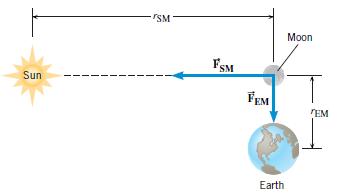
The drawing (not to scale) shows one alignment of the sun, earth, and moon. The gravitational force F(vector)SM that the sun exerts on the moon is perpendicular to the force F(vector)EM that the earth exerts on the moon. The masses are: mass of sun = 1.99 × 1030 kg, mass of earth = 5.98
Consult Multiple-Concept Example 9 to explore a model for solving this problem. A person pushes on a 57-kg refrigerator with a horizontal force of −267 N; the minus sign indicates that the force points in the −x direction. The coefficient of static friction is 0.65.(a) If the refrigerator does
Consult Multiple-Concept Example 10 in preparation for this problem. Traveling at a speed of 16.1 m/s, the driver of an automobile suddenly locks the wheels by slamming on the brakes. The coefficient of kinetic friction between the tires and the road is 0.720. What is the speed of the automobile
Review Conceptual Example 16 as background for this problem. The water skier there has a mass of 73 kg. Find the magnitude of the net force acting on the skier when(a) She is accelerated from rest to a speed of 11 m/s in 8.0 s (b) She lets go of the tow rope and glides to a halt in 21 s.
In preparation for this problem, review Conceptual Example 7. A space traveler whose mass is 115 kg leaves earth. What are his weight and mass (a) On earth(b) In interplanetary space where there are no nearby planetary objects?
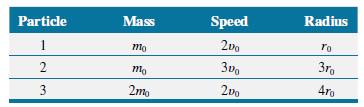
Three particles have the following masses (in multiples of m0) and move on three different circles with the following speeds (in multiples of υ0) and radii (in multiples of rRank the particles according to the magnitude of the centripetal force that acts on them, largest first.(a) 1, 2, 3(b) 1, 3,
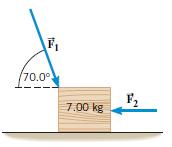
Two forces, F1(vector) and F2(vector) , act on the 7.00-kg block shown in the drawing. The magnitudes of the forces are F1 = 59.0 N and F2 = 33.0 N. What is the horizontal acceleration (magnitude and direction) of the block? 70.0° 7.00 kg
Consult Multiple-Concept Example 10 for insight into solving this type of problem. A box is sliding up an incline that makes an angle of 15.0° with respect to the horizontal. The coefficient of kinetic friction between the box and the surface of the incline is 0.180. The initial speed of the box
You are in a helicopter towing a 129-kg laser detector that is mapping out the thickness of the Brunt Ice Shelf along the coast of Antarctica. The original cable used to suspend the detector was damaged and replaced by a lighter one with a maximum tension rating of 310 pounds, not much more than
You and your friends pull your car off a mountain road onto an overlook to take pictures of the frozen lake below. You lose your footing on the packed snow, fall over the cliff , and land in a soft snow bank on a ledge, 10 feet below the edge. The cliff ’s wall is too smooth to climb upwards and
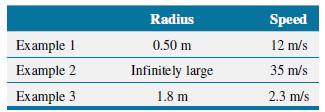
The following table lists data for the speed and radius of three examples of uniform circular motion. Find the magnitude of the centripetal acceleration for each example. Radius Speed Example 1 0.50 m 12 m/s Example 2 Infinitely large 35 m/s Example 3 1.8 m 2.3 m/s
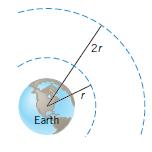
Two identical satellites are in orbit about the earth. As the drawingshows, one orbit has a radius r and the other 2r. The centripetal force on the satellite in the larger orbit is ________ as that on the satellite in the smaller orbit.(a) The same(b) Twice as great(c) Four times as great(d) Half
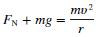
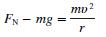
The drawing shows an extreme skier at the bottom of a ski jump. At this point the track is circular with a radius r. Two forces act on the skier, her weight mg and the normal force FN. Which relation describes how the net force acting on her is related to her mass m and speed υ and to the radius
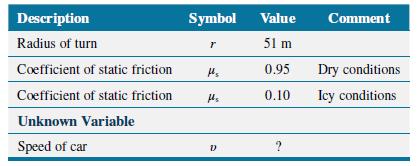
Multiple-Concept Example 7 reviews the concepts that play a role in this problem. Car A uses tires for which the coefficient of static friction is 1.1 on a particular unbanked curve. The maximum speed at which the car can negotiate this curve is 25 m/s. Car B uses tires for which the coefficient of
Showing 100 - 200
of 204
1
2
3
Step by Step Answers

 Get 50% OFF
Claim Now
Get 50% OFF
Claim Now