



Question: A study described in Data A.1 on page 136 found that mice exposed to light at night gained substantially more weight than mice who had
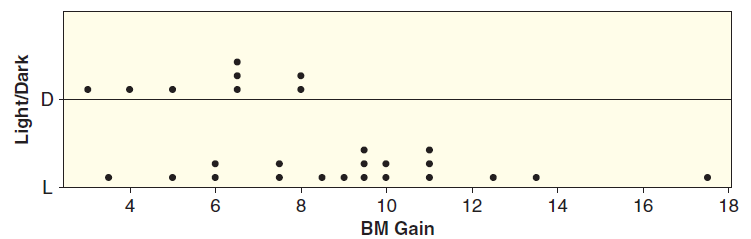
A study described in Data A.1 on page 136 found that mice exposed to light at night gained substantially more weight than mice who had complete darkness at night, despite the fact that calorie intake and activity levels were the same for the two groups. How large is the effect of light on weight gain? In the study, 27 mice were randomly divided into two groups. The 8 mice with darkness at night gained an average of 5.9 grams in body mass, with a standard deviation of 1.9 grams. The 19 mice with light at night gained an average of 9.4 grams with a standard deviation of 3.2 grams. We see in Figure 6.24 that there is no extreme skewness or extreme outliers, so it is appropriate to use a t-distribution. Find and interpret a 99% confidence interval for the difference in mean weight gain.
Figure 6.24
Data A.1 on page 136
Numerous studies have shown that exposure to light at night is harmful to human health. A recent study72 in mice shows that even low-level light at night can interfere with normal eating and sleeping cycles. Furthermore, the study finds that food is especially fattening if consumed at the wrong time of day, at least in mice. In the study, 27 mice were randomly split into three groups. One group was on a normal light€“dark cycle (LD), one group had bright light on all the time (LL), and one group had light during the day and dim light at night (DM). The dim light was equivalent to having a television set on in a room. The mice in darkness ate most of their food during their active (nighttime) period, matching the behavior of mice in the wild. The mice in both dim light and bright light, however, consumed more than half of their food during the well-lit rest period, when most mice are sleeping. Although the data collected show that the three groups of mice ate approximately the same amount of food and had the same levels of physical activity, the mice exposed to light at night gained substantially more weight, ate a greater percent of calories during the day, and were more likely to be classified as glucose intolerant at the end of the study. An absence of darkness seems to be associated with fatter mice.
14 8 4 6 10 12 16 18 BM Gain Light/Dark
Step by Step Solution
3.38 Rating (173 Votes )
There are 3 Steps involved in it
We estimate the difference in population means usin... View full answer

Get step-by-step solutions from verified subject matter experts