







Question: Digital (or even analog) Multimeters (DMMs) are ubiquitous engineering tools. They can be purchased for as little as $5 to as much as several thousand
Digital (or even analog) Multimeters (DMMs) are ubiquitous engineering tools.
They can be purchased for as little as $5 to as much as several thousand dollars. Most popular models are in the range of $100 to $200 and are hand-held portables. Clearly there must be differences to warrant such a wide range of prices. These differences are durability, accuracy, functions, input resistance, and battery or plug-in powered, to mention a few. For this discussion let us focus on input resistance.
Consider the circuit of Figure 4–37(a). A particular DMM is used to measure the voltage across the 10-MΩ resistor. The anticipated voltage was 8 V. However, the meter reads 6 V. The meter has an internal resistance that is in parallel with the
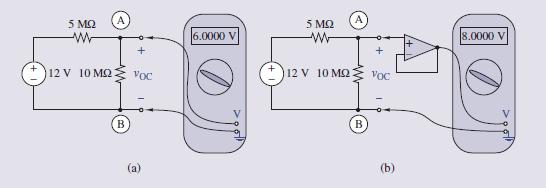
resistor that is being measured and is significantly altering the reading. One can calculate the internal resistance of the meter RM using voltage division as follows
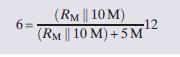
where
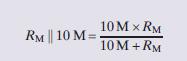
Solving for RM, we find that RM =10MΩ.
The reason for the problem is that the current splits at node A sending some through the DMM. In theory, with a perfect DMM all of the current would flow through the load.
The problem can be solved by inserting a follower in front of theDMMas shown in Figure 4–37(b). BetterDMMs have a follower in the front end to permit themtomeasure voltages across high resistances. The down side is that a follower requires power to operate. It should be noted that most voltage measurements are made across resistors significantly smaller than 10 MΩ, negating the need for a follower.
5 www 12 V 10 MQ Voc B (a) 16.0000 V 5 w 8.0000 V + 12 V 10 MQ Voc B (b)
Step by Step Solution
There are 3 Steps involved in it

Get step-by-step solutions from verified subject matter experts
 Study Help