







Question: A rocket design team has a need to detect the temperatures in a rocket motor. The combustion chamber is that part of a thrust chamber
A rocket design team has a need to detect the temperatures in a rocket motor. The combustion chamber is that part of a thrust chamber where the combustion of the propellant takes place. The combustion temperature is much higher than the melting points of most chamber wall materials and reaches a temperature of . Therefore, it is necessary either to cool these walls or to stop rocket operation before the critical wall areas become too hot. If the heat transfer is too high and thus the wall temperatures become locally too high, the thrust chamber will fail. The most critical wall regions are at and near the nozzle throat and at the nozzle exit. There are two thermocouples located in a rocket engine, namely, one at the throat and the other at the end of the nozzle exit. Your task is to design an emergency shutoff of the rocket engine if either temperature exceeds \(600 \mathrm{~K}\). Shutoff is done by sending a 5 -VDC signal to a fuel controller that will immediately stop the flow of fuel and abort the rocket. Use a unipolar comparator powered by a \(\mathrm{o}-\) and \(5-\mathrm{V}\) supply. Set the comparator reference voltage at 600 \(\mathrm{K}\) as \(1 \mathrm{~V}\). Use the R-type thermocouple shown in Figure P4-69. because of its superior accuracy and stability, especially in a reducing environment as is found in rocket engines.
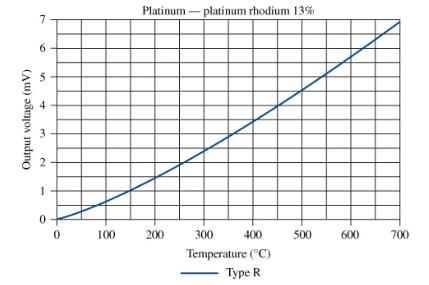
Output voltage (mV) 7 6 3 1 0 0 100 Platinum - platinum rhodium 13% 200 300 400 Temperature (C) Type R 500 600 700
Step by Step Solution
3.47 Rating (160 Votes )
There are 3 Steps involved in it
At a temperature of 600 K the thermocouple output voltage is 56 mV T... View full answer

Get step-by-step solutions from verified subject matter experts
 Study Help