New Semester
Started
Get
50% OFF
Study Help!
--h --m --s
Claim Now
Question Answers
Textbooks
Find textbooks, questions and answers
Oops, something went wrong!
Change your search query and then try again
S
Books
FREE
Study Help
Expert Questions
Accounting
General Management
Mathematics
Finance
Organizational Behaviour
Law
Physics
Operating System
Management Leadership
Sociology
Programming
Marketing
Database
Computer Network
Economics
Textbooks Solutions
Accounting
Managerial Accounting
Management Leadership
Cost Accounting
Statistics
Business Law
Corporate Finance
Finance
Economics
Auditing
Tutors
Online Tutors
Find a Tutor
Hire a Tutor
Become a Tutor
AI Tutor
AI Study Planner
NEW
Sell Books
Search
Search
Sign In
Register
study help
business
accounting
Fundamentals of Financial Management Concise 6th Edition Eugene F. Brigham, Joel F. Houston - Solutions
What is the value of a 13% coupon bond that is otherwise identical to the bond described in Part D? Would we now have a discount or a premium bond?
What is the value of a 7% coupon bond with these characteristics? Would we now have a discount or a premium bond?
What would happen to the values of the 7%, 10%, and 13% coupon bonds over time if the required return remained at 10%?
What is the yield to maturity on a 10-year, 9%, annual coupon, $1,000 par value bond that sells for $887.00? That sells for $1,134.20? What does the fact that it sells at a discount or at a premium tell you about the relationship between rd and the coupon rate?
What are the total return, the current yield, and the capital gains yield for the discount bond? Assume that it is held to maturity and the company does not default on it.
What is interest rate (or price) risk? Which has more interest rate risk, an annual payment 1-year bond or a 10-year bond? Why?
What is reinvestment rate risk? Which has more reinvestment rate risk, a 1-year bond or a 10-year bond?
Suppose a firm will need $100,000 20 years from now to replace some equipment. It plans to make 20 equal payments, starting today, into an investment fund. It can buy bonds that mature in 20 years or bonds that mature in 1 year. Both types of bonds currently sell to yield 10%, i.e., rd = YTM = 10%.
If the company decides to invest enough right now to produce the future $100,000, how much must it put up?
Can you think of any other type of bond that might be useful for this company’s purposes?
What type of bond would you recommend that it actually buy?
How does the equation for valuing a bond change if semiannual payments are made? Find the value of a 10-year, semiannual payment, 10% coupon bond if nominal rd = 13%.
Suppose for $1,000 you could buy a 10%, 10-year, annual payment bond or a 10%, 10-year, semiannual payment bond. They are equally risky. Which would you prefer? If $1,000 is the proper price for the semiannual bond, what is the equilibrium price for the annual payment bond?
Suppose a 10-year, 10%, semiannual coupon bond with a par value of $1,000 is currently selling for $1,135.90, producing a nominal yield to maturity of 8%. However, it can be called after 4 years for $1,050. What is the bond’s nominal yield to call (YTC)?
If you bought this bond, would you be more likely to earn the YTM or the YTC? Why?
Does the yield to maturity represent the promised or expected return on the bond? Explain.
If this firm were to default on the bonds, would the company be immediately liquidated? Would the bondholders be assured of receiving all of their promised payments? Explain.
These bonds were rated AA- by S&P. Would you consider them investment-grade or junk bonds?
What factors determine a company’s bond rating?
Suppose you owned a portfolio consisting of $250,000 of long-term U.S. government bonds.a. Would your portfolio be riskless? Explain.b. Now suppose the portfolio consists of $250,000 of 30-day Treasury bills. Every 30 days your bills mature, and you will reinvest the principal ($250,000) in a new
The probability distribution of a less risky expected return is more peaked than that of a riskier return. What shape would the probability distribution be for(a) Completely certain returns and(b) Completely uncertain returns?
A life insurance policy is a financial asset, with the premiums paid representing the investment’s cost.a. How would you calculate the expected return on a 1-year life insurance policy?b. Suppose the owner of a life insurance policy has no other financial assets—the person’s only other asset
Is it possible to construct a portfolio of real-world stocks that has an expected return equal to the risk-free rate?
Stock A has an expected return of 7%, a standard deviation of expected returns of 35%, a correlation coefficient with the market of – 0.3, and a beta coefficient of !0.5. Stock B has an expected return of 12%, a standard deviation of returns of 10%, a 0.7 correlation with the market, and a
A stock had a 12% return last year, a year when the overall stock market declined. Does this mean that the stock has a negative beta and thus very little risk if held in a portfolio? Explain.
If investors’ aversion to risk increased, would the risk premium on a high-beta stock increase by more or less than that on a low-beta stock? Explain. Discuss.
If a company’s beta were to double, would its required return also double?
In Chapter 7, we saw that if the market interest rate, rd, for a given bond increased, the price of the bond would decline. Applying this same logic to stocks, explain(a) How a decrease in risk aversion would affect stocks’ prices and earned rates of return,(b) How this would affect risk premiums
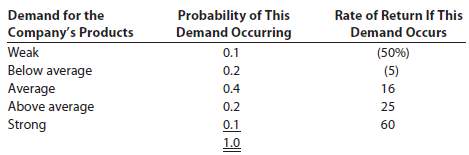
A stock’s returns have the following distribution:Calculate the stock’s expected return, standard deviation, and coefficient of variation.
An individual has $35,000 invested in a stock with a beta of 0.8 and another $40,000 invested in a stock with a beta of 1.4. If these are the only two investments in her portfolio, what is her portfolio’s beta? Discuss.
Assume that the risk-free rate is 6% and the expected return on the market is 13%. What is the required rate of return on a stock with a beta of 0.7?
Assume that the risk-free rate is 5% and the market risk premium is 6%. What is the expected return for the overall stock market? What is the required rate of return on a stock with a beta of 1.2?
A stock has a required return of 11%, the risk-free rate is 7%, and the market risk premium is 4%.a. What is the stock’s beta?b. If the market risk premium increased to 6%, what would happen to the stock’s required rate of return? Assume that the risk-free rate and the beta remain unchanged.
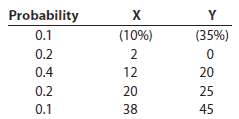
Stocks X and Y have the following probability distributions of expected future returns: a. Calculate the expected rate of return, rY, for Stock Y (rX = 12%).b. Calculate the standard deviation of expected returns, ??X, for Stock X (??Y = 20.35%). Now calculate the coefficient of variation for
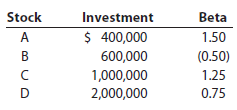
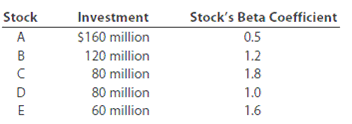
Suppose you are the money manager of a $4 million investment fund. The fund consists of four stocks with the following investments and betas:If the market’s required rate of return is 14% and the risk-free rate is 6%, what is the fund’s required rate of return?
Given the following information, determine the beta coefficient for Stock J that is consistent with equilibrium: rJ = 12.5%; rRF = 4.5%; rM = 10.5%.
Stock R has a beta of 1.5, Stock S has a beta of 0.75, the expected rate of return on an average stock is 13%, and the risk-free rate of return is 7%. By how much does the required return on the riskier stock exceed the required return on the less risky stock?
Bradford Manufacturing Company has a beta of 1.45, while Farley Industries has a beta of 0.85. The required return on an index fund that holds the entire stock market is 12.0%. The risk-free rate of interest is 5%. By how much does Bradford’s required return exceed Farley’s required return?
Calculate the required rate of return for Manning Enterprises assuming that investors expect a 3.5% rate of inflation in the future. The real risk-free rate is 2.5%, and the market risk premium is 6.5%. Manning has a beta of 1.7, and its realized rate of return has averaged 13.5% over the past 5
Suppose rRF = 9%, rM = 14%, and bi = 1.3.a. What is ri, the required rate of return on Stock i?b. Now suppose that rRF (1) increases to 10% or (2) decreases to 8%. The slope of the SML remains constant. How would this affect rM and ri?c. Now assume that rRF remains at 9% but rM (1) increases to 16%
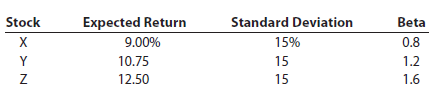
Consider the following information for three stocks, Stocks X, Y, and Z. The returns on the three stocks are positively correlated, but they are not perfectly correlated. (That is, each of the correlation coefficients is between 0 and 1.)Fund Q has one-third of its funds invested in each of the
Suppose you held a diversified portfolio consisting of a $7,500 investment in each of 20 different common stocks. The portfolio’s beta is 1.12. Now suppose you decided to sell one of the stocks in your portfolio with a beta of 1.0 for $7,500 and use the proceeds to buy another stock with a beta
Industries (HRI) has a beta of 1.8, while LR Industries’ (LRI) beta is 0.6. The risk-free rate is 6%, and the required rate of return on an average stock is 13%. The expected rate of inflation built into rRF falls by 1.5 percentage points, the real risk-free rate remains constant, the required
You have been managing a $5 million portfolio that has a beta of 1.25 and a required rate of return of 12%. The current risk-free rate is 5.25%. Assume that you receive another $500,000. If you invest the money in a stock with a beta of 0.75, what will be the required return on your $5.5 million
A mutual fund manager has a $20 million portfolio with a beta of 1.5. The risk-free rate is 4.5%, and the market risk premium is 5.5%. The manager expects to receive an additional $5 million, which she plans to invest in a number of stocks. After investing the additional funds, she wants the
Suppose you won the lottery and had two options: (1) receiving $0.5 million or (2) taking a gamble in which at the flip of a coin you receive $1 million if a head comes up but receive zero if a tail comes up.a. What is the expected value of the gamble?b. Would you take the sure $0.5 million or the
Stock X has a 10% expected return, a beta coefficient of 0.9, and a 35% standard deviation of expected returns. Stock Y has a 12.5% expected return, a beta coefficient of 1.2, and a 25% standard deviation. The risk-free rate is 6%, and the market risk premium is 5%.a. Calculate each stock’s
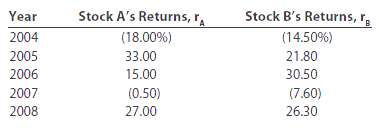
Stocks A and B have the following historical returns: a. Calculate the average rate of return for each stock during the period 2004 through 2008.b. Assume that someone held a portfolio consisting of 50% of Stock A and 50% of Stock B. What would the realized rate of return on the portfolio have
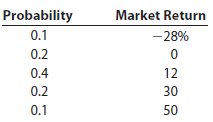
You plan to invest in the Kish Hedge Fund, which has total capital of $500 million invested in five stocks:Kish’s beta coefficient can be found as a weighted average of its stocks’ betas. The risk-free rate is 6%, and you believe the following probability distribution for future market returns
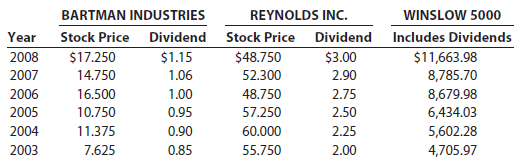
Bartman Industries’ and Reynolds Inc.’s stock prices and dividends, along with the Winslow 5000 Index, are shown here for the period 2003–2008. The Winslow 5000 data are adjusted to include dividends.a. Use the data to calculate annual rates of return for Bartman, Reynolds, and the Winslow
Why is the T-bill’s return independent of the state of the economy? Do T-bills promise a completely risk-free return? Explain.
Why are High Tech’s returns expected to move with the economy, whereas Collections’ are expected to move counter to the economy?
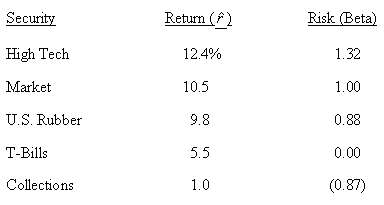
Calculate the expected rate of return on each alternative and fill in the blanks on the row for in the previous table.
You should recognize that basing a decision solely on expected returns is appropriate only for risk-neutral individuals. Because your client, like most people, is risk-averse, the riskiness of each alternative is an important aspect of the decision. One possible measure of risk is the standard
What type of risk is measured by the standard deviation? Discuss.
Draw a graph that shows roughly the shape of the probability distributions for High Tech, U.S. Rubber, and T-bills.
Suppose you suddenly remembered that the coefficient of variation (CV) is generally regarded as being a better measure of stand-alone risk than the standard deviation when the alternatives being considered have widely differing expected returns. Calculate the missing CVs, and fill in the blanks on
Suppose you created a 2-stock portfolio by investing $50,000 in High Tech and $50,000 in Collections. Calculate the expected return (̂r̂p), the standard deviation ((p), and the coefficient of variation (CVp) for this portfolio and fill in the appropriate blanks in the table.
How does the riskiness of this 2-stock portfolio compare with the riskiness of the individual stocks if they were held in isolation?
Does the expected rate of return on the portfolio depend on the percentage of the portfolio invested in each stock? What about the riskiness of the portfolio?
Suppose an investor starts with a portfolio consisting of one randomly selected stock. What would happen (1) to the riskiness and to the expected return of the portfolio as more randomly selected stocks were added to the portfolio? (2) What is the implication for investors? Draw a graph of the
Should the effects of a portfolio impact the way investors think about the riskiness of individual stocks?
If you decided to hold a 1-stock portfolio (and consequently were exposed to more risk than diversified investors), could you expect to be compensated for all of your risk; that is, could you earn a risk premium on the part of your risk that you could have eliminated by diversifying?
The expected rates of return and the beta coefficients of the alternatives as supplied by Merrill Finch's computer program are as follows: What is a beta coefficient, and how are betas used in riskanalysis?
The yield curve is currently flat; that is, long-term Treasury bonds also have a 5.5% yield. Consequently, Merrill Finch assumes that the risk-free rate is 5.5%. Write out the Security Market Line (SML) equation, use it to calculate the required rate of return on each alternative, and graph the
How do the expected rates of return compare with the required rates of return? Discuss.
Does the fact that Collections has an expected return that is less than the T-bill rate make any sense? Explain.
What would be the market risk and the required return of a 50-50 portfolio of High Tech and Collections? Of High Tech and U.S. Rubber?
Suppose investors raised their inflation expectations by 3 percentage points over current estimates as reflected in the 5.5% risk-free rate. What effect would higher inflation have on the SML and on the returns required on high- and low-risk securities?
Suppose instead that investors’ risk aversion increased enough to cause the market risk premium to increase by 3 percentage points. (Inflation remains constant.) What effect would this have on the SML and on returns of high- and low-risk securities?
Financial managers are more concerned with investment decisions relating to real assets such as plant and equipment than with investments in financial assets such as securities. How does the analysis that we have gone through relate to real-asset investment decisions, especially corporate capital
Suppose Bon Temps decided to issue preferred stock that would pay an annual dividend of $5 and that the issue price was $50 per share. What would be the stock’s expected return? Would the expected rate of return be the same if the preferred was a perpetual issue or if it had a 20-year maturity?
It is frequently stated that the one purpose of the preemptive right is to allow individuals to maintain their proportionate share of the ownership and control of a corporation.a. How important do you suppose control is for the average stockholder of a firm whose shares are traded on the New York
Two investors are evaluating GE’s stock for possible purchase. They agree on the expected value of D1 and on the expected future dividend growth rate. Further, they agree on the riskiness of the stock. However, one investor normally holds stocks for 2 years, while the other holds stocks for 10
A bond that pays interest forever and has no maturity is a perpetual bond. In what respect is a perpetual bond similar to a no-growth common stock? Are there preferred stocks that are evaluated similarly to perpetual bonds and other preferred stocks that are more like bonds with finite lives?
Warr Corporation just paid a dividend of $1.50 a share (that is, D0 = $1.50). The dividend is expected to grow 7% a year for the next 3 years and then at 5% a year thereafter. What is the expected dividend per share for each of the next 5 years?
Thomas Brothers is expected to pay a $0.50 per share dividend at the end of the year (that is, D1 = $0.50). The dividend is expected to grow at a constant rate of 7% a year. The required rate of return on the stock, rs, is 15%. What is the stock’s current value per share?
Harrison Clothiers’ stock currently sells for $20.00 a share. It just paid a dividend of $1.00 a share (that is, D0 = $1.00). The dividend is expected to grow at a constant rate of 6% a year. What stock price is expected 1 year from now? What is the required rate of return?
Hart Enterprises recently paid a dividend, D0, of $1.25. It expects to have non-constant growth of 20% for 2 years followed by a constant rate of 5% thereafter. The firm’s required return is 10%.a. How far away is the terminal, or horizon, date?b. What is the firm’s horizon, or terminal,
Smith Technologies is expected to generate $150 million in free cash flow next year, and FCF is expected to grow at a constant rate of 5% per year indefinitely. Smith has no debt or preferred stock, and its WACC is 10%. If Smith has 50 million shares of stock outstanding, what is the stock’s
Fee Founders has perpetual preferred stock outstanding that sells for $60 a share and pays a dividend of $5 at the end of each year. What is the required rate of return?
What will be the nominal rate of return on a perpetual preferred stock with a $100 par value, a stated dividend of 8% of par, and a current market price of(a) $60,(b) $80,(c) $100, and(d) $140?
Ezzell Corporation issued perpetual preferred stock with a 10% annual dividend. The stock currently yields 8%, and its par value is $100.a. What is the stock’s value?b. Suppose interest rates rise and pull the preferred stock’s yield up to 12%. What is its new market value?
Bruner Aeronautics has perpetual preferred stock outstanding with a par value of $100. The stock pays a quarterly dividend of $2, and its current price is $80.a. What is its nominal annual rate of return?b. What is its effective annual rate of return?
A stock is expected to pay a dividend of $0.50 at the end of the year (that is, D1 = 0.50), and it should continue to grow at a constant rate of 7% a year. If its required return is 12%, what is the stock’s expected price 4 years from today?
Investors require a 15% rate of return on Levine Company’s stock (that is, rs = 15%).a. What is its value if the previous dividend was D0 = $2 and investors expect dividends to grow at a constant annual rate of (1) #5%, (2) 0%, (3) 5%, or (4) 10%?b. Using data from Part a, what would the Gordon
You are considering an investment in Keller Corp’s stock, which is expected to pay a dividend of $2.00 a share at the end of the year (D1 = $2.00) and has a beta of 0.9. The risk-free rate is 5.6%, and the market risk premium is 6%. Keller currently sells for $25.00 a share, and its dividend is
Microtech Corporation is expanding rapidly and currently needs to retain all of its earnings; hence, it does not pay dividends. However, investors expect Microtech to begin paying dividends, beginning with a dividend of $1.00 coming 3 years from today. The dividend should grow rapidly—at a rate
Dozier Corporation is a fast-growing supplier of office products. Analysts project the following free cash flows (FCFs) during the next 3 years, after which FCF is expected to grow at a constant 7% rate. Dozier’s WACC is 13%.a. What is Dozier’s terminal, or horizon, value?b. What is the
Mitts Cosmetics Co.’s stock price is $58.88, and it recently paid a $2.00 dividend. This dividend is expected to grow by 25% for the next 3 years, then grow forever at a constant rate, g; and rs = 12%. At what constant rate is the stock expected to grow after Year 3?
Your broker offers to sell you some shares of Bahnsen & Co. common stock that paid a dividend of $2.00 yesterday. Bahnsen’s dividend is expected to grow at 5% per year for the next 3 years. If you buy the stock, you plan to hold it for 3 years and then sell it. The appropriate discount rate
Taussig Technologies Corporation (TTC) has been growing at a rate of 20% per year in recent years. This same growth rate is expected to last for another 2 years, then decline to gn = 6%. a. If D0 = $1.60 and rs = 10%, what is TTC’s stock worth today? What are its expected dividend and capital
Barrett Industries invests a large sum of money in R&D; as a result, it retains and reinvests all of its earnings. In other words, Barrett does not pay any dividends and it has no plans to pay dividends in the near future. A major pension fund is interested in purchasing Barrett’s stock. The
Assume that today is December 31, 2008, and that the following information applies to Vermeil Airlines:• After-tax operating income [EBIT(1 – T)] for 2009 is expected to be $500 million.• The depreciation expense for 2009 is expected to be $100 million.• The capital expenditures for 2009
Assume that it is now January 1, 2009. Wayne-Martin Electric Inc. (WME) has developed a solar panel capable of generating 200% more electricity than any other solar panel currently on the market. As a result, WME is expected to experience a 15% annual growth rate for the next 5 years. Other firms
Rework Problem 9-18, Parts a, b, and c, using a spreadsheet model. For Part b, calculate the price, dividend yield, and capital gains yield as called for in the problem. After completing Parts a through c, answer the following additional question using the spreadsheet model.d. TTC recently
Describe briefly the legal rights and privileges of common stockholders. Discuss.
Write a formula that can be used to value any stock, regardless of its dividend pattern.
What is a constant growth stock? How are constant growth stocks valued?
What are the implications if a company forecasts a constant g that exceeds its rs? Will many stocks have expected g > rs in the short run (that is, for the next few years)? In the long run (that is, forever)?
Showing 4800 - 4900
of 107766
First
42
43
44
45
46
47
48
49
50
51
52
53
54
55
56
Last
Step by Step Answers

 Get 50% OFF
Claim Now
Get 50% OFF
Claim Now