New Semester
Started
Get
50% OFF
Study Help!
--h --m --s
Claim Now
Question Answers
Textbooks
Find textbooks, questions and answers
Oops, something went wrong!
Change your search query and then try again
S
Books
FREE
Study Help
Expert Questions
Accounting
General Management
Mathematics
Finance
Organizational Behaviour
Law
Physics
Operating System
Management Leadership
Sociology
Programming
Marketing
Database
Computer Network
Economics
Textbooks Solutions
Accounting
Managerial Accounting
Management Leadership
Cost Accounting
Statistics
Business Law
Corporate Finance
Finance
Economics
Auditing
Tutors
Online Tutors
Find a Tutor
Hire a Tutor
Become a Tutor
AI Tutor
AI Study Planner
NEW
Sell Books
Search
Search
Sign In
Register
study help
business
finance
Finance Applications and Theory 3rd edition Marcia Cornett, Troy Adair - Solutions
A firm recently paid a $0.60 annual dividend. The dividend is expected to increase by 12 percent in each of the next four years. In the fourth year, the stock price is expected to be $110. If the required return for this stock is 14.5 percent, what is its current value?
Waller Co. paid a $0.286 dividend per share in 2006, which grew to $0.55 in 2012. This growth is expected to continue. What is the value of this stock at the beginning of 2013 when the required return is 13.7 percent?
Campbell Soup Co. (CPB) paid a $0.632 dividend per share in 2003, which grew to $0.76 in 2006. This growth is expected to continue. What is the value of this stock at the beginning of 2007 when the required return is 8.7 percent?
Consider a firm that had been priced using a 10 percent growth rate and a 12 percent required return. The firm recently paid a $1.20 dividend. The firm has just announced that because of a new joint venture, it will likely grow at a 10.5 percent rate. How much should the stock price change (in
Consider a firm that had been priced using an 11.5 percent growth rate and a 13.5 percent required return. The firm recently paid a $1.50 dividend. The firm has just announced that because of a new joint venture, it will likely grow at a 12 percent rate. How much should the stock price change (in
A fast growing firm recently paid a dividend of $0.35 per share. The dividend is expected to increase at a 20 percent rate for the next three years. Afterwards, a more stable 12 percent growth rate can be assumed. If a 13 percent discount rate is appropriate for this stock, what is its value?
A fast-growing firm recently paid a dividend of $0.40 per share. The dividend is expected to increase at a 25 percent rate for the next four years. Afterwards, a more stable 11 percent growth rate can be assumed. If a 12.5 percent discount rate is appropriate for this stock, what is its value?
Suppose that a firm’s recent earnings per share and dividend per share are $2.50 and $1.30, respectively. Both are expected to grow at 8 percent. However, the firm’s current P/E ratio of 22 seems high for this growth rate. The P/E ratio is expected to fall to 18 within five years. Compute a
Suppose that a firm’s recent earnings per share and dividend per share are $2.75 and $1.60, respectively. Both are expected to grow at 9 percent. However, the firm’s current P/E ratio of 23 seems high for this growth rate. The P/E ratio is expected to fall to 19 within five years. Compute a
Spreadsheets are especially useful for computing stock value under different assumptions. Consider a firm that is expected to pay the following dividends:and grow at 5 percent thereafterA. Using an 11 percent discount rate, what would be the value of this stock?B. What is the value of the
Ultra Petroleum (UPL) has earnings per share of $1.56 and a P/E ratio of 32.48. What’s the stock price?
JP Morgan Chase Co. (JPM) has earnings per share of $3.53 and a P/E ratio of 13.81. What is the price of the stock?
A firm is expected to pay a dividend of $1.35 next year and $1.50 the following year. Financial analysts believe the stock will be at their price target of $68 in two years. Compute the value of this stock with a required return of 10 percent.
Financial analysts forecast Safeco Corp.’s (SAF) growth rate for the future to be 8 percent. Safeco’s recent dividend was $0.88. What is the value of Safeco stock when the required return is 12 percent?
Financial analysts forecast Limited Brands’ (LTD) growth rate for the future to be 12.5 percent. LTD’s recent dividend was $0.60. What is the value of Limited Brands’ stock when the required return is 14.5 percent?
Carnival Corp. provides cruises to major vacation destinations. Carnival operates 100 cruise ships with a total capacity of 180,746 passengers in North America, Europe, the United Kingdom, Germany, Australia, and New Zealand. The company also operates hotels, sightseeing motor coaches and rail
Characterize the historical return, risk, and risk-return relationship of the stock, bond and cash markets.
What does diversification do to the risk and return characteristics of a portfolio?
Many employees believe that their employer’s stock is less likely to lose half of its value than a well diversified portfolio of stocks. Explain why this belief is erroneous.
Why is the percentage return a more useful measure than the dollar return?
How do we define risk in this chapter and how do we measure it?
What are the two components of total risk? Which component is part of the risk-return relationship? Why?
Which company is likely to have lower total risk, General Electric or Coca-Cola? Why?
Can a company change its total risk level over time? How?
What does the coefficient of variation measure? Why is a lower value better for the investor?
You receive an investment newsletter advertisement in the mail. The letter claims that you should invest in a stock that has doubled the return of the S&P 500 Index over the last three months. It also claims that this stock is a surefire safe bet for the future. Explain how these two claims are
Describe the diversification potential of two assets with a -0.8 correlation. What is the potential if the correlation is +0.8?
You are a risk adverse investor with a low-risk portfolio of bonds. How is it possible that adding some stocks (which are riskier than bonds) to the portfolio can lower the total risk of the portfolio?
You own only two stocks in your portfolio but want to add more. When you add a third stock, the total risk of your portfolio declines. When you add a tenth stock to the portfolio, the total risk declines. Adding which stock, the third or the tenth, likely reduced the total risk more? Why?
Explain what we mean when we say that one portfolio dominates another portfolio?
Explain what the efficient frontier is and why it is important to investors.
If an investor’s desired risk level changes over time, should the investor change the composition of his or her portfolio? How?
Say you own 200 shares of Mattel and 100 shares of RadioShack. Would your portfolio return be different if you instead owned 100 shares of Mattel and 200 shares of RadioShack? Why?
FedEx Corp stock ended the previous year at $103.39 per share. It paid a $0.35 per share dividend last year. It ended last year at $106.69. If you owned 200 shares of FedEx, what was your dollar return and percent return?
Sprint Nextel Corp stock ended the previous year at $23.36 per share. It paid a $2.37 per share dividend last year. It ended last year at $18.89. If you owned 500 shares of Sprint, what was your dollar return and percent return?
An investor owns $6,000 of Adobe Systems stock, $5,000 of Dow Chemical, and $5,000 of Office Depot. What are the portfolio weights of each stock?
An investor owns $3,000 of Adobe Systems stock, $6,000 of Dow Chemical, and $7,000 of Office Depot. What are the portfolio weights of each stock?
The past five monthly returns for PG&E are -3.17 percent, 3.88 percent, 3.77 percent, 6.47 percent, and 3.58 percent. What is the average monthly return?
Compute the standard deviation of Kohls’ monthly returns shown in Problem. In Problem, The past five monthly returns for Kohl’s are 4.11 percent, 3.62 percent, -1.68 percent, 9.25 percent, and -2.56 percent. What is the average monthly return?
Compute the standard deviation of PG&E’s monthly returns shown in Problem. In Problem The past five monthly returns for PG&E are -3.17 percent, 3.88 percent, 3.77 percent, 6.47 percent, and 3.58 percent. What is the average monthly return?
Assess the risk-return relationship of the bond market (Tables) during each decade since 1950.
Assess the risk-return relationship in T-bills (Tables) during each decade since 1950.
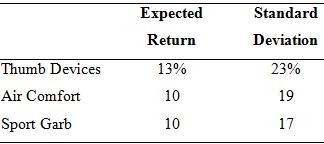
Consider the characteristics of the following three stocks: The correlation between Thumb Devices and Air Comfort is -0.12. The correlation between Thumb Devices and Sport Garb is -0.21. The correlation between Air Comfort and Sport Garb is 0.77. If you can pick only two stocks for your
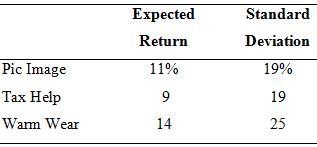
Consider the characteristics of the following three stocks: The correlation between Pic Image and Tax Help is 0.88. The correlation between Pic Image and Warm Wear is -0.21. The correlation between Tax Help and Warm Wear is -0.19. If you can pick only two stocks for your portfolio, which would
If you own 200 shares of Alaska Air at $42.88, 350 shares of Best Buy at $51.32, and 250 shares of Ford Motor at $8.51, what are the portfolio weights of each stock?
If you own 400 shares of Xerox at $17.34, 500 shares of Qwest at $8.15, and 350 shares of Liz Claiborne at $44.73, what are the portfolio weights of each stock?
At the beginning of the month, you owned $5,500 of General Dynamics, $7,500 of Starbucks, and $8,000 of Nike. The monthly returns for General Dynamics, Starbucks, and Nike were 7.44 percent, -1.36 percent, and -0.54 percent. What is your portfolio return?
At the beginning of the month, you owned $6,000 of News Corp, $5,000 of First Data, and $8,500 of Whirlpool. The monthly returns for News Corp, First Data, and Whirlpool were 8.24 percent, -2.59 percent, and 10.13 percent. What’s your portfolio return?
You have a portfolio with an asset allocation of 50 percent stocks, 40 percent long-term Treasury bonds, and 10 percent T-bills. Use these weights and the returns in Table 9.2 to compute the return of the portfolio in the year 2000 and each year since. Then compute the average annual return and
You have a portfolio with an asset allocation of 35 percent stocks, 55 percent long-term Treasury bonds, and 10 percent T-bills. Use these weights and the returns in Table 9.2 to compute the return of the portfolio in the year 2000 and each year since. Then compute the average annual return and
You have $15,000 to invest. You want to purchase shares of Alaska Air at $42.88, Best Buy at $51.32, and Ford Motor at $8.51. How many shares of each company should you purchase so that your portfolio consists of 30 percent Alaska Air, 40 percent Best Buy, and 30 percent Ford Motor? Report only
You have $20,000 to invest. You want to purchase shares of Xerox at $17.34, Qwest at $8.15, and Liz Claiborne at $44.73. How many shares of each company should you purchase so that your portfolio consists of 25 percent Xerox, 40 percent Qwest, and 35 percent Liz Claiborne? Report only whole stock
The following table shows your stock positions at the beginning of the year, the dividends that each stock paid during the year, and the stock prices at the end of the year. What is your portfolio dollar return and percentagereturn?
The table below shows your stock positions at the beginning of the year, the dividends that each stock paid during the year, and the stock prices at the end of the year. What is your portfolio dollar return and percentagereturn?
Consider the following annual returns of Estee Lauder and Lowe€™s Companies:Compute each stock€™s average return, standard deviation, and coefficient of variation. Which stock appears better?Why?
Consider the following annual returns of Molson Coors and International Paper:Compute each stock€™s average return, standard deviation, and coefficient of variation. Which stock appears better?Why?
Following are the monthly returns for October 2007 to March 2013 of three international stock indices; All Ordinaries of Australia, Nikkei 225 of Japan, and FTSE 100 of England.A. Compute and compare each indices' monthly average return and standard deviation.B. Compute the correlation
A corporate bond that you own at the beginning of the year is worth $975. During the year, it pays $35 in interest payments and ends the year valued at $965. What was your dollar return and percent return?
A Treasury bond that you own at the beginning of the year is worth $1,055. During the year, it pays $35 in interest payments and ends the year valued at $1,065. What was your dollar return and percent return?
Rank the following three stocks by their risk-return relationship, best to worst. Rail Haul has an average return of 12 percent and standard deviation of 25 percent. The average return and standard deviation of Idol Staff are 15 percent and 35 percent; and of Poker-R-Us are 9 percent and 20
Rank the following three stocks by their risk-return relationship, best to worst. Night Ryder has an average return of 12 percent and standard deviation of 32 percent. The average return and standard deviation of WholeMart are 11 percent and 25 percent; and of Fruit Fly are 16 percent and 40
Year-to-date, Oracle had earned a -1.34 percent return. During the same time period, Valero Energy earned 7.96 percent and McDonalds earned 0.88 percent. If you have a portfolio made up of 30 percent Oracle, 25 percent Valero Energy, and 45 percent McDonalds, what is your portfolio return?
Year to date, Yum Brands had earned a 3.80 percent return. During the same time period, Raytheon earned 4.26 percent and Coca-Cola earned -0.46 percent. If you have a portfolio made up of 30 percent Yum Brands, 30 percent Raytheon, and 40 percent Coca-Cola, what is your portfolio return?
The past five monthly returns for Kohl’s are 4.11 percent, 3.62 percent, -1.68 percent, 9.25 percent, and -2.56 percent. What is the average monthly return?
Many more types of investments are available besides stocks, bonds, and cash securities. Many people invest in real estate and in precious metals, primarily gold. What are the risk and return characteristics of these investments and do they provide diversification opportunities to the typical
In 2000, the S&P 500 Index earned -9.1 percent while the T-bill yield was 5.9 percent. Does this mean the market risk premium was negative? Explain.
Describe how adding a risk-free security to modern portfolio theory allows investors to do better than the efficient frontier.
Show on a graph like Figure where a stock with a beta of 1.3 would be located on the security market line. Then show where that stock would be located if it is undervalued.
Consider that you have three stocks in your portfolio and wish to add a fourth. You want to know if the fourth stock will make the portfolio riskier or less risky. Compare and contrast how this would be assessed using standard deviation versus market risk (beta) as the measure of risk.
Describe how different allocations between the risk-free security and the market portfolio can achieve any level of market risk desired. Give examples of a portfolio from a person who is very risk averse and a portfolio for someone who is not so averse to taking risk.
Explain how the concept of a positive risk-return relationship breaks down if you can systematically find stocks that are overvalued and undervalued.
Describe a stock market bubble. Can a bubble occur in a single stock?
Compare and contrast the assumptions that need to be made to compute a required return using CAPM and the constant growth rate model.
Consider an asset that provides the same return no matter what economic state occurs. What would be the standard deviation (or risk) of this asset? Explain.
Why is expected return considered “forward-looking”? What are the challenges for practitioners to utilize expected return?
How might the magnitude of the market risk premium impact people’s desire to buy stocks?
Note from Table that some technology-oriented firms (Intel) in the Dow Jones Industrial Average have high market risk while others (AT&T and Verizon) have low market risk. How do you explain this?
Find a beta estimate from three different sources for General Electric (GE). Compare these three values. Why might they be different?
Determine what level of market efficiency each event is consistent with:a. Immediately after an earnings announcement the stock price jumps and then stays at the new level.b. The CEO buys 50,000 shares of his company and the stock price does not change.c. The stock price immediately jumps when a
Why do most investment scams conducted over the Internet and e-mail involve penny stocks instead of S&P 500 Index stocks?
If stock prices are not strong-form efficient, then what might be the price reaction to a firm announcing a stock buyback? Explain.
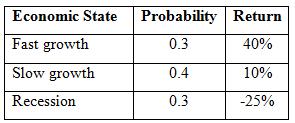
Compute the expected return given these three economic states, their likelihoods, and the potential returns:
Compute the expected return given these three economic states, their likelihoods, and the potential returns:
You own $10,000 of Olympic Steel stock that has a beta of 2.2. You also own $7,000 of Rent-a-Center (beta = 1.5) and $8,000 of Lincoln Educational (beta = 0.5). What is the beta of your portfolio?
You own $7,000 of Human Genome stock that has a beta of 3.5. You also own $8,000 of Frozen Food Express (beta = 1.6) and $10,000 of Molecular Devices (beta = 0.4). What is the beta of your portfolio?
Compute the expected return and standard deviation given these four economic states, their likelihoods, and the potential returns:
Compute the expected return and standard deviation given these four economic states, their likelihoods, and the potential returns:
You own $10,000 of Denny’s Corp stock that has a beta of 2.9. You also own $15,000 of Qwest Communications (beta = 1.5) and $5,000 of Southwest Airlines (beta = 0.7). Assume that the market return will be 11.5 percent and the risk-free rate is 4.5 percent. What is the market risk premium? What
You own $15,000 of Opsware, Inc. stock that has a beta of 3.8. You also own $10,000 of Lowe’s Companies (beta = 1.6) and $10,000 of New York Times (beta = 0.8). Assume that the market return will be 12 percent and the risk-free rate is 6 percent. What is the market risk premium? What is the risk
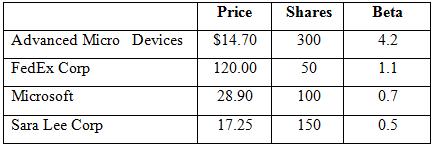
You hold the positions in the following table. What is the beta of your portfolio? If you expect the market to earn 12 percent and the risk-free rate is 3.5 percent, what is the required return of the portfolio?This problem can be solved two different and equivalent ways. Both ways require the
You hold the positions in the following table. What is the beta of your portfolio? If you expect the market to earn 12 percent and the risk-free rate is 3.5 percent, what is the required return of the portfolio?This problem can be solved two different and equivalent ways. Both ways require the
Using the information in the table, compute the required return for each company using both CAPM and the constant growth model. Compare and discuss the results. Assume that the market portfolio will earn 12 percent and the risk-free rate is 3.5 percent.
Using the information in the table, compute the required return for each company using both CAPM and the constant growth model. Compare and discuss the results. Assume that the market portfolio will earn 11 percent and the risk-free rate is 4 percent.
As discussed in the text, beta estimates for one firm will vary depending on various factors like such as the time over which the estimation is conducted, the market portfolio proxy, and the return intervals. You will demonstrate this variation using returns for Microsoft.a. Using all 45 monthly
Paccar’s current stock price is $48.20 and it is likely to pay a $0.80 dividend next year. Since analysts estimate Paccar will have an 8.8 percent growth rate, what is its required return?
Universal Forest’s current stock price is $57.50 and it is likely to pay a $0.26 dividend next year. Since analysts estimate Universal Forest will have a 9.5 percent growth rate, what is its required return?
For the same economic state probability distribution in Problem, determine the standard deviation of the expected return.In Problem, Compute the expected return given these three economic states, their likelihoods, and the potential returns:
For the same economic state probability distribution in Problem, determine the standard deviation of the expected return.In PROBLEM Compute the expected return given these three economic states, their likelihoods, and the potential returns:
A manager believes his firm will earn a 14 percent return next year. His firm has a beta of 1.5, the expected return on the market is 12 percent, and the risk-free rate is 4 percent. Compute the return the firm should earn given its level of risk and determine whether the manager is
A manager believes his firm will earn a 14 percent return next year. His firm has a beta of 1.2, the expected return on the market is 11 percent, and the risk-free rate is 5 percent. Compute the return the firm should earn given its level of risk and determine whether the manager is
Showing 7300 - 7400
of 20267
First
67
68
69
70
71
72
73
74
75
76
77
78
79
80
81
Last
Step by Step Answers

 Get 50% OFF
Claim Now
Get 50% OFF
Claim Now



.png)
.png)
.png)
.png)
.png)
-1.png)
-2.png)
.png)
.png)
.png)
.png)
.png)
.png)
.png)
.png)


