New Semester
Started
Get
50% OFF
Study Help!
--h --m --s
Claim Now
Question Answers
Textbooks
Find textbooks, questions and answers
Oops, something went wrong!
Change your search query and then try again
S
Books
FREE
Study Help
Expert Questions
Accounting
General Management
Mathematics
Finance
Organizational Behaviour
Law
Physics
Operating System
Management Leadership
Sociology
Programming
Marketing
Database
Computer Network
Economics
Textbooks Solutions
Accounting
Managerial Accounting
Management Leadership
Cost Accounting
Statistics
Business Law
Corporate Finance
Finance
Economics
Auditing
Tutors
Online Tutors
Find a Tutor
Hire a Tutor
Become a Tutor
AI Tutor
AI Study Planner
NEW
Sell Books
Search
Search
Sign In
Register
study help
business
marketing
Marketing Channels 8th edition Rosenbloom - Solutions
What is the difference between channel strategy and logistics management?
Identify the various flows in marketing channelsand the direction of the flows. Why is the concept of channel flows useful for a better understanding of channel management?
ROCKAUTO.COM is a leading online auto parts store that prides itself for offering a huge selection of auto parts, everyday low prices, fast shipping, and an easy-to-use Web site. Some ROCKAUTO.COM advertisements have even claimed that this online auto parts store is “head and shoulders” above
The TV reporter for a network news show is walking through a cornfield with a downtrodden-looking farmer in Iowa. As they continue through the field, the farmer comments: “My family and I have worked real hard over the years to produce a good crop, but we hardly get much of a price for it. But
Growth in online retail sales has been outstripping conventional sales in retail stores. This online sales growth might be enhanced significantly by the latest online sales phenomenon of mobile commerce—shopping via mobile smart phones such as Apple’s iPhone, Research in Motion’s Blackberry,
The dramatic growth in online sales in recent years has led many pundits to predict that mail order channels driven by paper catalogs would virtually disappear. But this has not happened. By the close of the first decade of the Twenty First Century, over 17 billion catalogs were mailed to U.S.
One of the major themes presented in this chapter is the need for choice as to how products and services are made available to customers. Thus, multi-channel strategies that provide a wide range of channels including an Internet based online channel option have become imperative. Yet there are very
Susan Jensen, a marketing manager for a major consumer package goods manufacturer, is very upset with the sales results of the new oat bran cookies her company introduced three months ago. She believes that an important factor in the lackluster sales results is that too many super markets across
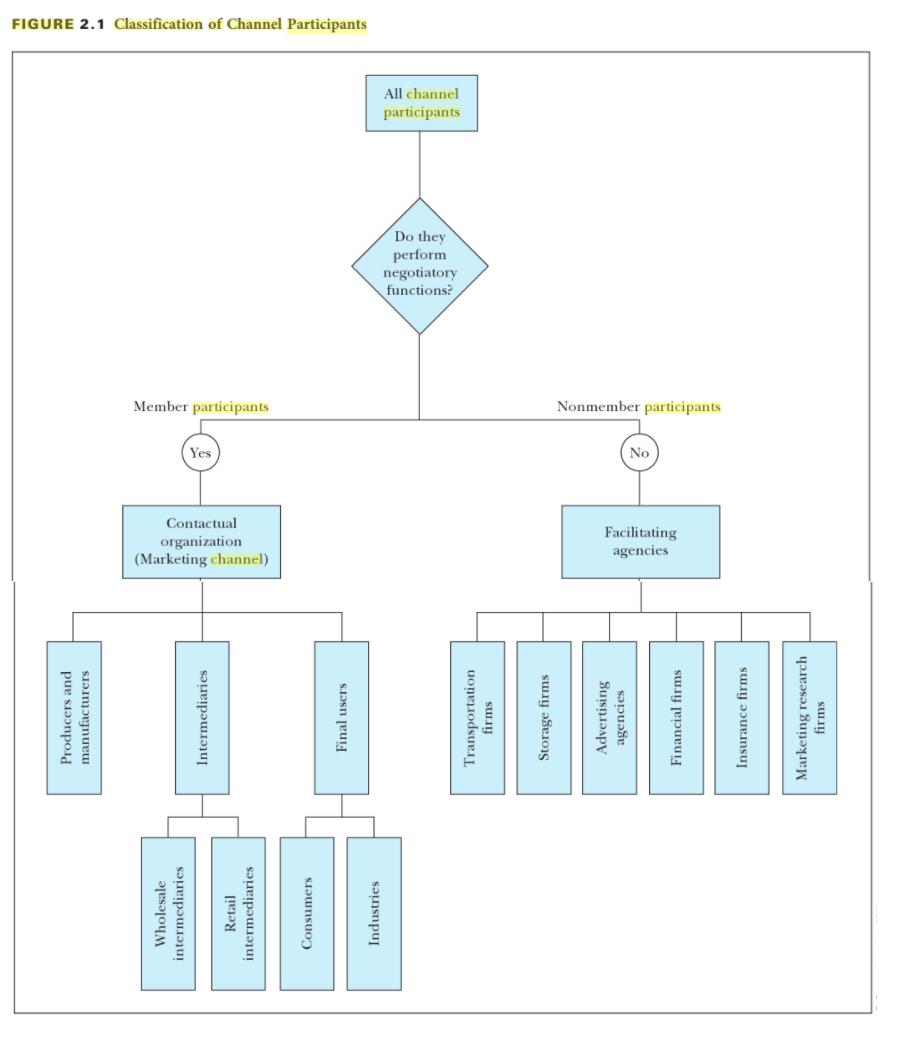
Explain the classification scheme of the channel participants shown in Figure 2.1.
Describe the distribution tasks that retailers are especially well suited for performing.
Discuss retailers’ growing power in the marketing channel in terms of the possible implications for channel management.
Identify and discuss several types of facilitating agencies and the role they play in channels of distribution.
Expertise and economies of scale in production do not necessarily translate into expertise and economies of scale and/or scope in distribution. Discuss this statement.
Why do you suppose the average costs of performing many distribution tasks are lower for intermediaries and facilitating agencies than for producers and manufacturers?
How does the Census of Wholesale Trade classify wholesale intermediaries?
Contrary to some predictions, wholesalers have not died out. What has happened to wholesalers in recent years?
Discuss the basic trends over the past 30 years with regard to total wholesale sales for (a) Merchant wholesalers; (b) Manufacturers’ sales branches and offices and (c) Agents, brokers and commission merchants.
Describe the distribution tasks that wholesalers are especially well suited for performing.
The average size of retail units (as measured by sales volume) has been increasing. What are some of the implications of this trend for channel management in producing and manufacturing firms?
What patterns seem to be emerging with respect to online retail sales vs. conventional retail sales since the first couple of years of the twenty-first century?
Wrigley is the world’s leading manufacturer of chewing gum, producing literally millions of packages of gum every day. It is a large, financially strong company whose manufacturing technology for producing gum is state-of-the-art. It sells its products to millions of gum-chewing consumers all
The Census of Wholesale Trade and the Census of Retail Trade are published every five years by the Department of Commerce. The most recent census was taken in 2002 and the one before that was in 1997. However, the actual findings from the census are not made available until two and one-half to
W. W. Grainger, headquartered in Skokie, Ill., is one of the nation’s largest wholesalers, with more than 600 branch locations. The company sells mainly industrial products such as electric motors, fans, blowers, air compressors, power transmission equipment along with thousands of different
Web fulfillment companies may start a new trend in online retailing. These firms allow conventional retailers to operate their online divisions without the expense and hassle of developing and running their own e-commerce operations. GSI Commerce, for example, handles Web site design, order
Best Buy is by far the largest consumer electronics retailer in the world with sales of over $45 billion and almost 4,000 stores world wide. Best Buy enjoys tremendous power in the marketing channels within which it operates. All manufacturers and other suppliers providing products to Best Buy have
Jacobson Companies, headquartered in Des Moines, Iowa, describes itself on its Web site as a “can do” third party logistics company. The company is indicative of the new breed of logistics services firms that can do it all. If a company, whether a manufacturer, wholesaler, retailer or other
How does the impact of the environment on channel strategy differ from other major strategy areas of the marketing mix?
What is the underlying philosophy of the Sherman Act with respect to the role of competition versus monopoly in promoting public welfare? Discuss.
Discuss the basic provisions of the (1) Sherman Antitrust Act; (2) Clayton Act; (3) Federal Trade Commission Act; (4) Robinson-Patman Act and (5) Celler-Kefauver Act.
Exclusive dealing, full-line forcing and tying agreements all have something in common. What is it? Discuss the antitrust implications of this common element.
Price maintenance, refusal to deal and resale restrictions all represent attempts by the supplier to exercise control over its channel members. What are the legal limits on the degree of control the supplier can exercise through these three approaches?
Discuss the basic legal implications associated with the policies of dual distribution, price discrimination and vertical integration through acquisitions and mergers.
In dealing with the effects of environment on channel strategy, the channel manager has a lot more to think about. Discuss this statement.
Discuss the fundamental channel management issues associated with recessionary, inflationary and deflationary periods in the economy.
Why might even “normal” economic conditions pose channel management problems?
Explain the four types of competition discussed in the chapter. Why is it important to recognize these different forms of competition?
Marketing channels reflect the sociocultural environments within which they exist. Explain this statement.
Discuss several major sociocultural forces that have emerged in recent years and how they have already affected marketing channel strategy and management and how they might do so in the future.
Technological changes, though continual, do not occur evenly or predictably over time. Discuss the implications of this statement for channel management strategy.
Discuss the channel management implications of such technological developments as electronic scanners, high-tech point-of-sale displays, computerized inventory management systems, EDI, the digital revolution, smartphones, RFID and cloud computing.
James Johnson, vice president of marketing for a major manufacturer of fiberglass home insulation aimed at the DIY market, was elated after reading an article in The Wall Street Journal about the recent steep rise in energy prices. “This will be great for us. Our sales could double next
Almost 80 percent of chief financial officers at the 100 largest retailers say that too much in ventory is the greatest risk factor to the viability of their businesses during recessionary periods. High inventories lead to heavy discounting when consumer demand is lacking. This, in turn, undermines
Home Depot, Toys “R” Us, Staples, Best Buy and many other giant retailers (often referred to as “category killers” or “big box” retailers because of their dominance in particular merchandise categories and the sheer physical size of the stores) are fierce competitors and are frequently
When Circuit City, the world’s second largest consumer electronics retailer went out of business in January of 2009, pundits thought most of Circuit City’s business would be picked up by the largest consumer electronics retailer, Best Buy, as well as Walmart, which also sells a great deal of
By 2009, social media services, such as Facebook and Twitter, had become a popular marketing tool for small businesses. In fact, almost 25 percent of firms with fewer than 100 employees were using social media for marketing purposes. This was more than double the percentage of the prior year. Many
Channels of distribution for books have gone through a metamorphosis in recent years with the emergence of e-books, such as Amazon’s Kindle, Barnes & Noble’s Nook, or Apple’s iPad. Indeed, by mid-2010, Amazon.com reported that sales of books through its Kindle outnumbered its sales of
In mid-2009, a class action lawsuit was launched against Babies “R” Us, a division of Toys “R” Us, as well as five manufacturers from whom Babies “R” Us purchased baby products for resale in its stores. The suit alleges that Babies “R” Us and the supplying manufacturers conspired to
A purely economic model of the marketing channel is inadequate. Explain.
Why is it necessary to use power in the development and management of the channel?
What are the bases of power in the marketing channel? Is it possible to rank these bases according to their degree of effectiveness in influencing the behavior of another channel member before examining the particular set of circumstances or context of the influence attempt as it takes place in the
How would a channel manager know which power bases are available?
Summarize what is known about the use of power in the marketing channel.
How can the channel manager use the concept of role to develop a more effective and efficient channel?
Discuss some of the behavioral problems that can “foul up” effective communications in the marketing channel.
Why does the channel manager need a familiar-ity with some of the behavioral processes occurring in the channel?
Discuss the distinction between conflict andcompetition in the marketing channel.
What are some of the underlying causes of conflict? Are these causes usually obvious? Are issues over which conflict may develop the same as the underlying causes?
Could more than one cause be associated with the development of conflict in the marketing channel?
Are the effects of conflict necessarily detrimental to channel efficiency? Explain.
How might conflict be a good thing in the mar- keting channel? Explain.
Discuss some of the means available to the channel manager for detecting channel conflict. Do you think they would be practical to use in the real world?
Discuss some of the approaches that the channel manager may use in attempting to manage conflict. Do all of these approaches share a common theme?
Soon after the “Great Recession” of 2007–2008, food manufacturers and supermarkets got in to what many industry observers describe as a pricing war. The supermarkets were upset because food manufacturers had been increasing price-sensitive consumers hurt by the recession. But the food
Bill Schwartz, the owner of Newvalue Supply, a medium-sized wholesaler of plumbing supplies, was furious. He had just gotten off the phone with the sales manager of Jefferson Industries, the manufacturer of a very profitable line of high-quality faucets that Newvalue had been selling for several
Amoco, one of the nation’s largest oil companies, has been forcing a number of its independent service stations to convert from full-service stations offering repair service to convenience stores or “gas only” stations. Thus the highly profitable repair part of the business will no longer be
“This is really out of bounds,” remarked Lisa Johnston, the buyer of athletic footwear for alarge chain of sporting goods stores. Ms. Johnston was referring to a new policy by Nike, the famous athletic shoe manufacturer, that required retailers o place their orders six months in advance of
In the summer of 2009, Walmart, the world’s largest retailer, left no doubt about its enormous power in the marketing channel. Walmart announced to all manufacturers whose products it sells that they must adhere to Walmart’s new “green” environmental initiative. The manufac- turers must
As part of the U.S. government-initiated and supervised bankruptcy reorganization of Chrysler Corp., almost 800 Chrysler dealerships were terminated. Many of those dealers felt that the forced closings by Chrysler of their businesses was grossly unfair and wanted to contest the closing either
UPS Stores operate “pack and ship” stores on a franchise basis granted by the franchisor, UPS Inc. The stores not only provide pack and ship services but offer a variety of other products and services such as office supplies, copying, and notary services. The stores are also required by the
How does channel strategy relate to marketing strategy?
Discuss the key strategic questions the channel manager faces when managing the marketing channel.
Discuss the portfolio concept as it applies to the motivation of channel members.
What is meant by “using the marketing mix” to gain the cooperation of channel members in implementing the manufacturer’s channel strategy?
Discuss the underlying theme involved in channel strategy as it relates to the evaluation of channel member performances.
Delineate and comment briefly on the six basic distribution decisions most firms will need to consider at one time or another.
Can a manufacturer automatically decide that distribution is of vital importance to the firm and should be an integral part of its strategic plan?
Should a firm automatically dismiss distribution in formulating its long term corporate objectives and strategies?
Where does channel strategy “fit” into the marketing mix?
What clues should the channel manager look for in deciding how much emphasis to place on distribution as a key strategic variable in the marketing mix?
Explain the concept of synergy as it might apply to marketing channel strategy.
Discuss the concept of differential advantage as it relates to channel design strategy.
How does channel positioning relate to channel design and in turn to differential advantage via channel design?
Although online sales channels have enjoyed tremendous growth over the past decade, a strategic disadvantage which could limit future growth potential is that of immediacy. For physical products ordered online, consumers do not have the same experience of taking the product with them immediately
Oakley Inc., based in Foothill Ranch, California, is best known as a manufacturer of high-end, avant-garde sunglasses, which it sells to the tune of over $300 million per year. It is also the company that donated sunglasses to all the miners rescued in the Chile mine disaster of 2010. About one
Milwaukee is a famous name in industrial quality power tools. Its products are renowned for their rugged design and reliability. Most of its products are sold through wholesalers (industrial distributors) to a wide variety of power tool users including factories, contractors, mechanics, schools,
Lincoln automobiles, the luxury car division of the Ford Motor Company has fallen on hard times in recent years. Over the decade from 2000 to 2010, Lincoln fell from the top-selling luxury brand in the U.S. all the way down to number eight. Further many consumers who buy luxury cars such as Lexus,
Nespresso, a division of Nestle’s SA, pioneered the development of the single serving coffee ma chine in 1986. By 2009, Nespresso had achieved sales of over $2.6 billion with double-digit growth projected for the next several years. The machines which have been imitated by more than twenty
For many years, Procter & Gamble, as well as the Mother giant consumer packaged goods manufacturers, used special deals and merchandising campaigns as the mainstay of their channel management strategy for dealing with channel members. Special discounts, allowances, slotting fees, coupons,
The grocery business is one of the most competitive of all businesses, especially when it comes to getting a new product from a small manufacturer onto supermarket shelves. The typical supermarket carries about 30,000 different items, but some 15,000 new products are introduced each year. There is
Movie studios are in something of a dilemma lately when it comes to planning their future channel strategy for distribution of their films. Electronic distribution is very profitable because, of the typical $4.99 cable companies charge consumers to rent a movie. The studios get to keep about 70
Discuss the meaning of channel design in relation to such concepts as channel structure, selection, evolution of channels, and the allocation of distribution tasks.
Discuss the difficulties involved in attempting to choose an optimal channel structure.
Compare and contrast the so-called judgmental heuristic approach to choosing a channel structure with any of the other approaches discussed in the chapter.
Discuss the role of channel design in the quest to gain differential advantage.
In this chapter we discussed a number of conditions that may foster the need for channel design decisions. Name some others.
What is a distribution objective? What does it mean when we say that distribution objectives should be coordinated with other objectives and strategies of the firm?
Give an example of an incongruent distribution objective.
How do distribution tasks viewed from the perspective of the channel manager in a producing or manufacturing firm differ from the traditional lists of marketing functions?
Briefly describe the major categories of variables that should be considered when evaluating alternative channel structures.
Discuss the three dimensions of channel structure that should be considered in developing alternative channel structures.
Showing 3100 - 3200
of 13098
First
25
26
27
28
29
30
31
32
33
34
35
36
37
38
39
Last
Step by Step Answers

 Get 50% OFF
Claim Now
Get 50% OFF
Claim Now