







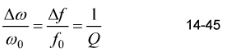
Question: In this problem, you are to use the result of Problem 129 to derive Equation 14-45, which relates the width of the resonance curve to
In this problem, you are to use the result of Problem 129 to derive Equation 14-45, which relates the width of the resonance curve to the Q value when the resonance is sharp. At resonance, the denominator of the fraction in brackets in Equation 14-51 is b2ώ02 and Pav has its maximum value. For a sharp resonance, the variation in w in the numerator in Equation 14-51 can be neglected. Then the power input will be half its maximum value at the values of w, for which the denominator is 2b2 ώ02.
(a) Show that w then satisfies.

(b) Using the approximation ώ + ώ0 ≈ 2ώ0, show that
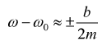
(c) Express b in terms of Q.
(d) Combine the results of (b) and (c) to show that there are two values of w for which the power input is half that at resonance and that they are given by
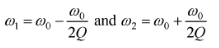
Therefore, ώ2 – ώ1 = ∆ώ = ώ0/Q, which is equivalent to Equation 14-45.
f 14-45 fo ) -1
Step by Step Solution
3.31 Rating (160 Votes )
There are 3 Steps involved in it
a Set m 2 0 2 w 2 2 b 2 2 2 b 2 0 2 So m 2 0 2 2 2 b 2 0 2 If The resonance is sharp Note ... View full answer

Get step-by-step solutions from verified subject matter experts
Document Format (1 attachment)

10-P-O-O-W (329).docx
120 KBs Word File
 Study Help