New Semester
Started
Get
50% OFF
Study Help!
--h --m --s
Claim Now
Question Answers
Textbooks
Find textbooks, questions and answers
Oops, something went wrong!
Change your search query and then try again
S
Books
FREE
Study Help
Expert Questions
Accounting
General Management
Mathematics
Finance
Organizational Behaviour
Law
Physics
Operating System
Management Leadership
Sociology
Programming
Marketing
Database
Computer Network
Economics
Textbooks Solutions
Accounting
Managerial Accounting
Management Leadership
Cost Accounting
Statistics
Business Law
Corporate Finance
Finance
Economics
Auditing
Tutors
Online Tutors
Find a Tutor
Hire a Tutor
Become a Tutor
AI Tutor
AI Study Planner
NEW
Sell Books
Search
Search
Sign In
Register
study help
physics
modern physics
Fundamentals of Ethics for Scientists and Engineers 1st Edition Edmund G. Seebauer, Robert L. Barry - Solutions
Test the following decays for violation of the conservation of energy, electric charge, baryon number, and lepton number:(a) n → π+ + π– +μ+ + μ–(b) π0 → e+ + e– + γ. Assume that linear and angular momentum are conserved. State which conservation laws (if any) are violated in each
Are there any quark–antiquark combinations that result in a nonintegral electric charge?
Find the baryon number, charge, and strangeness for the following quark combinations and identify the hadron:(a) uud,(b) udd,(c) uus,(d) dds,(e) uss, and(f) dss.
Repeat Problem 17 for the following quark combinations:(a) ud,(b) ud,(c) us, and(d) us.
The Δ++ particle is a baryon that decays via the strong interaction. Its strangeness, charm, topness, and bottomness are all zero. What combination of quarks gives a particle with these properties?
Find a possible combination of quarks that gives the correct values for electric charge, baryon number, and strangeness for(a) K + and(b) K 0.
The D + meson has no strangeness, but it has charm of +1.(a) What is a possible quark combination that will give the correct properties for this particle?(b) Repeat (a) for the D – meson, which is the antiparticle of the D +.
Find a possible combination of quarks that gives the correct values for electric charge, baryon number, and strangeness for(a) K – (the K – is the antiparticle of the K +) and(b) K 0.
Find a possible quark combination for the following particles:(a) Λ0,(b) p – , and(c) ∑–.
Find a possible quark combination for the following particles:(a) n ,(b) (0, and(c) ∑+.
Find a possible quark combination for the following particles:(a) Ω– and(b) (–.
State the properties of the particles made up of the following quarks:(a) ddd,(b) uc,(c) ub, and(d) sss.
(a) What conditions are necessary for a particle and its antiparticle to be the same? Find the antiparticle for(b) π 0 and(c) Ξ0.
Consider the following decay chain:ΞX0 → Λ0 + π 0Λ0 → p + π –π0 → γ + γπ – → μ – + vμμ – → e – + v e + vμ(a) Are all the final products shown stable? If not, finish the decay chain.(b) Write the overall decay reaction for Ξ0 to
Test the following decays for violation of the conservation of energy, electric charge, baryon number, and lepton number:(a) Λ0 → p + π–,(b) ∑– → n + p –,(c) μ– → e – + ve + vμ.Assume that linear and angular momentum are conserved. State which conservation laws (if
(a) Calculate the total kinetic energy of the decay products for the decay Λ0 → p + π–. Assume the Λ0 is initially at rest.(b) Find the ratio of the kinetic energy of the pion to the kinetic energy of the proton.(c) Find the kinetic energies of the proton and the pion for this decay.
A ∑0 particle at rest decays into a Λ0 plus a photon.(a) What is the total energy of the decay products?(b) Assuming that the kinetic energy of the Λ0 is negligible compared with the energy of the photon, calculate the approximate momentum of the photon.(c) Use your result for (b) to calculate
Determine the change in strangeness for each decay, and state whether the decay can proceed via the strong interaction, the weak interaction, or not at all:(a) Ω– → Λ0 + v e + e – and(b) ∑+ → p + π0.
1. When light of wavelength λ1 is incident on a certain photoelectric cathode, no electrons are emitted no matter how intense the incident light is. Yet when light of wavelength λ2 < λ1 is incident, electrons are emitted even when the incident light has low intensity. Explain.2. The distance
An electron is moving at v = 2.5 × 10⁵ m/s. Find its de Broglie wavelength.
What is the kinetic energy of a proton whose de Broglie wavelength is(a) 1 nm, and(b) 1 fm?
1. A six-sided die has the number 1 painted on three sides and the number 2 painted on the other three sides.(a) What is the probability of a 1 coming up when the die is thrown?(b) What is the expectation value of the number that comes up when the die is thrown?2. Can the expectation value of x
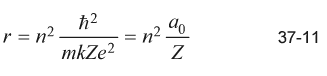
Use the known values of the constants in Equation 37-11 to show that a0 is approximately 0.0529nm.
The longest wavelength of the Lyman series was calculated in Example 37-2. Find the wavelengths for the transitions(a) n1 = 3 to n2 = 1 and(b) n1 = 4 to n2 = 1.
Find the photon energy for the three longest wavelengths in the Balmer series and calculate the wavelengths.
(a) Find the photon energy and wavelength for the series limit (shortest wavelength) in the Paschen series (n2 = 3).(b) Calculate the wavelengths for the three longest wavelengths in this series and indicate their positions on a horizontal linear scale.
Repeat Problem 10 for the Brackett series (n2 = 4).
A hydrogen atom is in its tenth excited state according to the Bohr model (n = 11).(a) What is the radius of the Bohr orbit?(b) What is the angular momentum of the electron?(c) What is the electron’s kinetic energy?(d) What is the electron’s potential energy?(e) What is the electron’s total
The binding energy of an electron is the minimum energy required to remove the electron from its ground state to a large distance from the nucleus.(a) What is the binding energy for the hydrogen atom?(b) What is the binding energy for He+?(c) What is the binding energy for Li2+? [Singly ionized
The electron of a hydrogen atom is in the n = 2 state. The electron makes a transition to the ground state.(a) What is the energy of the photon according to the Bohr model?(b) The linear momentum of the emitted photon is related to its energy by p = E/c. If we assume conservation of linear
Show that the speed of an electron in the nth Bohr orbit of hydrogen is given byvn = e2/2є0hn.
In this problem you will estimate the radius and the energy of the lowest stationary state of the hydrogen atom using the uncertainty principle. The total energy of the electron of momentum p and mass m a distance r from the proton in the hydrogen atom is given by E =
In a reference frame with the origin at the center of mass of an electron and the nucleus of an atom, the electron and nucleus have equal and opposite momenta of magnitude p.(a) Show that the total kinetic energy of the electron and nucleus can be written K = p2/2mr, where mr = meM/(M + me) is
For ℓ = 1, find(a) The magnitude of the angular momentum L and(b) The possible values of m.(c) Draw to scale a vector diagram showing the possible orientations of L with the z axis.
Work Problem 20 for ℓ = 3.
A compact disk has a moment of inertia of about 2.3 × 10⁻⁵ kg · m2.(a) Find its angular momentum L when it is rotating at 500 rev/min.(b) Find the approximate value of the quantum number ℓ for this angular momentum.
If n = 3,(a) What are the possible values of ℓ?(b) For each value of ℓ in (a), list the possible values of m.(c) Using the fact that there are two quantum states for each value of ℓ and m because of electron spin, find the total number of electron states with n = 3.
Find the total number of electron states with(a) n = 2 and(b) n = 4.
Find the minimum value of the angle θ between L and the z axis for(a) ℓ = 1,(b) ℓ = 4, and(c) ℓ = 50.
What are the possible values of n and m if(a) ℓ = 3,(b) ℓ = 4, and(c) ℓ = 0?
What are the possible values of n and ℓ if(a) m = 0,(b) m = -1, and(c) m = 2?
For the ground state of the hydrogen atom, find the values of(a) ψ,(b) ψ2, and(c) The radial probability density P(r) at r = a0. Give your answers in terms of a0.
(a) If spin is not included, how many different wave functions are there corresponding to the first excited energy level n = 2 for hydrogen?(b) List these functions by giving the quantum numbers for each state.
For the ground state of the hydrogen atom, find the probability of finding the electron in the range Δr = 0.03a0 at(a) r = a0 and(b) r = 2a0.
The value of the constant C2,0,0 in Equation 37-36 isFind the values of(a) ψ,(b) ψ2, and(c) The radial probability density P(r) at r = a0 for the state n = 2, ℓ = 0, m = 0 in hydrogen. Give your answers in terms of a0.
Show that the radial probability density for the n = 2, ℓ = 1, m = 0 state of a one-electron atom can be written as P(r) = A cos2 θr4e–Zr/ a0, where A is a constant.
Calculate the probability of finding the electron in the range Δr = 0.02a0 at(a) r = a0 and(b) r = 2a0 for the state n = 2, ℓ = 0, m = 0 in hydrogen.
The radial probability distribution function for a one-electron atom in its ground state can be written P(r) = Cr2e–2Zr/a0 , where C is a constant. Show that P(r) has its maximum value at r = a0/Z.
Find the expectation value of r, <r> = ∫∞0 rP(r) dr for hydrogen in its ground state.
Show that the number of states in the hydrogen atom for a given n is 2n2.
Calculate the probability that the electron in the ground state of a hydrogen atom is in the region 0 < r < a0.
The potential energy of a magnetic moment in an external magnetic field is given by U = –μ · B.(a) Calculate the difference in energy between the two possible orientations of an electron in a magnetic field B = 0.600 T k.(b) If these electrons are bombarded with photons of energy equal to this
Why is the energy of the 3s state considerably lower than that of the 3p state for sodium, whereas in hydrogen these states have essentially the same energy?
Discuss the evidence from the periodic table of the need for a fourth quantum number. How would the properties of He differ if there were only three quantum numbers, n, ℓ, and m?
The properties of iron (Z = 26) and cobalt (Z = 27), which have adjacent atomic numbers, are similar, whereas the properties of neon (Z = 10) and sodium (Z = 11), which also have adjacent atomic numbers, are very different. Explain why.
Separate the following six elements—potassium, calcium, titanium, chromium, manganese, and copper—into two groups of three each such that those in a group have similar properties.
What element has the electron configuration:(a) 1s22s22p63s23p2 and(b) 1s22s22p63s23p64s2?
Write the electron configuration of(a) Carbon and(b) Oxygen.
Write the electron configuration of(a) Aluminum and(b) Chromium.
Give the possible values of the z component of the orbital angular momentum of(a) A d electron and(b) An f electron.
If the outer electron in sodium moves in the n = 3 Bohr orbit, the effective nuclear charge would be Z’e = 1e, and the energy of the electron would be –13.6 eV/32 = –1.51 eV. However, the ionization energy of sodium is 5.14 eV, not 1.51 eV. Use this fact and Equation 37-45 to
The optical spectra of atoms with two electrons in the same outer shell are similar, but they are quite different from the spectra of atoms with just one outer electron because of the interaction of the two electrons. Separate the following elements into two groups such that those in each group
Write down the possible electron configurations for the first excited state of(a) Hydrogen,(b) Sodium,(c) Helium.
Indicate which of the following elements should have optical spectra similar to hydrogen and which should be similar to helium: Li, Ca, Ti, Rb, Hg, Ag, Cd, Ba, Fr, Ra.
(a) Calculate the next two longest wavelengths in the K series (after the Kα line) of molybdenum.(b) What is the wavelength of the shortest wavelength in this series?
The wavelength of the Kα line for a certain element is 0.3368 nm. What is the element?
The wavelength of the Kα line for a certain element is 0.0794 nm. What is the element?
Calculate the wavelength of the Ka line of rhodium.
Calculate the wavelength of the Ka line in(a) Magnesium (Z = 12)(b) Copper (Z = 29).
The Bohr theory and the Schrödinger theory of the hydrogen atom give the same results for the energy levels. Discuss the advantages and disadvantages of each model.
In Figure, there are small dips in the ionization-energy curve at Z = 31 (gallium) and Z = 49 (indium) that are not labeled. Explain these dips using the electron configurations of these atoms given in Table 37-1.
The wavelength of a spectral line of hydrogen is 97.254 nm. Identify the transition that results in this line.
The wavelength of a spectral line of hydrogen is 1093.8 nm. Identify the transition that results in this line.
Spectral lines of the following wavelengths are emitted by singly ionized helium: 164 nm, 230.6 nm, and 541 nm. Identify the transitions that result in these spectral lines.
We are often interested in finding the quantity ke2/r in electron volts when r is given in nanometers. Show that ke2 = 1.44 eV · nm.
The wavelengths of the photons emitted by potassium corresponding to transitions from the 4P3/2 and 4P1/2 states to the ground state are 766.41 nm and 769.90 nm. (a) Calculate the energies of these photons in electron volts.(b) The difference in the energies of these photons equals the difference
To observe the characteristic K lines of the X-ray spectrum, One of the n = 1 electrons must be ejected from the atom. This is generally accomplished by bombarding the target material with electrons of sufficient energy to eject this tightly bound electron. What is the minimum energy required to
The combination of physical constants α = e2k/hc, where k is the Coulomb constant, is known as the fine-structure constant. It appears in numerous relations in atomic physics.(a) Show that α is dimensionless.(b) Show that in the Bohr model of hydrogen vn = cα/n, where vn is the speed of the
The positron is a particle identical to the electron except that it carries a positive charge of e. Positronium is the bound state of an electron and positron.(a) Calculate the energies of the five lowest energy states of positronium using the reduced mass as given by Equation 37-47 in Problem
The deuteron, the nucleus of deuterium (“heavy hydrogen”), was first recognized from the spectrum of hydrogen. The deuteron has a mass twice that of the proton.(a) Calculate the Rydberg constant for hydrogen and for deuterium using the reduced mass as given by Equation 37-47 in Problem 17.(b)
The muonium atom is a hydrogen atom with the electron replaced by a μ – particle. The μ – is identical to an electron but has a mass 207 times as great as the electron.(a) Calculate the energies of the five lowest energy levels of muonium using the reduced mass as given by
The triton, a nucleus consisting of a proton and two neutrons, is unstable with a fairly long half-life of about 12 years. Tritium is the bound state of and electron and a triton.(a) Calculate the Rydberg constant of tritium using the reduced mass as given by Equation 37-47 in Problem 17.(b) Using
Suppose that the interaction between an electron and proton were of the form F = –Kr, where K is a constant, rather than 1/r2. If the stationary state orbits are again limited by the angular momentum condition L = nh, what are then the radii of these orbits? Show that for this case the
The frequency of revolution of an electron in a circular orbit of radius r is frev = v/2Ï€r, where v is the speed.(a) Show that in the nth stationary state(b) Show that when n1 = n, n2 = n – 1, and n is much greater than 1,(c) Use your result in part (b) and Equation 37-13 to show that in this
(Multiple choice)(1)The energy of the ground state of doubly ionized lithium (Z = 3) is ______, where E0 = 13.6 eV.(a) –9E0,(b) –3E0,(c) –E0/3,(d) –E0/9.(2)Bohr’s quantum condition on electron orbits requires(a) That the angular momentum of the electron about the hydrogen nucleus equal
1. As n increases, does the spacing of adjacent energy levels increase or decrease?2. If an electron moves to a larger orbit, does its total energy increase or decrease? Does its kinetic energy increase or decrease?3. The total angular momentum of a hydrogen atom in a certain excited state has the
1. The total angular momentum of a hydrogen atom in a certain excited state has the quantum number j = 1½. What can you say about the orbital angular-momentum quantum number ℓ?2. A hydrogen atom is in the state n = 3, ℓ = 2. What are the possible values of j?
1. For the principal quantum number n = 3, what are the possible values of the quantum numbers ℓ and m?2. What is the energy of the shortest wavelength photon emitted by the hydrogen atom?
The proper mean lifetime of pions is 2.6 10-8 s. If a beam of pions has a speed of 0.85c,(a) What would their mean lifetime be as measured in the laboratory?(b) How far would they travel, on average, before they decay?(c) What would your answer be to part (b) if you neglect time dilation?
(a) In the reference frame of the pion in Problem 2, how far does the laboratory travel in a typical lifetime of 2.6 × 10⁻⁸ s?(b) What is this distance in the laboratory’s frame?
The proper mean lifetime of a muon is 2 μs. Muons in a beam are traveling at 0.999c.(a) What is their mean lifetime as measured in the laboratory?(b) How far do they travel, on average, before they decay?
(a) In the reference frame of the muon in Problem 4, how far does the laboratory travel in a typical lifetime of 2 μs?(b) What is this distance in the laboratory’s frame?
Jay has been posted to a remote region of space to monitor traffic. Toward the end of a quiet shift, a spacecraft goes by, and he measures its length using a laser device, which reports a length of 85 m. He flips open his handy reference catalogue and identifies the craft as a CCCNX-22, which has a
A spaceship travels to a star 95 light-years away at a speed of 2.2 × 10⁸ m/s. How long does it take to get there,(a) As measured on earth and(b) As measured by a passenger on the spaceship?
The mean lifetime of a pion traveling at high speed is measured to be 7.5 × 10⁻⁸ s. Its lifetime when measured at rest is 2.6 × 10⁻⁸ s. How fast is the pion traveling?
A meterstick moves with speed V = 0.8c relative to you in the direction parallel to the stick.(a) Find the length of the stick as measured by you.(b) How long does it take for the stick to pass you?
The half-life of charged pions, π+ and π– s, is 1.8 × 10⁻⁸ s; i.e., in the rest frame of the pions if there are N pions at time t = 0, there will only be N/2 pions at time t = 1.8 × 10⁻⁸ s. Pions are produced in an accelerator and emerge with a speed of 0.998c. How far do
A friend of yours who is the same age as you travels to the star Alpha Centauri, which is 4 light-years away and returns immediately. He claims that the entire trip took just 6 y. How fast did he travel?
Two spaceships pass each other traveling in opposite directions. A passenger in ship A, which she knows to be 100 m long, notes that ship B is moving with a speed of 0.92c relative to A and that the length of B is 36 m. What are the lengths of the two spaceships as measured by a passenger in ship B?
In the Stanford linear collider, small bundles of electrons and positrons are fired at each other. In the laboratory’s frame of reference, each bundle is about 1 cm long and 10 μm in diameter. In the collision region, each particle has an energy of 50 GeV, and the electrons and positrons are
Showing 2000 - 2100
of 8241
First
14
15
16
17
18
19
20
21
22
23
24
25
26
27
28
Last
Step by Step Answers

 Get 50% OFF
Claim Now
Get 50% OFF
Claim Now


.png)
.png)

.png)
.png)
.png)
.png)
.png)
.png)
-1.png)
-2.png)



