New Semester
Started
Get
50% OFF
Study Help!
--h --m --s
Claim Now
Question Answers
Textbooks
Find textbooks, questions and answers
Oops, something went wrong!
Change your search query and then try again
S
Books
FREE
Study Help
Expert Questions
Accounting
General Management
Mathematics
Finance
Organizational Behaviour
Law
Physics
Operating System
Management Leadership
Sociology
Programming
Marketing
Database
Computer Network
Economics
Textbooks Solutions
Accounting
Managerial Accounting
Management Leadership
Cost Accounting
Statistics
Business Law
Corporate Finance
Finance
Economics
Auditing
Tutors
Online Tutors
Find a Tutor
Hire a Tutor
Become a Tutor
AI Tutor
AI Study Planner
NEW
Sell Books
Search
Search
Sign In
Register
study help
physics
modern physics
Fundamentals of Ethics for Scientists and Engineers 1st Edition Edmund G. Seebauer, Robert L. Barry - Solutions
Use the binomial expansion(1 + x)n = 1 + nx + n(n -1)x2/2 + . . . ≈ 1 + nxTo derive the following results for the case when V is much less than c, and use the results when applicable in the followingproblems:
Show that when V << c the transformation equations for x, t, and u reduce to the Galilean equations.
Supersonic jets achieve maximum speeds of about (3 × 10⁻⁶)c.(a) By what percentage would you see a jet traveling at this speed contracted in length?(b) During a time of 1 y = 3.15 × 10⁷ s on your clock, how much time would elapse on the pilot’s clock? How many minutes are lost by the pilot’s
How great must the relative speed of two observers be for the time-interval measurements to differ by 1%? (See Problem 14.)
A spaceship of proper length L’ = 400 m moves past a transmitting station at a speed of 0.76c. At the instant that the nose of the ship passes the transmitter, clocks at the transmitter and in the nose of the ship are synchronized to t = t’ = 0. The instant that the tail of the ship passes the
A beam of unstable particles emerges from the exit slit of an accelerator with a speed of 0.89c. Particle detectors 3.0 and 6.0 m from the exit slit measure beam intensities of 2 × 10⁸ particles/cm2 · s and 5 × 10⁷ particles/cm2·s, respectively.(a) Find the proper half-life of the
Show that if and U’x in Equation 39-18a are both less than c, then ux is less than c.
Two events in S are separated by a distance D = x2 - x1 and a time T = t2 - t1.(a) Use the Lorentz transformation to show that in frame S’, which is moving with speed V relative to S, the time separation is t2’ - t1’ = γ(T -VD/c2).(b) Show that the events can be
What is the separation distance between clocks Aï‚¢ï€ and Bï‚¢ï€ according to the observer inS?
As the light pulse from the flashbulb travels toward A¢ with speed c, A¢ travels toward C with speed 0.6c. Show that the clock in S reads 25 min when the flash reaches A¢.
Show that the clock in S reads 100 min when the light flash reaches B¢, which is traveling away from C with speed 0.6c.
The time interval between the reception of the flashes at A’ and B’ in Problems 26 and 27 is 75 min according to the observer in S. How much time does he expect to have elapsed on the clock at A’ during this 75-min interval?
The time interval calculated in Problem 28 is the amount that the clock at A’ leads that at B’ according to the observer in S. Compare this result with LpV/c2.
In frame S, event B occurs 2 ms after event A, which occurs at Dx = 1.5 km from event A. How fast must an observer be moving along the +x axis so that events A and B occur simultaneously? Is it possible for event B to precede event A for some observer?
Observers in reference frame S see an explosion located at x1 = 480 m. A second explosion occurs 5 μs later at x2 = 1200 m. In reference frame S’, which is moving along the +x axis at speed V, the explosions occur at the same point in space. What is the separation in time between the two
How fast must you be moving toward a red light (λ = 650 nm) for it to appear green (λ = 525 nm)?
A distant galaxy is moving away from us at a speed of 1.85 × 10⁷ m/s. Calculate the fractional redshift (λ – λ0)/ λ0 in the light from this galaxy.
Sodium light of wavelength 589 nm is emitted by a source that is moving toward the earth with speed V. The wavelength measured in the frame of the earth is 620 nm. Find V.
A student on earth hears a tune on her radio that seems to be coming from a record that is being played too fast. She has a 33-rev/min record of that tune and determines that the tune sounds the same as when her record is played at 78 rev/min, that is, the frequencies are all too high by a factor
Derive Equation 39-16a for the frequency received by an observer moving with speed V toward a stationary source of electromagneticwaves.
Herb and Randy are twin jazz musicians who perform as a trombone–saxophone duo. At the age of twenty, however, Randy got an irresistible offer to join a road trip to perform on a star 15 light-years away. To celebrate his bounteous luck, he bought a new vehicle for the trip—a deluxe space-coupe
A clock is placed in a satellite that orbits the earth with a period of 90 min. By what time interval will this clock differ from an identical clock on earth after 1 y? (Assume that special relativity applies and neglect general relativity.)
A and B are twins. A travels at 0.6c to Alpha Centauri (which is 4 c · y from earth as measured in the reference frame of the earth) and returns immediately. Each twin sends the other a light signal every 0.01 y as measured in her own reference frame.(a) At what rate does
A light beam moves along the y’ axis with speed c in frame S’, which is moving to the right with speed V relative to frame S.(a) Find the x and y components of the velocity of the light beam in frame S.(b) Show that the magnitude of the velocity of the light beam in S is c.
A spaceship is moving east at speed 0.90c relative to the earth. A second spaceship is moving west at speed 0.90c relative to the earth. What is the speed of one spaceship relative to the other?
Two spaceships are approaching each other.(a) If the speed of each is 0.6c relative to the earth, what is the speed of one relative to the other?(b) If the speed of each relative to the earth is 30,000 m/s (about 100 times the speed of sound), what is the speed of one relative to the other?
A particle moves with speed 0.8c along the x² axis of frame S², which moves with speed 0.8c along the x¢ axis relative to frame S¢. Frame S¢ moves with speed 0.8c along the x axis relative to frame S.(a) Find the speed of the particle relative to frame
Find the ratio of the total energy to the rest energy of a particle of rest mass m0 moving with speed(a) 0.1c,(b) 0.5c,(c) 0.8c, and(d) 0.99c.
A proton (rest energy 938 MeV) has a total energy of 1400 MeV.(a) What is its speed?(b) What is its momentum?
How much energy would be required to accelerate a particle of mass m0 from rest to(a) 0.5c,(b) 0.9c, and(c) 0.99c? Express your answers as multiples of the rest energy.
If the kinetic energy of a particle equals its rest energy, what error is made by using p = m0u for its momentum?
A particle with momentum of 6 MeV/c has total energy of 8 MeV.(a) Determine the rest mass of the particle.(b) What is the energy of the particle in a reference frame in which its momentum is 4 MeV/c?(c) What are the relative velocities of the two reference frames?
Show that
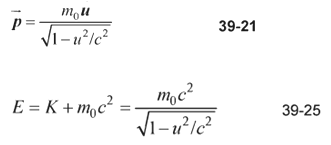
Use Equations 39-21 and 39-25 to derive the equation E2 = p2c2 + (m0c2)2.
Use the binomial expansion (Equation 39-27) and Equation 39-28 to show that when pc
(a) Show that the speed u of a particle of mass m0 and total energy E is given byAnd that when E is much greater than m0c2, this can be approximated byFind the speed of an electron with kinetic energy of(b) 0.51 MeV (c) 10MeV.
The rest energy of a proton is about 938 MeV. If its kinetic energy is also 938 MeV, find(a) Its momentum (b) Its speed.
What percentage error is made in using ½m0u2 for the kinetic energy of a particle if its speed is(a) 0.1c (b) 0.9c?
The K0 particle has a rest mass of 497.7 MeV/c2. It decays into a π– and π+, each with rest mass 139.6 MeV/c2. Following the decay of a K0, one of the pions is at rest in the laboratory. Determine the kinetic energy of the other pion and of the K0 prior to the decay.
The sun radiates energy at the rate of about 4 × 1026 W. Assume that this energy is produced by a reaction whose net result is the fusion of 4 H nuclei to form 1 He nucleus, with the release of 25 MeV for each He nucleus formed.
Two protons approach each other head on at 0.5c relative to reference frame S’.(a) Calculate the total kinetic energy of the two protons as seen in frame S’.(b) Calculate the total kinetic energy of the protons as seen in reference frame S, which is moving with speed 0.5c relative to S’ such
An antiproton p0 has the same rest energy as a proton. It is created in the reaction p + p → p + p + p + p . In an experiment, protons at rest in the laboratory are bombarded with protons of kinetic energy KL, which must be great enough so that kinetic energy equal to 2m0c2 can be converted into
A particle of rest mass 1 MeV/c2 and kinetic energy 2 MeV collides with a stationary particle of rest mass 2 MeV/c2. After the collision, the particles stick together. Find(a) The speed of the first particle before the collision,(b) The total energy of the first particle before the collision,(c)
A horizontal turntable rotates with angular speed ω. There is a clock at the center of the turntable and one at a distance r from the center. In an inertial reference frame, the clock at distance r is moving with speed u = rω.(a) Show that from time dilation according to special
The Lorentz transformation for y and z is the same as the classical result: y = y¢ and z = z¢. Yet the relativistic velocity transformation does not give the classical result uy = uy¢ and uz = uz¢. Explain.
A spaceship departs from earth for the star Alpha Centauri, which is 4 light-years away. The spaceship travels at 0.75c. How long does it take to get there(a) As measured on earth and(b) As measured by a passenger on the spaceship?
The total energy of a particle is twice its rest energy.(a) Find u/c for the particle.(b) Show that its momentum is given by p = √3m0c.
How fast must a muon travel so that its mean lifetime is 46 ms if its mean lifetime at rest is 2 μs?
A distant galaxy is moving away from the earth with a speed that results in each wavelength received on earth being shifted such that λ’ = 2λ0. Find the speed of the galaxy relative to the earth.
How fast must a meterstick travel relative to you in the direction parallel to the stick so that its length as measured by you is 50 cm?
Show that if V is much less than c, the doppler shift is given approximately by Δf/f ≈ ±V/c.
If a plane flies at a speed of 2000 km/h, for how long must it fly before its clock loses 1 s because of time dilation?
The radius of the orbit of a charged particle in a magnetic field is related to the momentum of the particle byp = BqR 39-41This equation holds classically for p = mu and relativistically for p = m0u/√1 – u2/c2. An electron with kinetic energy of 1.50 MeV
Oblivious to economics and politics, Professor Spenditt proposes building a circular accelerator around the earth’s circumference using bending magnets that provide a magnetic field of magnitude 1.5 T.(a) What would be the kinetic energy of protons orbiting in this field in a circle of radius RE?
Frames S and S’ are moving relative to each other along the x and x’ axis. Observers in the two frames set their clocks to t = 0 when the origins coincide. In frame S, event 1 occurs at x1 = 1.0 c·y and t1 = 1 y and event 2 occurs at x2 = 2.0 c·y and t2 = 0.5 y. These events
An interstellar spaceship travels from the earth to a distant star system 12 light-years away (as measured in the earth’s frame). The trip takes 15 years as measured on the ship.(a) What is the speed of the ship relative to the earth?(b) When the ship arrives, it sends a signal to the earth. How
The neutral pion π0 has a rest mass of 135 MeV/c2. This particle can be created in a proton–proton collision:p + p → p + p + π0Determine the threshold kinetic energy for the creation of a π0 in a collision of a moving and stationary proton. (See problem 60.)
A rocket with a proper length of 1000 m moves in the +x direction at 0.6c with respect to an observer on the ground. An astronaut stands at the rear of the rocket and fires a bullet toward the front of the rocket at 0.8c relative to the rocket. How long does it take the bullet to reach the front of
In a simple thought experiment, Einstein showed that there is mass associated with electromagnetic radiation. Consider a box of length L and mass M resting on a frictionless surface. At the left wall of the box is a light source that emits radiation of energy E, which is absorbed at the right wall
A rocket with a proper length of 700 m is moving to the right at a speed of 0.9c. It has two clocks, one in the nose and one in the tail, that have been synchronized in the frame of the rocket. A clock on the ground and the nose clock on the rocket both read t = 0 as they pass.(a) At t = 0, what
An observer in frame S standing at the origin observes two flashes of colored light separated spatially by Δx = 2400 m. A blue flash occurs first, followed by a red flash 5 μs later. An observer in S’ moving along the x axis at speed V relative to S also observes the flashes 5 μs apart and
Reference frame S’ is moving along the x’ axis at 0.6c relative to frame S. A particle that is originally at x’ = 10 m at t1’ = 0 is suddenly accelerated and then moves at a constant speed of c/3 in the -x’ direction until time t2’ = 60 m/c , when it is suddenly
In reference frame S the acceleration of a particle is a = axi + ayj + azk. Derive expressions for the acceleration components ax', ay', and az' of the particle in reference frame S' that is moving relative to S in the x direction with velocity V.
When a projectile particle with kinetic energy greater than the threshold kinetic energy Kth strikes a stationary target particle, one or more particles may be created in the inelastic collision. Show that the threshold kinetic energy of the projectile is given by
A particle of rest mass M0 decays into two identical particles of rest mass m0, where m0 = 0.3M0. Prior to the decay, the particle of rest mass M0 has an energy of 4M0c2 in the laboratory. The velocities of the decay products are along the direction of motion of M0. Find the velocities of the decay
A stick of proper length Lp makes an angle θ with the x axis in frame S. Show that the angle θ‘ made with the x’ axis in frame S’, which is moving along the +x axis with speed V, is given by tan θ‘ = γ tan θ and that the length of the stick in S’ is
Show that if a particle moves at an angle θ with the x axis with speed ?u in frame S, it moves at an angle θ’ with the x’ axis in S’ given by
For the special case of a particle moving with speed u along the y axis in frame S, show that its momentum and energy in frame S’ are related to its momentum and energy in S by the transformation equations.Compare these equations with the Lorentz transformation for x’, y’, z’, and t’.
The equation for the spherical wavefront of a light pulse that begins at the origin at time t = 0 is x2 + y2 + z2 -(ct)2 = 0. Using the Lorentz transformation, show that such a light pulse also has a spherical wavefront in frame S’ by showing that x’2 + y’2 + z’2 -(ct’)2 = 0 in S’.
In Problem 90, you showed that the quantity x2 + y2 + z2 -(ct)2 has the same value (0) in both S and S’. Such a quantity is called an invariant. From the results of Problem 89, the quantity p2x + p2y + p2z – (E/c)2 must also be an invariant. Show that this quantity has the value -m0c2
Two identical particles of rest mass m0 are each moving toward the other with speed u in frame S. The particles collide inelastically with a spring that locks shut (Figure) and come to rest in S, and their initial kinetic energy is transformed into potential energy. In this problem you are going to
(Multiple choice)(1)The approximate total energy of a particle of mass m moving at speed u << c is(a) mc2,(b) ½mu2,(c) cmu,(d) ½ mc2,(e) ½cmu.(2)A set of twins work in an office building. One works on the top floor and the other works in the basement. Considering general relativity, which
1. You are standing on a corner and a friend is driving past in an automobile. Both of you note the times when the car passes two different intersections and determine from your watch readings the time that elapses between the two events. Which of you has determined the proper time interval?2. What
1. Two events are simultaneous in a frame in which they also occur at the same point in space. Are they simultaneous in other reference frames?2. If event A occurs before event B in some frame, might it be possible for there to be a reference frame in which event B occurs before event A?3. Two
Give the symbols for two other isotopes of(a) 14N,(b) 56Fe, and(c) 118Sn
Calculate the binding energy and the binding energy per nucleon from the masses given in Table 40-1 for(a) 12C,(b) 56Fe,(c) 238U.
Repeat Problem 2 for(a) 6Li,(b) 39K,(c) 208Pb.
Use Equation 40-1 to compute the radii of the following nuclei:(a) 16O,(b) 56Fe, and(c) 197Au.
(a) Given that the mass of a nucleus of mass number A is approximately m = CA, where C is a constant, find an expression for the nuclear density in terms of C and the constant R0 in Equation 40-1. (b) Compute the value of this nuclear density in grams per cubic centimeter using
Derive Equation 40-2; that is, show that the rest energy of one unified mass unit is 931.5MeV.
Use Equation 40-1 for the radius of a spherical nucleus and the approximation that the mass of a nucleus of mass number A is A u to calculate the density of nuclear matter in grams per cubiccentimeter.
The electrostatic potential energy of two charges q1 and q2 separated by a distance r is U = kq1q2/r, where k is the Coulomb constant.(a) Use Equation 40-1 to calculate the radii of 2H and 3H.(b) Find the electrostatic potential energy when these two nuclei are just touching, that
(a) Calculate the radii of 56141Ba and3692 Kr from Equation 40-1.(b) Assume that after the fission of 235U into 141Ba and 92Kr, the two nuclei are momentarily separated by a distance r equal to the sum of the radii found in (a), and calculate the electrostatic potential energy for these
Homer enters the visitors’ chambers, and his geiger-beeper goes off. He shuts off the beep, removes the device from his shoulder patch and holds it near the only new object in the room: an orb which is to be presented as a gift from the visiting Cartesians. Pushing a button marked “monitor”,
A certain source gives 2000 counts/s at time t = 0. Its half-life is 2 min.(a) What is the counting rate after 4 min?(b) After 6 min?(c) After 8 min?
The counting rate from a radioactive source is 8000 counts/s at time t = 0, and 10 min later the rate is 1000 counts/s.(a) What is the half-life?(b) What is the decay constant?(c) What is the counting rate after 20 min?
The half-life of radium is 1620 y. Calculate the number of disintegrations per second of 1 g of radium, and show that the disintegration rate is approximately 1 Ci.
A radioactive silver foil (t1/2 = 2.4 min) is placed near a Geiger counter and 1000 counts/s are observed at time t = 0.(a) What is the counting rate at t = 2.4 min and at t = 4.8 min?(b) If the counting efficiency is 20%, how many radioactive nuclei are there at time t = 0? At time t = 2.4 min?(c)
Using Table 40-1 to calculate the energy in MeV for the α decay of(a) 226Ra (b) 242Pu.
Suppose that two billion years ago 10% of the mass of the earth were 14C. Approximately what percent of the mass of the earth today would be 14C, neglecting formation of 14C in the atmosphere?
At the scene of the crime, in the museum’s west wing, Angela found some wood chips, so she slipped them into her purse for future analysis. They were allegedly from an old wooden mask, which the guard said he threw at the would-be thief. Later, in the lab, she determined the age of the chips,
The thief in problem 21 had been after a valuable carving made from a 10,000 year old bone. The guard said that he chased the thief away, but Angela suspects that the guard is an accomplice, and that the bone in the display case is in fact a fake. If a sample of the bone containing 15 g of carbon
Through a friend in security at the museum, Angela got a sample having 175 g of carbon. The decay rate of 14C was 8.1 Bq.(a) How old is it?(b) Is it from the carving described in problem 22?
A sample of a radioactive isotope is found to have an activity of 115.0 Bq immediately after it is pulled from the reactor that formed it. Its activity 2 h 15 min later is measured to be 85.2 Bq.(a) Calculate the decay constant and the half-life of the sample.(b) How many radioactive nuclei were
Derive the result that the activity of 1 g of natural carbon due to the β decay of 14C is 15 decays/min = 0.25 Bq.
Measurements of the activity of a radioactive sample have yielded the following results. Plot the activity as a function of time, using semilogarithmic paper, and determine the decay constant and half-life of the radioisotope.
(a) Show that if the decay rate is R0 at time t = 0 and R1 at some later time t1, the decay constant is given by λ = t1-1 ln(R0/R1) and the half-life is given by t1/2 = 0.693t1/ln(R0/R1).(b) Use these results to find the decay constant and the half-life if the decay rate is 1200 Bq
A wooden casket is thought to be 18,000 years old. How much carbon would have to be recovered from this object to yield a 14C counting rate of no less than 5 counts/min?
A 1.00-mg sample of substance of atomic mass 59.934 u emits β particles with an activity of 1.131 Ci. Find the decay constant for this substance in s–1 and its half-life in years.
The counting rate from a radioactive source is measured every minute. The resulting counts per second are 1000, 820, 673, 552, 453, 371, 305, 250. Plot the counting rate versus time on semilog graph paper, and use your graph to find the half-life of the source.
Showing 2100 - 2200
of 8241
First
15
16
17
18
19
20
21
22
23
24
25
26
27
28
29
Last
Step by Step Answers

 Get 50% OFF
Claim Now
Get 50% OFF
Claim Now


.png)
.png)
.png)
.png)
.png)
.png)
.png)
.png)
.png)
.png)
.png)
-1.png)
-2.png)
.png)
.png)
.png)
.png)
.png)
.png)
-1.png)
-2.png)
.png)
.png)
.png)
.png)
.png)
.png)
.png)
.png)
.png)


