New Semester
Started
Get
50% OFF
Study Help!
--h --m --s
Claim Now
Question Answers
Textbooks
Find textbooks, questions and answers
Oops, something went wrong!
Change your search query and then try again
S
Books
FREE
Study Help
Expert Questions
Accounting
General Management
Mathematics
Finance
Organizational Behaviour
Law
Physics
Operating System
Management Leadership
Sociology
Programming
Marketing
Database
Computer Network
Economics
Textbooks Solutions
Accounting
Managerial Accounting
Management Leadership
Cost Accounting
Statistics
Business Law
Corporate Finance
Finance
Economics
Auditing
Tutors
Online Tutors
Find a Tutor
Hire a Tutor
Become a Tutor
AI Tutor
AI Study Planner
NEW
Sell Books
Search
Search
Sign In
Register
study help
physics
modern physics
Probability & Statistics For Engineers & Scientists 7th Edition Ronald E. Walpole, Raymond H. Myers, Sharon L. Myers, Keying - Solutions
Plutonium isotope 239Pu decays by alpha decay with a half-life of 24 100 y. How many milligrams of helium are produced by an initially pure 12.0 g sample of 239Pu, at the end of 20 000 y? (Consider only the helium produced directly by the plutonium and not by any by-products of the decay process.)
The radionuclide 56Mn has a half-life of 2.58 h and is produced in a cyclotron by bombarding a manganese target with deuterons. The target contains only the stable manganese isotope 55Mn, and the manganese - deuteron reaction that produces 56Mn is 55Mn + d → 56Mn + p. If the bombardment lasts
Calculate the mass of a sample of (initially pure) 40K that has an initial decay rate of 1.70 x 10⁵ disintegrations. The isotope has a half-life of 1.28 x 10⁹ y.
The air in some caves includes a significant amount of radon gas, which can lead to lung cancer if breathed over a prolonged time. In British caves, the air in the cave with the greatest amount of the gas has an activity per volume of 1.55 x 10⁵ Bq/m3. Suppose that you spend two full days exploring
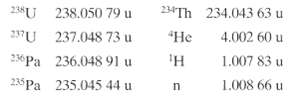
How much energy is released when a 238U nucleus decays by emitting? (a) An alpha particle and (b) A sequence of neutron, proton, neutron, proton? (c) Convince yourself both by reasoned argument and by direct calculation that the difference between these two numbers is just the total binding energy
Generally, more massive nuclides tend to be more unstable to alpha decay. For example, the most stable isotope of uranium, 238U, has an alpha decay half-life of 4.5 x 10⁹ y. The most stable isotope of plutonium is 244Pu with an 8.0 x 10⁷ y half-life, and for curium we have 248Cm and 3.4 x 10⁵y.
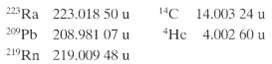
Under certain rare circumstances, a nucleus can decay by emitting a particle more massive than an alpha particle. Consider the decays 223Ra ?? 209Pb + 14C and 223Ra ?? 219Rn + 4He. Calculate the Q value for the (a) First and (b) Second decay and determine that both are energetically possible. (c)
A nucleus emits a 4.196 MeV alpha particle. Calculate the disintegration energy Q for this process, taking the recoil energy of the residual 234Th nucleus into account.
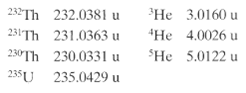
Large radio-nuclides emit an alpha particle rather than other combinations of nucleons because the alpha particle has such a stable, tightly bound structure. To confirm this statement, calculate the disintegration energies for these hypothetical decay processes and discuss the meaning of your
A free neutron decays according to Equation 42-26. If the neutron-hydrogen atom mass difference is 840μu, what is the maximum kinetic energy Kmax possible for the electron produced in neutron decay?
An electron is emitted from a middle-mass nuclide (A - 150, say) with a kinetic energy of 1.0 MeV.(a) What is its de Broglie wavelength?(b) Calculate the radius of the, emitting nucleus.(c) Can such an electron be confined as a standing wave in a "box" of such dimensions? (d) Can you use these
The cesium isotope 137Cs is present in the fallout from aboveground detonations of nuclear bombs. Because it decays with a slow (30.2y) half-life into 137Ba, releasing considerable energy in the process, it is of environmental concern. The atomic masses of the Cs and Ba are 136.9071 and 136.9058 u,
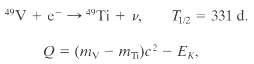
Some radio-nuclides decay by capturing one of their own atomic electrons, K- shell electrons, say. An example is below. Show that the disintegration energy Q for this process is given by, where mV and mTi, arte the atomic masses of 49V and 49Ti, respectively, and EK is the binding energy of the
The radionuclide 11C decays according to 11C → 11B + e+ + v, T1/2 = 20.3. The maximum energy of the positions is 0.960MeV.(a) Show that the designation energy Q for this process is given by Q = (mC - mB – 2me) c2 where mC and mB are the atomic masses of 11C and 11B, respectively, and me is the
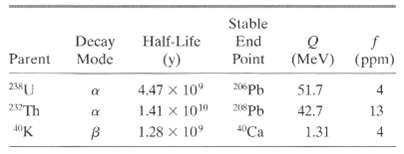
Two radioactive materials that alpha decay, 238U and 232Th, and one that beta decays, 40K, are sufficiently abundant in granite to contribute significantly to the heating of Earth through the decay energy produced. The alpha-decay isotopes give rise to decay chains that stop when stable lead
The radionuclide 32P decays to 32S as described by Equation 42-24.In a particular decay event, a 1.71MeV electron is emitted, the maximum possible value. What is the kinetic energy of the recoiling "S atom in this event?
A 5.00 g charcoal sample from an ancient fire pit has a 14C activity of 63.0 disintegrations /min. A living tree has a 14C activity of 15.3 disintegrations /min per 1.00 g. The half-life of 14C is 5730 y. How old is the charcoal sample?
(a) 238U; and(b) 206Pb does the rock now contain?(c) How many atoms of 238U did the rock contain at formation?(d) What is the age of the rock?
A particular rock is thought to be 260 million years old. If it contains 3.70 mg of 238U, how much 206Pb should it contain?
A rock recovered from far underground is found to contain 0.86 mg of 238U, 0.15 mg of 206Pb, and 1.6 mg of 40Ar. How much 40K will it likely contain? Assume that 40K decays to only 40Ar with a half-life of 1.25 x 10⁹ y. Also assume that 238U has a half-life of 4.47 x 10⁹ y.
The isotope 40K can decay to either 40Ca or 40Ar; assume both decays have a half-life of 1.26 x 10⁹ y. The ratio of the Ca produced to the Ar produced is 8.54/1 = 8.54. A sample originally had only 40K. It now has equal amounts of 40K and 40Ar; that is, the ratio of K to Ar is 1/1 = l. How old is
An organic sample of mass 4.00 kg absorbs 2.00 mJ via slow neutron radiation (RBE = 5). What is the dose equivalent (mSv)?
A radiation detector records 8700 counts in 1.00 min assuming that the detector records all decays, what is the activity of the radiation source in(a) Becquerel’s and(b) Curies?
The nuclide 198Au, with a half-life of 2.70 d, is used in cancer therapy. What mass of this nuclide is required to produce an activity of 250 Ci?
A 75 kg person receives a whole-body radiation dose of 2.4 x 10⁻⁴ Gy, delivered by alpha particles for which the RBE factor is 12. Calculate(a) The absorbed energy in joules and the dose equivalent in(b) Sieverts and(c) Rem.
An 85 kg worker at a breeder reactor plant accidentally ingests 2.5 mg of 239Pu, dust. This isotope has a half-life of 24 100 y, decaying by alpha decay. The energy of the emitted alpha particles is 5.2 MeV with an RBE factor of 13. Assume that the plutonium resides in the worker's body for 12 h
In the following list of nuclides, identify(a) Those with filled nucleon shells,(b) Those with one nucleon outside a filled shell, and(c) Those with one vacancy in an otherwise filled shell: 13C, 18O, 40K, 49Ti, 60Ni, 91Zr, 92Mo, 121Sb, 143Nd, 144Sm, 205Tl, and 207Pb,
An intermediate nucleus in a particular nuclear reaction decays within 10-22 s of its formation.(a) What is the uncertainty ΔE in our knowledge of this intermediate state?(b) Can this state be called a compound nucleus?
A typical kinetic energy for a nucleon in a middle-mass nucleus may be taken as 5.00 MeV. To what effective nuclear temperature does this correspond, based on the assumptions of the collective model of nuclear structure?
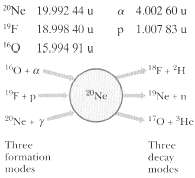
Consider the three formation processes shown for the compound nucleus 20Ne in Figure. Here are some of the masses. What energy must? (a) The alpha particle, (b) The proton, and (c) The γ-ray photon has to provide 25.0 MeV of excitation energy to the compound nucleus
At the end of World War II, Dutch authorities arrested Dutch artist Hans van Meegeren for treason because, during the war, he had sold a masterpiece painting to the Nazi Hermann Goering. The painting, Christ and His Disciples at Emmaus by Dutch master Johannes Vermeer (1632-1675), had been
One of the dangers of radioactive fallout from a nuclear bomb is its 90Sr, which decays with a 29 year half-life. Because it has chemical properties much like those of calcium, the strontium, if ingested by a cow, becomes concentrated in the cow's milk. Some of the e0sr ends up in the bones of
Because of the 1986 explosion and fire in a reactor at the Chernobyl nuclear power plant in northern Ukraine, part of Ukraine is contaminated with 137Cs, which undergoes beta-minus decay with a half-life of 30.2y. In 1996, the total activity of this contamination over an area of 2.6 x 10s km2 was
The radionuclide 32P (T1/2 = 14.28 d) is often used as a tracer to follow the course of biochemical reactions involving phosphorus.(a) If the counting rate in a particular experimental setup is initially 3050 counts/s, how much time will the rate take to fall to 170counts/s?(b) A solution
In a certain rock, the ratio of lead atoms to uranium atoms is 0.300. Assume that uranium has a half-life of 4.47 x 10⁹ y and that the rock had no lead atoms when it formed. How old is the rock?
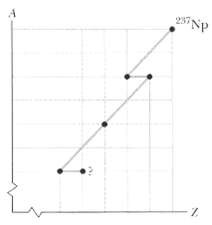
Figure shows part of the decay scheme of 237Np on a plot of mass number A versus proton number Z; five lines that represent either alpha decay or beta-minus decay connect dots that represent isotopes. What is the isotope at the end of the five decays (as marked with a question mark in Figure?)
Radioactive element AA can decay to either element BB or element CC. The decay depends on chance, but the ratio of the resulting number of BB atoms to the resulting number of CC atoms is always 2/1.The decay has a half-life of 8.00 days. We start with a sample of pure AA. How long must we wait
A typical chest x-ray radiation dose is 250μSv, delivered by x rays with an RBE factor of 0.85. Assuming that the mass of the exposed tissue is one-half the patient's mass of 88 kg, calculate the energy absorbed in joules.
A radium source contains 1.00 mg of 256Ra, which decays with a half-life of 1600 y to produced 222Rn, a noble gas. This radon isotope in turn decays by alpha emission with a half-life of 3.82 d. If this process continues for a time much longer than the half-life of 222Rn, the 222Rn decay rate
Because a nucleon is confined to a nucleus, we can take the uncertainty in its position to be approximately the nuclear radius r. Use the uncertainty principle to determine the uncertainty Δ p in the linear momentum of the nucleon. Using the approximation p = Δ p and the fact that the nucleon is
Assume that a gold nucleus has a radius of 6.23 fm and an alpha particle has a radius of 1.80 fm. What energy must an incident alpha particle have in order to "touch" the gold nucleus according to the type of calculation in Sample Problem?
How many years are needed to reduce the activity of 14C to 0.020 of its original activity? The half-life of 14C is 5730 y.
After a brief neutron irradiation of silver, two isotopes are present: 108Ag (T1/2 = 2.42min) with an initial decay rate of 3.1 x 10⁵/s, and 110Ag (T1/2 = 24.6s) with an initial decay rate of 4.1 x 10⁶/s. Make a semilog plot similar to Figure showing the total combined decay rate of the two
A certain stable nuclide, after absorbing a neutron, emits an electron, and the new nuclide splits spontaneously into two alpha particles. Identify the nuclide.
High-mass radio-nuclides, which may be either alpha or beta emitters, belong to one of four decay chains, depending on whether their mass number A is of the form 4n,4n + 1, 4n + 2, or 4n + 3, where n ts a positive integer.(a) Justify this statement and show that if a nuclide belongs to one of these
Consider a 238U nucleus to be made up of an alpha particle (4He) and a residual nucleus (234Th). Plot the electrostatic potential energy U(r), where r is the distance between these particles. Cover the approximate range 10 fm < r < 100 fm and compare your plot with that of Figure.
From data presented in the first few paragraphs of Section 42-4, find(a) The disintegration constant λ and(b) The half-life of 238U.
Make a nuclides chart similar to Figure for the 2.5 nuclides 118-122 Te, 117-121 Sb, 116-120 Sn, 115-119 I n, and 114-118Cd. Draw in and label (a) All isobaric (constant A) lines and (b) All lines of constant neutron excess, defined as N -Z.
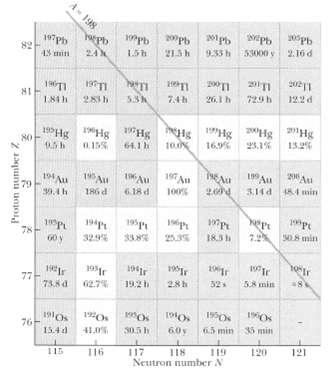
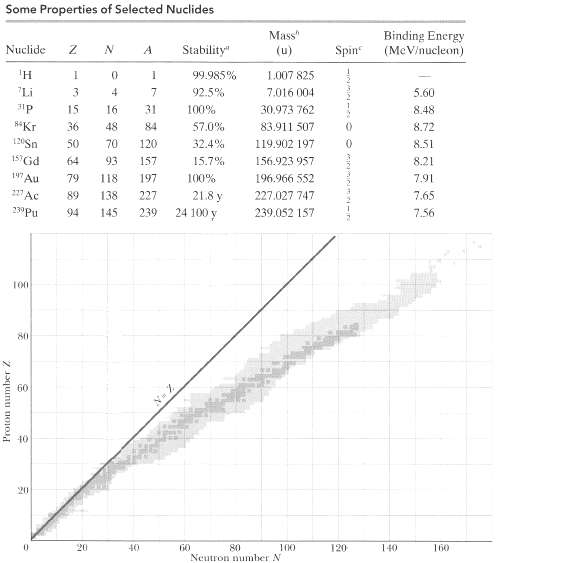
Locate the nuclides displayed in Table on the nuclidic chart of Figure. Verify that they lie in the stability zone.
If the unit for atomic mass were defined so that the mass of 1H were exactly 1.000 000 u, what would be the mass of(a) 14C (actual mass 12.000 000 u) and(b) 238U (actual mass 238.050 785 u)?
Using a nuclidic chart write the symbols for(a) All stable isotopes with Z = 60,(b) All radioactive nuclides with N = 60 and(c) All nuclides with A = 60.
The radius of a spherical nucleus is measured, by electron- scattering methods, to be 3.6 fm. What is the likely mass number of the nucleus?
Characteristic nuclear time is a useful but loosely defined quantity, taken to be the time required for a nucleon with a few million electron-volts of kinetic energy to travel a distance equal to the diameter of a middle-mass nuclide. What is the order of magnitude of this quantity? Consider 5 MeV
Find the disintegration energy Q for the decay of 49V by K-electron capture. The needed data are mv = 48.948 52u, mTi = 48.947 87 u, and Ek = 5.47keV.
The ground-state energy of an electron trapped in a one-dimensional infinite potential well is 2.6eV. What will this quantity be if the width of the potential well is doubled?
An electron, trapped in a one-dimensional infinite potential well 250 pm wide, is in its ground state. How much energy must it absorb if it is to jump up to the state with n = 4?
What must be the width of a one-dimensional infinite potential well if an electron trapped in it in the n = 3 state is to have an energy of 4.7eV?
A proton is confined to a one-dimensional infinite potential well 100 pm wide. What is its ground-state energy?
Consider an atomic nucleus to be equivalent to a one-dimensional infinite potential well with L = 1.4 x 10⁻¹⁴, a typical nuclear diameter. What would be the ground-state energy of an electron if it were trapped in such a potential well? (Note: Nuclei do not contain electrons.)
What is the ground-state energy of (a) An electron and(b) A proton if each is trapped in a one-dimensional infinite potential well that is 200 pm wide?
An electron in a one-dimensional infinite potential well of length L has ground-state energy E1. The length is changed to L' so that the new ground-state energy is E'1 = 0.5004. What is the ratio L'/L?
An electron is trapped in a one-dimensional infinite potential well. For what (a) Higher quantum number and (b) Lower quantum number is the corresponding energy difference equal to the energy difference ∆E43 between the levels n = 4 and n = 3? (c) Show that no pair of adjacent levels
An electron is trapped in a one-dimensional infinite potential well. For what (a) Higher quantum number and (b) Lower quantum number is the corresponding energy difference equal to the energy of the n = 5 level? (c) Show that no pair of adjacent levels has an energy difference equal to the energy
An electron is trapped in a one-dimensional infinite well of width 250 pm and is in its ground state. What are the(a) Longest, (b) Second longest, and (c) Third longest wavelengths of light that can excite the electron from the ground state via single photon absorption?
Suppose that an electron trapped in a one-dimensional infinite well of width 250 pm is excited from its first excited state to its third excited state. (a) What energy must be transferred to the electron for this quantum jump? The electron then de-excites back to its ground state by emitting light.
An electron is trapped in a one-dimensional infinite well and is in its first excited state. Figure indicates the five longest wavelengths of light that the electron could absorb in transitions from this initial state via a single photon absorption: ?a = 80.78 nm, ?b = 33.66nm, ?c = 19.23nm, ?d =
An electron is trapped in a one-dimensional infinite potential well that is 100 pm wide; the electron is in its ground state. What is the probability that you can detect the electron in an interval of width ∆x = 5.0 pm centered at x = (a) 25 pm, (b) 50 pm, and (c) 90 pm?
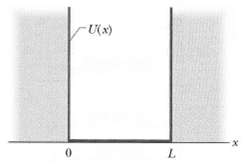
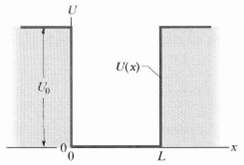
A particle is confined to the one-dimensional infinite potential well of figure. If the particle is in its ground state, what is its probability of detection between?(a) x = 0 and x = 025L,(b) x = 0.75L and x = L, and(c) x = 0.25L and x =0.75L?
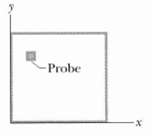
A one-dimensional infinite well of length 200 pm contains an electron in its third excited state. We position an electron-detector probe of width 2.00 pm so that it is centered on a point of maximum probability density. (a) What is the probability of detection by the probe? (b) If we insert the
An electron is in a certain energy state in a one-dimensional, infinite potential well from x = 0 to x = L = 200 pm. The electron's probability density is zero at x = 0.300 L, and x = 0.400L; it is not zero at intermediate values of x. The electron then jumps to the next lower energy level by
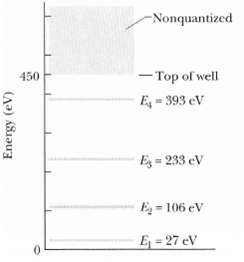
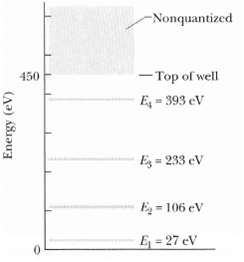
An electron in the n = 2 state in the finite potential well of figure absorbs 400eV of energy from an external source. Using the energy-level diagram of figure, determine the electron's kinetic energy after this absorption, assuming that the electron moves to a position for which x >L.
Figure gives the energy levels for an electron trapped in a finite potential energy well 450eV deep. If the electron is in the n = 3 state, what is its kineticenergy?
(a) Show that for the region x > L in the finite potential well of figure ?(x) = De2ks is a solution of Schrodinger's equation in its one-dimensional form, where D is a constant and k is positive.(b) On what basis do we find this mathematically acceptable solution to be physically unacceptable?
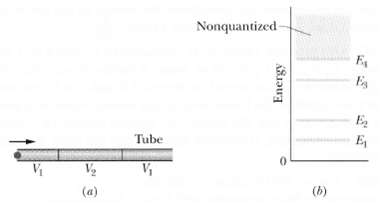
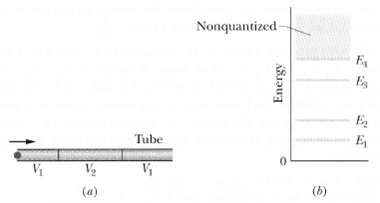
Figure a shows a thin tube in which a finite potential trap has been set up where V2 = 0 V. An electron is shown traveling rightward toward the trap, in a region with a voltage of V1 = ?? 9.00 V, where it has a kinetic energy of 2.00eV. When the electron enters the trap region, it can become
Figure a shows a thin tube in which a finite potential trap has been set up where V2 = 0 V. An electron is shown traveling rightward toward the trap, in a region with a voltage of V1 = ?? 9.00 V, where it has a kinetic energy of 2.00eV. When the electron enters the trap region, it can become
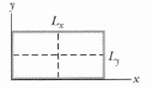
An electron is contained in the rectangular corral of figure with widths Lx = 800 pm and Ly = 1600 pm. What is the electron's ground-state energy?
An electron is contained in the rectangular box of figure with widths Lx = 800pm, Ly = 1600 pm, and Lz = 390 pm. What is the electron's ground-state energy?
A rectangular corral of widths Lx = L and Ly = 2L contains an electron. What multiple of h2/8mL2, where m is the electron mass, gives? (a) The energy of the electron's ground state, (b) The energy of its flrst excited state, (c) The energy of its lowest degenerate states, and (d) The difference
An electron (mass m) is contained in a rectangular corral of widths Lx = L and Ly = 2L. (a) How many different frequencies of light could the electron emit or absorb if it makes a transition between a pair of the lowest five energy levels? What multiple of h2/8mL2 gives the (b) Lowest, (c) Second
A cubical box of widths Lx = Ly = Lz = L contains an electron. What multiple of h2l8mL2, where m is the electron mass, is? (a) The energy of the electron's ground state, (b) The energy of its second excited state, and (c) The difference between the energies of its second and third excited states?
An electron (mass m) rs contained in a cubical box of widths Lx = Ly = Lz. (a) How many different frequencies of light could the electron emit or absorb if it makes a transition between a pair of the lowest five energy levels? What multiple of, h2/8mL2 gives the (b) Lowest, (c) Second lowest, (d)
Figure shows a two-dimensional, infinite-potential well lying in an xy plane that contains an electron. We probe for the electron along a line that bisects Lx and find three points at which the detection probability is maximum. Those points are separated by 2.00 nm. Then we probe along a line that
The two-dimensional, infinite corral of figure is square, with edge length L 150 pm. A square probe is centered at xy coordinates (0.200L, 0.800L) and has an x width of 5.00 pm and a y width of 5.00 pm. What is the probability of detection if the electron is in the E1,3 energystate?
An electron is in the ground state in a two-dimensional, square, infinite potential well with edge lengths L. We will probe for it in a square of area 400 pm2 that is centered at x = L/8 and y = L/8. The probability of detection turns out to be 0.0450. What is edge length L?
For the hydrogen atom in its ground state, calculate (a) The probability density ψ2(r) and (b) The radial probability density P(r) for r = a, where a is the Bohr radius.
Calculate the radial probability density P(r) for the hydrogen atom in its ground state at (a) r = 0, (b) r = a, and(c) r = 2a, where a is the Bohr radius.
A neutron with a kinetic energy of 6.0eV collides with a stationary hydrogen atom in its ground state. Explain why the collision must be elastic-that is, why kinetic energy must be conserved.
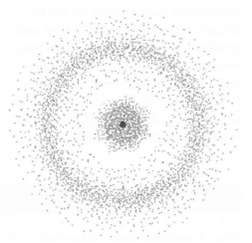
(a) What is the energy E of the hydrogen-atom electron whose probability density is represented by the dot plot of figure?(b) What minimum energy is needed to remove this electron from theatom?
What are the (a) Energy., (b) Magnitude of the momentum, and (c) Wavelength of the photon emitted when a hydrogen atom undergoes a transition from a state with n = 3 to a state with n = 1?
An atom (not a hydrogen atom) absorbs a photon whose associated frequency is 6.2 x 10¹⁴ Hz. By what amount does the energy of the atom increase?
What is the ratio of the shortest wavelength of the Balmer series to the shortest wavelength of the Lyman series?
An atom (not a hydrogen atom) absorbs a photon whose associated wavelength is 375 nm and then immediately emits a photon whose associated wavelength is 580 nm. How much net energy is absorbed by the atom in this process?
How much work must be done to pull apart the electron and the proton that make up the hydrogen atom if the atom is initially in? (a) Its ground state and (b) The state with n = 2?
A hydrogen atom is excited from its ground state to the state with n = 4. (a) How much energy must be absorbed by the atom? Consider the photon energies that can be emitted by the atom as it de-excites to the ground state in the several possible ways. (b) How many different energies are possible;
What is the probability that in the ground state of the hydrogen atom, the electron will be found at a radius greater than the Bohr radius?
Light of wavelength 121.6 nm is emitted by u hydrogen atom. What are the (a) Higher quantum number and (b) Lower quantum number of the transition producing this emission?(c) What is the name of the series that includes the transition?
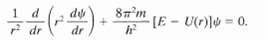
Schrodinger's equation for states of the hydrogen atom for which the orbital quantum number ? is zero is Verify that Eq. 39-39, which describes the ground state of the hydrogen atom, is a solution of this equation.
What are the (a) Wavelength range and (b) Frequency range of the Lyman series? What are the (c) Wavelength range and (d) Frequency range of the Balmer series?
In the ground state of the hydrogen atom, the electron has a total energy of – 13.6eV. What are(a) Its kinetic energy and (b) Its potential energy if the electron is one Bohr radius from the central nucleus?
A hydrogen atom, initially at rest in the n = 4 quantum state, undergoes a transition to the ground state, emitting a photon in the process. What is the speed of the recoiling hydrogen atom?
Showing 1500 - 1600
of 8241
First
9
10
11
12
13
14
15
16
17
18
19
20
21
22
23
Last
Step by Step Answers

 Get 50% OFF
Claim Now
Get 50% OFF
Claim Now