New Semester
Started
Get
50% OFF
Study Help!
--h --m --s
Claim Now
Question Answers
Textbooks
Find textbooks, questions and answers
Oops, something went wrong!
Change your search query and then try again
S
Books
FREE
Study Help
Expert Questions
Accounting
General Management
Mathematics
Finance
Organizational Behaviour
Law
Physics
Operating System
Management Leadership
Sociology
Programming
Marketing
Database
Computer Network
Economics
Textbooks Solutions
Accounting
Managerial Accounting
Management Leadership
Cost Accounting
Statistics
Business Law
Corporate Finance
Finance
Economics
Auditing
Tutors
Online Tutors
Find a Tutor
Hire a Tutor
Become a Tutor
AI Tutor
AI Study Planner
NEW
Sell Books
Search
Search
Sign In
Register
study help
business
development economics
Development Economics 1st Edition Debraj Ray - Solutions
Why might environmentalists and trade protectionists form political alliances in developed countries?
Understand why the Heckscher-Ohlin model does not lead to complete specialization, in contrast to the Ricardian framework. Take the car-textiles example studied in this chapter. Recall that in our example, each of these goods is produced by capital and labor, but cars use capital more intensively.
If poorer people consume a greater proportion of those products which are produced using a high intensity of unskilled labor (relative to physical and human capital), show that international trade between rich and poor countries will be lower than that predicted by the Heckscher-Ohlin theory.
Two countries, A and B, identical in all respects, each produce two goods, bread and wine, using a single input, labor. The production of each good is carried out under constant returns to scale.But a higher economy-wide production of any of the goods has positive externalities for individual
By drawing production possibility frontiers and international price lines, show that trade can be viewed as just another method of production, where exports serve as “inputs” and imports are “outputs.” In so doing, show that the opportunity to trade always represents a potential Pareto
(a) Show that if all individuals in a country have the same holdings of all factors of production (and the same shareholdings in all companies), and if there are no externalities, the opportunity to trade must lead to an unambiguous Pareto improvement in that country. In this sense, lobbying for
Suppose that we divide commodities into two groups: food and nonfood.(a) Draw indifference curves that reflect the fact that preferences for food grow relatively weaker as we increase consumption of both commodities. Now introduce a budget constraint (income and fixed prices) and chalk out the
Review the arguments for trade policy in this chapter, paying particular attention to (i) Externalities (ii) Distributional issues and (iii) Capital market imperfections. Show that these arguments all rely on some sort of market failure.
Discuss circumstances under which tariffs and quotas have equivalent effects, and circumstances under which they do not. Pay particular attention to(i) Issues of tariff revenue,(ii) The possibility of black markets or bribes in the allocation of quotas, and (iii) The lack of information that the
Suppose that domestic producers in a developing country are able to produce cement at a unit cost of $5 per kilogram, up to a capacity limit of ten million kilograms a year. The world price of cement is $1.50 per kilogram. Suppose that there are two categories of cement users: industrial
Here is the large-country argument for an optimal tariff. Recall the welfare analysis conducted for tariffs in this chapter. We will use this methodology in the exercise that follows.(a) For simplicity, suppose that a good is fully imported, so that there are no domestic producers of it. On a
Suppose that the government follows a policy of infant-industry protection, allowing the domestic production of automobiles in an economy sheltered by tariffs on car imports.(a) Discuss the critical features of a policy that aims to generate efficiency and international competitiveness in the car
It may be optimal for a country to restrict the exports of some commodity for which it is a principal exporter. Examine this statement. In particular, address the question of why individual exporters do not spontaneously impose export restrictions on themselves even if it is optimal for them to do
The liberalization of agricultural exports is a major issue in India. Higher exports for farmers will mean greater revenues and higher prices for them. Why might the government be opposed to such a policy?
Developed countries argue for the protection of intellectual property rights in developing countries, so that new technological advances can be protected by means of patents. They argue that such protection will enhance technical progress (because the fruits of such progress can be appropriated by
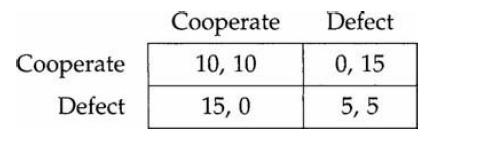
Suppose that there is a single lender and a single borrower, and there is no legal mechanism to enforce loan repayment. A borrower can costlessly keep any amount borrowed, but the lender can then decide not to lend to the borrower in the future. By studying the theory of repeated games discussed in
“Governments never go bankrupt. So, lending to them is a wise idea. They can always repay.” Using the concepts of involuntary and strategic default (see Chapter 14), examine this statement carefully.
Countries that have a high international debt face what is called the debt overhang. The prospect of having to service a large debt from investment returns discourages investment. In such situations, some amount of debt forgiveness can help. To see this, consider the following example:A country
Conditionality” refers to the specification of certain policies that a government must follow in order to receive loans or assistance from international organizations such as the International Monetary Fund or the World Bank. Here is an example to illustrate one useful aspect of conditionality.A
The “gains-from-trade” theorem tells us that irrespective of what other countries do, free trade is the best policy for any country. Yet countries routinely threaten to pursue restrictive trading practices if their trading partners do so as well. Reconcile these two observations using the
If the status quo is restricted trade, a liberalization policy may not have popular support even if it will benefit a majority of the population and even if the monetary value of the gains outweighs the losses. One reason for this is that it may be hard, ex ante, for an individual to predict
Critically review the general arguments that suggest that increased trade between similar countries is more likely to lead to actual rather than potential Pareto improvements, while the opposite is true for new trade between countries with dissimilar factor endowments. Explicitly list the
Why might developing countries with a poorly developed system of income taxes be reluctant to have free trade?
Consider the following parable. There are five individuals. They can form into groups of different sizes. A group of size 1 gets a total income of $100; of size 2, $250; of size 3, $600; of size 4, $750; and of size 5, $900.(a) Which collection of groupings maximizes “world income” in this
Evaluate the validity of the following statements.(a) A developing country is likely to have an overall death rate that is lower than that of a developed country.(b) The populations of Europe and North America grew at a combined rate between 1750 and 1900 that significantly exceeded the
Review the data on the demographic transitions for one developed and one less developed country. For instance, you could study the demographic transitions of England and Sri Lanka (see Gillis, Perkins, Roemer, and Snodgrass [1997, Chapter 7]) and make sure that you understand the main trends in
You are gathering demographic data in a village. You suspect that families have a gender bias; that is, they have children until a certain target number of sons are born, but you don’t have direct evidence of this. All you have is information on the sex and birth order of each child born to each
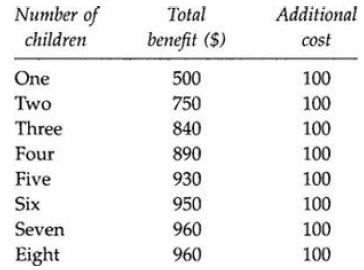
This is a question on joint families, externalities, and fertility choice. Suppose that Ram and Rani are the heads of a nuclear family, making their fertility decisions. For simplicity, assume away gender bias and issues of child survival. The following table details the costs and benefits (in
Here is more on gender bias. In many Southern Asian countries, there is evidence that the ratio of boys to girls is too high (see also Chapter 8). A ratio of 110 boys to 100 girls is not uncommon. One obvious hypothesis that springs to mind is that girls are treated badly relative to boys (or are
Discuss the impact of population growth on per capita income and its growth.
Review the concepts of formal and informal sectors. Explain why labor might receive better treatment (in pay or conditions of work) in the formal sector. How do you think such differentials persist? Why can’t informal sector workers simply enter the formal sector by offering to work on terms that
Describe the two fundamental resource flows that link the agricultural sector with the industrial sector. Discuss the market forces that are relevant to the magnitudes of these flows.
Review the Lewis model of economic development. In particular, discuss the following concepts: agricultural surplus, average agricultural surplus, surplus labor, disguised unemployment, family farming, capitalist farming, and the three phases of development in the Lewis model.
(a) Consider a family farm that is in the surplus labor phase. Now suppose that some members migrate to work elsewhere. Describe what happens to the average income of the family farm.(b) Reconcile your observation with the assertion that the supply curve is perfectly elastic (or flat) in the
Present arguments why, all other things being the same, the industrial supply curve of labor is steeper, when the economy is closer to minimum subsistence to begin with. If food can be freely traded on the world market, do you anticipate that the supply curve will be flatter or steeper? Justify
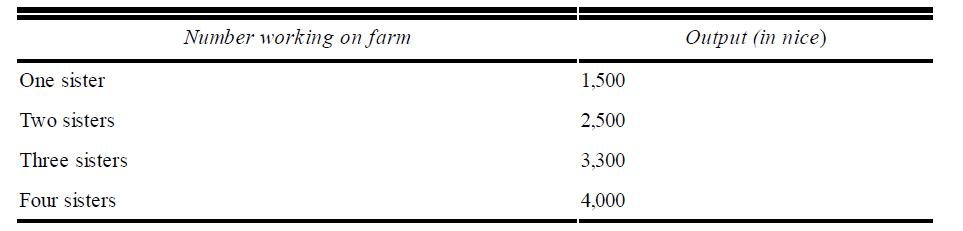
Pim and her three sisters own a small farm in the agricultural sector of the land of Grim. They work equally hard, and the value of their output measured in the local currency, nice, is 4,000 nice, which they divide equally. The urban sector of Grim has two kinds of jobs. There are informal jobs
Taxes on industrial profits will leave less room for capital accumulation and slow down the rate of growth. Do workers already employed in the industrial sector have an incentive to lobby for such taxes, the proceeds of which are transferred to them in the form of additional benefits? Show that the
A farm household in rural Mexico consists of five adult brothers and no other dependents. Total annual income depends on the number of brothers working on the farm through the year and is given by the following schedule:Each brother, at the beginning of the year, can decide to migrate to Mexico
Are the following statements true, false or uncertain? Provide a brief explanation to back up your answer.(a) In the dual economy model, the phase of disguised unemployment must be associated with a horizontal supply curve of industrial labor.(b) A low or moderate inequality of land holdings
In the 1950s, facing massive unemployment in the cities (much of it disguised in the informal sector), the Kenyan government embarked on a “Keynesian” policy of creating new urban jobs through public investment. By many accounts, the size of the informal sector in Kenya went up instead of
Carefully review the different migration policies studied in this chapter. Explain under what circumstances the flexible equilibrium allocation is the efficient allocation and how different policies situate themselves relative to the efficient allocation.
(a) Calculate the expected values of the following lotteries:(i) 100 with probability 0.4 and 200 with probability 0.5(ii) 100 with probability p and 200 with probability 1 − p (evaluate the amount as p varies between 0 and 1: does this make sense?); (iii) 100 with probability p and if this
A farming family owns some land. Suppose that in any year the equivalent of two people are needed to farm each acre of land that they own. The following information is given to you:(i) There are six people in the family. (ii) The going annual wage per person (which each person can earn if he or
Suppose that two individuals A and B meet and undertake a joint project in which the returns are 1,000 with probability 0.5, and 2,000 otherwise. They are negotiating an agreement regarding the division of the returns. That is they decide on a division rule before the project comes to fruition and
(a) Generalize the setting in (1). There are ownership distributions for land, for labor, for bullocks, for access to working capital. Explain carefully how the operational distribution of land will relate to these various ownership distributions.(b) As an illustration, suppose that there are
Compare and contrast the features of agrarian structure in Latin America and Asia, paying particular attention to the problem of land ownership.
(a) Show that in an economy with extensive possibilities for perfect crop insurance, fixed-rent tenancy must be dominant irrespective of whether potential tenants are risk-averse or risk-neutral.(b) Show that in an economy where risk is a major factor, where tenants are risk-averse, and where the
Consider a production cooperative with just two farmers. Each farmer chooses independently how much labor to supply to the cooperative. Each unit of labor is supplied at an opportunity cost of w. Output is produced by means of a standard production function (exhibiting diminishing returns), with
It is not uncommon to observe that in sharecropping contracts with cost sharing, the cost share borne by the tenant is equal to the output share accruing to him (see, for instance, the box on sharecropping in the Sindh region of Pakistan). Explain why this might be the case.
(a) Why might tenant laws that confer permanent use rights on a tenant who has farmed a plot of land for some years have counterproductive effects on the security of a tenant?(b) Explain why the presence of limited liability can give rise to situations in which eviction threats are used by the
A widely observed feature of backward agriculture is the inverse relationship between farm size and productivity; that is, larger farms tend to produce lower output per acre than smaller ones. Brief sketches of two alternative explanations for this phenomenon are provided in (a) and (b). Elaborate
Consider various forms of land rights:(i) Communal ownership, (ii) Individual use rights without ownership, and (iii) Full ownership rights. Discuss how these rights affect the productivity of cultivation.
Review the standard supply–demand model for the study of labor market equilibrium. Discuss some features of labor markets that require substantial extensions to, or changes in, the standard supply–demand model.
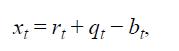
In this question we review various aspects of the capacity curve.(a) Look at the energy balance equation (13.1) that we studied. Recall that it reads as follows:where x is energy input, r is resting metabolism, q is energy required in work, and b is borrowing from the body. When will borrowing be
On a graph where the total income is on the horizontal axis and the number of tasks is on the vertical axis, why does the piece rate appear as a straight line? Show that if the piece rate goes up, the line becomes flatter. What would the following contracts look like on the same graph, with the
(a) We showed that with a large supply of labor (and with no long-term storage or borrowing effects), the equilibrium piece rate settles at the level where the line describing the piece rate is tangent to the capacity curve. Explain why this is the case.(b) To help you understand how piece rates
Suppose that spot market wages fluctuate between the two values $50 and $100, each with probability 1/2. Suppose that a risk-averse worker dislikes fluctuations in income and wants to smooth out these wages. He therefore approaches a large employer, who is risk-neutral and goes by expected values.
Consider a second possible reason to hire permanent labor, which is to carry out tasks that cannot be easily monitored by the employer. In this case, the only punishment power that the employer might have been firing the permanent employee from the job. Consider the following information:(i) The
This problem explores the way in which a shortage of food might act as a constraint to industrial employment and how the situation is affected by the presence of inequality. Suppose that an unemployed person who is not doing strenuous productive work requires 100 kilograms of wheat per year to
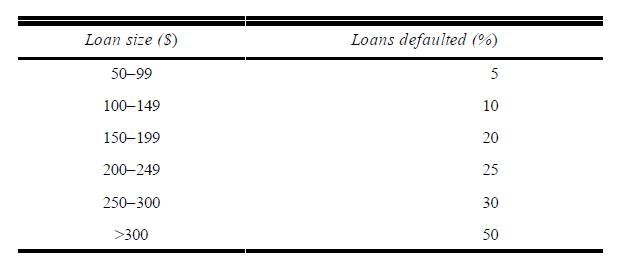
If people have different costs of default, such that for each person there is a threshold repayment burden that they will always want to default upon, explain why loans above a certain size will never be offered by any lender, even with very high-risk premiums built into the rate of interest. Use
Explain the concept of a risk premium in words. This example will help you understand how a risk premium may be calculated. In each of cases (a)–(d), assume that you always have the option to keep extra money in the bank at a 10% rate of interest, with no fear of losing any of this money. For
A risk-lover is an individual who prefers a lottery with some expected value to a fixed amount of money with the same value. Show that with limited liability, a risk-neutral or even a risk-averse borrower may behave as if he is a risk-lover when considering the projects in which he would like to
Carefully reproduce the example of a landlord lending to a laborer, where underpriced labor as well as interest can be charged as repayment for the loan. Show that the loan will be advanced at the opportunity cost of the lender, whereas all interest will be charged by underpricing labor.
Here is another way to think about output–credit interlinkage between a trader and a farmer. Recall that the borrower–farmer maximizes his profit. Note that (i) marginal revenue equals price times marginal product of an extra $1 of loan and that(b) marginal cost equals $1 plus the rate of
Carefully reproduce the example of a trader lending to a farmer, where output sold by the farmer to the trader at a discounted price (as well as direct interest) can be required as repayment for the loan. Show that the loan will be advanced at a rate of interest that is below the opportunity cost
Do you expect that there will be a systematic discrepancy in interest rates between loans that are made for production purposes and loans that are given for consumption purposes? Analyze some sources of this possible discrepancy.
An expansion of credit from formal financial institutions to large informal lenders will increase competition among such lenders and improve the terms of credit for small borrowers with no access to formal credit. Discuss.
Consider a monopolist lender who lends to borrowers on a repeated basis. The loans are informal and are not backed up by written contracts. The lender has no way to recover a loan if the borrower chooses to default. The lender, however, threatens to cut off credit in the future to any defaulting
SelfHelp is a newly formed credit cooperative which receives partial financing from government banks. Members of SelfHelp can deposit savings with the cooperative and they can also turn to SelfHelp for a loan if they need one. If a borrower defaults on a SelfHelp loan he is punished (which is
A lending organization, inspired by the Grameen Bank, is attempting to provide loans to small farmers. It is lending to farmers in groups of two (say).(a) Provide at least two reasons why a strategy of group lending may be better than a strategy of lending to individuals. Provide at least two
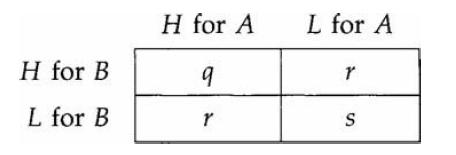
Suppose that two persons, A and B, can each earn a high income(H) or a low income (L). The following table describes the probability of each of the four events. Make sure that you understand what each cell means: in particular, you should note that q + s + 2r = 1.(a) If each person expects H with
Discuss the main problems with agricultural crop insurance. Pay particular attention to the problems of correlation and information. Using these concepts, comment on the possibility of a twotier system in which a giant insurance company makes insurance payouts to the village as a whole, while a
Suppose that we find that temporary income shocks (such as those due to weather fluctuations) have small effects on the consumption of a household. Then this is prima facie evidence that households can smooth such shocks, but the smoothing may arise from self-insurance, credit, or mutual insurance.
Suppose that a household builds up stocks of assets, such as bullocks, land, jewelry, and cash. When faced with an adverse income shock in a particular year, the household will use these assets to smooth consumption. Discuss the factors that influence the choice of assets used in smoothing.
Consider two economies: one with a high population density, so that villages are clumped together and intervillage transportation costs are low, and another in which villages are spread apart and largely isolated from one another. In which economy would you expect bullocks to be used for
Consider two groups of risk-averse farmers. One group practices mutual insurance, but the other does not. In the questions to follow, base your arguments on the assumption that a menu of production techniques and crops are available for cultivation, and that farmers choose from this menu.(a) If
Quite apart from considerations of altruism, discuss why insurance among members of an extended family is more likely than insurance among a group of strangers of the same size and occupational composition.
We have seen that moral hazard restricts the scope of insurance: if unobserved effort must be expended to produce efficient levels of output, then such effort may not be forthcoming in the presence of insurance. Review the relevant arguments in this chapter. Now,(i) Discuss if poor farming groups
Review the material on enforcement constraints in insurance. Why might higher mobility (of people) lead to a breakdown in mutual insurance?
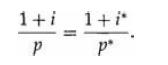
Why might an increase in trade volume not correspond to an increase in hard-currency earnings? Illustrate your argument by using the example of a devaluation, which is a deliberate cheapening of the exchange rate—the rate at which domestic currency can be exchanged for foreign currency, say
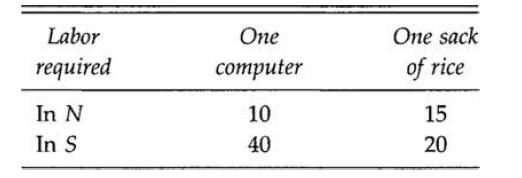
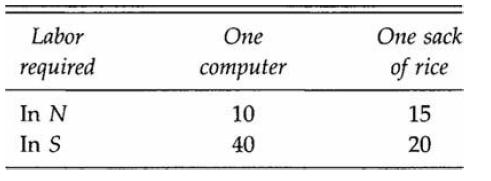
Consider the Ricardian model of trade described in this chapter. Use Table 16.5 to answer the questions that follow.Table 16.5(a) Show that if the relative price of computers to rice were any amount smaller than 2:3, country N would only produce rice. Likewise, show that country N will only
Here is another exercise on the Ricardian model: If less resources are used in country N to produce each of the goods, how is it that country S gets to export one of the goods? The answer is that country N must pay its factor of production (labor in our example) a higher wage. To appreciate this
Per capita income is a measure of purchasing power. People who live and work in developing countries often find that their incomes are meager when buying an international airline ticket, making an international phone call, sending an airmail letter to a friend who lives abroad, buying a book
McDonald’s operates in various countries. It has been found that the relative price of a Big Mac is a better guide to the overall cost of living than estimates using the exchange rate. Why do you think this might be the case?
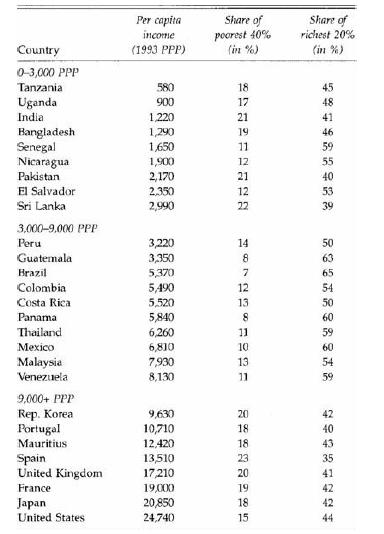
Use Table 2.1 to construct what is known as a Kuznets ratio (named after the economist and historian Simon Kuznets): the ratio of incomes earned by the richest 20% of the population to the those earned by the poorest 40% of the population. If incomes were distributed almost equally, what value
Why do you think that European or Japanese television transmits at resolutions that are superior to those in the United States? After looking into this question, formulate a hypothesis that suggests why countries that have poor infrastructure might be more likely to leapfrog over countries with
Make sure you understand the power of exponential growth (and of rapid exponential inflation) by doing the following exercises:(a) How quickly will a country be growing at 10% a year double its income? Quadruple its income? What about a country growing at 5% per year?(b) Suppose a country’s per
Construct an imaginary mobility matrix from a sample of countries that shows no mobility at all. What would it look like? What would a mobility matrix with “perfect mobility” look like? What would a mobility matrix look like if poor countries grow, on average, faster than rich countries?
Think of various indicators of development that you would like to see in your concept of “economic development.” Think about why per capita income, as measured, may or may not be a good proxy for these indicators. Find a copy of the Human Development Report and look at it to see how different
A cogent example in which per capita magnitudes may be misleading if we do not have a good idea of distribution comes from the study of modern famine. Why do famines simply not make sense if we look at them from the viewpoint of worldwide per capita availability of food grain? Do they make better
The best way to think about the Harrod–Domar equations is to attach some numbers to them. First, let us work with the simple Harrod–Domar equation (3.5). Imagine that a country has a national savings rate of 20% and that the capital–output ratio is 4. This latter statement means that $4 of
(a) Why do you think population growth rates fall with development? If people consume more goods, in general, as they get richer and children are just another consumption good (a source of pleasure to their parents), then why don’t people in richer countries “consume” more children?(b) Why
A firm is set up to produce and sell cotton shirts. It buys plant and machinery for $2 million and land for $1 million, and constructs a warehouse for another $1 million. Each year, it hires 100 workers and pays each of them $2,000 per year. It buys $600,000 worth of cotton fabric to be used in
Suppose that the country of Xanadu saves 20% of its income and has a capital–output ratio of 4.(a) Using the Harrod–Domar model, calculate the rate of growth of total GNP in Xanadu.(b) If population growth were 3% per year and Xanadu wanted to achieve a growth rate per capita of 4% per year,
(a) Suppose that as a professor in India my salary is rupees (Rs) 100,000 per year and that I get a raise of Rs 1,000 per year. Suppose that a schoolteacher who earns Rs 50,000 per year also gets the same raise of Rs 1,000. Convince yourself that the growth rates of our incomes are indeed
This is an exercise to understand the Solow model,(a) The economy of Ping Pong produces its GNP using capital and labor. The labor force is growing at 2% per year. At the same time, there is “labor-augmenting” technical progress at the rate of 3% per year, so that each unit of labor is
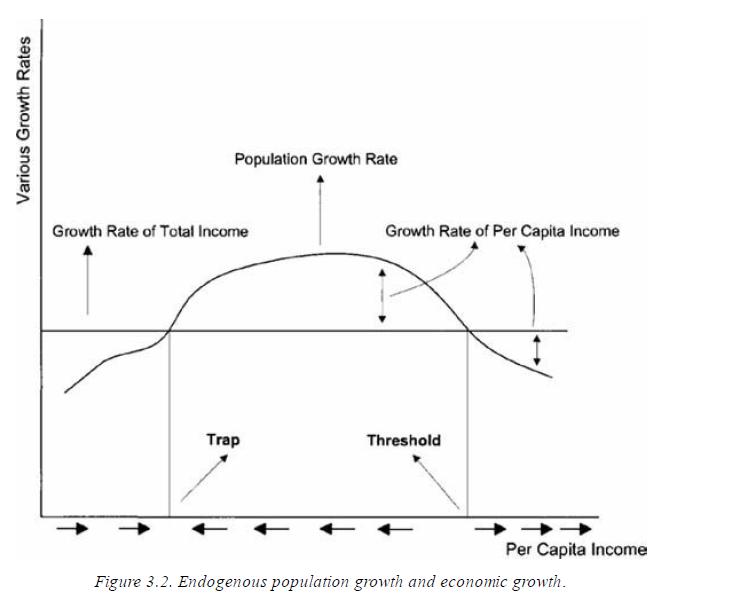
Consider the model of endogenous population growth that we summarized in Figure 3.2.Figure 3.2.Suppose that the curve describing population growth rates always lies below the line describing growth of total incomes. Explain this situation in words and describe what per capita growth rates will look
(a) Consider the Solow model. Show that savings rates and depreciation rates have only level effects on both per capita income and total income. What about the effect of population growth on per capita income?(b) Recall the Harrod–Domar model. What kind of effect do the same parameters have on
Discuss whether the following statements are true or false.(a) The Harrod–Domar model states that a country’s per capita growth rate depends on its rate of savings, whereas the Solow model states that it does not.(b) According to the Harrod–Domar model, if the capital–output ratio in a
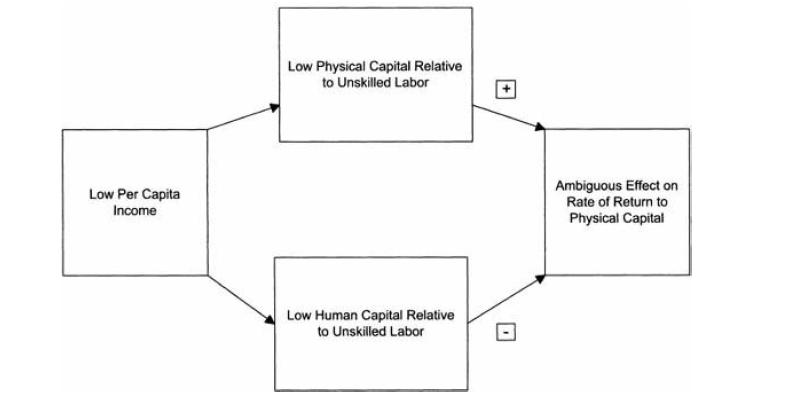
Think about the model of human capital and growth introduced in this chapter. One useful feature of this model is that it simultaneously explains how rates of return to physical capital as well as the wage rate for unskilled labor might be low for developing countries (see Figure 4.1 for a
Showing 300 - 400
of 606
1
2
3
4
5
6
7
Step by Step Answers

 Get 50% OFF
Claim Now
Get 50% OFF
Claim Now