New Semester
Started
Get
50% OFF
Study Help!
--h --m --s
Claim Now
Question Answers
Textbooks
Find textbooks, questions and answers
Oops, something went wrong!
Change your search query and then try again
S
Books
FREE
Study Help
Expert Questions
Accounting
General Management
Mathematics
Finance
Organizational Behaviour
Law
Physics
Operating System
Management Leadership
Sociology
Programming
Marketing
Database
Computer Network
Economics
Textbooks Solutions
Accounting
Managerial Accounting
Management Leadership
Cost Accounting
Statistics
Business Law
Corporate Finance
Finance
Economics
Auditing
Tutors
Online Tutors
Find a Tutor
Hire a Tutor
Become a Tutor
AI Tutor
AI Study Planner
NEW
Sell Books
Search
Search
Sign In
Register
study help
business
econometrics
Econometrics 1st Edition Bruce Hansen - Solutions
For each of the following monthly series from FRED-MD implement theDickey-Fuller unit root test. For each, you need to consider the AR order p and the trend specification.(a) log real personal income: log(rpi)(b) industrial production index: indpro(c) housing starts: houst(d) help-wanted index:
An economist wants to build an autoregressive model for the number of daily tweets by a prominant politician. For a model with an intercept they obtain ADF Æ ¡2.0. They assert “The number of tweets is a unit root process.” Is there an error in their reasoning?
An economist takes Yt , detrends to obtain the detrended series Zt , applies a ADF test to Zt and finds ADF Æ ¡2.5. They assert: “Stata provides the 5% critical value ¡1.9 with p-value less than 1%. Thus we reject the null hypothesis of a unit root.” Is there an error in their reasoning?
An economist estimates the model Yt Æ ®Yt¡1 Å et and finds b®Æ 0.9 with s (b®) Æ 0.04.They assert: “The 95% confidence interval for ® is [0.82,0.98] which does not contain 1. So ® Æ 1 is not consistent with the data.” Is there an error in their reasoning?
An economist estimates the model Yt Æ ®Yt¡1Ået and finds b®Æ 0.9 with s (b®) Æ 0.05. They assert: “The t-statistic for testing ® Æ 1 is 2, so ® Æ 1 is rejected.” Is there an error in their reasoning?
Take the VECM(1) model ¢Yt Æ ®¯0Yt¡1Ået . Showthat Zt Æ ¯0Yt follows an AR(1) process.
Take the AR(1) model Yt Æ ®Yt¡1 Ået with i.i.d. et and the least squares estimator b®. In Chaper 14 we learned that the asymptotic distribution when j®j Ç 1 is pn (b®¡®) ¡!d N¡0,1¡®2¢. How do you reconcile this with Theorem 16.9, especially for ® close to one?
LetUt ÆUt¡1 Ået , Yt ÆUt Åvt and Xt Æ 2Ut Åwt , where (et , vt ,wt ) is an i.i.d. sequence.Find the cointegrating vector for (Yt ,Xt ).
Let Yt Æ et be i.i.d. and Xt Æ ¢Yt .(a) Show that Yt is stationary and I (0).(b) Show that Xt is stationary but not I (0).
Suppose Yt Æ Xt Åut where Xt Æ Xt¡1 Ået with (et ,ut ) » I (0).(a) Is Yt I (0) or I (1)?.(b) Find the asymptotic functional distribution of n¡1/2Ybnr c.
Find the Beveridge-Nelson decomposition of ¢Yt Æ et Å£1et¡1 Å£2et¡2.
Take St Æ St¡1 Ået with S0 Æ 0 and et i.i.d. (0,¾2).(a) Calculate E[St ] and var[St ].(b) Set Yt Æ (St ¡E[St ])/p var[St ]. By construction E[Yt ] Æ 0 and var[Yt ] Æ 1. Is Yt stationary?(c) Find the asymptotic distribution of Ybnr c for r 2 [±,1].
Shapiro and Watson (1988) estimated a structural VAR imposing long-run constraints.Replicate a simplified version of their model. Take the quarterly series hoanbs (hours worked, nonfarm business sector), gdpc1 (real GDP), and gdpctpi (GDP deflator) from FRED-QD. Transform the first two to growth
Take the quarterly series gdpc1 (real GDP), m1realx (real M1 money stock), and cpiaucsl(CPI) fromFRED-QD. Create nominalM1 (multiply m1realx times cpiaucsl), and transformreal GDP and nominal M1 to growth rates. The hypothesis of monetary neutrality is that the nominal money supply has no effect on
Take the Kilian2009 dataset which has the variables oil (oil production), output (global economic activity), and price (price of crude oil). Consider a structural VAR based on short-run restrictions.Use a structure of the form Aet Æ "t . Impose the restrictions that oil production does not respond
Take the quarterly series gpdic1 (Real Gross Private Domestic Investment), gdpctpi (GDP price deflator), gdpc1 (real GDP), and fedfunds (Fed funds interest rate) from FRED-QD. Transform the first three into logs, e.g. gdpÆ 100log(gdpc1). Consider a structural VAR based on short-run
Take themonthly series permit (building permits), houst (housing starts), and realln (real estate loans) from FRED-MD. The listed ordering is motivated by transaction timing. A developer is required to obtain a building permit before they start building a house (the latter is known as a “housing
Take the Kilian2009 dataset which has the variables oil (oil production), output (global economic activity), and price (price of crude oil). Estimate an orthogonalized VAR(4) using the same ordering as in Kilian (2009) as described in Section 15.24. (As described in that section, multiply “oil”
Take the quarterly series gdpc1 (real GDP), gdpctpi (GDP price deflator), and fedfunds(Fed funds interest rate) from FRED-QD. Transform the first two into growth rates as in Section 15.13.Estimate the same three-variable VAR(6) using the same ordering. The identification strategy discussed in
You read an empirical paper which estimates a VAR in a listed set of variables and displays estimated orthogonalized impulse response functions. No comment is made in the paper about the ordering or the identification of the system, and you have no reason to believe that the order used
Cholesky factorization(a) Derive the Cholesky decomposition of the covariance matrix·¾21½¾1¾2½¾1¾2 ¾21 ¸.(b) Write the answer for the correlation matrix (the special case ¾21Æ 1 and ¾22Æ 1).(c) Find an upper triangular decomposition for the correlation matrix. That is, an
Let bet be the least squares residuals from an estimated VAR,b§be the residual covariance matrix, and bB Æ chol(b§). Show that bB can be calculated by recursive least squares using the residuals.
Suppose that you have 20 years of monthly observations onm Æ 8 variables. Your advisor recommends p Æ 12 lags to account for annual patterns. Howmany coefficients per equation will you be estimating? How many observations do you have? In this context does it make sense to you to estimate a
Continuting the previous exercise, suppose that both Y2t does not Granger-cause Y1t , and Y1t does not Granger-cause Y2t . What are the implications for the VAR coefficient matrices A1 and A2?
Let Yt Æ (Y1t ,Y2t )0 be 2£1 and consider a VAR(2) model. Suppose Y2t does not Grangercause Y1t . What are the implications for the VAR coefficient matrices A1 and A2?
Derive a VAR(1) representation of a VAR(p) process analogously to equation (14.33) for autoregressions.Use this to derive an explicit formula for the h-step impulse response IRF(h) analogously to (14.42).
In the VAR(2) model Yt Æ A1Yt¡1 Å A2Yt¡2 Ået find explicit expressions for the moving average matrix £h from (15.3) for h Æ 1, ...4.
In the VAR(1) model Yt Æ A1Yt¡1 Ået find an explicit expression for the h-step moving average matrix £h from (15.3).
Suppose Yi t , i Æ 1, ...,m, are independent AR(p) processes. Derive the form of their joint VAR representation.
Suppose Yt Æ AYt¡1 Åut and ut Æ But¡1 Ået . Show that Yt is a VAR(2) and derive the coefficient matrices and equation error.
Take the VAR(2) model Yt Æ A1Yt¡1ÅA2Yt¡2Ået with A1 Æ·0.3 0.2 0.2 0.3¸and A2 Æ·0.4 ¡0.1¡0.1 0.4¸.Assume et is i.i.d. Is Yt strictly stationary? Use mathematical software if needed.
Take the VAR(1) model Yt Æ AYt¡1 Ået . Assume et is i.i.d. For each specified matrix A below, check if Yt is strictly stationary. Use mathematical software to compute eigenvalues if needed.(a) A Æ·0.7 0.2 0.2 0.7¸(b) A Æ·0.8 0.4 0.4 0.8¸(c) A Æ·0.8 0.4¡0.4 0.8¸
Take the quarterly series gdpc1 (real GDP) and houst (housing starts) from FRED-QD.“Housing starts” are the number of new houses on which construction is started.(a) Transformthe real GDP series into its one quarter growth rate.(b) Estimate a distributed lag regression of GDP growth on housing
Take the quarterly series unrate (unemployment rate) and claimsx (initial claims) from FRED-QD. “Initial claims” are the number of individuals who file for unemployment insurance.(a) Estimate a distributed lag regression of the unemployment rate on initial claims. Use lags 1 through 4. Which
Take themonthly series unrate (unemployment rate) from FRED-MD.(a) Estimate AR(1) through AR(8) models, using the sample starting in 1960m1 so that all models use the same observations.(b) Compute the AIC for each AR model and report.(c) Which ARmodel has the lowest AIC?(d) Report the coefficient
Take the quarterly series oilpricex (real price of crude oil) from FRED-QD.(a) Transformthe series by taking first differences.(b) Estimate an AR(4)model. Report using heteroskedastic-consistent standard errors.(c) Test the hypothesis that the real oil prices is a random walk by testing that the
Take the quarterly series pnfix (nonresidential real private fixed investment) fromFRED-QD.(a) Transformthe series into quarterly growth rates.(b) Estimate an AR(4)model. Report using heteroskedastic-consistent standard errors.(c) Repeat using the Newey-West standard errors, using M Æ 5.(d)
Take the nonlinear process Yt Æ Y ®t¡1u1¡®t where ut is i.i.d. with strictly positive support.(a) Find the condition under which Yt is strictly stationary and ergodic.(b) Find an explicit expression for Yt as a function of (ut ,ut¡1, ...).
Assume that Yt is a Gaussian AR(1) as in the previous exercise. Calculate the moments¹ Æ E[Yt ]¾2 Y Æ E h¡Yt ¡¹¢2 i· Æ E h¡Yt ¡¹¢4 iA colleague suggests estimating the parameters (®0,®1,¾2) of the Gaussian AR(1) model by GMM applied to the corresponding sample moments. He points
A Gaussian AR model is an autoregression with i.i.d. N(0,¾2) errors. Consider the Gaussian AR(1) model Yt Æ ®0 Å®1Yt¡1 Ået et »N¡0,¾2¢with j®1j Ç 1. Show that the marginal distribution of Yt is also normal:Yt »Nî0 1¡®1,¾2 1¡®21!.Hint: Use the MA representation of Yt .
Suppose that Yt Æ Xt Ået Xt Æ ®Xt¡1 Åut where the errors et and ut are mutually independent i.i.d. processes. Show that Yt is an ARMA(1,1)process.
Suppose that Yt Æ et Åut ŵut¡1 where ut and et are mutually independent i.i.d. (0,1)processes.(a) Show that Yt is aMA(1) process Yt Æ ´t Åôt¡1 for a white noise error ´t .Hint: Calculate the autocorrelation function of Yt .(b) Find an expression for à in terms of µ.(c) Suppose µ Æ
Take themodel®(L)Yt Æ ut¯(L)ut Æ et where ®(L) and ¯(L) are p and q order lag polynomials. Show that these equations imply that°(L)Yt Æ et for some lag polynomial °(L). What is the order of °(L)?
Show that the models®(L)Yt Æ ®0 Ået and®(L)Yt Æ ¹Åut®(L)ut Æ et are identical. Find an expression for ¹ in terms of ®0 and ®(L).
Take the AR(2) model Yt Æ ®1Yt¡1 Å®2Yt¡1 Ået .(a) Find expressions for the impulse responses b1, b2, b3 and b4.(b) Let (b®1,b®2) be the least squares estimator. Find an estimator of b2.(c) Let bV be the estimated covariance matrix for the coefficients. Use the delta method to find a
Take the AR(1) model with no intercept Yt Æ ®1Yt¡1 Ået .(a) Find the impulse response function bj Æ @@et YtÅj .(b) Let b®1 be the least squares estimator of ®1. Find an estimator of bj .(c) Let s (b®1) be a standard error for b®1. Use the delta method to find a 95% asymptotic confidence
Suppose Yt Æ Yt¡1 Ået with et i.i.d. (0,1) and Y0 Æ 0. Find var[Yt ]. Is Yt stationary?
Verify the formula ½(k) ƳP1 jÆ0 µjÅkµj´/³Pq jÆ0 µ2j´for aMA(1) process.
Verify the formula ½(1) Æ µ/¡1ŵ2¢for aMA(1) process.
A stochastic volatility model is Yt Æ ¾t et log¾2tÆ !ůlog¾2t¡1 Åut where et and ut are independent i.i.d. N(0,1) shocks.(a) Write down an information set for which Yt is aMDS.(b) Show that if¯¯¯¯¯Ç 1 then Yt is strictly stationary and ergodic.
Continuing the previous exercise, show that if E£e4 t¤Ç1then n¡1/2 Xn tÆ1¡e2 t ¡¾2t¢¡!d N¡0, v2¢.Express v2 in terms of themoments of et .
Let ¾2tÆ E£e2 t jFt¡1¤. Show that ut Æ e2 t ¡¾2t is aMDS.
Show that if (et ,Ft ) is a MDS and Xt is Ft-measurable then ut Æ Xt¡1et is aMDS.
For a scalar time series Yt define the sample autocovariance and autocorrelationAssume the series is strictly stationary, ergodic, strictly stationary, and E £Y 2 t ¤Ç1.Show that b°(k) ¡!p °(k) and b½(k) ¡!p °(k) as n!1. (Use the Ergodic Theorem.) (k) = n (k) p(k) = (0) t=k+1 (Y-Y) (Y-k-Y)
Continuation of Exercise 12.24, which involved estimation of a wage equation by 2SLS.(a) Re-estimate the model in part (a) by efficient GMM. Do the results changemeaningfully?(b) Re-estimate the model in part (d) by efficient GMM. Do the results changemeaningfully?(c) Report the J statistic for
Continuation of Exercise 12.22, based on the empiricalwork reported in Acemoglu, Johnson, and Robinson (2001).(a) Re-estimate the model estimated in part (j) by efficient GMM. Use the 2SLS estimates as the firststep for the weight matrix and then calculate the GMMestimator using this weight matrix
Take the model Y Æ X0¯Åe with E[e j X] Æ 0 and E£e2 j X¤Æ ¾2. An econometrician more enterprising than the one in previous question notices that this implies the nk moment conditions E[Xi ei ] Æ 0, i Æ 1, ...,n.We can write the moments using matrix notation as E hX 0 ¡Y ¡X ¯¢i where X
Take themodel Y Æ X0¯Åe with E[Xe] Æ 0 where X contains an intercept so E[e] Æ 0. An enterprising econometrician notices that this implies the n moment conditions E[ei ] Æ 0, i Æ 1, ...,n.Given an n £n weight matrixW, this implies a GMMcriterion J (¯) Æ¡Y ¡X ¯¢0W¡Y ¡X ¯¢.(a) Under
Take themodel Y Æ µÅe with E[Xe] Æ 0, Y 2 R, X 2 Rk and (Yi ,Xi ) a random sample.(a) Find the efficient GMMestimator of µ.(b) Is this model over-identified or just-identified?(c) Find the GMMtest statistic for over-identification.
Take the model Y Æ X0¯Åe with E[Xe] Æ 0 and ¯ ÆQµ, where ¯ is k £1, Q is k £m with m Ç k, Q is known, and µ ism£1. The observations (Yi ,Xi ) are i.i.d. across i Æ 1, ...,n.Under these assumptions what is the efficient estimator of µ?
Consider the just-identified model Y Æ X0 1¯1 Å X0 2¯2 Åe with E[Ze] Æ 0 where X Æ (X0 1X0 2)0 2 Rk and Z 2 Rk . We want to test H0 : ¯1 Æ 0. Three econometricians are called for advice.• Econometrician 1 proposes testing H0 by aWald statistic.• Econometrician 2 suggests testing H0 by
Take the linear equation Y Æ X0¯Åe and consider the following estimators of ¯.1. b¯ : 2SLS using the instruments Z1.2. e¯ : 2SLS using the instruments Z2.3. ¯ : GMMusing the instruments Z Æ (Z1,Z2) and the weight matrix W Æà ¡Z0 1Z1¢¡1¸ 0 0¡Z0 2Z2¢¡1 (1¡¸)!for ¸ 2 (0, 1).Find an
Consider the model Y Æ X0¯Åe given E[Ze] Æ 0 and R0¯ Æ 0. The dimensions are X 2 Rk and Z 2 R` with ` È k. The matrix R is k £q, 1 · q Ç k. Derive an efficient GMMestimator for ¯.
You want to estimate ¹ Æ E[Y ] under the assumption that E[X] Æ 0, where Y and X are scalar and observed from a random sample. Find an efficient GMMestimator for ¹.
The observations are i.i.d., (Yi ,Xi ,Qi : i Æ 1, ...,n), where X is k £1 and Q is m£1. The model is Y Æ X0¯Åe with E[Xe] Æ 0 and E[Qe] Æ 0. Find the efficient GMMestimator for ¯.
The model is Y Æ Z¯Å X°Åe with E[e j Z] Æ 0, X 2 R and Z 2 R. X is potentially endogenous and Z is exogenous. Someone suggests estimating (¯,°) by GMM using the pair (Z,Z2) as instruments. Is this feasible? Under what conditions is this a valid estimator?
The observed data is {Yi ,Xi ,Zi } 2 R£Rk £R`, k È 1 and ` È k È 1, i Æ 1, ...,n. The model is Y Æ X0¯Åe with E[Ze] Æ 0.(a) Given a weightmatrixW È 0 write down the GMMestimator b¯ for ¯.(b) Suppose the model is misspecified. Specifically, assume that for some ± 6Æ 0, e Æ ±n¡1/2
Consider the model Y Æ X0¯Åe with E[Ze] Æ 0 and R0¯ Æ 0 (13.31)with Y 2 R, X 2 Rk , Z 2 R`, ` È k. The matrix R is k £ q with 1 · q Ç k. You have a random sample(Yi ,Xi ,Zi : i Æ 1, ...,n).For simplicity, assume the efficient weight matrixW Æ¡E£Z Z0e2¤¢¡1 is known.(a) Write out the
Take the model Y Æ X0¯Åe with E[Ze] Æ 0, Y 2 R, X 2 Rk , Z 2 R`, ` ¸ k. Consider the statisticfor some weight matrixW È 0.(a) Take the hypothesis H0 : ¯ Æ ¯0. Derive the asymptotic distribution of J (¯0) under H0 as n!1.(b) What choice for W yields a known asymptotic distribution in part
Take the linear model Y Æ X0¯Åe with E[Ze] Æ 0. Consider the GMM estimator b¯ of ¯.Let J Æ n g n( b¯)0b¡1g n( b¯) denote the test of overidentifying restrictions. Show that J ¡!dÂ2`¡k as n !1 by demonstrating each of the following.(a) Since È 0, we can write ¡1 ÆCC0 and
In the linear model Y Æ X0¯Åe with E[Xe] Æ 0 the GMMcriterion function for ¯ is J (¯) Æ1 n¡Y ¡X ¯¢0 Xb¡1X 0 ¡Y ¡X ¯¢(13.29)where bÆ n¡1PniÆ1 Xi X0 i be2 i , bei Æ Yi ¡ X0 ib¯ are the OLS residuals, and b¯ Æ¡X 0X¢¡1 X 0Y is least squares.The GMMestimator of ¯ subject
As a continuation of Exercise 12.7 derive the efficient GMM estimator using the instrument Z Æ (X X2)0. Does this differ from 2SLS and/or OLS?
The equation of interest is Y Æm(X,¯)Åe with E[Ze] Æ 0 wherem(x,¯) is a known function,¯ is k £1 and Z is `£1. Show how to construct an efficient GMMestimator for ¯.
Prove Theorem13.10.
Prove Theorem13.9.
Showthat the constrainedGMMestimator (13.16)with the efficientweight matrix is (13.19).
Derive the constrained GMMestimator (13.16).
Prove Theorem13.8.
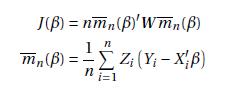
In the linear model estimated by GMMwith general weight matrixW the asymptotic variance of b¯gmm is V Æ¡Q0WQ¢¡1Q0WWQ¡Q0WQ¢¡1 .(a) Let V 0 be this matrix whenW Æ¡1. Show that V 0 Æ¡Q0¡1Q¢¡1 .(b) Wewant to showthat for anyW, V ¡V 0 is positive semi-definite (for then V 0 is the
Take the model Y Æ X0¯Åe with E[Ze] Æ 0. Let eei Æ Yi ¡ X0 ie¯ where e¯ is consistent for ¯(e.g. a GMMestimator with some weight matrix). An estimator of the optimal GMMweight matrix is cW ÆÃ1 nXn iÆ1 Zi Z0 i ee2 i!¡1.Show that cW ¡!p¡1 where Æ E£Z Z0e2¤.
Take the model Y Æ X0¯Åe with E[e j Z] Æ 0. Let b¯gmm be the GMM estimator using the weight matrixWn Æ¡Z0Z¢¡1 . Under the assumption E£e2 j Z¤Æ ¾2 show that pn¡ b¯¡¯¢¡!d N³0,¾2 ¡Q0M¡1Q¢¡1´where Q Æ E£Z X0¤and M Æ E£Z Z0¤.
Take themodelFind the method of moments estimators ¡ b¯, b°¢for ¡¯,°¢. Y = X'B+e E[Xe]=0 e = Z'y+n E Zn] = 0.
In Exercise 12.26 you extended the work reported in Angrist and Krueger (1991) by estimating wage equations for the subsample of Black men. Re-estimate equation (12.92) for this group using as instruments only the three quarter-of-birth dummy variables. Calculate the standard error for the return
You will extend Angrist and Krueger (1991) using the data file AK1991 on the textbook website.. Their Table VIII reports estimates of an analog of (12.90) for the subsample of 26,913 Black men. Use this sub-sample for the following analysis.(a) Estimate an equation which is identical in form to
In Exercise 12.24 you extended the work reported in Card (1995). Now, estimate the IV equation corresponding to the IV(a) column of Table 12.1 which is the baseline specification considered in Card. Use the bootstrap to calculate a BC percentile confidence interval. In this example should we also
You will replicate and extend the work reported in the chapter relating to Card (1995).The data is from the author’s website and is posted as Card1995. The model we focus on is labeled 2SLS(a) in Table 12.1 which uses public and private as instruments for edu. The variables you will need for this
In Exercise 12.22 you extended the work reported in Acemoglu, Johnson, and Robinson(2001). Consider the 2SLS regression (12.88). Compute the standard errors both by the asymptotic formula and by the bootstrap using a large number (10,000) of bootstrap replications. Re-calculate the bootstrap
You will replicate and extend the work reported in Acemoglu, Johnson, and Robinson(2001). The authors provided an expanded set of controls when they published their 2012 extension and posted the data on the AER website. This dataset is AJR2001 on the textbook website.(a) Estimate the OLS regression
In the linear model Y Æ X¯Åe with X 2 R suppose ¾2(x) Æ E£e2 j X Æ x¤is known. Show that the GLS estimator of ¯ can be written as an instrumental variables estimator using some instrument Z. (Find an expression for Z.)
The model is Y Æ X0¯Åe with E[Ze] Æ 0. An economist wants to obtain the 2SLS estimates and standard errors for ¯. He uses the following steps• Regresses X on Z, obtains the predicted values bX.• Regresses Y on bX, obtains the coefficient estimate b¯ and standard error s( b¯) from this
You want to use household data to estimate ¯ in the model Y Æ X¯Åe with X scalar and endogenous, using as an instrument the state of residence.(a) What are the assumptions needed to justify this choice of instrument?(b) Is the model just identified or overidentified?
You have two independent i.i.d. samples (Y1i ,X1i ,Z1i : i Æ 1, ...,n) and (Y2i ,X2i ,Z2i : i Æ1, ...,n). The dependent variables Y1 and Y2 are real-valued. The regressors X1 and X2 and instruments Z1 and Z2 are k-vectors. The model is standard just-identified linear instrumental variables Y1 Æ
Take the model Y Æ X0¯ Å e with E[Ze] Æ 0 and consider the two-stage least squares estimator. The first-stage estimate is least squares of X on Z with least squares fitted values bX. The second-stage is least squares of Y on bX with coefficient estimator b¯ and least squares residuals bei ÆYi
Take a linear equation with endogeneity and a just-identified linear reduced form Y ÆX¯Åe with X Æ °Z Åu2 where both X and Z are scalar 1£1. Assume that E[Ze] Æ 0 and E[Zu2] Æ 0.(a) Derive the reduced formequation Y Æ Z¸Åu1. Show that ¯ Æ ¸/° if ° 6Æ 0, and that E[Zu] Æ 0.(b)
Take the linear instrumental variables equation Y1 Æ Z¯1 Å Y2¯2 Å e with E[e j Z] Æ 0 where both X and Z are scalar 1£1.(a) Can the coefficients (¯1,¯2) be estimated by 2SLS using Z as an instrument for Y2?Why or why not?(b) Can the coefficients (¯1,¯2) be estimated by 2SLS using Z and
Take the linear instrumental variables equation Y1 Æ Z0 1¯1ÅY 0 2¯2Åe with E[Ze] Æ 0 where Z1 is k1 £1, Y2 is k2 £1, and Z is `£1, with ` ¸ k Æ k1 Åk2. The sample size is n. Assume that QZ Z ÆE£Z Z0¤È 0 and QZ X Æ E£Z X0¤has full rank k.Suppose that only (Y1,Z1,Z2) are available
Consider the structural equation Y1 Æ Z0 1¯1 ÅY 0 2¯2 Åe with E[Ze] Æ 0 where Y2 is k2 £1 and treated as endogenous. The variables Z Æ (Z1,Z2) are treated as exogenous where Z2 is `2 £1 and`2 ¸ k2. You are interested in testing the hypothesis H0 : ¯2 Æ 0.Consider the reduced
Consider the structural equation and reduced form Y Æ ¯X2 Åe X Æ °Z Åu E[Ze] Æ 0 E[Zu] Æ 0 with X2 treated as endogenous so that E£X2e¤6Æ 0. For simplicity assume no intercepts. Y , Z, and X are scalar. Assume ° 6Æ 0. Consider the following estimator. First, estimate ° by OLS of X on
Consider the structural equation Y Æ ¯0 ů1X ů2X2 Åe (12.93)with X 2 R treated as endogenous so that E[Xe] 6Æ 0. We have an instrument Z 2 R which satisfies E[e j Z] Æ 0 so in particular E[e] Æ 0 , E[Ze] Æ 0 and E£Z2e¤Æ 0.(a) Should X2 be treated as endogenous or exogenous?(b)
Consider the model Y Æ X0¯Åe X Æ ¡0Z Åu E[Ze] Æ 0 E£Zu0¤Æ 0 with Y scalar and X and Z each a k vector. You have a random sample (Yi ,Xi ,Zi : i Æ 1, ...,n). Take the control function equation e Æ u0°Åº with E[uº] Æ 0 and assume for simplicity that u is observed.Inserting into the
Showing 800 - 900
of 4105
First
2
3
4
5
6
7
8
9
10
11
12
13
14
15
16
Last
Step by Step Answers

 Get 50% OFF
Claim Now
Get 50% OFF
Claim Now