New Semester
Started
Get
50% OFF
Study Help!
--h --m --s
Claim Now
Question Answers
Textbooks
Find textbooks, questions and answers
Oops, something went wrong!
Change your search query and then try again
S
Books
FREE
Study Help
Expert Questions
Accounting
General Management
Mathematics
Finance
Organizational Behaviour
Law
Physics
Operating System
Management Leadership
Sociology
Programming
Marketing
Database
Computer Network
Economics
Textbooks Solutions
Accounting
Managerial Accounting
Management Leadership
Cost Accounting
Statistics
Business Law
Corporate Finance
Finance
Economics
Auditing
Tutors
Online Tutors
Find a Tutor
Hire a Tutor
Become a Tutor
AI Tutor
AI Study Planner
NEW
Sell Books
Search
Search
Sign In
Register
study help
business
microeconomics
Microeconomics In Context 4th Edition Neva Goodwin , Jonathan M. Harris, Julie A. Nelson , Pratistha Joshi Rajkarnikar , Brian Roach , Mariano Torras - Solutions
20. How can government spending policies and other regulations impact inequality?
19. Does economic resear generally support the view that increasing the minimum wage will reduce income inequality?
18. What is the difference between market and disposable income?
17. How can tax and transfer policies be used to reduce inequality?
16. What are some of the consequences of inequality?
15. What is the Kuznets curve hypothesis? Does the resear generally support the theory?
14. What are the four main reasons proposed to explain growing inequality in the United States and other developed countries?
13. How do median wealth levels in the United States compare to other industrialized countries?
12. How is it that the global Gini coefficient is declining but the Gini coefficients in most countries are increasing?
11. How is it that the global Gini coefficient for income is higher than the Gini coefficient for any single country?
10. How does economic inequality in the United States compare to other countries?
9. How does economic mobility in the United States compare to that in other industrialized countries?
8. What is economic mobility?
7. How does income and wealth vary by race?
6. How has income inequality in the United States anged in recent decades?
5. What tends to be more unequal—the distribution of income or wealth? Why?
4. What effect do taxes and transfer payments have on the distribution of U.S. household income?
3. What is the Gini coefficient (or ratio)? What does a higher value of the coefficient signify?
2. How is a Lorenz curve constructed? What does it measure?
1. About what share of aggregate income does ea quintile of households receive in the United States?
2. Do you think the spending priorities of the government should be anged in order to reduce economic inequality? Beyond the suggestions in the text, can you think of any other ways that government spending priorities could be anged?
1. Do you generally believe that raising taxes on the ri is an appropriate approa for reducing economic inequality? What level of taxation on the ri do you think is fair? (Note that we will also consider this topic in the next apter.)
2. Do you think rising inequality in a rapidly developing low-income country is necessarily a problem?How might you approa the issue of high economic inequality differently in a developing versus a developed country?
1. If you could ange a single one of the “causes” of inequality described above, on whi would youoose to focus? Why?
2. What are the main trends in global inequality? Do these seem to be positive or negative in terms of human well-being?
1. What do you think are the reasons that the United States is more unequal than other developed countries, and has lower economic mobility? What policies might be used to address this issue?
2. Make a list of the reasons that inequality can be considered desirable, and the ways in whiinequality hurts social well-being. Is it possible to limit the negative consequences of inequality while still harnessing the positive aspects?
1. Were your parents beer off economically than their parents? Do you believe that you will be beer off than your parents? Do you think that this is true of most of your friends?
2. What do you think is the minimal amount of annual income that an individual, or a small family, would need to live in your community? (ink about the rent or mortgage on a one- or two-bedroom residence, etc.) What does this probably mean about where the average level of income in your
1. What are some of the differences between inequality of income and inequality of “capabilities” or well-being? How are these three concepts related? Whi one do you think deserves the most aention from policymakers?
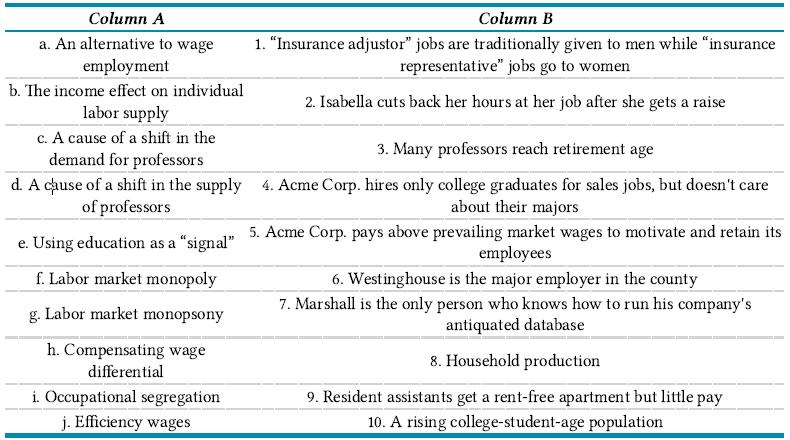
5. Mat ea concept in Column A with an example in Column B. Column A Column B a. An alternative to wage 1. "Insurance adjustor" jobs are traditionally given to men while "insurance representative" jobs go to women employment b. The income effect on individual labor supply c. A cause of a shift
4. e U.S. Bureau of Labor Statistics keeps tra of the average wages and number of workers involved in various occupations over time and also makes projections about what jobs may show the most growth in the future. Using data available at the bureau’s Web site, www.bls.gov, try to look up
3. Suppose that you observe that the wages for accountants in your town have gone up and that the number of accountants employed has also gone up. Whi one of the following conditions could explain this? Illustrate your answer with a graph and explain in a brief paragraph.a. Businesses are
2. Draw labor market graphs illustrating the following examples that were mentioned in the text.a. A labor demand curve, when very good substitutes for labor in the production process exist.b. e effect of a drop in demand for the organization’s product.c. e effect of a rise in the price of
1. Reviewing Chapters 3 and 4 if necessary, illustrate on a labor market graph the following examples that were described in the text.a. A relatively elastic supply curve for wait staff.b. A virtually “fixed” supply of aerospace engineers, in the short run.c. e effect on the supply of
23. What is the role of political power in explaining the stagnation of median wages in the United States in recent decades?
22. What has been the trend in median wages in the United States in the past few decades? How does this compare with the trend in corporate profits?
21. How do paid vacation and leave policies in the United States compare to most other countries?
20. How do average work hours per year in the United States compare to most other countries?
19. What are worker cooperatives, and how do they differ from traditional firms in terms of labor organization?
18. What is the economic evidence about how immigration affects wages?
17. What is employment flexibility from the perspective of workers? From the perspective of employers?
16. How has labor market participation anged in the United States in recent decades?
15. What is occupational segregation?
14. How can we identify labor discrimination?
13. What are dual labor markets?
12. What is efficiency wage theory?
11. What is oligopsony?
10. What is monopsony?
9. What are compensating wage differentials?
8. How is human capital important in explaining wage variations?
7. How does the neoclassical labor model explain variations in wages?
6. How can we use a supply-and-demand graph to illustrate the operation of a labor market?
5. In what types of labor markets might labor supply be relatively wage elastic? In what types of markets might labor supply be relatively wage inelastic?
4. Why can we generally assume that market labor supply curves will slope upward?
3. Why might the individual labor supply curve bend baward?
2. What are some of the opportunity costs of paid employment?
1. In the neoclassical labor model, how does a firm decide on the quantity of labor to hire?
2. Do you think that the relative wages of average workers and top executives reflect their respective marginal revenue product? What kinds of policies would you favor regarding worker pay and executive compensation?
1. What evidence have you seen—in your own experience, others’ experiences, or through the media—of increasing “flexibility” in labor markets? Do you think that these anges have been beneficial, harmful, or both?
3. What do you think society should be doing, if anything, to reduce labor market discrimination? Do you have any experience with discrimination in the workplace?
2. is $10.87 for home health aides, $24.29 for firefighters, $38.39 for computer programmers, $56.81 for lawyers, and $76.81 for dentists.44 Based on the information in this section, try to explain why the wages for these various occupations differ. Do you think these wage differences are justified
1. According to the U.S. Bureau of Labor Statistics, the hourly median wage in
2. Opticians fit people who have poor eyesight with glasses or contact lenses, prescribed by an optometrist. Beginning in the 1990s, tenological developments in laser eye surgery made surgery an increasingly popular way of correcting bad eyesight. What effect do you think this development had on
1. Suppose that your college or university substantially raises the wages that it offers to pay students who tend computer laboratories, monitoring the equipment and answering questions. What do you think would happen to the quantity of labor supplied? Why? Where would the extra labor hours come
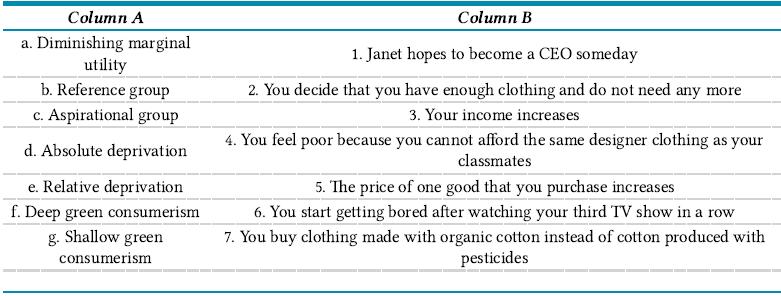
6. Mat ea concept in Column A with an example in Column B. Column A a. Diminishing marginal utility b. Reference group c. Aspirational group d. Absolute deprivation e. Relative deprivation f. Deep green consumerism g. Shallow green consumerism Column B 1. Janet hopes to become a CEO someday
5. Various U.S. government agencies, among them the Food and Drug Administration (FDA) and the Environmental Protection Agency (EPA), include “consumer protection” as one of their goals. e FDA, for example, decides whether drugs that pharmaceutical companies want to sell are safe and
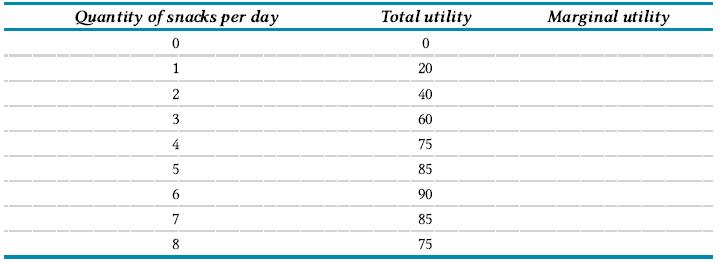
4. Suppose that Antonio’s total utility from different quantities of snas per day is given by the table below.a. Draw and label Antonio’s utility function for snas.b. Fill in the last column of the table above, calculating Antonio’s marginal utility from snas.c. Does Antonio always
3. Next, suppose that Monifa’s income stays at $100, but the price of concert tiets drops from $20 to$12.50 ea.a. Draw and carefully label both her original and her new budget lines.b. Can she afford 2 movie tiets and 6 concert tiets aer the price drop?
2. Continuing from the previous exercise, suppose that Monifa’s income rises to $120. Add her new budget line to the previous graph.
1. Monifa plans to spend her income on concert tiets and movie tiets. Suppose that she has an income of $100. e price of a concert tiet is $20, and the price of a movie tiet is $10.a. Draw, and carefully label, a budget line diagram illustrating the consumption combinations that she
25. How would consumption taxation work?
24. How can flexible work-hour policies reduce excessive consumerism?
23. What is voluntary simplicity?
22. About what percentage of Americans are considered compulsive shoppers?
21. What are the results of resear on the relationship between materialistic values and wellbeing?
20. Over time, does average happiness increase as a country’s average income increases?
19. Is average happiness higher in countries with higher average incomes?
18. Within one country, are those with higher incomes happier, on average?
17. What is subjective well-being?
16. What is green consumerism? What is the difference between “deep” and “shallow” green consumerism?
15. What is the ecological footprint approa to quantifying environmental impacts? What are some of the findings of ecological footprint resear?
14. About how mu is spent annually on advertising in the United States, on a per-person basis?
13. What are reference and aspirational groups?
12. What is the difference between absolute and relative deprivation?
11. How has revolving debt in the United States anged over time?
10. What were some of the key developments in the history of consumerism?
9. What is the consumer society?
8. What are some of the limitations of the standard consumer model?
7. What is diminishing marginal utility? What does it imply about the shape of a utility function?
6. What is marginal utility?
5. What is a utility function? How can we represent one on a graph?
4. How does a budget line ange when the price of one of the items anges?
3. How does a budget line ange when one’s income anges?
2. What is a budget line? How can we show one on a graph?
1. What is consumer sovereignty?
2. Do you believe that the government has a right to influence or otherwise interfere in consumer decisions? What additional policies, if any, do you think are needed regarding consumer behaviors?
1. In what ways do you think money can buy happiness? In what ways can having a lot of money decrease one’s happiness? How does money enter into your own conception of what happiness means?
2. Do you think that green consumerism is an oxymoron? Do you think that your own consumer behaviors are environmentally sustainable? Why or why not?
1. ink about one product you have purased recently that is not mentioned in the text. Try to list the environmental impacts of this product, considering the production, consumption, and eventual disposal of it. What steps do you think could be taken to reduce the environmental impacts
Showing 2000 - 2100
of 7548
First
14
15
16
17
18
19
20
21
22
23
24
25
26
27
28
Last
Step by Step Answers

 Get 50% OFF
Claim Now
Get 50% OFF
Claim Now