New Semester
Started
Get
50% OFF
Study Help!
--h --m --s
Claim Now
Question Answers
Textbooks
Find textbooks, questions and answers
Oops, something went wrong!
Change your search query and then try again
S
Books
FREE
Study Help
Expert Questions
Accounting
General Management
Mathematics
Finance
Organizational Behaviour
Law
Physics
Operating System
Management Leadership
Sociology
Programming
Marketing
Database
Computer Network
Economics
Textbooks Solutions
Accounting
Managerial Accounting
Management Leadership
Cost Accounting
Statistics
Business Law
Corporate Finance
Finance
Economics
Auditing
Tutors
Online Tutors
Find a Tutor
Hire a Tutor
Become a Tutor
AI Tutor
AI Study Planner
NEW
Sell Books
Search
Search
Sign In
Register
study help
business
microeconomics
Microeconomics In Context 4th Edition Neva Goodwin , Jonathan M. Harris, Julie A. Nelson , Pratistha Joshi Rajkarnikar , Brian Roach , Mariano Torras - Solutions
2. ink about at least one fashion item you own, su as an item of clothing, jewelry, or accessory, that you think says a lot about who you are. What do you think it says about you? Do you think others interpret the item in the same way that you do? How mu do you think that you were
1. What are your reference groups? Describe why you consider these your reference groups? What are your aspirational groups? Why do you aspire to be a member of these groups?
2. What do you know about views on consumerism in other countries, either from what you have read or what you have observed from traveling? Whi societies, if any, do you find too focused on consumerism? Whi societies, if any, do you think have appropriate views on consumerism?
1. Considering what you know about the societies in whi your grandparents or great-grandparents grew up, would you say that they lived in a “consumer society”? How do you think their views on consumerism as young adults might have differed from those of you and your friends?
2. Explain in words why the total utility curve has the shape that it does in Figure 8.4.
1. Budget lines can be used to analyze various kinds of tradeoffs. Suppose that you have a total “time budget” for recreation of 2 hours. ink of two activities you might like to do for recreation, and draw a budget line diagram illustrating the recreational opportunities open to you. What if
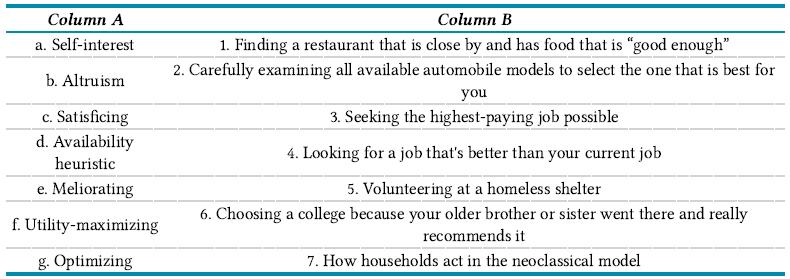
5. Mat ea concept in Column A with an example in Column B. Column A a. Self-interest b. Altruism c. Satisficing d. Availability heuristic e. Meliorating f. Utility-maximizing g. Optimizing Column B 1. Finding a restaurant that is close by and has food that is "good enough" 2. Carefully
4. Consider a rational, profit-maximizing business firm. What motivations might the firm have that are not directly related to making a profit? For example, what if the firm made a donation to a community organization or voluntarily cleaned up pollution resulting from its production process?Why
3. How does time discounting affect your own decision making? Do you do things today with a view toward future benefits, or do you look mainly for short-term satisfaction? Does your time discount rate differ in different areas of your life?
2. Consider the process of applying to college and oosing a college to aend if admied. Would you say that this process involves:a. Maximizing behaviorb. Satisficing behaviorc. Meliorating behaviord. Bounded rationality Could it involve a combination of them? Could this differ from person
1. Whi of the following is consistent with the view of human behavior as purely self-interested?Whi may indicate broader motivations?a. Miael sells his car on eBay.b. Jane joins a community clean-up group.c. Ramon studies to become a doctor.d. Joe buys a birthday present for his
22. What are some policy examples of "nudges"?
21. What is libertarian paternalism?
20. What are the policy implications of behavioral economics?
19. What is loss aversion?
18. Summarize the model of economic behavior in contextual economics.
17. Explain the concept of bounded rationality.
16. What is meliorating?
15. What is satisficing?
14. What are some of the insights from neuroeconomics?
13. What does the evidence indicate about the relationship between selfishness and happiness?
12. Does the scientific evidence indicate that people act only out of self-interest?
11. Does behavioral economics suggest that people's decisions can be significantly influenced by outside factors?
10. Does the evidence suggest that people should always make economic decisions without relying upon their emotions?
9. What is the difference between a high and low time discount rate?
8. What is the anoring effect?
7. Why is the default oice in a decision so important?
6. How can "framing" affect decision making?
5. What is the availability heuristic?
4. What is behavioral economics?
3. What are the policy implications of the neoclassical model?
2. What is the neoclassical model?
1. Did Adam Smith think that people were always self-interested?
2. What do you think about libertarian paternalism as a way to guide policies? Do you think there are any problems with this approa?
1. Do you think “satisficing” should be considered rational behavior? What about “meliorating”? For example, recall the example of the fisherman who compares ea fish that he cates to the one in the boat, keeping the larger one and throwing the others ba into the water. What might
2. Discuss how one or more conclusions reaed by behavioral economists help you to understand an experience that you have had making an economic decision.
1. Can you think of any other economic situations where people seem to make irrational decisions? For the most part, do you think people are rational or irrational?
2. Do you believe economics should strive, as mu as possible, to be value free? What do you think are the advantages and disadvantages of this approa?
1. Do you agree with the assumption of the neoclassical model that human behavior is rational and selfinterested?Can you think of some examples of economic behavior that might contradict these assumptions?
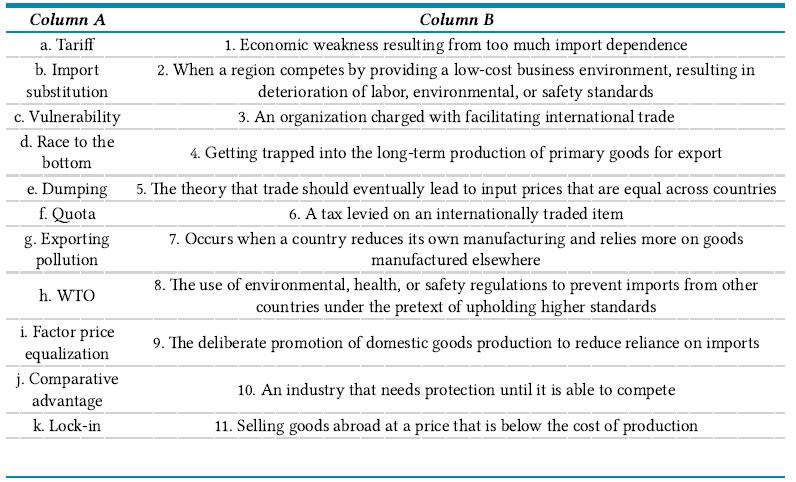
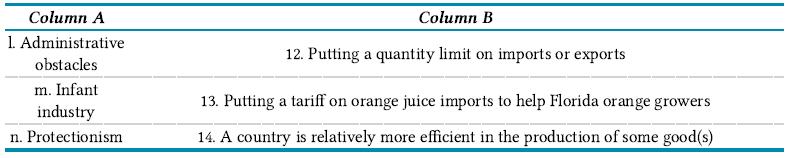
3. Mat ea concept in Column A with a definition or example in Column B. Column A a. Tariff b. Import substitution c. Vulnerability d. Race to the bottom e. Dumping f. Quota g. Exporting pollution h. WTO i. Factor price equalization j. Comparative advantage k. Lock-in Column B 1. Economic
2. Continuing the Ricardian story from Section 2.1 of this apter, suppose that England were, aer a while, to put a tariff on imports of Portuguese wine. Since we only have wine and cloth in this story, we will have to (somewhat unrealistically) express this tax in terms of units of goods
1. Hereland and ereland are two small countries. Ea currently produces both milk and corn, and they do not trade. If Hereland puts all its resources into milk, it can produce 2 tanker truloads, while if it puts all its resources into corn production, it can produce 8 tons. ereland can
27. What are some of the conflicts between developed and developing countries over trade issues?
26. What are some of the advantages and disadvantages of bilateral and regional trade agreements?
25. How can a trade war make both countries worse off?
24. What does the World Trade Organization do?
23. What are some administrative obstacles that can be used to influence trade?
22. How do countries use subsidies to influence trade?
21. What is a tariff, and have tariffs been increasing or decreasing in recent years?
20. What is the infant industry argument for trade protectionism?
19. What is import substitution?
18. List and describe four types of protectionist policies.
17. What is "trade protectionism," and why do countries oen engage in it?
16. What are some of the countries that are most active in international trade, as a percentage of GDP?
15. What is globalization?
14. What do we mean when we say that trade is more a story of redistribution than a story of efficiency gains?
13. What is “exporting pollution”?
12. What are some of the relationships between trade and the environment?
11. What is “lo-in,” and why is it a potential problem?
10. Why does a country’s vulnerability increase with expanded trade?
9. What are some other advantages of free trade?
8. What is the theory of “factor price equalization”? Does the evidence tend to support it?
7. What does it mean to say that a particular country is suited for labor-intensive production? What is capital-intensive production?
6. How do we determine whi country has the comparative advantage in the production of something in the Ricardian model of trade?
5. What is meant by the “principle of comparative advantage”?
4. How do we determine the opportunity cost of producing something in the Ricardian model of trade?
3. What is an absolute advantage in the production of something?
2. Explain how more extensive markets tend to produce a higher degree of specialization.
1. How does specialization lead to greater productivity, according to Adam Smith?
2. Debates between advocates of “free trade” and advocates of “protectionism” have gone on for hundreds of years. How aware are you of current debates, whi are now oen framed in terms of pro- and anti-“globalization”? Do you have more sympathy for one side than for the other? What
1. What international trade issues have been in the news recently? What views are presented by different interest groups in trade debates? Are there any issues that particularly affect your community?
2. What do you suppose Smith or Ricardo would have had to say about the disadvantages of free trade discussed in this apter? Do you agree with them? Why or why not?
1. Do you think it is beer to buy products made in your own country? If so, why? Can you think of situations where it is beer to buy foreign products?
2. Ricardo’s model discusses benefits to countries at an aggregate level. But what if you were a Portuguese cloth maker or an English winemaker? Might you have a different view about the benefits of trade? Whi factors might influence what you think about your country’s trade policies?
1. Suppose that in a one-hour period, you can buy six bags of groceries or clean three rooms. Your housemate, however, is slower moving and can buy only three bags of groceries or clean only one room in an hour. You clearly have an absolute advantage in production of both these services. Does this
2. Do you currently “specialize” in something? If not, what do you plan to do aer college? Do you hope to develop knowledge or expertise in only one area or more than one? Why?
1. Does it make sense that the larger or more extended a market is, the greater would be the incentive to specialize in supplying that market? What if everyone decided to specialize in shoemaking because the shoe market went global? What would Adam Smith say?
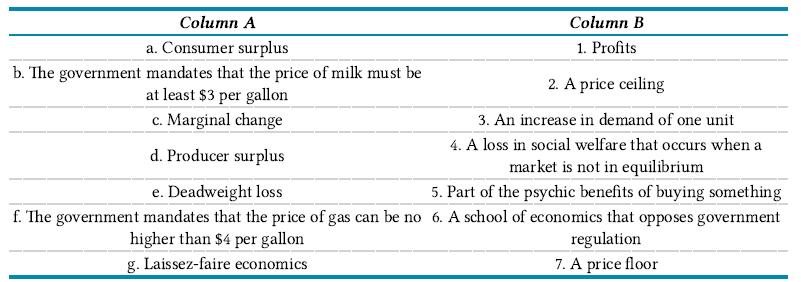
7. Mat ea concept in Column A with an example in Column B. Column A a. Consumer surplus b. The government mandates that the price of milk must be at least $3 per gallon c. Marginal change d. Producer surplus e. Deadweight loss Column B 1. Profits 2. A price ceiling 3. An increase in demand of
6. Consider the market for electricity. Suppose that the price of producing energy decreases due to lower fossil fuel costs and the increasing availability of affordable renewable energy.a. How does the decrease in electricity production costs affect total net social welfare? Useb. graph to support
5. Consider the market for wheat. Suppose that the demand for wheat decreases because of dietary concerns.a. How does the decrease in the demand for wheat affect total net social welfare in the wheat market? Use a graph to support your answer, and indicate the area that represents theange in
4. Suppose that the market equilibrium price for a basic medical e-up is $50, in a market in whithere is no health insurance. To encourage more people to get a e-up, the local government mandates that the price of a e-up cannot be more than $40.a. Is this a price floor or a
3. Consider the following supply sedule for apartments in a local market.a. Draw the supply curve for apartments. Be sure to label the axes.b. Suppose the going rental price for apartments is $550 per month. How many apartments will be supplied? (Assume the supply curve is a straight line
2. Suppose the maximum willingness to pay for a new iPhone by different consumers in a market is given in the table below.a. If the price of iPhones is $420, how many iPhones will be sold?b. What is the total consumer surplus in the market?c. Suppose the price of iPhones decreases to $390. Now how
1. Consider the following demand sedule for umbrellas at a local storea. Draw the demand curve for umbrellas. Be sure to label the axes.b. Suppose the price of umbrellas is $14. Indicate the area of market consumer surplus in your graph. Also indicate the area that represents the total amount
23. What is market failure?
22. What is the laissez-faire approa to government regulation?
21. How does a price floor affect consumer and producer surplus?
20. What limits the quantity sold with a price floor: supply or demand?
19. What is a price floor? How can it be represented in a supply-and-demand graph?
18. What is a deadweight loss? How is it represented in a supply-and-demand graph?
17. How does a price ceiling affect consumer and producer surplus?
16. What limits the quantity sold with a price ceiling: supply or demand?
15. What is a price ceiling? How can it be represented in a supply-and-demand graph?
14. Why is a market equilibrium socially efficient?
13. What is social efficiency? What are some limitations of this concept?
12. How is market producer surplus represented in a supply-and-demand graph?
11. How is producer surplus for an individual transaction represented in a supply-and-demand graph?
10. What does ea point on a supply curve represent?
9. What is another name for a supply curve, in reference to welfare analysis?
8. Define producer surplus
Showing 2100 - 2200
of 7548
First
15
16
17
18
19
20
21
22
23
24
25
26
27
28
29
Last
Step by Step Answers

 Get 50% OFF
Claim Now
Get 50% OFF
Claim Now