New Semester
Started
Get
50% OFF
Study Help!
--h --m --s
Claim Now
Question Answers
Textbooks
Find textbooks, questions and answers
Oops, something went wrong!
Change your search query and then try again
S
Books
FREE
Study Help
Expert Questions
Accounting
General Management
Mathematics
Finance
Organizational Behaviour
Law
Physics
Operating System
Management Leadership
Sociology
Programming
Marketing
Database
Computer Network
Economics
Textbooks Solutions
Accounting
Managerial Accounting
Management Leadership
Cost Accounting
Statistics
Business Law
Corporate Finance
Finance
Economics
Auditing
Tutors
Online Tutors
Find a Tutor
Hire a Tutor
Become a Tutor
AI Tutor
AI Study Planner
NEW
Sell Books
Search
Search
Sign In
Register
study help
business
microeconomics
Microeconomics 9th Edition David Colander - Solutions
Q-10 If a model tells you that price controls will reduce people’s welfare, does it follow that economists will advise governments not to impose price controls?
Q-9 Is the supply and demand model a path-dependent model?
Q-8 True or false? Debates in modern economics will be resolved by letting the data speak.
Q-7 Why are economists very hesitant to base knowledge on heuristic models?
Q-6 Does the author’s tendency to wear Velcro shoes demonstrate that he is beyond social pressures?
Q-5 Which are better—models based on traditional building blocks or models based on behavioral building blocks?
Q-4 Can adding a constraint on people make them better off?
Q-3 If an economist argues that people tend to be purposeful and follow their enlightened self interest, would you most likely characterize that economist as a behavioral or a traditional economist?
Q-2 Are modern economists more likely to use inductive models than earlier economists?
Q-1 What is the glue that holds modern economics together?
LO21-4 Discuss how modern economics and traditional economics differ in their policy prescriptions.
LO21-3 Distinguish an empirical model from a formal model and list some formal models used by modern economists.
LO21-2 Explain what heuristic models are and how traditional and behavioral heuristic economic models differ.
LO21-1 Differentiate traditional economic building blocks from behavioral economic building blocks.
2. Two firms, TwiddleDee and TwiddleDum, make up the entire market for widgets. They have identical costs. They are currently colluding explicitly and are making $2 million each. TwiddleDee has a new CEO, Mr. Notsonice, who is considering cheating and producing more than he has agreed to produce.
1. Netflix and Blockbuster each expects profit to rise by$100,000 in the coming year. Netflix, thinking that it would like its net profit to rise by more, considers advertising during the Super Bowl. An advertisement on the Super Bowl will cost $80,000. If Netflix advertises, and Blockbuster does
7. In a Vickrey auction how would a person’s bid differ if he knew that the seller had someone at the auction submitting a bid for the seller?
6. Say that 90 percent of the people in a market demonstrate loss aversion and 10 percent are “rational.” Say that, initially, all people have equal wealth.a. How would you expect the wealth distribution to change over time?b. Would you expect the traditional model’s predictions, which are
5. Suppose the two-thirds game described in the chapter were changed to the “average” game, so that the class had to guess a number between 0 and 100, and the person who wins is the person who guesses closest to the average number.a. What would the Nash equilibrium likely be?b. If your class
4. In 1970 economist Martin Shubik proposed the following game that involved auctioning off a one-dollar bill with the following rules:1. The highest bidder wins the dollar bill and pays his bid.2. The second-highest bidder also has to pay the amount of his last bid—and gets nothing in return.3.
3. In 1950, economists Merrill Flood and Melvin Dresher devised an experiment to challenge the Nash equilibrium.They presented the following payoff matrix to two economists and asked them to play the following game 100 times in succession:a. What is the Nash equilibrium of this payoff matrix?b. Is
2. How is investing in the stock market similar to playing the two-thirds game?
1. How is the fact that employers look to see that applicants took difficult courses in college, even though the subject matter has no bearing on the work they will likely do, an example of screening?
6. How do the findings of behavioral economics undermine the assumptions of the standard model as to the nature of human beings? (Radical)
5. In the opening to this chapter, the author describes a scene in the movie A Beautiful Mind . What is disturbing about that scene? Is John Nash representative of economic sensibility?(Feminist)
4. How does game theory demonstrate the importance of institutions?(Institutionalist)
3. Do you believe that women will arrive at different outcomes than men when playing a strategic game? Why?Which is preferable? (Feminist)
2. Austrian economist Ludwig von Mises defined economics as “the science of human action.” Does game theory or standard supply/demand analysis better fit with that definition?Why? (Austrian)
1. Do you believe people with religious training will arrive at different outcomes than others in a strategic game?Why? Which interaction is preferable? (Religious)
16. Why does it take just a few people to act rationally for the standard model to hold?
15. When consumers were given the opportunity to select a package of ground beef labeled “75% lean” or a package of ground beef labeled “25% fat,” most consumers chose“75% lean.” Why? What concept from the chapter does this illustrate? ( LO20-4 )
14. Say that you are bidding in a sealed-bid auction and that you really want the item being auctioned. Winning it would be worth $250 to you. Say you expect the nexthighest bidder to bid $100. ( LO20-3 )a. In a standard “highest-bid” auction, what bid would a rational person make?b. In a
13. Why do sellers generally prefer a Vickrey auction to a regular sealed bid if sellers don’t receive the highest bid in the Vickrey auction? ( LO20-3 )
12. Why might the multiple-play ultimatum game have a different result than the single-play ultimatum game? ( LO20-2 )
11. True or false? If a game has a Nash equilibrium, that equilibrium will be the equilibrium that we expect to observe in the real world. (LO20-2)
10. Can a player have a rollback strategy in a simultaneous move game? ( LO20-2 )
9. State whether each of the following situations is a simultaneous or sequential game. Explain your answer.( LO20-2 )a. A congressional vote by roll call.b. The ultimatum game.c. The Civil War.d. The segregation game (requires reading the box “The Segregation Game and Agent-Based Modeling” on
8. Would the results of the prisoner’s dilemma game be different if it were a sequential rather than a simultaneous game? ( LO20-2 )
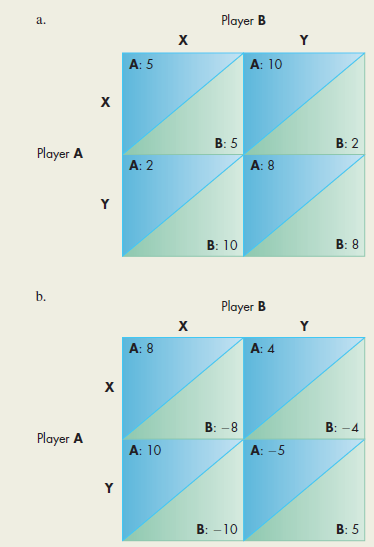
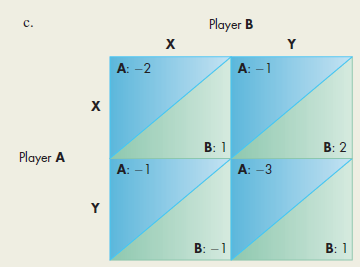
7. For each of the following, state whether Player A and Player B have a dominant strategy and, if so, what each player’s dominant strategy is. a. x A: 5 Player A A: 2 b. x Player B A: 10 B: 5 A: 8 B: 2 B: 10 B: 8 Player B A: 8 A: 4 B: -8 B: -4 Player A A: 10 A: -5 Y B: -10 B: 5
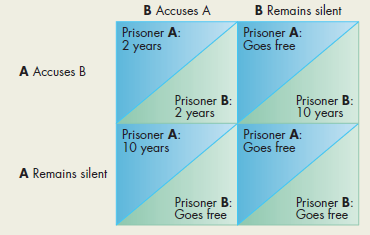
6. Two people are arrested and charged with the same crime. Each is given the opportunity to accuse the other of the crime. The payoff matrix shows how much time each will serve depending on who rats out whom. ( LO20-1 )a. What is the dominant strategy for each, if any?b. What is the Nash
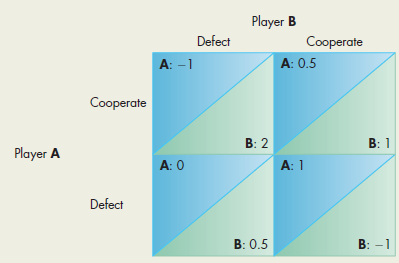
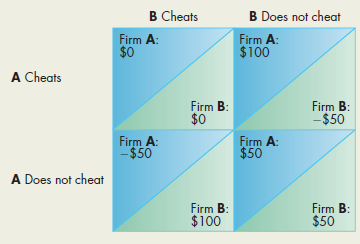
5. Two firms have entered an agreement to set prices. The accompanying payoff matrix shows profit for each firm in a market depending upon whether the firm cheats on the agreement by reducing its prices. ( LO20-1 )a. What is the dominant strategy for each firm, if any?b. What is the Nash
4. If a player does not have a dominant strategy, can the game still have a Nash equilibrium? ( LO20-1 )
3. Is the solution to the prisoner’s dilemma game a Nash equilibrium? Why? ( LO20-1 )
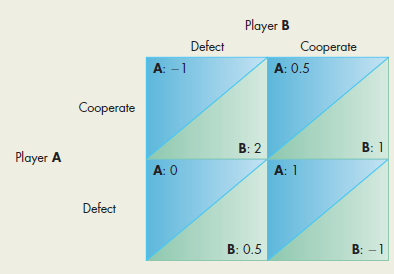
2. In the following payoff matrix, Player A announces that she will cooperate. ( LO20-1 )a. How is this likely to change the outcome compared to when neither cooperates?b. What does your answer to a suggest about the value of cheap talk?c. How could Player A make her pronouncement believable?
1. Define the prisoner’s dilemma game. ( LO20-1 )a. What assumptions lead to the dilemma?b. What creates the possibility of escaping it?c. What does the standard model say about your answer to b? What does experimental economics say?
Q-10 If 90 percent of people operate as behavioral economics suggests, does that mean that the standard economic model is no longer applicable?
Q-9 If a firm wants to increase the number of employees who participate in a savings plan, should the enrollment form ask whether the employee wants an automatic withdrawal from a paycheck to retirement or automatic deposit to retirement from a paycheck?
Q-8 How does a Vickrey auction differ from a standard sealed-bid auction?
Q-6 In a single-play ultimatum game, what is the optimal strategy for the first player?
Q-7 What is the Nash equilibrium in the two-thirds game?
Q-5 In formal game theory, should cheap talk influence the results?
Q-3 In the payoff matrix in Figure 20-1, what is B’s best strategy if A does not confess?
Q-4 If Prisoners A and B are in love and care for each other as they care for themselves, what is the expected outcome of the prisoner’s dilemma game?
Q-2 In the payoff matrix in Figure 20-1, what is B’s best strategy if A confesses?
Q-1 True or false? Game theory is inconsistent with supply/demand analysis. Explain your answer.
LO20-4 Describe how the results of game theory experiments challenge some standard economic assumptions.
LO20-3 Distinguish informal game theory differs from formal game theory.
LO20-2 Discuss how strategic reasoning and backward induction are used in solving games.
LO20-1 Explain what game theory is and give an example of a game and a solution to a game.
4. What might an indifference curve look like if the law of diminishing marginal utility did not hold?
3. What would an indifference curve look like if the marginal rate of substitution were zero? If it were constant?
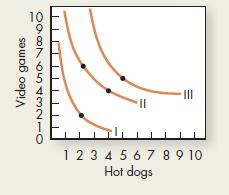
2. Zachary’s indifference curves are shown in the following graph. Determine on which indifference curve Zachary will be, given the budget constraints and prices in a , b , and c from question 1.a. Given a choice, which budget constraint would Zachary prefer most? Least?b. What is the marginal
1. Zachary has $5 to spend on two goods: video games and hot dogs. Hot dogs cost $1 apiece while video games cost 50 cents apiece.a. Draw a graph of Zachary’s budget constraint, placing video games on the y axis.b. Suppose the price of hot dogs falls to 50 cents apiece.Draw the new budget
16. Say that the ultimatum game described in the chapter was changed so that the first individual could keep the money regardless of whether the offer was accepted by the second individual or not. ( LO19-4 )a. What would you expect would likely happen to the offers?b. What would happen to the
15. According to Thorstein Veblen, what is the purpose of conspicuous consumption? Does the utility derived from the consumption of these goods come from their price or functionality? Give an example of such a good. ( LO19-4 )
14. There is a small but growing movement known as “voluntary simplicity,” which is founded on the belief in a simple life of working less and spending less. Do Americans who belong to this movement follow the principle of rational choice? ( LO19-3 )
13. If the supply curve is perfectly inelastic, what is the opportunity cost of the supplier? ( LO19-3 )
12. State the law of supply and explain how it relates to opportunity cost. ( LO19-3 )
11. Your study partner tells you that if you are compensated for the impact on your budget of a rise in the price of a good, your purchase choices won’t change. Is he right?Explain. ( LO19-3 )
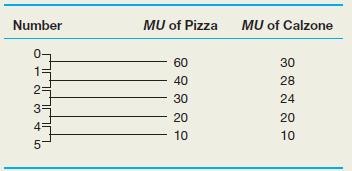
10. Suppose a large cheese pizza costs $10 and a calzone costs $5. You have $40 to spend. The marginal utility( MU ) that you derive from each is as follows:a. How many of each would you buy?b. Suppose the price of a calzone rises to $10. How many of each would you buy?c. Use this to show how the
8. Early Classical economists found the following“diamond/water” paradox perplexing: “Why is water, which is so useful and necessary, so cheap, when diamonds, which are so useless and unnecessary, so expensive?” Using the utility concept, explain why it is not really a paradox. (Difficult)
7. The total utility of your consumption of widgets is 40; it changes by 2 with each change in widgets consumed.The total utility of your consumption of wadgets is also 40 but changes by 3 with each change in wadgets consumed.The price of widgets is $2 and the price of wadgets is $3. How many
5. The following table gives the price and total utility of three goods: A, B, and C.As closely as possible, determine how much of the three goods you would buy with $20. Explain why you chose what you did. ( LO19-2 ) Total Utility Good Price 1 2 3 4 5 6 7 8 A $10 200 380 530 630 680 700 630 430 BC
4. What key psychological assumptions do economists make in their theory of individual choice? ( LO19-1 )
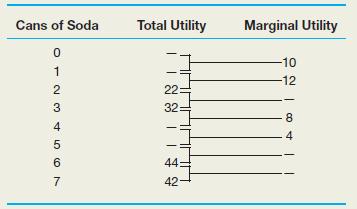
3. Complete the following table of Scout’s utility from drinking cans of soda and answer the questions below.a. At what point does marginal utility begin to fall?b. Will Scout consume the 7th can of soda? Explain your answer.c. True or false? Scout will be following the utilitymaximizing rule by
2. According to the principle of diminishing marginal utility, how does marginal utility change as more of a good is consumed? As less of a good is consumed? ( LO19-1 )
1. Explain how marginal utility differs from total utility. ( LO19-1 )
Q-10 Using the principle of rational choice, explain why a change in tastes will shift the demand curve.
Q-9 True or false? Bounded rationality violates the principle of rational choice.
Q-6 What are two effects that generally cause the quantity demanded to fall when the price rises?
Q-4 True or false? You are maximizing total utility only when the marginal utility of all goods is zero. Explain your answer.
Q-2 True or false? Consuming more of a good generally increases its marginal utility. Why?
LO19-4 Name three assumptions of the theory of choice and discuss why they may not reflect reality.
LO19-3 Summarize how the principle of rational choice accounts for the laws of demand and supply.
LO19-2 Explain the relationship between marginal utility and price when a consumer is maximizing total utility.
LO19-1 Discuss the principle of diminishing marginal utility and the principle of rational choice.
3. In 2011 the poverty level for a family of four was $23,201.a. If one-third of the total income of lower-income households is typically used for food, estimate the amount of money per day per person available for food for a person living at or below the poverty rate.b. How much does that leave
2. In the Old Testament, God promised riches to Israel if Israel kept God’s commandments. But in the New Testament, Jesus says that it is easier for a camel to go through the eye of a needle than for a rich man to enter the kingdom of heaven.a. Considering the wealth distribution in Figure 18-5,
13. In Taxland, the first $10,000 earned per year is exempt from taxation. Between $10,000.01 and $30,000, the tax rate is 25 percent. Between $30,000.01 and $50,000, it’s 30 percent. Above $50,000, it’s 35 percent. You’re earning $75,000 a year. ( LO18-4 )a. How much in taxes will you have
12. In what instance would John Rawls support greater income inequality? ( LO18-3 )
11. Why did Bertrand de Juvenal argue for a high level of income inequality? ( LO18-3 )
10. How is the distribution of income related to the emergence of the Tea Party and the Occupy movement? ( LO18-2 )
9. Is the class system in the United States more like a pyramid, diamond, or pentagon? Why is this so? ( LO18-2 )
8. How has the median income of women compared to men changed since 1980? What do you think is the cause? ( LO18-2 )
7. Would the Lorenz curve for the world be more or less bowed out compared to the Lorenz curve for the United States? ( LO18-1 )
6. How does social mobility in the United States compare to that in Britain? Why do you think this is so? ( LO18-1 )
5. Should poverty be defined absolutely or relatively?Why? ( LO18-1 )
3. Why are we concerned with the distribution of income between whites and blacks, but not between redheads and blondes? ( LO18-1 )
2. What would the Lorenz curve for lawyers, represent? ( LO18-1 )
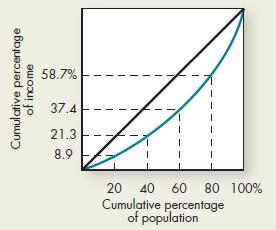
1. The Lorenz curve for Bangladesh looks like this:How much income do individuals in the top income quintile in Bangladesh receive? ( LO18-1 ) Cumulative percentage of income 58.7% 37.4 21.3 8.9 20 40 60 80 100% Cumulative percentage of population
Showing 3900 - 4000
of 7548
First
33
34
35
36
37
38
39
40
41
42
43
44
45
46
47
Last
Step by Step Answers

 Get 50% OFF
Claim Now
Get 50% OFF
Claim Now