New Semester
Started
Get
50% OFF
Study Help!
--h --m --s
Claim Now
Question Answers
Textbooks
Find textbooks, questions and answers
Oops, something went wrong!
Change your search query and then try again
S
Books
FREE
Study Help
Expert Questions
Accounting
General Management
Mathematics
Finance
Organizational Behaviour
Law
Physics
Operating System
Management Leadership
Sociology
Programming
Marketing
Database
Computer Network
Economics
Textbooks Solutions
Accounting
Managerial Accounting
Management Leadership
Cost Accounting
Statistics
Business Law
Corporate Finance
Finance
Economics
Auditing
Tutors
Online Tutors
Find a Tutor
Hire a Tutor
Become a Tutor
AI Tutor
AI Study Planner
NEW
Sell Books
Search
Search
Sign In
Register
study help
business
microeconomics
Microeconomics 9th Edition David Colander - Solutions
4. How do the effects of voluntary restraint agreements differ from the effects of a tariff? (LO10-2)
3. Demonstrate graphically how the effects of a tariff differ from the effects of a quota. (LO10-2)
2. Which countries are the two greatest trading partners for the United States? With which countries is trade rapidly increasing? (LO10-1)
1. How important is international trade in terms of its relationship to total U.S. production? What does this suggest about the importance of trade policies relative to other countries? (LO10-1)
Q-10 What is economists’ view of limited free trade associations such as the EU or NAFTA?
Q-9 What are two important international economic organizations?
Q-8 Is it efficient for a country to maintain a trade barrier in an industry that exhibits economies of scale?
Q-7 True or false? In strategic trade bargaining, it is sometimes reasonable to be unreasonable. Explain.
Q-6 Who is likely to be more vocal when lobbying government to impose trade restrictions: producers or consumers? Explain your answer.
Q-5 How might a country benefit from having an inefficient customs agency?
Q-4 Why do importers prefer a quota to a tariff? Why does government prefer a tariff?
Q-3 How are tariffs like taxes?Demonstrate with a supply and demand curve.
Q-2 Will a debtor nation necessarily be running a trade deficit?
Q-1 How has the nature of U.S.imports from China changed in recent years?
LO10-4 Explain how free trade associations both help and hinder international trade.
LO10-3 Summarize the reasons for trade restrictions and why economists generally oppose trade restrictions.
LO10-2 Explain policies countries use to restrict trade.
LO10-1 Summarize some important data of trade.
5. Assuming a law such as the one suggested in question 4 were passed in the mid-1990s in the U.S., what subgroups of U.S. workers would have likely been helped, and what subgroups of U.S. workers would have likely been hurt?
4. One way to equalize imports and exports would be to pass a law that (1) in order to import, importers must provide a certificate certifying that an equal value of exports had occurred; and (2) in order to export, exporters must provide a certificate certifying that an equal value of imports had
3. The normal textbook presentation of international trade does not include the international trader. How does including the trader in the model provide a different view of trade than one would get from a model that did not include the trader?
2. One of the basic economic laws is the “law of one price.”Does it imply that the U.S. wage level will have to equal the Chinese wage level if free trade is allowed? Why or why not?
1. How is outsourcing to China and India today different from U.S. outsourcing in the past?
5. In the Wealth of Nations Adam Smith claimed, “Servants, labourers and workmen of different kinds, make up the far greater part of every great political society. But what improves the circumstances of the greater part can never be regarded as an inconvenience to the whole. No society can surely
4. In David Ricardo’s original example of comparative advantage in his Principles of Political Econ o my, written in 1817, Portugal possesses an absolute advantage in both the production of cloth and the production of wine. But England has a comparative advantage in the production of cloth, while
3. Global outsourcing has cost the U.S. economy far more than one million jobs since 2001, or somewhere between 15 and 35 percent of the total decline in employment since the onset of the 2001 recession.a. How does outsourcing affect the bargaining power of U.S. workers and the bargaining power of
2. In the 10th century B.C., King Solomon brought the Israelites into great economic wealth through specialization and trade. It was difficult when faced with the practices and beliefs of their trading partners, however, for Israel to maintain its identity as a people of one God. King Solomon, for
1. Evaluate the following statement: Comparative advantage will benefit all people because everyone has a comparative advantage in something. Therefore, trade based on comparative advantage should be facilitated without undue government intervention. (Austrian)
20. Would you expect the resource curse to improve or worsen the distribution of income in a country?
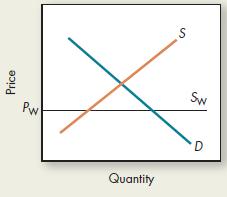
19. Using the graph below, indicate domestic production and imports.a. Would the United States want to raise or lower the world supply of the good? Why?b. How might that happen? Price Pw S Sw Quantity D
18. How does a depreciation of a currency change the price of imports and exports? Explain using the U.S. dollar and the Chinese yuan. (LO9-4)
17. The dollar price of the South African rand fell from 29 cents to 22 cents in 1996, the same year the country was rocked by political turmoil. Using supply/demand analysis, explain why the turmoil led to a decline in the price of the rand. (LO9-4)
16. From the standpoint of adjustment costs to trade, which would a country prefer—inherent or transferable comparative advantage? Why? (LO9-3)
15. How do inherent comparative advantages differ from transferable comparative advantages? (LO9-3)
14. List at least three sources of comparative advantage that the United States has and will likely maintain over the coming decade. (LO9-3)
13. How has globalization made the rich richer and poor poorer in the United States? (LO9-2)
12. How does the outsourcing of manufacturing production benefit production in the United States? (LO9-2)
11. True or false? Wages in China are lower than those in the United States. This means that China has a comparative advantage in everything. Explain your answer. (LO9-2)
10. What are four reasons why economists’ and laypeople’s view of trade differ? (LO9-2)
9. Country A can produce, at most, 40 olives or 20 pickles, or some combination of olives and pickles such as the 20 olives and 10 pickles it is currently producing.Country B can produce, at most, 120 olives or 60 pickles, or some combination of olives and pickles such as the 100 olives and 50
8. What are some reasons why a small country might not get the gains of trade? (LO9-1)
7. Why do smaller countries usually get most of the gains from trade? (LO9-1)
6. Why does competition among traders affect how much of the gains from trade are given to the countries involved in the trade? (LO9-1)
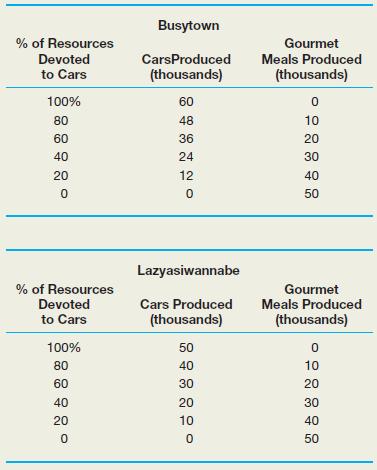
5. Suppose there are two countries, Busytown and Lazyasiwannabe, with the following production possibility tables:a. Draw the production possibility curves for each country.b. Which country has the comparative advantage in producing cars? In producing gourmet meals?c. Suppose each country
4. Suppose that two countries, Machineland and Farmland, have the following production possibility curves: (LO9-1)a. Explain how these two countries can move from points A and C, where they currently are, to points B and D.b. If possible, state by how much total production for the two countries has
3. Suppose there are two states that do not trade: Iowa and Nebraska. Each state produces the same two goods: corn and wheat. For Iowa the opportunity cost of producing 1 bushel of wheat is 3 bushels of corn. For Nebraska the opportunity cost of producing 1 bushel of corn is 3 bushels of wheat. At
2. Widgetland has 60 workers. Each worker can produce 4 widgets or 4 wadgets. Each resident in Widgetland currently consumes 2 widgets and 2 wadgets. Wadgetland also has 60 workers. Each can produce 3 widgets or 12 wadgets. Wadgetland’s residents consume 1 widget and 9 wadgets. Is there a basis
1. Will a country do better importing or exporting a good for which it has a comparative advantage? Why?
Q-10 How can the discovery of a highly valuable resource lead to the appreciation of a currency and loss of comparative advantage in other goods?
Q-9 If the world supply of goods is at the domestic price level, will there be a trade deficit or trade surplus?Explain your answer.
Q-8 Interest rates and income rise in Britain. Would you expect the British currency, the pound, to appreciate or depreciate? Explain your answer using supply and demand curves.
Q-7 Show graphically the effect on the price of euros of an increase in the demand for dollars by Europeans.
Q-6 What are two likely adjustments that will reduce the wage gap between China and the United States?
Q-5 Will transferable or inherent comparative advantages be more impacted by the law of one price?Why?
Q-4 Why has globalization caused employment and wages to decline in the manufacturing sector but not in the education, government, and health care sectors?
Q-3 What are four reasons for the difference between laypeople’s and economists’ views of trade?
Q-2 In what circumstances would a small country not get the larger percentage of the gains from trade?
Q-1 If the opportunity cost of oil for food were the same for both the United States and Saudi Arabia, what should I.T. do?
LO9-4 Discuss how exchange rates are determined and what their role is in equalizing trade flows.
LO9-3 Summarize the sources of U.S. comparative advantage and discuss some concerns about the future in the U.S. economy.
LO9-2 Explain why economists’and laypeople’s views of trade differ.
LO9-1 Explain the principle of comparative advantage.
LO8W-3 Discuss real-world pressures politicians face when designing agricultural policy.
LO8W-2 Explain how a price support system works and show the distributional consequences of four alternative methods of price support.
LO8W-1 Explain the good/bad paradox in farming and how it can be avoided.
10. A debate about dairy products concerns the labeling of milk produced from cows that have been injected with the hormone BST, which significantly increases milk production.Since the FDA has determined that this synthetically produced copy of a milk hormone is indistinguishable from the hormone
9. Would a high tax on oil significantly reduce the total amount of pollution in the environment?
8. List five ways you are affected on a daily basis by government intervention in the market. For what reason might government be involved? Is that reason justified?
7. Recently scientists identified a gene that accounts for 5 percent of thrill-seeking behavior. People with this gene are likely to take more risks such as smoking and bungee jumping in search of the next thrill. Provide two arguments—one for and one against—requiring people to undergo testing
6. Financial analysts are not currently required to be licensed. Should they be licensed? Why or why not?
5. Should government eliminate the Food and Drug Administration’s role in restricting which drugs may be marketed? Why or why not?
4. Economist Robert W. Turner suggested three market failures that could justify government provision of national parks. What three failures did he likely discuss and what is the cause of the failure?
3. Suppose an air-quality law is passed that requires 3.75 percent of all the cars sold to emit zero pollution.a. What would be the likely impact of this law?b. Can you think of any way in which this law might actually increase pollution rather than decrease it?c. How might an economist suggest
2. In his book At the Hand of Man, Raymond Bonner argues that Africa should promote hunting, charging large fees for permits to kill animals (for example, $7,500 for a permit to shoot an elephant).a. What are some arguments in favor of this proposal?b. What are some arguments against?
1. More than half of 30 economists polled recently stated that the federal gasoline tax should be raised to $1 or higher. What do you suppose were their reasons?
5. Water privatization in South Africa has been guided by what the World Bank calls the “cost recovery” approach:Water should be made available to people only if the company providing it can recover its costs plus a profit.In 1995, private companies began taking over the provision of water in
4. Post-Keynesians suggest that contractual agreements might be a way to deal with asymmetric information.a. Name a business or consumer transaction where asymmetric information might occur.b. How could a contractual agreement overcome the problems of asymmetric information in that market?c. Would
3. Institutional economists define economics as the study of how people use institutions to socially interact in the process of extracting materials from the biophysical world to produce and exchange goods and services to reproduce culture and better the human condition. If you accept this
2. In the late 19th century, Washington Gladden said, “He who battles for the Christianization of society will find their strongest foe in the field of economics. Economics is indeed the dismal science because of the selfishness of its maxims and the inhumanity of its conclusions.”a. Evaluate
1. The book titles this chapter “Market Failure versus Government Failure.”a. Does the fact that the author spends most of the chapter discussing market failure rather than government failure suggest an ideological bias in the book?b. If so, how would you characterize that bias? (Austrian)
24. True or false? Burning fossil fuels contributes to global warming. Thus, it makes sense for the government to place a tax on the burning of fossil fuels. Why? (LO8-5)
23. When Ben wears his red shirt, it bothers Sally, who hates the color red. Since Ben’s wearing of a red shirt imposes a cost on Sally, it involves an externality. Would it therefore be correct to have the government intervene and forbid Ben from wearing a red shirt? (LO8-5)
22. Economics professors Thomas Hopkins and Arthur Gosnell of the Rochester Institute of Technology estimated that in the year 2000, regulations cost the United States $662 billion, or about $5,700 per family. (LO8-5)a. Do their findings mean that the United States had too many regulations?b. How
21. What is the effect of the moral hazard problem on insurance premiums? Explain your answer. (LO8-4)
20. Who would benefit and who would lose if an informational alternative to licensing doctors were introduced? (LO8-4)
19. An advanced degree is required to teach at most colleges.In what sense is this a form of restricting entry through licensure? (LO8-4)
18. Automobile insurance companies charge lower rates to married individuals than they do to unmarried individuals.What economic reason is there for such a practice? Is it fair? (LO8-4)
17. If neither buyers nor sellers could distinguish between“lemons” and “cherries” in the used-car market, what would you expect to be the mix of lemons and cherries for sale? (LO8-4)
16. What is the adverse selection problem? (LO8-4)
15. Automobile insurance companies offer low-premium contracts with a high deductible and high-premium contracts with low deductibles. How is this an example of screening? (LO8-4)
14. Give three examples of signaling in the real world. (LO8-4)
13. If you are willing to pay $1,000 for a used stereo that is a“cherry” and $200 for a used stereo that is a “lemon,”how much will you be willing to offer to purchase a stereo if there is a 50 percent chance that the stereo is a lemon? If owners of cherry stereos want $700 for their
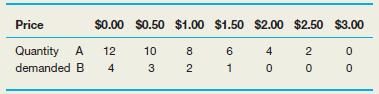
12. Use the table below, which shows the demand for a public good in an economy consisting of two households, A and B, to answer a to d below. (LO8-3)a. Graph the individual demand curves and the market demand curve.b. What would make you doubt that the table is an accurate reporting of the
11. Why are voluntary contributions to provide for public goods such as city parks unlikely to lead to an efficient quantity of parks in a city? (LO8-3)
10. Why are both nonexcludability and nonrivalry important elements of public goods? (LO8-3)
9. List the public-good aspects (if any) of the following goods: safety, street names, and a steak dinner. (LO8-3)
8. Economists Don Fullerton and Thomas C. Kinnaman studied the effects of Charlottesville, Virginia’s change from charging a flat fee for garbage collection to charging $0.80 per 32-gallon bag and found the following results: (LO8-2)The weight of garbage collected fell by 14 percent.The volume of
Consumers of gas can be divided into two groups—one group whose demand is elastic and another group whose demand is inelastic. (LO8-2)a. How will the proposals affect each group?b. Which group would support a regulatory policy?c. Which would support a tax policy?
7. There’s a gas shortage in Gasland. You’re presented with two proposals that will achieve the same level of reduction in the use of gas. Proposal A would force everybody to reduce their gas consumption by 5 percent. Proposal B would impose a 50-cent tax on the consumption of a gallon of gas,
6. Which is more efficient: a market incentive program or a direct regulatory program? Why? (LO8-2)
Showing 4400 - 4500
of 7548
First
38
39
40
41
42
43
44
45
46
47
48
49
50
51
52
Last
Step by Step Answers

 Get 50% OFF
Claim Now
Get 50% OFF
Claim Now