New Semester
Started
Get
50% OFF
Study Help!
--h --m --s
Claim Now
Question Answers
Textbooks
Find textbooks, questions and answers
Oops, something went wrong!
Change your search query and then try again
S
Books
FREE
Study Help
Expert Questions
Accounting
General Management
Mathematics
Finance
Organizational Behaviour
Law
Physics
Operating System
Management Leadership
Sociology
Programming
Marketing
Database
Computer Network
Economics
Textbooks Solutions
Accounting
Managerial Accounting
Management Leadership
Cost Accounting
Statistics
Business Law
Corporate Finance
Finance
Economics
Auditing
Tutors
Online Tutors
Find a Tutor
Hire a Tutor
Become a Tutor
AI Tutor
AI Study Planner
NEW
Sell Books
Search
Search
Sign In
Register
study help
business
microeconomics
Microeconomics 9th Edition David Colander - Solutions
Q-10 Why are property rights important in the determination of whether any particular income distribution is fair?
Q-9 True or false? The U.S. Social Security system is only a retirement system.
Q-8 True or false? A progressive tax is preferable to a proportional tax. Why?
Q-7 When determining the effects of programs that redistribute income, can one reasonably assume that other things will remain equal?
Q-6 You are dividing a pie among five individuals. What would be a fair distribution of that pie?
Q-5 Is it self-evident that greater equality of income would make the society a better place to live? Why?
Q-4 How have distributional fights about income changed over time?
Q-3 How does the income distribution in the United States compare with that in other countries?
Q-2 Is the U.S. definition of poverty an absolute or a relative definition?
Q-1 When drawing a Lorenz curve, what do you put on the two axes?
LO18-4 Discuss the practical and theoretical problems of redistributing income.
LO18-3 Explain why there are so many philosophical debates about equality and fairness, and summarize some of them.
LO18-2 Summarize the socioeconomic tensions that high income and wealth inequalities can cause.
LO18-1 Explain how income, wealth, and poverty are measured, and how their real-world measures changed over time.
to show whether her choices are consistent with utilitymaximizing behavior. If so, show how she ranks the three baskets. If it is not possible to infer how she ranks the baskets, explain why not.
4.30. Carina consumes two goods, X and Y, both of which she likes. In month 1 she chooses basket A given budget line BL1. In month 2 she chooses B given budget line BL2, and in month 3 she chooses C given budget line BL3. Assume her indifference map is unchanged over the three months. Use the
4.29. Brian consumes units of electricity (E) and a composite good (Y ), whose price is always 1. He likes both goods.In period 1 the power company sets the price of electricity at $7 per unit, for all units of electricity consumed. Brian consumes his optimal basket, 20 units of electricity and 70
4.28. Alex buys two goods, food (F) and clothing (C).He likes both goods. His preferences for the goods do not change from month to month. The following table shows his income, the baskets he selected, and the prices of the goods over a two-month period.
4.25. Darrell has a monthly income of $60. He spends this money making telephone calls home (measured in minutes of calls) and on other goods. His mobile phone company offers him two plans:
4.23. As shown in the following figure, a consumer buys two goods, food and housing, and likes both goods.When she has budget line BL1, her optimal choice is basket A. Given budget line BL2, she chooses basket B, and with BL3, she chooses basket C.Food BL1 BL2 BL3 BC AHousinga) What can you infer
4.22. Samantha purchases food (F ) and other goods(Y ) with the utility function U ! FY, with and. Her income is 12. The price of a food is 2 and the price of other goods 1.a) How many units of food does she consume when she maximizes utility?b) The government has recently completed a study
4.20. The figure in this problem shows a budget set for a consumer over two time periods, with a borrowing rate rB and a lending rate rL, with rL # rB. The consumer purchases C1 units of a composite good in period 1 and C2 units in period 2. The following is a general fact about consumers making
4.19. Jack makes his consumption and saving decisions two months at a time. His income this month is $1,000, and he knows that he will get a raise next month, making his income $1,050. The current interest rate (at which he is free to borrow or lend) is 5 percent. Denoting this month’s
4.14. A consumer has preferences between two goods, hamburgers (measured by H) and milkshakes(measured by M). His preferences over the two goods are represented by the utility function .For this utility function and.a) Determine if there is a diminishing MRSH,M for this utility function.b) Draw a
4.13. Toni likes to purchase round trips between the cities of Pulmonia and Castoria and other goods out of her income of $10,000. Fortunately, Pulmonian Airways provides air service and has a frequent flyer program. A round trip between the two cities normally costs $500, but any customer who
4.12. Julie consumes two goods, food and clothing, and always has a positive marginal utility for each good. Her income is 24. Initially, the price of food is 2 and the price of clothing is 2. After new government policies are implemented, the price of food falls to 1 and the price of clothing
4.10. The utility that Corey obtains by consuming hamburgers (H) and hot dogs (S) is given by The marginal utility of hamburgers is and the marginal utility of steaks is equal toa) Sketch the indifference curve corresponding to the utility level U ! 12.b) Suppose that the price of hamburgers is $1
4.3. Julie has preferences for food F and clothing C described by a utility function U(F, C) ! FC. Her marginal utilities are MUF ! C and MUC ! F. Suppose that food costs $1 a unit and that clothing costs $2 a unit. Julie has$12 to spend on food and clothing.a) On a graph draw indifference curves
4.2. Sarah consumes apples and oranges (these are the only fruits she eats). She has decided that her monthly budget for fruit will be $50. Suppose that one apple costs$0.25, while one orange costs $0.50.a) What is the expression for Sarah’s budget constraint?b) Draw a graph of Sarah’s budget
4.1. Pedro is a college student who receives a monthly stipend from his parents of $1,000. He uses this stipend to pay rent for housing and to go to the movies (assume that all of Pedro’s other expenses, such as food and clothing have already been paid for). In the town where Pedro goes to
9. What is a composite good?
Employ the concept of revealed preference to determine whether observed choices are consistent with utility maximization.
Describe the concept of revealed preference.
Illustrate the budget line and optimal consumer choice graphically when one of the goods a consumer can choose is a composite good.
Explain why the optimal consumption basket could occur at a corner point.
Explain why the optimal consumption basket solves both a utility maximization problem and an expenditure minimization problem.
Solve for an optimal consumption basket, given information about income, prices, and marginal utilities.
Illustrate graphically the tangency condition for optimal consumer choice.
Describe the conditions for optimal consumer choice.
Illustrate graphically how a change in income or a change in a price affects the budget line.
Write the equation of the budget constraint and graph the budget line.
LO17W-4 Explain the marginal productivity theory of income distribution.
LO17W-3 Define interest and demonstrate how it is used in determining present value.
LO17W-2 Define profit and explain its relationship to entrepreneurship.
LO17W-1 Distinguish rent from other types of income and explain the relationship between rent seeking and property rights.
8. Your manager comes in with three sets of proposals for a new production process. Each process uses three inputs:land, labor, and capital. Under proposal A, the firm would be producing an output where the MPP of land is 30, labor is 42, and capital is 36. Under proposal B, at the output produced
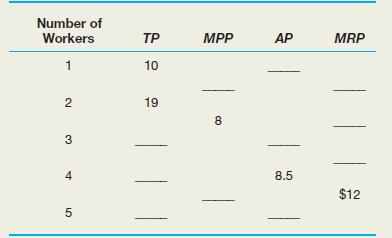
7. Fill in the following table for a competitive firm that has a$2 price for its goods. Number of Workers TP MPP AP MRP 1 10 2 19 8 3 4 5 8.5 $12
6. How would your answer to Question 5 change if the firm were a monopolist?
5. A competitive firm gets $3 per widget. A worker’s average product is 4 and marginal product is 3. What is the maximum the firm should pay the worker?
4. Should teachers be worried about the introduction of computer- and video-based teaching systems? Why or why not?
3. In the 1980s and the 1990s farmers switched from small square bales, which they hired students on summer break to stack for them, to large round bales, which can be handled almost entirely by machines. What is the likely reason for the switch?
2. If firms were controlled by workers, would they likely hire more or fewer workers? Why?
1. Using the information in Figure A17-1, answer the following questions:a. If the market wage were $7 an hour, how many workers would the firm hire?b. If the price of the firm’s product fell to $1, how would your answer to a change?
11. More than half of agricultural workers in the United States are undocumented immigrants. Some Americans support strong enforcement of immigration laws that limit the number of workers from Central and South America coming to the United States so that U.S. citizens can get those jobs, while
10. In an article in the Journal of Human Resources titled“The Economic Reality of the Beauty Myth,” economists Susan Averett and Sanders Korenman found that family income of obese women is about 17 percent lower than that of women who are of recommended weight. The differential was less for
9. Interview three married female and three married male professors at your college, asking them what percentage of work in the professor’s household each adult household member does.a. Assuming your results can be extended to the population at large, what can you say about the existence of
8. Give four reasons why women earn less than men. Which reasons do you believe are most responsible for the wage gap?
7. Why is unemployment nearly twice as high among blacks as among whites? What should be done about the situation?
6. Why might it be inappropriate to discuss the effect of immigration policy using supply and demand analysis?
5. In 1997, a Dutch charity sponsored an incentive program in which teachers received prizes equal to about 30 percent of their salary if their students improved their scores on a standardized test.a. What effect would you expect the program to have on test scores?b. If not all the teachers’
4. According to economist Colin Camerer of the California Institute of Technology, many New York taxi drivers decide when to finish work for the day by setting an income goal for themselves. Once they reach it, they stop working.a. Is that what you would expect if the drivers are rational?b.
3. Some economists have argued against need-based scholarships because they work as an implicit tax on parents’salaries and hence discourage saving for college.a. If the marginal tax rate parents face is 20 percent, and 5 percent of parents’ assets will be deducted from a student’s financial
2. Which would you choose: selling illegal drugs at $75 an hour (20 percent chance per year of being arrested) or a$6-an-hour factory job? Why?
1. “Welfare laws are bad, not for society, but for the people they are meant to help.” Discuss.
6. In firms, the manager is assumed to hold down worker’s wages in order to maximize his profits. Who holds down the pay of managers? (Institutionalist)
5. Radical economists argue that labor markets are governed by nonmarket forces such as discrimination as well as by the supply and demand for labor. As they see it, poverty and inequality are not aberrations but systematic labor market outcomes. They also believe that unions are muchneeded
4. Table 17-1 provides data about starting salaries for selected professional degrees; in it you can see that Ph.D. economists are paid less than MBAs. If economists are rational, why are they economists? (Institutionalist)
3. Gloria Steinem pointed out the following: “I’ve yet to be on any campus where women weren’t worried about some aspect of combining marriage, children, and a career. I’ve yet to find one where many men were worrying about the same thing.”a. What does this insight suggest about the
2. In his book Forbidden Grounds, University of Chicago Professor Richard Epstein argues that federal employment antidiscrimination laws ought to be abolished.[Hint. Reading Westmont College economist Edd Noell’s paper “Racial Discrimination, Police Power and the 1964 Civil Rights Act” in
1. How might the minimum wage lead to greater racial and gender discrimination in the labor market? (Austrian)
28. What is the difference between a union shop and a closed shop? Which did the Taft-Hartley Act make illegal? How have more recent laws changed the role of unions?
27. What has happened to union membership in the United States since the 1960s? ( LO17-5 )
26. In 1993 Congress passed the Family and Medical Leave Act (FMLA), which requires firms with more than 50 employees grant a 12-week unpaid leave of absence for family and medical reasons. What is the likely effect on the demand for female employees? ( LO17-5 )
25. In the early 1990s a teen subminimum training wage law was passed by which employers were allowed to pay teenagers less than the minimum wage. ( LO17-5 )a. What effect would you predict this law would have, based on standard economic theory?b. In analyzing the effects of the law, Professors
24. Comparable worth laws require employers to pay the same wage scale to workers who do comparable work or have comparable training. What likely effect would these laws have on the labor market? ( LO17-5 )
23. According to a study by economists Muriel Niederle and Lise Vesterlund, women are less willing to participate in competitive environments. ( LO17-4 )a. What is the potential impact on the number of women in high-level management positions?b. If this were the cause of fewer women working in
22. A study in 2005 reported that the average male CEO of Fortune 500 firms is 6 feet, about 2.5 inches more than the average male. Why might this be difficult to eliminate through laws that restrict companies from hiring based on height? ( LO17-4 )
21. Which type of discrimination is easier to address legally—demand side or institutional? Explain your answer. ( LO17-4 )
20.a. List three types of demand discrimination.b. Which is the most difficult to eliminate? Why?c. Which is the easiest to eliminate? Why? ( LO17-4 )
19. A recent study by the International Labor Organization estimates that 250 million children in developing countries between the ages of 5 and 14 are working either full or part time. The estimates of the percentage of children working within particular countries is as high as 42 percent in
18. Explain each of the following phenomena using the invisible hand or social or political forces: ( LO17-3 )a. Firms often pay higher than market wages.b. Wages don’t fluctuate much as unemployment rises.c. Pay among faculty in various disciplines at colleges does not vary much although market
17. Show graphically how a minimum wage can simultaneously increase employment and raise the wage rate. ( LO17-3 )
16. The following statement appeared in a recent article: 7½cents of every dollar spent at retail stores in America is spent at Walmart. With such market power, Walmart is able to name the price at which it is willing to buy goods from suppliers. ( LO17-3 )a. Could this be a correct statement if
15. The town of Oberlin, Ohio, has one hospital. How would you classify this market structure, and what effect will this market structure likely have on wages of nurses in Oberlin compared to a perfectly competitive market structure? Demonstrate your answer graphically. ( LO17-3 )
14. New websites such as ifreelance.com have developed a place for companies to post projects for which freelancers can bid. What is the likely effect of this new market on market demand for freelancers?Wages? ( LO17-3 )
13. As telecommunications improve, performers can reach larger and larger audiences. In the past, one could only perform in a concert hall; today one can perform for the entire world. How might that change in technology affect the relative pay of performers? ( LO17-3 )
12. Demonstrate graphically the effect of a minimum wage law. Does economic theory tell us such a law would be a bad idea? ( LO17-3 )
11. Economists Mark Blaug and Ruth Towse studied the market for economists in Britain and found that the quantity demanded was about 150–200 a year, and that the quantity supplied was about 300 a year. ( LO17-3 )a. What did they predict would happen to economists’salaries?b. What likely happens
10. The president of the United States receives an annual salary of $400,000. Derek Jeter, shortstop for the New York Yankees, receives $20.6 million annually. ( LO17-2 )a. Based on marginal productivity theory, what does this say about their contributions to society?b. What qualifications to your
9. List four shift factors of demand and their effect on demand. ( LO17-2 )
8. List four factors that contribute to the elasticity of labor demand. ( LO17-2 )
7. If the wage goes up 20 percent and the quantity of labor supplied increases by 5 percent, what’s the elasticity of labor supply? ( LO17-1 )
6. Using the concept of opportunity cost, explain why welfare programs might increase the number of poor. (LO17-1)
5. Is an increase in the marginal income tax rate reflected by a shift in the after-tax supply of labor or a movement along the supply curve when the pretax wage rate is on the vertical axis? Explain your answer. ( LO17-1 )
4. Using the economic decision rule and opportunity cost, explain why an increase in the wage rate increases quantity of labor supplied? ( LO17-1 )
3. How is opportunity cost related to the supply of labor? ( LO17-1 )
2. Economist Edward Prescott observed that while Americans worked 5 percent fewer hours per week than the French in the 1970s, they worked 50 percent more hours per week in the early 2000s. He found that taxes accounted for nearly all of the difference. What was his likely argument? ( LO17-1 )
1. Why are social and political forces more active in the labor market than in most other markets? ( LO17-1 )
Q-10 Why is discrimination based on characteristics that affect job performance difficult to eliminate?
Q-9 True or false? Economic theory argues that discrimination should be eliminated. Why?
Showing 4000 - 4100
of 7548
First
34
35
36
37
38
39
40
41
42
43
44
45
46
47
48
Last
Step by Step Answers

 Get 50% OFF
Claim Now
Get 50% OFF
Claim Now