New Semester
Started
Get
50% OFF
Study Help!
--h --m --s
Claim Now
Question Answers
Textbooks
Find textbooks, questions and answers
Oops, something went wrong!
Change your search query and then try again
S
Books
FREE
Study Help
Expert Questions
Accounting
General Management
Mathematics
Finance
Organizational Behaviour
Law
Physics
Operating System
Management Leadership
Sociology
Programming
Marketing
Database
Computer Network
Economics
Textbooks Solutions
Accounting
Managerial Accounting
Management Leadership
Cost Accounting
Statistics
Business Law
Corporate Finance
Finance
Economics
Auditing
Tutors
Online Tutors
Find a Tutor
Hire a Tutor
Become a Tutor
AI Tutor
AI Study Planner
NEW
Sell Books
Search
Search
Sign In
Register
study help
business
microeconomics
Microeconomics 9th Edition David Colander - Solutions
Q-8 Why might efficiency wages make sense in the long run?
Q-7 How could an increase in the supply of labor lead to an increase in the demand for labor?
Q-6 Name two factors besides relative wages that determine the demand for labor in one country compared to another.
Q-5 What would happen to a firm’s demand for labor if its product became more popular?
Q-4 Name at least two factors that influence the elasticity of a firm’s derived demand for labor.
Q-3 What is the irony of any need-based program?
Q-2 Why do income taxes reduce your incentive to work?
Q-1 Under the usual conditions of supply, what would you expect would happen to the amount of time you study if the wage of your part-time job rises?
LO17-5 Summarize the evolving labor laws and the implications of the labor market analysis for you.
LO17-4 Contrast four types of discrimination that occur in labor markets.
LO17-3 Explain how wages are determined by both the supply and demand for labor in combination with social forces.
LO17-2 Explain how the demand for labor is determined.
LO17-1 Explain how the supply of labor is determined.
11. One of the things that is slowing the development of nanotechnology is the legal morass of patents that anyone working with new ideas must deal with. Some have argued that the government should give prizes for new discoveries, such as was offered for the first private flight in space, or as was
10. Monsanto Corporation lost its U.S. patent protection for its highly successful herbicide Roundup in the year 2000.What do you suppose was Monsanto’s strategy for Roundup in the short run? In the long run?
9. Soft-drink companies pay universities for the exclusive“pouring rights” to sell their products on campus. In a recent deal, the University at Buffalo signed a contract with Pepsi for $220,000 per year limiting on-campus soft-drink sales to only Pepsi.a. Why would Pepsi agree to pay such a
8. The title of an article in The Wall Street Journal was“Pricing of Products Is Still an Art, Often Having Little Link to Costs.” In the article, the following cases were cited:• Vodka pricing: All vodkas are essentially indistinguishable—colorless, tasteless, and odorless—and the cost
7. Why would a company want to sacrifice short-run profits to establish market position?
6. According to The Wall Street Journal, the wholesale price of the generic drug fluoxetine (the generic for Prozac) is$3.60 per 100.a. Given that the cost of dispensing them is about $5 to$10 per prescription, how much would you expect the drug to sell for?b. In 2008 a prescription for 100 tablets
5. Find a prescription drug that you, someone in your family, or a friend normally takes.a. What is the price you (they) pay for it?b. What is the lowest online U.S. price for that drug?(Costco is a good place to look.)c. If the online price (with shipping) is cheaper, why don’t you (they) buy it
4. Author Charles Murray has argued that museums actually inhibit rather than foster the appreciation of art. He points out that the technology exists to make essentially “perfect”copies of any major art work that even the best-trained artistic eye could not differentiate from the original.a.
3. True or false? Nonprofit colleges must be operating relatively efficiently. Otherwise for-profit colleges would develop and force existing colleges out of business. Why?
2. Are managers and high-level company officials paid high salaries because they’re worth it to the firm, or because they’re simply extracting profit from the company to give to themselves? How would you tell whether you’re correct?
1. Airlines and hotels have many frequent-flier and frequentvisitor programs in which individuals who fly the airline or stay at the hotel receive bonuses that are the equivalent of discounts.a. Give two reasons why these companies have such programs rather than simply offering lower prices.b. Can
6. Large corporations spend tremendous sums in an effort to influence public policy. Some corporations fund “citizens’” groups to push policies that the corporations want. Giant drug companies fund scientists to prove that the companies’ drugs work. Large businesses even hire economists to
5. Because the future is inherently uncertain, firms often follow “rules of thumb” to make decisions such as how much capital (factories and machinery for production) to buy and how to price their products. Examples are financial ratios and mark-up pricing.a. Does this behavior make sense?b.
4. While some assets, such as forests, can provide benefits to society in perpetuity, some firms see forests as consumable assets. One example was when corporate raider James Goldsmith forcibly acquired Crown Zellerbach in Washington State. After doing so, he cut all of Crown Zellerbach’s trees,
3. In the list of CEOs in the chapter, how many of the CEOs were women? (To find out, you can go to the paywatch source, www.paywatch.org, on the web.) What is the likely reason for your finding? (Feminist)
2. Think of the pay of various groups in society.a. How does the compensation awarded to heads of religious organizations compare to the salary of CEOs in profit-making organizations?b. What is the explanation for this difference?c. Should there be a difference? (Religious)
1. Some economists have compared managers to politicians.a. How do the incentives facing managers resemble those of politicians?b. How do they differ?c. What does your answer say about the relative value of each to society? (Austrian)
14. True or false? Technically competent firms will succeed.Why?
13. How do network externalities increase the winner-take-all nature of a market? (LO16-4)
12. Taking into consideration changing technologies, why might the basic supply/demand framework not lead to the most efficient outcome? (LO16-4)
11. What two characteristics does a market structure need to have for firms in that industry to engage in technological advance? What market structure best meets these criteria? (LO16-4)
10. Discuss each of the following market structures in terms of static and dynamic efficiency: (LO16-4)a. Perfect competition.b. Monopolistic competition.c. Oligopoly.d. Monopoly.
9. True or false? Monopolies are bad; patents give firms monopoly;therefore, patents are bad. Why? (LO16-3)
8. True or false? Natural monopolies should be broken up to improve competition. Why? (LO16-3)
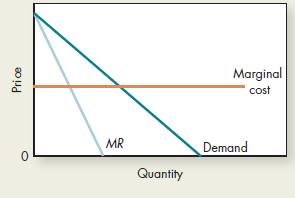
7. Up to how much is the monopolist depicted in the accompanying graph willing to spend to protect its market position?Demonstrate your answer graphically Price MR Demand Quantity Marginal cost
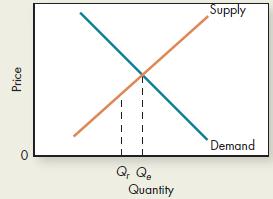
6. Demonstrate graphically the net gain to producers and the net loss to consumers if suppliers are able to restrict their output to Q r in the accompanying graph Demonstrate the net deadweight loss to society. Price Q, Qe Quantity Demand Supply
5. True or false? If it were easier for consumers to collude than for suppliers to collude, there would often be shortages of goods. Why? (LO16-2)
4. Some analysts have argued that competition will eliminate X-inefficiency from firms. Will it? Why? (LO16-1)
3. Define X-inefficiency. Can a perfect competitor be X-inefficient? Explain why or why not. (LO16-1)
2. Describe the monitoring problem. How does an incentive-compatible contract address the monitoring problem? (LO16-1)
1. True or false? It is obvious that all for-profit businesses in the United States will maximize profit.Why? (LO16-1)
Q-10 Why is oligopoly the best market structure for technological advance?
Q-9 Why isn’t perfect competition a good market structure for technological advance?
Q-8 What decision rule does a firm use when deciding whether to create or maintain a monopoly?
Q-7 What is the problem with regulations that set prices relative to costs?
Q-6 Why is it almost impossible for a perfect monopoly to exist?
Q-5 Explain, using supply and demand curves, why most agricultural markets are not perfectly competitive.
Q-4 In what way does the threat of a corporate takeover place competitive pressures on a firm?
Q-3 Why doesn’t a manager have the same incentive to hold costs down as an owner does?
Q-1 What are two reasons why real-world firms are not pure profit maximizers?
Q-2 Why would most economists be concerned about third-party-payer systems in which the consumer and the payer are different?
LO16-4 Explain why oligopoly is the best market structure for technological change.
LO16-3 Summarize how firms protect monopoly.
LO16-2 Discuss why competition should be seen as a process, not a state.
LO16-1 Define the monitoring problem and state its implications for economics.
7. What did Adam Smith mean when he wrote, “Seldom do businessmen of the same trade get together but that it results in some detriment to the general public”?
6. You’re working at the Department of Justice. Ms. Ecofame has just developed a new index, the Ecofame index, which she argues is preferable to the Herfindahl index. The Ecofame index is calculated by cubing the market share of the top 10 firms in the industry.a. Calculate an Ecofame guideline
5. In 1992 American Airlines offered a 50-percent-off sale and cut fares. In 1993 Continental Airlines and Northwest Airlines sued American Airlines over this action.a. What was the likely basis of the suit?b. How does the knowledge that Continental and Northwest were in serious financial trouble
4. How would the U.S. economy likely differ today if Standard Oil had not been broken up?
3. In the 1990s, the infant/preschool toy market four-firm concentration ratio was 72 percent. With 8 percent of the market, Mattel was the fourth largest firm in that market.Mattel proposed to buy Fisher-Price, the market leader with 27 percent.a. Why would Mattel want to buy Fisher-Price?b. What
2. Private colleges of the same caliber generally charge roughly the same tuition. Would you characterize these colleges as a cartel type of oligopoly?
1. A firm is convinced that if it lowers its price, no other firm in the industry will change price; however, it believes that if it raises its price, some other firms will match its increase, making its demand curve more inelastic. The current price is$8 and its marginal cost is constant at $4.a.
5. A BusinessWeek magazine study of mergers and acquisitions between 1990 and 1995 found that 83 percent of these deals achieved, at best, marginal returns, and 50 percent recorded a loss.a. If such mergers are not especially profitable, why do they occur?b. U.S. antitrust policy has changed
4. Does market structure determine firm behavior or does firm behavior determine market structure? (Post-Keynesian)
3. In which market structure would women likely be most successful? Why? (Feminist)
2. Alexis de Tocqueville once stated that “The Americans have applied to the sexes the great principle of political economy which governs the manufacturers of our age, by carefully dividing the duties of men from those of women, in order that the great work of society may be the better carried on
1. In the past two chapters you have learned much about market power: how it is used, the efficiency implications, and how society has responded. Yet this power remains, albeit minimally checked from time to time. The economist Thorstein Veblen would not be surprised by this. He would argue that
20. What was the resolution of the AT&T case?
19. Why was AT&T given a monopoly in the telephone industry? (LO15-4)
18. What technological advances threatened Microsoft’s monopoly? ( LO15-4 )
17. In what market did Microsoft have a monopoly in the late 1990s and early 2000s? ( LO15-4 )
16. Discuss the effect of antitrust policy in the: ( LO15-4 )a. monopolistic competition model.b. cartel model of oligopoly.c. contestable market model of oligopoly.
15. Demonstrate graphically how regulating the price of a monopolist can both increase quantity and decrease price.(Difficult) ( LO15-4 )a. Why did the regulation have the effect it did?b. How relevant to the real world do you believe this result is in the contestable markets view of the
14. Distinguish the basis of judgment for the Standard Oil and the ALCOA cases.
13. Is a contestable model or cartel model more likely to judge an industry by performance? Explain your answer. ( LO15-4 )
12. What is the difference between judgment by performance and judgment by structure? (LO15-4)
11. Suppose you are an economist for Mattel, manufacturer of the doll Barbie, which was making an unsolicited bid to take over Hasbro, manufacturer of the doll G.I. Joe. ( LO15-4 )a. Would you argue that the relevant market is dolls, preschool toys, or all toys including video games? Why?b. Would
10. If you were an economist for a firm that wanted to merge, would you argue that the three-digit or five-digit NAICS industry is the relevant market? Why? ( LO15-3 )
9. The pizza market is divided as follows:a. How would you describe its market structure?b. What is the approximate Herfindahl index?c. What is the four-firm concentration ratio? Pizza Hut Domino's 20.7% 17.0 Little Caesars 6.7 Pizza Inn/Pantera's 2.2 Round Table 2.0 All others 51.4
8. Which industry is more highly concentrated: one with a Herfindahl index of 1,200 or one with a four-firm concentration ratio of 55 percent? ( LO15-3 )
7. In 1993 Mattel proposed acquiring Fisher-Price for$1.2 billion. In the toy industry, Mattel is a major player with 11 percent of the market. Fisher-Price has 4 percent.The other two large firms are Tyco, with a 5 percent share, and Hasbro, with a 15 percent share. In the infant/preschool toy
6. Kellogg’s, which controls 32 percent of the breakfast cereal market, cut the prices of some of its best-selling brands of cereal to regain market share lost to Post, which controls 20 percent of the market. General Mills has 24 percent of the market. The price cuts were expected to trigger a
5. In 1982 Robert Crandell, CEO of American Airlines, phoned the Braniff Airways CEO and said, “Raise your fares 20 percent and I’ll raise mine the next morning.” ( LO15-2 )a. Why would he do this?b. If you were the Braniff Airways CEO, would you have gone along?c. Why should Crandell not
4. How are the contestable market model and the cartel model of oligopoly related? ( LO15-2 )
3. What is the difference between the contestable market model and the cartel model of oligopoly? ( LO15-2 )
2. Is an oligopolist more or less likely to engage in strategic decision making compared to a monopolistic competitor? ( LO15-1 )
1. What distinguishes oligopoly from monopolistic competition? ( LO15-1 )
Q-10 What was the resolution of the Microsoft case?
Q-9 How was market competitiveness judged in the Standard Oil and ALCOA cases?
Q-8 The Herfindahl index is 1,500. Using a structural analysis of markets approach, what would you conclude about this industry?
Q-7 The Herfindahl index is 1,500. Using a contestable market approach, what would you conclude about this industry?
Q-6 If the four-firm concentration ratio of an industry is 60 percent, what is the highest Herfindahl index that industry could have?What is the lowest?
Q-5 Which would have more output: the two-digit industry 21 or the four-digit industry 2111? Explain your reasoning.
Q-4 What are the two extremes an oligopoly model can take?
Q-3 Is the demand curve as perceived by an oligopolist likely to be more or less elastic for a price increase or a price decrease?
Q-2 Why is it difficult for firms in an industry to maintain a cartel?
Q-1 Your study partner, Jean, has just said that monopolistic competitors use strategic decision making. How would you respond?
Showing 4100 - 4200
of 7548
First
35
36
37
38
39
40
41
42
43
44
45
46
47
48
49
Last
Step by Step Answers

 Get 50% OFF
Claim Now
Get 50% OFF
Claim Now