New Semester
Started
Get
50% OFF
Study Help!
--h --m --s
Claim Now
Question Answers
Textbooks
Find textbooks, questions and answers
Oops, something went wrong!
Change your search query and then try again
S
Books
FREE
Study Help
Expert Questions
Accounting
General Management
Mathematics
Finance
Organizational Behaviour
Law
Physics
Operating System
Management Leadership
Sociology
Programming
Marketing
Database
Computer Network
Economics
Textbooks Solutions
Accounting
Managerial Accounting
Management Leadership
Cost Accounting
Statistics
Business Law
Corporate Finance
Finance
Economics
Auditing
Tutors
Online Tutors
Find a Tutor
Hire a Tutor
Become a Tutor
AI Tutor
AI Study Planner
NEW
Sell Books
Search
Search
Sign In
Register
study help
business
nonparametric statistical inference
Probability And Statistical Inference 2nd Edition Robert Bartoszynski, Magdalena Niewiadomska-Bugaj - Solutions
10.6.9 A die is unbalanced in such a way that the probability of tossing k ( k =1, . . . , 6 ) is proportional to k . You pay $4 for a toss, and win $ k if you toss k. Find the approximate probability that you are ahead after 100 tosses.
10.6.8 Referring to Example 8.40, assume that a man’s shoe has an average length of 1 foot and 0 = 0.1 foot. Find the (approximate) probability that the mean of I6 lengths of men’s shoes exceed 1 foot by more than 1 inch.
10.6.7 A fair coin is tossed 2n times. How large must n be if it is known that the probability of the equal number of heads and tails is less than 0.1?
10.6.6 Let XI, . . . , X 3 6 0 represent the outcomes of 360 tosses of a fair die. Let S360 be the total score X 1 + . . . + x 3 6 0 , and for j = 1, . . . ,6, let Y j be the total number of tosses that give outcome j . Use a normal approximation to obtain: (i) P(55
10.6.5 A regular dodecahedron (12-sided Platonian solid) has six red and six white faces, with the faces of each color labeled 1, . . . , 6. If you toss a face with label k you pay or win $k, depending on whether the color is red or white. Find the probability that after 50 tosses you are ahead by
10.6.4 Let X I , . . . , X, be a random sample from the BETA(2,3) distribution. Let S, = X1 + . . . + X,. Find the smallest n for which P{ S, 2 0.75n) 5 0.01.
10.6.3 Passengers on an international flight have a luggage weight limit B. The actual weight W of the passenger’s luggage is such that W/B has a BETA(a, b)distribution where a/(. +b) = 0.9. Assume that the weights of luggage of different passengers are independent and that the plane has 220
10.6.2 Assume that 500 students at a certain college will graduate on a given day.Because of space limitations the college offers each student two tickets for the commencement ceremony. From past experience it is known that 50% of the students will invite two guests to attend the ceremony, 20%
10.6.1 Let XI, . . . , X, be a random sample from the distributionwith density f(x) =ze-”, x > 0. Find c if it is known that P{X, > c } = 0.75 for n = 250.
10.5.6 A random variable has a Pareto distributionwith parameters a , b (a > 0, b >0) if its density is a,x > 0. f (x;a1b) = b ( l + x/b)a+l Let XI,. . . X, be a random sample from the Pareto distributionwith density f(z;1 ,l).(i) Find the limiting distribution of random variable U, = n X l Z n .
10.5.5 Let X1 , . . . , X, be a random sample from a logistic distribution with a cdf F ( z ) = 1/(1 + e-z)l and let V, = X,:,, Then V, --f 00, but V, - logn converge to a limiting distribution. Find P{ (V, -P P{ V, - log n 5 0) and logn/ 5 1).
10.5.4 Let X1 I . . . X, be a random sample from continuous distribution with a cdf F . Find the limitingdistributionof: (i) U, = nF(X1:,). (ii) W, = n[l-F(X,:,)].(iii) V, = nF(Xs:,).
10.5.3 Let XI,. . . X, be a random sample from distribution with cdf F ( z ) =1 - x F 2 for 1 I z < 00, and 0 otherwise. Find the limitingdistributionof: (i) XI:,.(ii) X;,. (iii) X,:,/J?I.
10.5.2 Let 21 . . . 2, be a random sample from N(0,l) distribution. Find the limitingdistributionof Y, = c Z l ( Z i + l/n)/J?I.
10.5.1 Let X1 . . . X, be a random sample from a POI(X) distribution. Show that-e-xn 5 P(X1= 0).
10.4.9 Genest (1987) provides the following algorithm for generating random Samples from the so-called Frank family of bivariate distributions: (a) Generate two independent observations U, and U2 from U[O, 11. (b) Obtain T = aul +(a-au1)U2.(c) Let X = U, and Y = log,[T/(T + (1 - a)&) ]w, here a
10.4.8 Kennedy and Gentle (1980) provide the following algorithm for generating a beta distribution: Generate U1 and Uz-two independent observations from the U[O, 13 distribution. For a > 0 and p > 0 denote V1 = Up and V2 = U!. According to the AcceptReject algorithm, let X = V I / ( V+~ V2) if V1
10.4.7 The Box-Muller transformation of two independent, uniform variables into two independent standard normal variables was presented in Theorem 7.4.1. Another algorithm, proposed by Marsaglia and Bray (1964), is to generate U1 and U2 as two independent observations from U[ -1,1]. If V = Uf + U;
10.4.6 Apply an Accepmeject method to the Laplace distribution with density(1.5)e-31zl to generate observations from a standard normal distribution. List the obtained values and specify how many of them you were able to obtain using the random sample of size 5 from U[O, 11: 0.222795, 0.516174,
10.4.5 Generate a random sample from the Gompertz distribution with survival function S(t) = exp{ 1 - exp(2t)) using the following random sample from the U[O,l] distribution: 0.289365,0.228349,0.732889.
10.4.4 A generalized Laplace distribution has a density given by the formula where X 1 > 0, A 2 > 0 . Generate two independent observations from a generalized Laplace distributionwith p = 1/4, X 1 = 3 and X 2 = 1/2, based on a random sample 0.647921,0.049055 from U[O, 11 distribution. f(x):
10.4.3 The double exponential (or Laplace) distribution has a density given by the formula j ( z ) = (X/2)e-’IzI for -co < E < co, A > 0. Obtain a random sample from the Laplace distribution with X = 2 based on a random sample 0.744921, 0.464001 from the U[O, 11 distribution.
10.4.2 Obtain a random sample of size 4 from a Pareto distribution with a density j ( z ) = (1 + E ) - ~fo r z > 0 and 0 otherwise. Use the following random sample from U[O, 11: 0.187724,0.386997,0.182338,0.028113.
10.4.1 Obtain a sample of size 6 from a POI(2) distribution based on following six independent observations from U[O, 11 distribution: 0.090907,O. 185040,O. 124341, 0.299086,0.428996, 0.927245.
10.3.8 Find ~ ( rn;,F o) when Fe is the U[O, 6'1 distribution. Find ~ ( rn;,3 )f or the family 3 = {&}, 6' > 0.
10.3.7 Let X I , .. . , X , and Yi., . . , Y, be two independent random samples from the same continuous distribution with a densityf. Show that P { X i , , 5 t } 2 P{ q:, 5 t } for every t if and only if i 5 j .
10.3.6 Let X I , . . . , X5 be a random sample from the BETA(2, 1) distribution. Find:(i) The density of a joint distribution of x1:5X, 2:5,X 45. (ii) E(Xz:51X4:5)(.i ii)The distribution of Y = x2:5/x1:5.
10.3.5 Let X I , . . . , X , be a random sample from the U[O, 11 distribution. Find sample size n such that E(R) = 0.75, where R = X,:, - XI:,.
10.3.4 Use results from Example 10.3 to determine Var(Xl:, - Xk:,, 1 > k,) in a random sample X I , . . . , X , from the U[O, 61 distribution.
10.3.3 Let X I , X2 be a random sample of size 2 from a continuous distribution with a median 6. (i) Find P(X1:z < 6 < X Z : ~ )(i.i) Generalize part (i) finding P(X1,, < 6 < X,,,) in a random sample of size n.
10.3.2 Let X I , . . . , X , be a random sample selected from the U[O, 11 distribution.(i) Show that the distribution of X j , , is BETA(j, n - j + 1) for j = 1, . . . , n. (ii)Find the distribution of a sample median Xk+l:,, and obtain its variance if n =3,7,15,2k + 1. Do you see any trend?
10.3.1 Determine the distribution of X I : , in a random sample selected from the EXP(X) distribution.
10.2.7 Derive the formula for E ( X k ) , where X - F(v1, vg). (Hint: Use similar approach as in Problem 10.2.6).
10.2.6 Derive formula (10.20). [Hint: Use formula (9.52) for the kth moment of a GAM(a, A) distribution and the fact that variables X and U in (10.15) are independent.]
10.2.5 Show that variable aX/ ( l +ax)w, here X - F(u1,u2) and a = u1/v2, has a BETA(u1/2,~2/2)d istribution.
10.2.4 Let X1 - GAM(1, A), X2 - GAM(2, A), X3 N GAM(3, A) be independent random variables. Find constant a such that variable Y = aX1/(X2 + X3) has an F distribution.
10.2.3 Let X, Y, W be independent random variables such that X -N(O, I), Y -N( 1, l), and W -N(2,4), respectively. Use Table A6. to find k such that x2 + (Y - 1 ) 2 { X2 + (Y - 1)2 + (W - 2)2/4
10.2.2 Show that if x, is the a-quantile of a random variable X with an F,,,,, distribution, then l/xa is the (1 - a)-quantile of a random variable with an FvZlvl distribution.
10.2.1 Let X - t,. Show that X2 has Fl,, distribution.
10.1.3 Let X 1 , X 2 , X 3 be sample means in three independent samples of sizes n1, n2, " 3 , respectively. Each sample was obtained from the N(p, 02) distribution.Find the distribution of V1 = (1/3) (XI + x2 + Y3)a nd fi = w l x l + ~ 2 x +2 w3T3, where wi = ni(n1 + 722 + 123).
10.1.2 Let X I , . . . , Xn and Y1, . . . , Y, be two random samples from distributions with means p1 and p2, respectively, and the same variance u2. (i) Find E ( x - y)and Var(X - y). (ii) Assuming that p1 = p2 and both samples are of equal size, find n = m such that P(lX - 71 > u / 4 ) 5 0.05.- -
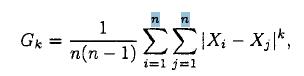
10.1.1 Statistic Gk, defined fork = 1 , 2 as n nwas proposed as a measure of variation by Jordan (1869). Show that G2 = 2S2, where S2 is given by formula (10.1). n n 1 Gk = (n-1) . - *, *, i=1 j=1
9.6.4 Let X I , X z , . . . be iid with an exponential distribution. For any positive m and n find the distribution of the ratio XI + ’ ’ ’ + Xm Tm3n =XI + ’ ’ + Xm+n ’
9.6.3 Let X have a symmetric beta distribution. Find a and /3 if the coefficient of variation (ratio of standard deviation and the mean) is k . Does a solution exist for all k?
9.6.2 Let X I , . . . , X , be independent variables with a U[O, 11 distribution. The joint density of the X = min(X1, . . . , X,) and Y = max(X1, . . . , X,) has density f(x, y) = n(n - l ) ( y - x)n-2 for 0 5 x 5 y 5 1 and f(x, y) = 0 otherwise. Find:(i) E ( X m ) ,E ( Ym)a, n d p ( X ,Y ) .( ii)
9.6.1 Let X have a distribution BETA(a, p). Find: (i) The distribution of Y =1 - X . (ii) E{X‘(I - x ) ~ } .
9.5.8 Assume that XI and X2 have a bivariate normal distribution with E(X1) =3,E(X2) = 2,Var(X1) = 4,Var(Xz) = 1 and p = -0.6. Find: (i) P(X1 5 41x2 = 3). (ii) P(JX2 - 11 2 1.51X1 = 2).
9.5.7 Assume that XI and X2 are independent, with N(3,6) and N(- 1,2) distributions, respectively. Find: (i) P(3X1 - 2x2 114). (ii) P(X1 < XZ).
9.5.6 Find rs-the skewness of a lognormal distributionwith parameters p and a’.
9.5.5 A “100-year water,” or flood, is the water level that is exceeded once in a hundred years (on average). Suppose that the threatening water levels occur once a year and have a normal distribution. Suppose also that at some location the 100-year water means the level of 30 feet above
9.5.4 Let random variable X have a N(p, a2) distribution. Find: (i) p if a2 = 2 and P ( X 5 12) = 0.72. (ii) a2 if p = 2 and P(X 25) = 0.39.
9.5.3 Find P(IX - 21 5 0.5) if X - N(1,4).
9.5.2 Determine z in the following cases (interpolate, ifnecessary): (i) @(z) = 0.62.(ii) @(z)= 0.45. (iii) P( lZ(5 z) = 0.98. (iv) P(1.4 5 Z 5 z)=0.12.
9.5.1 Use the tables of normal distribution to determine the probabilities:(i) P(0 5 Z 5 1.34). (ii) P(0.14 5 Z 5 2.01). (iii) P(-0.21 5 Z 5 -0.04). (iv)P(-0.87 5 Z 5 1.14). (v) P(IZ1 1. 1.02). (vi) P(Z 2 1.11).
9.4.7 It was found that the survival time (in years) in a group of patients who had a certain medical treatment and are in the similar risk group follows WEI( 2,1/3)distribution. Find: (i) The median survival time for such patients. (ii) The probability that a randomly selected patient will live at
9.4.6 (i) Find the median and the mode of the Weibull distribution with a density(9.56). (ii) Prove the formula (9.57).
9.4.5 Find the distribution of X = O ( - log U ) ' l k , if U - U(0,l).
9.4.4 For a random variable X that has a Laplace distribution with X = 1, find: (i)Survival and hazard functions. (ii) Variance. (iii) Kurtosis.
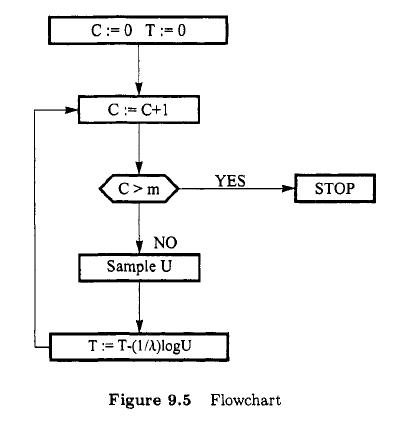
9.4.3 In the flowchart of Figure 9.5, the block denoted “sample U” means that the computer samples a value of random variable U with a distribution uniform on (0, l), the samplings being independent each time the program executes this instruction.Assume that m is a positive integer and X >
9.4.2 A system consists of five components. Suppose that the lifetimes of the components are independent, with exponential distributions EXP( XI), . . . , EXP(X5).Find the cdf and density of variable T = time to failure of the system if the components are connected: (i) In series (see Figure 9.2),
9.4.1 Show that if variable X has a GAM(n, 1) distribution, where n is a positive integer, then its cdf is given by the following formula:n-1 Fx(2) = -j = O(Hint: Integrate by parts and use induction.)
9.3.13 Assume that chocolate chips are distributed within a cake according to a Poisson process with parameter A. A cake is divided into two parts of equal volume(disregard the possibility of cutting through a chocolate chip). Show that the probability that each part of the cake has the same number
9.3.12 Consider two independent Poisson processes with the same parameter A. Let Ni ( t ) , i=l, 2 be the number of events in i-th process which occurred up to time t , and let UT be the set of all those times t with 0 5 t 5 T at which N l ( t ) = N2(t).Find E(&) given that: (i) N l ( T ) = N2(T) =
9.3.11 Traffic accidents at a given intersection occur following a Poisson process.(i) Given that 10 accidents occurred in June, what is the probability that the seventh accident occurred before June lo? (ii) If it is known that n accidents occurred in April, what is the expected number of
9.3.10 Suppose that the number of eggs X laid by a bird has a Poisson distribution.Each egg hatches with probability p , independently of what happens to other eggs.Let VI and V,, V1f V2 = X , denote the numbers of eggs that hatch, and the number of eggs that do not hatch, respectively. Show that
9.3.9 Let X be the number of failures preceding the rth success in a sequence of Bernoulli trials with probability of success p . Show that if q + 0, r + co in such a way that rq = X > 0, then Xk - A P{X = k} + -e k!for every k = 0, 1, 2, . . . . This shows that the negative binomial distribution
9.3.8 (Does Nature Prefer Even Numbers?) Generalizing Problem ??, let X be an integer-valued random variable such that X = X I + X2, where X I , X2 are independent, identically distributed integer-valued random variables. Show that P { X is even } 2 0.5 (this property has been pointed out to us by
9.3.7 Find the approximate probability that in 1000 randomly chosen persons there are exactly: (i) Two born on New Year and two born on Christmas. (ii) Four born on either Christmas or New Year.
9.3.6 Weekly numbers of traffic accidents at intersections A, B, and C are independent, each with a Poisson distribution. It is known that, on the average, the number of accidents at intersection A is the same as the number of accidents at intersections B and C combined, while the average number of
9.3.5 A certain store makes, on average, two sales per hour between 9:00 a.m. and 2:OO p.m., and three sales per hour between 2:OO p.m. and 9:OO p.m. The numbers of sales in different time periods are independent and have a Poisson distribution.Find: (i) The probability of more than three sales
9.3.4 Suppose that the daily numbers of ships arriving to a certain port are independent, each with POI(3) distribution. Find: (i) The expected number of days in April when there are no arrivals. (ii) The expected number and variance of days during the summer months (June, July, August) with the
9.3.3 Accidents in a given plant occur at a rate of 1.5 per month. The numbers of accidents in different months are independent and follow the Poisson distribution.Find the probability of (i) Five accidents in a period of five consecutive months. (ii)One accident in each of five consecutive months.
9.3.2 A book with 500 pages contains, on average, three misprints per ten pages.What is the probability that there will be more than one page containing at least three misprints?
9.3.1 Let X have the POI(X) distribution. Find: (i) The mode of X (i.e., the most likely value of X). (ii) P ( X is even). (Hint. Write the Taylor expansions for ex and e-’. Any ideas?)
9.2.3 Instead of (9.23), write X = 71 + 772 + ’ ’ + qa, where qj = 1 or 0 depending on whether or not the jth element representing success was selected. Use this representation to derive formulas for the mean and variance of X as given in Theorem 9.2.2.
9.2.2 An urn contains six chips, three red and three green. Four chips aye selected without replacement. Find E ( X ) and Var(X) where X = number of red chips in the sample.
9.2.1 An urn contains nine chips, five of them red and four blue. Three chips are drawn without replacement. Find the distribution of X = number of red chips drawn.
9.1.15 Show that if X has a negative binomial distributionNBIN( T , p ) , then E[(T - l ) / ( T + x - l)] = p
9.1.14 In the flowchart in Figure 9.1, m > 0 is an integer and 0 < p < 1. The block“sample U” means that a value of a random variable U is sampled from the U[O, 11 distribution, with consecutive samplings being independent. Find the distribution of X, and then calculate its mean and variance.
9.1.13 Assume that in a tennis match between A and B, the probability of winning a tennis set by player A is p , and that the results of sets are independent. Let T be the number of sets played in a match. Find the distribution of T and E ( T ) as a function of p , assuming that the match is played
9.1.12 A hospital needs 20 volunteers for the control group in testing the efficiency of some treatment. The candidates are subject to psychological and medical screening, and on average, only 1 in 15 candidates is found acceptable for the experiment.The cost of screening, whether or not a
9.1.11 Assume that the probability that a birth is a multiple one (twins, triplets, etc.)is 7-r. Given that a birth is a multiple one, probabilities 0 2 , 03, . . . of twins, triplets,, . .satisfy the condition f f k + l = y a k . Find x , 0 2 and y if it is known that the expected number of
9.1.10 Assume that the probability of twins being identical is p, and that the sexes of children are determined independently, with probability of a boy being b (possibly h # 1/2). Find the expected number of twin births recorded in the hospital before the first pair of: (i) Boys. (ii) Girls. (iii)
9.1.9 Six dice are tossed simultaneously until, for the first time, all of them show the same face. Find E(U) and Var(U), where U is the number of tosses until this happens.
9.1.8 Show that for the binomial distribution we have P{ S k} = (n k ) (^) / 2 n k1(1 x)*dz. - 0
9.1.7 Show that if S,, is a binomial random variable, then for k = 1 , 2 , . . . , n,(n - k + l ) p k ( 1 - P)P{S, = k } = P{S, = k - 1).
9.1.6 Two players (or two teams) are negotiating the rules for determining the championship.The two possibilities are “best of five” or “best of seven.” This means that whoever wins three (respectively four) games is the champion. Assume that games are independent, and that the probability
9.1.5 An experiment consists of tossing a fair coin 13 times. Such an experiment is repeated 17 times. Find the probability that in a majority of repetitions of the experiment the tails will be in minority.
9.1.4 Assume that X1 and X Z are independent random variables, with binomial distributions with parameters n1, p and n2, p respectively. Find a correlation coefficient between XI and X1 + XZ.
9.1.3 Suppose that random variables XI, . . . , X, are independent, each with the same Bernoulli distribution. Given that El”=, X i = T , find: (i) The probability that X1 = 1. (ii) The covariance between Xi and Xj, 1 5 i < j 5 n.
9.1.2 Assume that we score Y = 1 for a success and Y = -1 for a failure. Express Y as a function of the number X of successes in a single Bernoulli trial, and find moments E(Yn) ,n =1,2, . . . .
9.1.1 Label statements below as true or false:(i) Suppose that 6% of all cars in a given city are Toyotas. Then the probability that there are 4 Toyotas in a row of 12 cars parked in the municipal parking is( y ) ( 0.06)4 (0 .94)8.(ii) Suppose that 6% of all Europeans are French. Then the
8.8.8 Show that if X has the Poissondistributionwith mean A, then P ( X 5 X / 2 ) 5(2/e)’I2 and P ( X 2 2X) I (e/4)’. (Hint: Use the inequality in Problem 8.8.7, and find minimum of the right-hand sides for t.)
8.8.7 Let X be a random variable such that a mgf mx(t) exists for all t . Use the same argument as in the proof of the Chebyshev inequality to show that P{ X 2 y} I e - t YmX ( t ) ,t 2 0.
8.8.6 Let X have the Poisson distribution with mean A. Show that 1and P { X > 2 X } I -X.
8.8.5 Show that if X has a mgf bounded by the mgf of exponential distribution(i.e., X/(X - t ) for t < A), then for X E > 1 we have P { X > €} 2 X€e-(XL-l).(Hint: Use the mgf of exponential distribution to obtain the bound for P { X > E } , then determine its minimum.)
8.8.4 Derive the Chebyshev inequality from the Markov inequality.
8.8.3 Prove the Markov inequality when X is a continuous random variable.
8.8.2 Assume that E ( X ) = 12, P ( X 2 14) = 0.12, and P ( X 5 10) = 0.18.Show that the standard deviation of X is at least 1.2.
8.8.1 Show that E ( X ) 2 0.2 if P ( X 2 0) = 1 and P ( X 2 2 ) = 0.1.
Showing 200 - 300
of 5397
1
2
3
4
5
6
7
8
9
10
11
12
13
14
15
Last
Step by Step Answers

 Get 50% OFF
Claim Now
Get 50% OFF
Claim Now