New Semester
Started
Get
50% OFF
Study Help!
--h --m --s
Claim Now
Question Answers
Textbooks
Find textbooks, questions and answers
Oops, something went wrong!
Change your search query and then try again
S
Books
FREE
Study Help
Expert Questions
Accounting
General Management
Mathematics
Finance
Organizational Behaviour
Law
Physics
Operating System
Management Leadership
Sociology
Programming
Marketing
Database
Computer Network
Economics
Textbooks Solutions
Accounting
Managerial Accounting
Management Leadership
Cost Accounting
Statistics
Business Law
Corporate Finance
Finance
Economics
Auditing
Tutors
Online Tutors
Find a Tutor
Hire a Tutor
Become a Tutor
AI Tutor
AI Study Planner
NEW
Sell Books
Search
Search
Sign In
Register
study help
business
nonparametric statistical inference
Probability And Statistical Inference 2nd Edition Robert Bartoszynski, Magdalena Niewiadomska-Bugaj - Solutions
6.4.7 Find the density of Y = X(l - X) if X has U[O, I] distribution.
6.4.6 Assume that X has the standard normal distribution. Find the density of: (i)Y = X 3 . (ii) Y = ( X - (iii) Y = ex.
6.4.5 Let X have EXP(A) distribution, and let Y = n. Find:(i) The cdf and density of Y . (ii) The lower quartile of Y ,
6.4.4 Let X be U[O, 11. Find p such that Y = p(X) has EXP(X) distribution.
6.4.3 Let X have a continuous distribution with cdf Fx and density fx, such that FX (0) = 0.F ind the cdf and density of random variables: (i) 0.(i i) log X . (iii)1 / X . (iv) ex.
6.4.2 Let X have the Poisson distribution with parameter A, and let Y = 2 X . Find the distribution of Y .
6.4.1 If X is the result of tossing a balanced die, find the distribution of: (i) Y =( X - 1)2. (ii) 2 = /X - 2.51.
6.3.10 An oscillator sends the wave X ( t ) = A cos(27rt), where A = 1 or 2 with equal probabilities. We observe the value of X( t ) at the point chosen at random from theU[n,n+l] distributionforsome n. Find: (i) P ( X ( t )5 1). (ii) P( JX( t ) I> 3 / 2 ) .(iii) P ( X ( t ) > 0).
6.3.9 Let random variable X with the cdf F be uniformly distributed over the union of intervals (0,a) and ( a + 2, b ) . Assuming that F(4) = 0.2 and F ( a + 1) = 0.25, find: (i) a andb. (ii) F(8.39). (iii) P(3.01 5 X 5 9.14).
6.3.8 Let X have the density f(z) = Cx for 0
6.3.7 Let X , be the difference (possibly negative) between the number of heads and the number of tails in n tosses of a coin. Find: (i) The distribution of Xq. (ii) The cdf of X, at point z = -0.6. (iii) The probability that X, is positive given that it is nonnegative for (a) n = 4 and (b) n = 5.
6.3.6 Let X have EXP(X) distribution. Show that for s, t > 0 the following memorylessproperty holds: P { X > s + tlX > s} = P{X > t } .
6.3.4. (i) Find P ( Y = 2). (ii) Show that P ( Y = klZ = k + 1) = P ( Y = 2) for all k = 0 , 1 , . . . . (iii) Find P(Z = k + IIY = k ) fork = 0,1,. . ..
6.3.5 Let X have EXP(X) distribution, and let Y and Z be defined as in Problem
6.3.4 Let X have EXP( 1) distribution. Moreover, let Y = [XI be the integer part of X , and let Z be the integer nearest to X . Find: (i) The distributions of Y and 2. (ii)P ( Y = 2). (iii) P ( Y = 312 = 4 ) . (iv) P ( Z = 4 ( Y = 3 ) . (v) P ( Y = 412 = 3 ) .(vi) P ( Z = 3 / Y = 4).
6.3.3 Let X have the density f(z) = Ce-0.4151, -cc < z < +m (such distribution is called Lupluce or double exponential). Find C and then obtain: (i) P(X > -2).(ii) P(IX + 0.51 < 1).
6.3.2 You have 5 coins in your pocket: 2 pennies, 2 nickels, and a dime. Three coins are drawn at random. Let X be the total amount drawn (in cents). Find: (i)The distribution of X. (ii) P ( X 5 lOlX 5 15). (iii) The probabilities that two pennies are drawn, if it is known that X 5 11.
6.3.1 A die is biased in such a way that the probability of obtaining k dots ( k =1, . . . ,6) is proportional to Ic2. Which number of dots is more likely: odd or even?
6.2.7 Prove the first part of assertion (b) of Theorem 6.2.2.
6.2.6 A coin of diameter d is dropped on a floor covered with square tiles with side length D >d. Let X be the number of tiles which intersect with the coin. (i) Find the distribution of X. (ii) Determine the median of X as a hnction of D and d.
6.2.5 A point is chosen at random from a square with sidea. Let X be the distance from the selected point to the nearest corner of the square. Find and graph FX (x).
6.2.4 Determine the medians and lower and upper quartiles for random variables with the following cdf's:for x < 0 for 0 5 x 5 1/Gl for x > 1/G, k > 0
6.2.3 Let X be a random variable with cdf given by Fx(z) = 0 for 5 < 0 and F x ( z ) = 1 - 0.3e-’” for z 2 0. Determine: (i) P(X = 0). (ii) X if P(X 5 3) =3/4. (iii) P(jXl 5 5) using results of (ii).
6.2.2 Figure 6.3 shows the cdf of a random variable X. Find: (i) P(X = -2), P ( X = 0 ) . (ii) P ( X 5 3), P(X < 3), P ( X < 0.13). (iii) P(X > 2), P ( X >2.79). (iv) P(-1 < X 5 0.7), P(-2 5 X < 1). (v) P(l 5 1x1 5 2).
6.2.1 In the statements below, F and G stand for cdf‘s of random variables X and Y,re spectively. Classify each of the statements below as true or false:(i) If X is always strictly positive, then F ( t ) is strictly positive for all t .(ii) If F(37) = F(45), then P(40 < X < 42) = P(43 < X <
5.5.2 Consider the following simple model of evolution: On a small island there is room for 1000 members of a certain species. One year a favorable mutant appears.We assume that in each subsequent generation either the mutants take one place from the regular members of the species with probability
5.5.1 Find the probability of winning a game in tennis directly, using the fact that when the deuce (or 30-30) is attained, the probability ofwinning is xF=0(2pq)np2.
5.4.6 Let s(n) be a stationary Markov chain with transition probability matrix P =[pij] and P(s(n) = j ] = u j . Moreover, let q i j = P[s(n - 1) = jls(n) = i] so that Q = [qij] is also a transition probability matrix (why?). The chain with matrix Q is obtained from the chain with matrix P by
5.4.5 Another model of diffusion, intended to represent the diffusion of noncompressible substances (e.g., liquids) is as follows. There are N red and N green balls, distributed evenly between urns A and B, so that each urn contains exactly N balls.At each step one ball is selected from each urn at
5.4.4 Show that the probabilities uj for the dog flea model of diffusion are given by the formula uj = ( y ) 2 - N , j = 0 , 1 , . . . , N .
5.4.3 A stochastic matrix P = [pij] is called doubly stochastic if the sums of its columns are 1. Show that if an irreducible and aperiodic Markov chain with M states has a doubly stochastic transitionmatrix, then uj = 1/M for all j .
5.4.2 Argue that if the number of states is M , and state ej is accessible from state ei, then it is accessible in no more than M - 1 steps.
5.4.1 Determine the period of the dog flea model of Problem 5.2.4.
5.3.3 In Problem 5.3.2 it was assumed that every man has one son. Assume now that the probability that a man has a son is T . Define a Markov chain with four states, where the first three states are as in Problem 5.3.2, and the fourth state is entered when a man has no son. This state cannot be
5.3.2 Assume that a man’s occupation can be classified as professional, skilled laborer, or unskilled laborer. Assume that of the sons of professional men, a percent are professional, the rest being equally likely to be skilled laborers as unskilled laborers.In the case of sons of skilled
5.3.1 Find all two-step transition probabilities for: (i) The Markov chain described in Problem 5.2.2. (ii) The dog flea model of Problem 5.2.4.
5.2.5 Consider a specific kind of part needed for the operation of a certain machine(e.g., the water pump of a car). When the part breaks down, it is replaced by a new one. The probability that a new part will last for exactly n days is rnr n = 1 , 2 , . . . .Let the state of the system be defined
5.2.4 (Dog Fleas, or the Ehrenfest Model of Diffusion) Consider two urns (or dogs), and N balls (or fleas), labeled 1, . . . , N, allocated between the urns. At times t = 1 , 2 , . . . , a number 1 through N is chosen at random, and the ball with the selected number is moved to the other urn. Let s
5.2.3 A college professor teaches a certain course year after year. He has three favorite questions, and he always uses one of them in the final exam. He never uses the same question twice in a row. If he uses question A in one year, then the next year he tosses a coin to choose between question B
5.2.2 Suppose the results of an election in a certain city are found to depend only on the results of the last two elections. Specifically, letting R and D denote Republican and Democratic victories, the state before any election may be RR, RD, DR, DD, the letters signifying respectively the
5.2.1 (i) Modify Example 5.3 by assuming that in each game the player may win with probability p , lose with probability q, or draw (so that his fortune does not change) with probability T , where p + q + T = 1. Find the transition probability matrix in this case. (ii) Modify Example 5.4 same way
5.1.2 After some time spent in a bar, Peter starts to walk home. Suppose that the streets form a rectangular grid. Peter always walks to the nearest comer and then decides on the direction of the next segment of his walk (so that he never changes direction in the middle of the block). Define the
5.1.1 Customers arrive at a service station (a taxi stand, a cable car lift at a skiing resort, etc.) and form a queue. At times t = 1 , 2 , . . . the first rn customers (rn 2 1)in the queue are served (if there are that many). Let Yl, Yz, . . . denote the numbers of customers arriving during the
4.6.2 Generalizing the scheme of Problem 4.6.1, let p t be the probability of choosing size t for subset St c { 1, . . . , N } , 1 5 t 5 N . After choosing t , subset S, is selected at random, and all events with indices in S, occur while other events do not.(i) Argue that events A l , . . . , AN
4.6.1 A subset S of size t , 1 5 t 5 N , is selected at random from the set { I , . . . , N }and event Ai, i = 1,. . . , n, is defined as: “Element i was among the elements selected.” If S = {il, . . . , it} is chosen, we say that events A i l , . . . , Ai, occur, while the remaining events do
4.5.19 An athlete in a high jump competition has the right of three attempts at each height. Suppose that his chance of clearing the bar at height h is equal to p(h), independently of the results of previous attempts. The heights to be attempted are set by the judges to be hl < h2 < . . . . An
4.5.18 Is it possible to bias a die in such a way that in tossing the die twice, each sum 2 , 3 , . . . , 12 has the same probability?
4.5.17 The French mathematician Jean D’Alembert claimed that in tossing a coin twice, we have only three possible outcomes: “two heads,” “one head,” and “no heads.” This is a legitimate sample space, of course. However, D’Alembert also claimed that each outcome in this space has the
4.5.16 A machine has three independent components, two that fail with probability p and one that fails with probability 0.5. The machine operates as long as at least two parts work. Find the probability that the machine will fail.
4.5.15 Consider a die in which the probabilityof a face is proportional to the number of dots on this face. What is the probability that in six independent throws of this die each face appears exactly once?
4.5.14 Three people, A, B, and C, take turns rolling a die. The first one to roll 5 or 6 wins, and the game is ended. Find the probability that A will win.
4.5.13 Find the probability that in repeated tossing of a pair of dice, a sum of 7 will occur before a sum of 8.
4.5.12 A coin with probability p of turning up heads is tossed until it comes up tails. Let X be the number of tosses required. You bet that X will be odd, and your opponent bets that X will be even. For what p is the bet advantageous to you? Is there a p such that the bet is fair?
4.5.11 Two people take turns rolling a die. Peter rolls first, then Paul, then Peter again, and so on. The winner is the first to roll a six. What is the probability that Peter wins?
4.5.10 A coin is tossed six times. Find the probability that the number of heads in the first three trials is the same as the number of heads in the last three trials.
4.5.9 Events A and B are such that 3P(A) = P ( B ) = p , where 0 < p < 1. Find the correct answers in parts (i) and (ii).(i) The relation P(B1A) = 3P(A/B)is : (a) True. (b) True only if A and B are disjoint. (c) True only if A and B are independent. (d) False.(ii) The relation P ( A n BC) 5
4.5.8 Suppose that a point is picked at random from the unit square 0 5 z 5 1,0 5 y 5 1. Let A be the event that it falls in the triangle bounded by the lines y =0,z = 1, and z = y, and let B be the event that it falls into the rectangle with vertices (O,O), ( l , O ) , (1,1/2) and (0,1/2). Find
4.5.7 The probability that a certain event A occurs at least once in three independent trials exceeds the probability that A occurs twice in two independent trials. Find possible values of P( A ) .
4.5.6 Let X be the number on the ball randomly selected from a box containing 12 balls, labeled 1 through 12. Check pairwise independence of events A, B, and C, defined as: X is even, X 2 7, and X < 4, respectively.
4.5.5 If disjoint events A and B have positive probabilities, check independence of events in the following pairs : 0 and A, A and B, A and S , A and A n B, 0 and A'.
4.5.4 Events A and B are independent, A and C are mutually exclusive, and B and C are independent. Find P(A U B U C ) if P ( A ) = 0.5, P(B) = 0.25, and P(C) = 0.125.
4.5.3 Events A and B are independent, P ( A ) = kP(B), and at least one of them must occur. Find P(A' i l B).
4.5.2 Suppose that A and B are independent events such that P ( A fl Bc) = 1/3 and P(ACn B) = 1/6. Find P ( An B) .
4.5.1 Label the statements true or false.(i) The target is to be hit at least once. In three independent shots at the target(instead of one shot) you triple the chances of attaining the goal (assume each shot has the same positive chance of hitting the target).(ii) If A and B are independent, then
4.4.9 One of three prisoners, A, B, and C, is to be executed the next morning. They all know about it, but they do not know who is going to die. The warden knows, but he is not allowed to tell them until just before the execution.In the evening, one of the prisoners, say A, goes to the warden and
4.4.8 A prisoner is sentenced to life in prison. One day the warden comes to him and offers to toss a fair coin for either getting free or being put to death. After some deliberation the prisoner refuses, on the ground that it is too much risk: He argues that he may escape, or be pardoned, and so
4.4.7 Players A and B draw balls in turn, without replacement, from an urn containing three red and four green balls. A draws first. The winner is the person who draws the first red ball. Given that A won, what is the probability that A drew a red ball on the first draw?
4.4.6 We have three dice, each with numbers z = 1, . . . , 6 , and with probabilities as follows: die 1: p ( z ) = 1/6, die 2: p ( z ) = (7 - z)/21, die 3: p ( z ) = z2/91. A die is selected, tossed, and the number 4 appears. What is the probability that it is die 2 that was tossed?
4.4.5 Suppose that box A contains four red and five green chips and box B contains six red and three green chips. A chip is chosen at random from box A and placed in box B. Finally, a chip is chosen at random from those now in box B. What is the probability that a green chip was transfered given
4.4.4 One box contains six red and three green balls. The second box has six red and four green balls. A box is chosen at random. From this box two balls are selected and found to be green. Find the probability that the pair was drawn from the first box if the draws are: (i) Without replacement.
4.4.3 An urn originally contains three blue and two green chips. A chip is chosen at random from the urn, returned, and four chips of the opposite color are added to the urn. Then a second chip is drawn. Find the probability that: (i) The second chip is blue. (ii) Both chips are of the same color.
4.4.2 Two different suppliers, A and B, provide the manufacturer with the same part.All supplies of this part are kept in a large bin. In the past 2% of all parts supplied by A and 4% of parts supplied by B have been defective. Moreover, A supplies three times as many parts as B. Suppose that you
4.4.1 Suppose that medical science has developed a test for a certain disease that is 95% accurate, on both those who do and those who do not have the disease. If the incidence rate of this disease in the population is 5%, find the probability that a person: (i) Has the disease when the test is
4.3.6 Recall Example 4.9. Find the probability that the mother is a carrier if: (i)Both father and son are color blind, and the mother is not. (ii) It is known only that the son is color blind. (iii) The son is color blind, but the parents are not.
4.3.5 (Tom Sawyer Problem) You are given a task, say painting a fence. The probability that the task will be completed if k friends are helping you is pk ( k =0 , 1 , . . .). If j friends already helped you, the probability that the ( j + 1)st will also help is 7-rj (j = 0 , 1 , . . .). On the
4.3.4 Let A and B be two events with P(B) > 0, and let C1, C2, . . . be a possible partition of a sample space. Prove or disprove the following formulas:P(AIB) = C P ( A ~ Bn c i)p(ci), z P(AIB) = C P(AIB n Ci)P(BICi)P(Ci).i
4.3.3 Suppose that in Problem 4.3.2 we return the second ball to the urn, and add new balls as described, with the condition that if the second ball is blue, we add one ball of each color. Then we draw the third ball. What is the probability that the third ball is: (i) Blue. (ii) Blue if the first
4.3.2 Suppose that initially the urn contains one red and two green balls. We draw a ball and return it to the urn, adding three red, one green, and two blue balls if a red ball was drawn, and three green and one blue ball if a green ball was drawn. Then a ball is drawn from the urn. Find
4.3.1 An event W occurs with probability 0.4. If A occurs, then the probability of W is 0.6; if A does not occur but B occurs, the probability of W is 0.1. However, if neither A nor B occurs, the probability of W is 0.5. Finally, if A does not occur, the probability of B is 0.3. Find P(A).
4.2.14 An urn contains three red and two green balls. If a red ball is drawn, it is not returned, and one green ball is added to the urn. If a green ball is drawn, it is returned, and two blue balls are added. If a blue ball is drawn, it is simply returned to the urn. Find the probability that in
4.2.13 Three cards are drawn without replacement from an ordinary deck of cards.Find the probability that: (i) The first heart occurs on the third draw. (ii) There will be more red than black cards drawn. (iii) No two consecutive cards will be of the same value.
4.2.12 A tennis player has the right to two attempts at a serve: If he misses his first serve, he can try again. A serve can be played “fast” or “slow.” If a serve is played fast, the probability that it is good (the ball hits opponent’s court) is A; the same probability for a slow serve
4.2.11 A fair coin is tossed until a head appears. Given that the first head appeared on an even-numbered toss, what is the probability that it appeared on the 2nth toss?
4.2.10 A deck of eight cards contains four jacks and four queens. A pair of cards is drawn at random. Find the probability that both cards are jacks if: (i) At least one of the cards is jack? (ii) At least one of the cards is a red jack? (iii) One of the cards is a jack of hearts?
4.2.9 Three distinct integers are chosen at random from the set { 1 , 2 , . . . , 15). Find the probability that: (i) Their sum is odd. (ii) Their product is odd. (iii)) The sum is odd if it is known that product is odd. (iv) The product is odd if it is known that the sum is odd.(v) Answer
4.2.8 Events A, B , Care such that at least one ofthem occurs. Moreover, P(A1B) =2P(A n B n C ) . Find the probability that: (i) Exactly one of events A , B, and C occurs. (ii) Only B occurs.
4.2.7 Find P [ A n B n CI ( A n B ) u ( A n C)] if P(A) = 0.8, P ( B ) = 0.4, P (C) =0.4, P ( A U B ) = 1, P ( A U C ) = 0.9, and P(B U C) = 0.6.
4.2.6 Find P (AIB) ,if P (A“)= 2P (A) a nd P (BIA“)= 2P (BIA)= 0.2.
4.2.5 P(A) = P(B) = 1/2, P(AIB) = 1/3. Find P ( A n BC).
4.2.4 Find P ( A r l B ) if P(A) = 3/4, P ( B ) = 1/2, P (AIB) - P(B1A) = 2/9.
4.2.3 Assume that P(AnB)> 0 and determine P(A) / [P(A)+P(Ba)s] a function ofa, where a = P(BIA)/P(A/B).
4.2.2 Assume that A and B are disjoint. Find P(A”1B) and P(AU BIA‘).
4.2.1 Let events A , B, and C be such that P(A) > 0, P ( B ) > 0, and P(C) >0. Label the following statements as true or false: (i) The conditional probability P(AIB) can never exceed the unconditional probability P(A). (ii) If P(AIB) =P ( A J C ) then P ( B ) = P(C). (iii) If A and B are disjoint
4.1.1 A computer file contains data on households in a certain city. Each entry line in this file contains various information about one household: income, socioeconomic status, number of children, their ages, and so on. The computer is programmed so that it selects one entry at random, each with
3.5.6 Use Stirling’s formula to approximate the number of ways: (i) A set of size 2n can be partitioned into two equal parts. (ii) A set of size 3n can be partitioned into three equal parts.
3.5.5 A committee of 50 is to be chosen from the US Senate. Estimate the numerical value of the probability that every state will be represented.
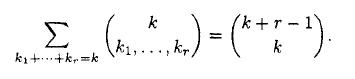
3.5.4 Show that k kit+kk (*)-(*+1-1). k
3.5.3 Use the argument analogous to that in Theorem 3.3.2 to show that if i 2 1, j 2 1, and k 2 1, then n (Z) = ( i - l n j , k ) + ( i , j - l , k ) + (i,j,L-l).
3.5.2 Find the coefficient of the term z4y5z3 in the expansion of (z - 2y + 3 ~ ) ’ ~ .
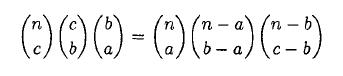
3.5.1 Show that if a 5 b 5 c 5 n, then (i) Use the definition of binomial coefficients as ratios of the factorials. (ii) Use directly the interpretation of the binomial coefficients as the number of subsets of a given size. (iii) How many ways can one choose an a-element subset from a belement
Showing 400 - 500
of 5397
1
2
3
4
5
6
7
8
9
10
11
12
13
14
15
Last
Step by Step Answers

 Get 50% OFF
Claim Now
Get 50% OFF
Claim Now