New Semester
Started
Get
50% OFF
Study Help!
--h --m --s
Claim Now
Question Answers
Textbooks
Find textbooks, questions and answers
Oops, something went wrong!
Change your search query and then try again
S
Books
FREE
Study Help
Expert Questions
Accounting
General Management
Mathematics
Finance
Organizational Behaviour
Law
Physics
Operating System
Management Leadership
Sociology
Programming
Marketing
Database
Computer Network
Economics
Textbooks Solutions
Accounting
Managerial Accounting
Management Leadership
Cost Accounting
Statistics
Business Law
Corporate Finance
Finance
Economics
Auditing
Tutors
Online Tutors
Find a Tutor
Hire a Tutor
Become a Tutor
AI Tutor
AI Study Planner
NEW
Sell Books
Search
Search
Sign In
Register
study help
business
nonparametric statistical inference
Probability And Statistical Inference 2nd Edition Robert Bartoszynski, Magdalena Niewiadomska-Bugaj - Solutions
8.7.4 The number of traffic accidents that occur in a certain city in a week is a random variable with mean p and variance u2. The numbers of people injured in an accident are independent random variables, each with mean m and variance k 2 .Find the mean and variance of the number of people injured
8.7.3 Let X, Y be continuous random variables with a joint density f . Assume that E(Y IX = x) = p for all 2. Show that Var(Y) = .I Var(Y1X = z ) fx(x) dx.
8.7.2 Let X and Y have the joint density uniform on the triangle with vertices( O , O ) , (2,O)and (3,l). Find: (i)E(XIY) andE(Y1X). (ii)Var(X/Y) andVar(Y1X).(iii) The expectations and variances of X and Y using formulas (8.47) and (8.48).
8.7.1 Variables X and Y are jointlydistributedwith the density f(x, y) = Cx(32 +2y) for 0 < z < y < 1, and f ( x , y) = 0 otherwise. Find: (i) C. (ii) E(YIX = x).
8.6.8 Let XI,. . . X , be independent random variables having the same distribution with a mean p and variance u2, Let 5? = (XI+ * + X n ) / n . Show that E { C ~ = ~ -( X7~) ’)= (n- 1)2[H. int: Since xi - X = (xi- p) - (X- p) , we have C:=,( X i - x)’= Cy=,((X-i p)’ - n(x- pl2.1
8.6.7 Let X, Y be independent, with means px , py and variances D$, 06. Show that Var(XY) = a$.$ + a$& + a$&.
8.6.6 Find the correlation of random variables X and Y jointly uniformly distributed on: (i) The triangle with vertices (0,O): (1,0), (1,2). (ii) The quadrangle with vertices (0, 0), (a, 0), (a, 2), and (2a, 2), where a > 0.
8.6.5 Let variables X and Y be such that E(X) = E ( Y ) = 0, Var(X) = Var(Y) =1, and px,y = p. Find E(W),Var(W), and pw,y if W = X - pY.
8.6.4 Find the variance of a random variable X with a cdf for 5 < 0 ie for z > 1.F ( z ) = fi for O 5 5 5 I
8.6.3 For random variables X and Y such that E ( X ) = 2 , E(Y) = 1, E(X2) =10, E(Y2) = 3 and E(XY) =c, find: (i) Var(3X - 5Y). (ii) p x , ~(i.ii ) The range of values of c for which the assumptions of the problem are consistent.
8.6.2 Find the variance of X if its first ordinary moment is 3 and the second factorial moment is 52.
8.6.1 The random variable X has binomial distribution with mean 5 and standard deviation 2. Find P{X = S}.
8.5.12 Show that the distribution of X is symmetric around 0 if and only if qx ( t )is real.
8.5.11 Show that if p(t) is achf, then Iq(t)I2 is also a chf.
8.5.10 A family 0 of distributions is said to be closed under convolution, if whenever independent random variables X and Y have distributions in 0; the same is true for the random variable X + Y . Show closeness under convolution in families of:(i) Poisson distributions. (ii) Normal distributions.
8.5.9 Find the characteristic function of the following distributions: (i) POI(X). (ii)GEO(p). (iii) EXP(X). (iv) N(p, a2).
8.5.8 Let X be a random variable with E ( X ) = p,Var(X) = a' and such that 7 4 = E ( X - p)4 exists. Then "y4/a4 is called the coefficient of kurtosis. Find kurtosis of the following distributions: (i) N(0, 1). (ii) N(p, a'). (iii) BIN(1, p ) . (iv)POI(X).
8.5.7 Let X be a random variable with E ( X ) = p,Var(X) = a' and such that the third central moment 7 3 = E ( X - p)3 exists. The ratio 73/a3 is called the coeficient of skewness. Find skewness of the following distributions: (i) U[O, 11. (ii)f(x) = aza-' for 0 5 z 5 1 and f(z) = 0 otherwise (a >
8.5.6 A continuous random variable X is called symmetric about c if its density f satisfies the condition f ( c - z ) = f(c+z) forall z. Showthat: (i) I f X issymmetric about c and E ( X ) exists, then E ( X ) =c. (ii) If X is symmetric about 0, then all moments of odd order (if they exist) are
8.5.5 Let X I , . . . , X , be independent random variables with the common distribution N(p, a). Find constants a , and ,& such that U = ( X I + . . + X , - a,)//3, and XI have the same distribution.
8.5.4 Find the moment generating function for a random variable with a density: (i)f(z) = ze-5 for z > 0. (ii) f(z; 0') = f i e - x 2 / 2 g 2 for z > 0.
8.5.3 Find the fourth factorial moment of the random variable X with a POI(X)distribution.
8.5.2 Let X be a nonnegative integer-valuedrandom variable. The function gx (s) =E s X , defined for Is1 5 1, is called a probabilifygenerating function, or simply a generating function, of X . Find g x ( s ) for random variables with: (i) Geometric distribution. (ii) Binomial distribution. (iii)
8.5.1 Find the moment generating function of a discrete random variable X with distribution P{ X = k } = l/n, k = 0,1, . . . , n - 1.
8.4.9 We say that X is stochastically smaller than Y ( X sst Y) if P{ 5 t } 1 P { Y 5 t } for all t. Show that if X and Y have finite expectations and X sst Y , then E ( X ) 5 E ( Y ) . (Hint: Start with nonnegative X and Yand use Theorem 8.2.2. Then use the decomposition into a positive and
8.4.8 Show that if X is such that P(u 5 X 5b) = 1, then E ( X ) exists and
8.4.7 A cereal company puts a plastic bear in each box of cereal. Every fifth bear is red. If you have three red bears, you get a free box of the cereal. If you decide to keep buying this cereal until you get one box free, how many boxes would you expect to buy before getting a free one? [Hint:
8.4.6 An urn contains w white and T red balls. We draw TI 5 T balls from the urn without replacement, and we let X be the number of red balls drawn. Find E ( X ) , by defining indicator variables: (i) X I , . . . , X , such that X = X I + . . . + X,. (ii)Yl, . . . , Y, such that X = Y1 + . . . + Yr.
8.4.5 Let X have the density 0 5 z l l f(x) = {c(2 -: z) 155 5 2 otherwise.Find: (i)c. (ii)E(X). (iii) E(2 - X ) 3 . (iv) E[1/(2 - X ) ] .
8.4.4 Let X be a random variable with density f(z) = 1/2 for -1 5 z 5 1 and f(x) = 0 otherwise. Find: (i) E ( X ) . (ii) E ( X 2 ) . (iii) E(2X - 3)2.
8.4.3 Find E ( X ) , E ( l / X ) , and E(2x) if X = 1 , 2 , . . . , 8 with equal probabilities 1/8.
8.4.2 Assume that X has density f(z) = az + bz3 for 0 5 z 5 2 and f ( z ) = 0 otherwise. Find a and b if E ( X 2 ) = 2 . 5 .
8.4.1 Show that E(X - E ( X ) ) = 0.
8.2.8 Let X be a continuous random variable with density f , and let Y be the area under f between -a and X. Find E ( Y ) . (Hint: Start by determining the cdf and the density of Y .)
8.2.7 Show that if the expectation of a continuous type random variable X exists, and the density f ( z ) of X satisfies the condition f(z) = f ( 2 a - z) for all z 2 0, then E ( X ) = a.
8.2.6 Let X be a nonnegative continuous random variable with hazard rate h(t) = t.Find E ( X ) .
8.2.5 Let X I X 2 , . . . , X , be independent, each with the same distribution. Find E[min(XI,. . . , X,)] if the distribution of variables is: (i) EXP(X). (ii) U[a, b].[Hint: First find the cdf (or density) of the random variable whose expectation is being computed.]
8.2.4 Find the expected value E(lXl), where X is a normal random variable with parameters p = 0 and a2 (the distribution of 1x1 is sometimes calledfolded normal or halfnormal).
8.2.3 Suppose there are k = 10 types of toys (plastic animals, etc.) to be found in boxes of some cereal. Assume that each type occurs with equal frequency. (i)Find E ( X ) , where X is the number of boxes you must buy until you collect three different types of toys. (ii) Suppose that your little
8.2.2 The density of the lifetime T of some part of electronic equipment is f ( t ) =X2te-xtl t > 0. Find E(T).
8.2.1 Variable X assumes values 0, 1, 2, and 3 with probabilities 0.3,a, 0.1, and b, respectively. Find a and b if: (i) E ( X ) = 1.5. (ii) E ( X ) = m. First determine all possible values of m.
7.5.4 Acan ofThree-Bean-Salad contains beans ofvarieties A , B, and C (plus other ingredients which are of no concern for the problem). Let X , Y, and 2 denote the relative weights of varieties A , B, and C in a randomly selected can (so that X + Y +2 = 1). Moreover, let the joint distribution of
7.5.3 Let random variables X, Y , and 2 have joint density f(z, y , z ) = c(z + y + z )for 0 < z < y < z < 1. Find: (i)c. (ii) P ( X + 2 > 1). (iii) P(X + 2 > 1IY =0.5).
7.5.2 Suppose that X I , X 2 , X3 have joint densityFind: (i)c. (ii) The joint density of ( YI, Y2 , Y3),w here YI = XI,Y 2 = XIX 2 , and Y3 = X1X2X3. f(x1, x2, x3)= { X1X2x3 for 0
7.5.1 Two cards are drawn without replacement from an ordinary deck. Let X be the number of aces, Y be the number of red cards, and 2 be the number of hearts.Find: (i) The joint distribution of ( X , Y, 2). (ii) P{Y = 2). (iii) The conditional distribution of 2 given Y = y .
7.4.9 A current of I amperes following through a resistance of R ohms varies according to the probability distribution with density f(.2) = { y - i ) O < i < l otherwise.Find the density of the power W = I2 R watts, if the resistance R varies independently of the current according to probability
7.4.8 Let R be a nonnegative random variable with density f ( r ) . Let ( X , Y ) be a bivariate distribution obtained as follows: First randomly choose a value of R, and then chose a value of U according to its U(0, 1) distribution. Now put X = Rcos(2~U), Y = Rsin(2rU). (7.28)Find: (i) The joint
7.4.7 Let f be the joint density of a pair ( X , Y) of random variables, and let a and b be two constants. Find the densities of: (i) aX + by. (ii) X Y . (iii) X / Y . (iv)(V,V ) ,w here U = aX + b,V = cY + d , anda c# 0 .
7.4.6 Random variables X and Y have joint density f(z, y) = cz for -z < y
7.4.5 Random variables (XI Y ) have a joint density Ic(az+by) i f O < z < 2 2 , O < y < 2 f(X1Y) = { 0 otherwise, where a > 0, b > 0 are given constants. Find: (i) The value of k as a function of a andb. (ii) The density of random variable 2 = 1/(Y + 1)2. (Hint: Express F ( t ) = P{ 2 5 t } in
7.4.4 Independent random variables X and Y are uniformly distributed over intervals(-1, 1), and (0, l), respectively. Find the joint distribution of variables U = X Y and V = Y. Determine the support of the density function.
7.4.3 Let X and Y be independent random variables with densities fx(z) = clza-le-zI fy(y) = czyp-le-~for z > 0, y > 0, a > 0, p > 0, and normalizing constants c l , c2. Find the density of W = X / ( X + Y ) .
7.4.2 Let random variables X I , X2 be independent and have both EXP(X) distribution.(i) Find the cdf and the density of XI - X2. (ii) Find the cdf and the density of X1/X2. (iii) Show that 21 = X I + X2 and 2 2 = X I / ( X l + X 2 ) are independent.
7.4.1 Let XI Y be independent, each with a standard normal distribution. Find the distributionof (i) V = X / Y . (ii) U = ( X - Y)2/2. (iii) W = X/lYI.
7.3.7 A fast-food restaurant has a dining room and a drive-thru window. Let X and Y be the fractions of time (during a working day) when the dining room (X)and the drive-thru window (Y)ar e busy. The joint density of (X,Y )i s f (z,y ) =k ( 2 z 2 + y2) for 0 5 z 5 1 , 0 5 y 5 1 and f(z,y ) = 0
7.3.6 The phrase “A stick is broken at random into three pieces” can be interpreted in several ways. Let us identify the stick with interval [0,1] and let 0 < X < Y < 1 be the breaking points. Some of the possible ways of generating X, Y are as follows:(i) A point (UV,) is chosen from the unit
7.3.5 Let X and Y have joint density of the form A(y - z)O f b 1 Y ) = { 0 otherwise.for 0 5 5 < y 5 1 Find: (i) The values of a such that f can be a density function. (ii) The value of A for n specified in part (i). (iii) The marginal densities of X and Y . (iv) The conditional densities glp(zIy)
7.3.4 Let variables X and Y be independent, each with U[O, 11 distribution. Find:(i) P(X + Y 5 0.5 I X = 0.25). (ii) P(X + Y 5 0.5 1 X 1 0.25). (iii) P(X 2 Y 1 Y 2 0.5).
7.3.3 Two parts of a document are typed by two typists. Let X and Y be the numbers of typing errors in the two parts of the paper. Assuming that X and Y are independent and have Poisson distributions with parameters A1 and A2 , respectively, find the probability that: (i) The paper (i.e., two
7.3.2 Let X and Y have the joint density f(z,y ) = X2e-'Y for 0 5 z 5 y and f(z,y ) = 0 otherwise. Find: (i) The joint cdf of (XIY ) .( ii) The marginal densities of X and Y . (iii) The conditional density of Y given X.
7.3.1 Suppose that three cards are drawn without replacement from an ordinary deck. Let X be the number of aces among the cards drawn and Y be the number of red cards among them. Find: (i) The joint distribution of ( X , Y ) . (ii) The conditional distribution of the number of aces if it is known
7.2.17 Let X and Y have distributionuniform in the shape of the letter Y (see Figure 7.8). Identify the shapes of the marginal densities of X and Y in Figure 7.9.
7.2.16 Let X, Y be independent, continuous random variables with a symmetric(but possibly different) distribution around 0. Show that Y/X and Y/lXl have the same distribution. (Hint: Compare the cdf's of W = X/Y and V = X/I Y 1 .>
7.2.15 Assume that X and Y are independent random variables with EXP(a) and EXP(b) distributions, respectively. Assume that it is not possible to observe both X and Y but that one can observe 1 i f X < Y 0 otherwise.This kind of situation, called censoring, occurs often in medicine and
7.2.14 An ecologist has to randomly select a point inside a circular region with radius R. She first samples the direction from the center of the region according to a uniform distribution on [ O", 360'1, and then samples the distance from the center according to U[O, R]. Find: (i) The density f(z,
7.2.13 Assume that in shooting in a target, the coordinates (XI Y) of the point of impact are independent random variables, each with a N(0, a2) distribution. Find the density of D, the distance of the point of impact from the center of the target.
7.2.12 Random variables X and Y have joint density k(ao +by) 0 < z < 1, 0 < y < 2 otherwise, where a > 0, b > 0. Find: (i) Ic (as a function of a and b). (ii) The marginal distributionsof X and Y. (iii) The cdf of (X, Y).
7.2.11 Let X and Y be the lifetimes of two components of a machine. Their joint distribution is given by the density f (z,y ) = ~ e - " ( ~ + y f)o r z 2 0, y 2 0 and zero otherwise. (i) Find P(X 1 5). (ii) Find the probability that max(X, Y ) > 2. (iii)Check the independence of X and Y using their
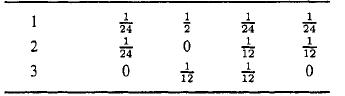
7.2.10 Let (XI Y ) have the distributiongiven by the table XIY 3 4 5 6Find the probability distribution of independent random variables (X' , Y') such that X' and Y' have the same marginals as X and Y . 2 - 120
7.2.9 Let TIT,2 be independent random variables with hazard functions hl ( t )a nd hZ(t), respectively. (i) Show that the variable with the hazard function h(t) =h l ( t ) + hz(t) has the same distribution as min(T1, T2). (ii) Express P(T1 < Tz)through hl and ha.
7.2.8 Consider a system consisting of three components connected as in Figure 7.7.Let Y1, Y2, Y3 be independent lifetimes of components 1,2, and 3, respectively, each with EXP(a) distribution. If T is the lifetime of the whole system, find: (i) The cdf of T . (ii) The hazard function of T .
7.2.7 Random variables have joint distribution given by the table XIY 1 2 3 1 a 2a 3a 2 b C d Finda, b,c, d if X, Y are independent, and P(X = 2) = 2P(X = 1).
7.2.6 Random variables X and Y have joint distribution given by the following table:XIY 1 2 3 12 b : c Show that X and Y are dependent, regardless of valuesa, b, and c.
7.2.5 Let X and Y have the joint distribution P { X = z,Y = y} = cX"+Y/(z!y!)for z = 0 , 1 , . . . , y = 0 , 1 , . . . , and X > 0. (i) Findc. (ii) Find the marginal distribution of X. (iii) Are X and Y independent?
7.2.4 A box contains three coconut candies, five hazelnut chocolates, and two peanut butter chocolates. A sample of four sweets is chosen from the box. Let X,Y ,a nd 2 be the number of coconut candies, hazelnut chocolates, and peanut butter chocolates in the sample, respectively. (i) Find the joint
7.2.3 An urn contains five balls, two of them red and three green. Three balls are drawn without replacement. Let X and Y denote the number of red (X)an d green( Y ) balls drawn. (i) Find the joint distribution of (X, Y ) . (ii) Find the marginal distributions of X and Y , (iii) Are X and Y
7.2.2 Two cards are drawn at random from the ordinary deck of cards. Let X be the number of aces and let Y be the number of hearts obtained. (i) Find the joint probability function of (X, Y ) , (ii) Find the marginal distribution of X and Y . (iii)Are X and Y independent?
7.2.1 The joint probability function of variables X and Y is f(z,y ) = cIz - yI for 5 = 0 , 1 , 2 , 3 , and y = 0 , 1 , 2 . Find: (i)c. (ii) P ( X = Y ) . (iii) P(X > Y ) . (iv)P(IX - 11 5 1). (v) P(X + Y 5 3).
7.1.9 Variables X and Y have the joint density f(z, y) = l / y for 0 < z < y < 1 and f(z, y) = 0 otherwise. Find: (i) P ( X + Y > 0.5). (ii) P(Y > 2 X ) .
7.1.8 Let the joint density of random variables X , Y be f(z, y) = cz3y2 for 0 5 z 5 1,z2 5 y 5 1 and f(z, y) = 0 otherwise. Find P ( X < Y ) .
7.1.7 Assume that (X, Y)h ave the joint density f(s,y ) = czy2 for 0 5 s 5 1 , 0 5 y 5 1, and f(z, y) = 0 otherwise. Find: (i)c. (ii) P { X 2 5 Y 5 X}. (iii) The cdf
7.1.6 Assume that X,Y have density f (z,y ) = s + y for 0 5 z 5 1 and 0 5 y 5 1, and f(z,y ) = 0 otherwise. Find P{Y 5 m}.
7.1.5 The joint density of X and Y is f ( z , y ) = y2(zy3 + 1) on the rectangle 0 5 2 5 k , 0 5 y 5 1. Find: (i) k . (ii) P ( X 5 Y ) .
7.1.4 Let the joint cdf of random variables X, Y be F ( z , y) = (1/48)zy(z + 2y)for 0 5 z 5 2,O 5 y 5 3. Find the density f(z, y).
7.1.3 A regular die is tossed twice. Let X be the number of times that 1 came up, and Y be the number of times 2 came up. Find: (i) The joint distribution of X and Y . (ii) The correlation coefficient between events { X = 1) and {Y = 2). [Hint:See formula (4.18) in Definition 4.5.2.1
7.1.2 Let X , Y have the joint distribution given by the following table:X I Y 2 3 4- b 0 4l8 0 O 48 848 11-5 -a 12 3- 0 48 48 O 5 12 48- -(i) Find a and b if it is known that P ( X = Y ) = 1/3. (ii) Find P ( X Y = 0).(iii) If F is the cdf of ( X , Y ) , find F(-1.5,3), F(0.7,2.11),and F(1.5,18).
7.1.1 A regular die is tossed twice. Find: (i) The joint distribution of variables X =the total of outcomes and Y= the best ofthe two outcomes. (ii) P ( X I 8, Y 5 5 ) ;P(X = 9, Y 5 2), P(4 5 X 5 7 , l 5 Y 5 3). (iii) P(Y = 31X = 4), P ( Y
6.5.7 A cancer specialist claims that the hazard function of random variable T, =“age at death due to cancer” is a bounded function which for large t has the form h,(t) = k / t 2 (where t is the age in years and k is some constant).Assume that h(t) is the hazard of the time of death due to
6.5.6 The series system is built in such a way that it operates only when all its components operate (so it fails when at least one component fails). Assuming that the lifetime of each component has EXP( 1) distribution and that the components operate independently, find the distribution and
6.5.5 Assume that the fuel pumps in a certain make of cars have lifetimes with a Weibull hazard rate 2 / f i (t measured in years). Find the probability that a fuel pump is still working after 5 months.
6.5.4 Find the cdf and density of Weibull distribution with the hazard function(6.53).
6.5.3 Let X be a random variable with density x < o f(z)= { 0.5 0 5 2 < 1 qO e-az x>l.(i) Find q if a: is known. (ii) Find hazard h(t) and survival function S(t).
6.5.2 Find the density and survival function of the distribution with hazard rate h(t) = a + bt for t > 0, a > 0 , b > 0.
6.5.1 Find the hazard function of the U[O, 13 distribution. Explain why h ( t ) is unbounded.
6.4.13 The speed of a molecule of gas at equilibrium is a random variable X with density kx2e-bxa for x > 0 f ( x ) = { 0 otherwise, where k is a normalizing constant and b depends on the temperature of the gas and the mass of the molecule. Find the probability density of the kinetic energy E =m X
6.4.12 Suppose that the measured radius R is a random variable with density fR(X) = { 0 otherwise, 12x2(1 - 2 ) for O 5 z 5 1 In a circle with radius R find the cdf of: (i) The diameter. (iii) The area.
6.4.11 Let X have density f(z) = 2(1 - z) for 0 5 z 5 1. Find the density of (i)Y = X(l - X). (ii) W = max(X, 1 - X).
6.4.10 The duration (in days) of the hospital stay following a certain treatment is a random variable Y = 4 + X, where X has a density f(z) = 32/(z + 4)3 for z > 0.Find: (i) The density of Y . (ii) The probability that a randomly selected patient will stay in the hospital for more than 10 days
6.4.9 Let X have U[-1, 11 distribution. Find the distribution of (i) Y = 1x1. (ii)2 = 21x1 - 1.
6.4.8 Random variable X has density fx(z) = Cx4 for -2 5 5 5 1 and 0 otherwise.Find the density of Y = X2 (follow Example 6.27).
Showing 300 - 400
of 5397
1
2
3
4
5
6
7
8
9
10
11
12
13
14
15
Last
Step by Step Answers

 Get 50% OFF
Claim Now
Get 50% OFF
Claim Now