New Semester
Started
Get
50% OFF
Study Help!
--h --m --s
Claim Now
Question Answers
Textbooks
Find textbooks, questions and answers
Oops, something went wrong!
Change your search query and then try again
S
Books
FREE
Study Help
Expert Questions
Accounting
General Management
Mathematics
Finance
Organizational Behaviour
Law
Physics
Operating System
Management Leadership
Sociology
Programming
Marketing
Database
Computer Network
Economics
Textbooks Solutions
Accounting
Managerial Accounting
Management Leadership
Cost Accounting
Statistics
Business Law
Corporate Finance
Finance
Economics
Auditing
Tutors
Online Tutors
Find a Tutor
Hire a Tutor
Become a Tutor
AI Tutor
AI Study Planner
NEW
Sell Books
Search
Search
Sign In
Register
study help
business
principles of behavior
Principles Of Behavior 7th Edition Richard W. Malott, Joseph T. Shane - Solutions
Describe two social validity methods and their limitations. LO7
Obtrusive assessment procedures—define them and give an example. LO7
Unobtrusive assessment procedures—define them and give an example. LO7
Products of behavior—define them and give an example. LO7
Define and give an example of each of the following behavior measures: LO7a. frequency or rateb. durationc. force
Interobserver agreement—define it and give an example. LO7
Explain how you would compute an interobserveragreement ratio using the point-by-point agreement procedure and be able to do the computation, given a set of interobserver data. LO7
Define and give an example of the following concepts: LO7a. research designb. internal validityc. experimental interactiond. interobserver agreement
Define and give an example of the following research designs: LO7a. case studyb. simple baselinec. reversald. multiple baselinee. changing criterionf. alternating treatments
Why is the case study a pre-experimental design? LO7
Give an example of the importance of collecting baseline data. Explain what could happen if we don’t. LO7
What advantage does the multiple-baseline design have over the reversal design? LO7
Give an example of the use of a multiple-baseline design to demonstrate the value of behaviorally based peer tutoring in driver education. LO7
What are two advantages and disadvantages of the alternating-treatments design? LO7
External validity—define it and give an example. LO7
Describe the use of the behavioral research supervisory system. List and illustrate the four rules of performance management. LO5
Performance contract—define it and give an example(it need not include more than one behavior). LO5
What’s the conventional interpretation of the role of rule statements? LO5
What is the author’s objection? LO5a. State the author’s theory.b. Give an example illustrating that theoretical analysis.
According to the authors, how important are delayed outcomes in causing problems of self-management? LO5a. Please explain.b. Give a couple of examples illustrating your explanation.
Give an example showing how rules describing small but cumulatively significant outcomes often fail to control our behavior. LO5
Now change your example rule to show how a similar rule probably would control our behavior if the cumulative outcome were, instead, one single, though delayed, outcome. LO5
Define the mythical cause of poor self-management. LO5
Give an example showing how rules describing improbable outcomes often fail to control our behavior. LO5
Rules that are easy to follow—state the principle and give an example. LO5
Rules that are hard to follow—state the principle and give an example. LO5
Draw and explain the contingency tree with outcome properties. LO5
Define the real cause of poor self-management. LO5
Why does our behavior tend not to be controlled by contingencies with improbable or small but cumulative outcomes? LO5
Present our theoretical analysis of why rules describing such contingencies usually fail to control people’s behavior. LO5
Using an example, explain why failure to meet a delayed deadline is a result of small and cumulative outcomes, not a result of delayed outcomes. LO5
When do we need performance management?Please explain and give an example. LO5
How do we do performance management with nonverbal clients? Please explain and give an example, including a contingency diagram. LO5
How do we do performance management with verbal clients? Please explain and give an example, including a contingency diagram. LO5
Apply the three-contingency model to the problem of getting parents to take their children to the dentist. LO5
Define the three-contingency model of performance management. LO5
Why did a good student like Sid have so much trouble finishing his dissertation? LO5
Why was the behavioral research supervisory system so effective in helping him finish his dissertation? LO5
Why do good students often have so much trouble finishing their doctoral dissertations? Show how your answer applies to the actual writing of the dissertation. LO5
Don’t they really care about graduating? Please explain. LO5
Graduation is a delayed outcome. Is that a serious problem? Please explain. LO5
Why does help in the form of the behavioral research supervisory system work? Please illustrate each component of your answer with an example. LO5
Apply the three-contingency model to dissertation completion. LO5
What kind of outcomes should be used in performance management contracts designed to increase or maintain behavior? LO5
Why Can’t We Live in a World Based Solely on Reinforcers, with No Aversiveness? LO5
Why Can’t We Build a World Free of Aversive Control? LO5
Why Can’t We Prepare for Class Simply as a Result of Reinforcement by the Presentation of Reinforcers? LO5
Why Can’t We Use Large Enough Learned Generalized Reinforcers to Reinforce Our Preparing for Class without Such Heavy Deprivation? LO5
Why can’t we build a world free of aversive control? LO5a. What are two types of aversive control provided by our physical world?b. What is the role of aversive control with deadlines?
Why can’t we prepare for class simply as a result of reinforcement by the presentation of reinforcers? LO5
Why can’t we use large enough learned generalized reinforcers to reinforce our preparing for class without such heavy deprivation? LO5
Why not build the reinforcers into the task? LO5
Define and give a Skinner-box example of a fixedinterval schedule of reinforcement. LO3
Explain the difference between the concept of fixed-interval schedule and the principle of fixedinterval behavior (i.e., scallop). At quiz time, people get confused with this one. LO3
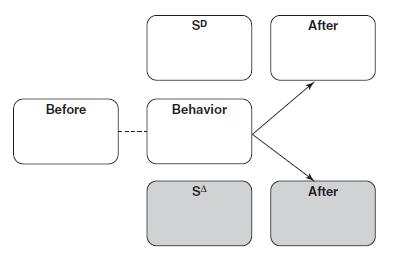
Please diagram the paycheck contingency. LO3 SD Before Behavior After SA After
This diagram shows that going for the biweekly paycheck is LO3a. reinforced on a biweekly fixed-interval schedule of reinforcement.b. under stimulus control and reinforced every time the SD is present.c. under stimulus control and reinforced on a biweekly fixed-interval schedule of reinforcement.
If going for the paycheck were really reinforced on a fixed-interval schedule, we’d expect to see that behavior LO3a. spread across 2 weeks on a fixed-interval scallop, which is what happens.b. spread across 2 weeks on a fixed-interval scallop, which is not what happens.c. occur just once, when
Describe the behavioral contingency supporting the writing of a term paper, and contrast it with a fixed-interval schedule or reinforcement. LO3
Describe the behavioral contingency supporting Congress’s law passing, and contrast it with a fixed-interval schedule or reinforcement. LO3
Diagram the avoidance contingency for turning on the TV to watch a weekly TV show and give the two reasons why it is or isn’t a good example of a fixed-interval schedule. LO3
Diagram the contingency of going for your biweekly paycheck and explain why it is or isn’t a good example of a fixed-interval schedule. LO3
A fixed-time schedule of reinforcer delivery- define it. LO3
Describe Dr. Skinner's experiment demonstrating the effects of a fixed-time schedule of reinforcer delivery. Specify:a. a response classb. the schedule of reinforcementc. the reinforcerd. the resultse. the name for the general type of behavior this schedule can producef. any other interesting
Superstitious behavior-define it. LO3
Give a human example that illustrates the role of accidental reinforcement. LO3
Analyze the example in terms of accidental reinforcement. LO3
Variable-interval schedule of reinforcement- define it and give an example. LO3
Explain the difference between the concept of variable-interval schedule and the principle of variable-interval responding. At quiz time, people get confused with this one. LO3
Describe the procedure and behavioral results of a variable-interval 2-minute schedule of reinforce- ment (VI 2'). LO3
List three characteristics of variable-interval schedules. LO3
Students often blow this one: On a variable-inter- val schedule of reinforcement, must a response occur before the reinforcer is delivered? LO3
Relatively speaking, describe the response rate with a variable-interval schedule if the time intervals are small. the time intervals are big. LO3
The concept of resistance to extinction—define it and give an example. LO3
The principle of resistance to extinction—define it and give an example. LO3
Compare and contrast a fixed-time schedule of reinforcer delivery and a fixed-interval schedule of reinforcement. Students have blown this one in the past. LO3
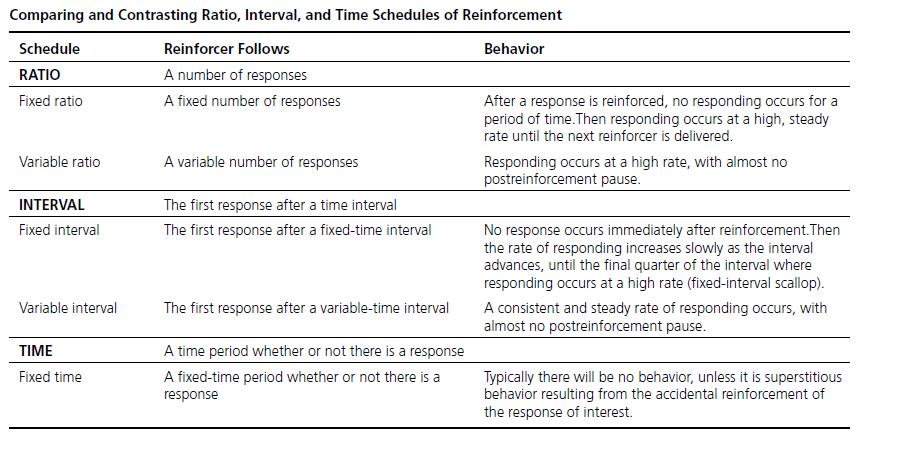
Construct and understand the summary table on the next page. In other words, specify the differences between ratio, interval, and time schedules of reinforcement in terms of LO3a. availability of reinforcementb. resulting behavior
Understand the relation between the rate of responding and the rate of reinforcers for ratio and interval schedules. LO3
Identify the cumulative records for each of the four basic schedules of reinforcement in the following table. LO3 Comparing and Contrasting Ratio, Interval, and Time Schedules of Reinforcement Schedule RATIO Reinforcer Follows A number of responses Behavior Fixed ratio Variable ratio INTERVAL Fixed
With ratio schedules, the faster you respond, the more reinforcers you will get per hour. LO3a. trueb. false
With interval schedules, the faster you respond, the more reinforcers you will get per hour. LO3a. trueb. false
When Does the Reinforcer Occur? LO3
Draw and recognize the cumulative records for each of the four basic schedules of reinforcement. LO3
Why does intermittent reinforcement make behavior more resistant to extinction than does continuous reinforcement? LO3
Illustrate the problems of the concept of response strength. LO3
Diagram the three contingencies involved in a behavioral intervention using punishment of selfstimulation to increase normal play. LO4
Concurrent contingency—define it and briefly give three examples. LO4
Recall the article by Koegel et al. “Increasing spontaneous play by suppressing self-stimulation in autistic children” (i.e., Mae’s punishment of self-stimulation).Is this an example of concurrent contingencies? LO4a. yesb. no
Our definition of concurrent contingencies suggests four types of concurrent contingencies. What are they, and how would you diagram examples of them? LO4
How might hearing impairment affect a child’s language learning? LO4
Explain how some people commit the error of reification when looking for a cause for behavioral problems. LO4
What kind of contingency was this concurrent performance-management contingency? LO4a. reinforcementb. penaltyc. avoidance of the loss of a reinforcerd. punishment by the prevention of the presentation of a reinforcer
Diagram the natural and performance-management contingencies in a behavioral intervention to decrease a child’s disruptive behavior while shopping. LO4
Using the concept of concurrent contingencies for physically incompatible responses, describe a behavioral approach to decrease hyperactivity. LO4a. Diagram one of the inappropriate natural contingencies.b. Diagram the concurrent performance-management avoidance contingency. (Hint: Remember that
Define Differential reinforcement of incompatible behavior. LO4
Diagram the performance-management contingency and one inappropriate contingency showing its use to decrease disruptive behavior(hyperactivity). LO4
Use a pair of similar examples to compare and contrast DRA and DRI. LO4
Symptom substitution—define it and give a presumed example. LO4
What is a behavioral analysis of this example, in terms of concurrent contingencies? Diagram the contingencies. LO4
What theoretical implications does the behavioral analysis have for the debate between the mentalistic medical model and a behavioral approach? LO4
In terms of concurrent contingencies of reinforcement and escape for physically incompatible responses, diagram the problem of staying awake when you’re working vs. when you’re playing (e.g., doing academic writing vs. chatting with friends ). LO4
Showing 1100 - 1200
of 1712
First
4
5
6
7
8
9
10
11
12
13
14
15
16
17
18
Step by Step Answers

 Get 50% OFF
Claim Now
Get 50% OFF
Claim Now