New Semester
Started
Get
50% OFF
Study Help!
--h --m --s
Claim Now
Question Answers
Textbooks
Find textbooks, questions and answers
Oops, something went wrong!
Change your search query and then try again
S
Books
FREE
Study Help
Expert Questions
Accounting
General Management
Mathematics
Finance
Organizational Behaviour
Law
Physics
Operating System
Management Leadership
Sociology
Programming
Marketing
Database
Computer Network
Economics
Textbooks Solutions
Accounting
Managerial Accounting
Management Leadership
Cost Accounting
Statistics
Business Law
Corporate Finance
Finance
Economics
Auditing
Tutors
Online Tutors
Find a Tutor
Hire a Tutor
Become a Tutor
AI Tutor
AI Study Planner
NEW
Sell Books
Search
Search
Sign In
Register
study help
business
principles of behavior
Principles Of Behavior 7th Edition Richard W. Malott, Joseph T. Shane - Solutions
Do the same thing in terms of incompatible concurrent escape and penalty contingencies. LO4
Intervention (treatment) package—define it and give an example. LO4
Discuss the use of intervention packages from the point of view of LO4a. scientific, applied-behavior analysis researchb. technology developmentc. providing a behavioral serviced. the economics of intervening.
For which of the following is an intervention (treatment)package usually least appropriate? LO4a. scientific, applied-behavior analysis researchb. technology developmentc. providing a behavioral service
If some components of an intervention were expensive and you would be using them repeatedly, then you should combine them as a treatment package rather than testing each component independently. LO4a. trueb. false
State the matching law and describe a situation to which it can be applied. LO4
Diagram a behavioral intervention to teach a child with cerebral palsy to walk. LO9
Behavioral chain—define it and diagram a diningtable example. LO9
The principle of dual-functioning chained stimuli—define it and give an example. LO9
Forward chaining—define it and diagram its use to teach walking to a child with cerebral palsy. LO9
Total-task presentation-define it and give two examples. LO9
Describe the response classes LO9
Describe the reinforcement contingencies LO9
Describe the presumed reinforcers the results any other interesting features of the intervention. LO9
Differential reinforcement of low rate-define it and describe its use to decrease the excessive rate of eating. Specify the response classes the reinforcement contingencies the extinction contingency the presumed reinforcer the results any other interesting features of the intervention. LO9
Define Extinction LO9
What are nine procedures for reducing the frequency of undesirable behavior? (See the summary table.) LO9
Give one pro and one con for each procedure. (See the summary table.) LO9
Cite an example of the use of each procedure. LO9
Diagram the use of backward chaining in the Skinner box. LO9
Diagram dual-functioning chained stimuli in the Skinner box. LO9
Give an example of a nonchained behavioral sequence. LO9
Differential reinforcement of low rate—describe its use in the Skinner box. LO9
Why do so many mentally handicapped people have poor table manners? LO9
Study the following table very carefully so that you can explain the differences between DRL and FI on a quiz or exam. LO9
Describe an intervention for eliminating the fear of darkness. LO6
Describe the anxiety-generating situation. LO6
List specific components of the anxiety situation, in increasing anxiety-generating sequence. LO6
How would you use fantasies to get rid of fear of darkness? LO6
Who was Ivan Pavlov? LO6
What was the great discovery of Pavlov and his colleagues? LO6
Phobia—give an example. LO6
Define unconditioned stimulus. LO6
Define unconditioned response. LO6
Define conditioned stimulus. LO6
Define conditioned response. LO6
Define respondent conditioning. LO6
Define operant conditioning. LO6
List three traditional differences between respondent and operant conditioning as indicated in the preceding table. LO6
Give an example of conditioning a phobia.Include the LO6 a. unconditioned stimulus (US)b. unconditioned response (UR)c. conditioned stimulus (CS)d. conditioned response (CR)e. procedure.
Higher-order respondent conditioning LO6 a. Define it.b. Give an example.c. Compare and contrast it with higher-order operant conditioning.
Please fill in the extinction diagram. LO6 Extinction of Escape Behavior Before Behavior After
Which is it, respondent or operant extinction (Hint:the fact that there is a response in this diagram should give it away)? LO6 a. respondent extinctionb. operant extinction
If Rod’s crying fails to extinguish, Dawn should suspect that the crying is LO6 a. respondent behavior, and the music is a respondent eliciting stimulusb. operant behavior, and the music is an aversive before condition Compare and Contrast Respondent and Operant Extinction Is responding Results
Respondent extinction—define it and give an example. LO6
Discuss the similarities and differences between respondent and operant extinction, in terms of:a. the procedureb. the operationc. the results. LO6
Illustrate how you could use operant extinction to determine if a stimulus is a respondent eliciting stimulus or an operant before condition. LO6
Describe a procedure to get rid of a car phobia. LO6
Give an example showing how phobias could evolve from operant and respondent conditioning. LO6
Describe the use of operant conditioning techniques to get rid of a car phobia. LO6
Systematic desensitization—define it and give an example. LO6
What is the difference between emotive imaginary treatment and systematic desensitization? LO6
Compare and contrast operant and respondent analyses of the Gilles de la Tourette syndrome. LO6
Describe the conditioned insulin phenomenon and diagram the respondent processes. LO6
How can respondent extinction get rid of the problem? LO6
Diagram respondent conditioning of the immune system. LO6
Give an example of stimulus generalization in respondent conditioning. LO6
On hearing his master opening a can of dog food, Spot runs into the kitchen. With regard to Spot’s behavior of running into the kitchen, what is the function of the sound of the can opening (and what is the overall process)? LO6 a. SD (operant conditioning)b. CS (respondent conditioning)
What about this one? You hold the food up, say OK, and Spot jumps toward the food. So, what’s OK? LO6 a. SD (operant conditioning)b. CS (respondent conditioning)
You drop the food on the floor and Spot bends down toward it. LO6 a. SD (operant conditioning)b. CS (respondent conditioning)
Describe the similarities and differences between the conditioned stimulus and the SD. LO6
Explain why is it risky to infer the history of conditioning by looking at the response. LO6
To determine the function of a stimulus—describe this general rule and give an example. LO6
What does anorexia nervosa mean? LO3
Describe and analyze the intervention for Mary’s anorexia. LO3
What part of the intervention seems to be based on simple reinforcement and what part seems to involve reinforcers that are too delayed to be useful in simple reinforcement? LO3
What were the results of the intervention? LO3
For each of the following concepts: define it and give an example. LO3a. ruleb. rule controlc. rule-governed behaviord. contingency controle. contingency-governed behavior (contingencyshaped behavior).
Give an example where behavior is controlled by the promise of the reinforcer rather than the delivery. LO3
Give an example where an apparent delayed analog to reinforcement is really a delayed analog to discriminated avoidance. LO3a. Include a discussion of the role of the deadline.b. Be able to diagram your example.
Give an example where an apparent delayed analog to reinforcement is really a delayed analog to nondiscriminated avoidance, with the time before the deadline merely being the time when there’s an opportunity to respond. LO3a. Include a discussion of the role of the deadline.b. Be able to diagram
Define and give an example of each of the following concepts: LO3a. direct-acting contingencyb. indirect-acting contingencyc. ineffective contingency
Construct the contingency tree. LO3
Rule-governed analog to reinforcement by the presentation of a reinforcer—state it, give an example, and explain how your example fits the definition. LO3
Give an example showing how such an analog can indirectly control behavior. LO3
Describe the traditional and the behavioral parenting techniques involved with Wayne. LO3
Diagram and label the contingency Wayne’s mother used during the behavioral intervention. LO3
Give an example of a statement of a rule, a related instructional statement, and a related statement of a request. LO3
Give an example of a complete rule and an incomplete rule. LO3
Using the bubblegum contingency, give an example of the difficulty of interpreting the effects of rules describing direct-acting contingencies. Show how it’s hard to tell whether the rule or the directacting contingency or both are controlling behavior.And explain the problem. LO3
Using the bubblegum contingency, give an example where we might be able to infer control by a rule describing that contingency—a direct-acting contingency. Explain why. LO3
To do well on the quizzes, you may have to keep in mind that rules can describe direct-acting contingencies as well as indirect-acting contingencies.This is easy to forget because we are mainly concerned with rules describing indirect-acting contingencies. LO3
Present an argument for the necessity of analyzing some sorts of behavior in terms of rule-governed behavior. LO3
Why do so many people procrastinate so much? LO3
And what causes them to get it together only at the last minute? Diagram and explain the relevant escape and avoidance contingencies. LO3
Why do we need deadlines to control our behavior? LO3
Give an example that shows how people procrastinate up to the deadline. LO3
Define and give an example of the following: LO1a. task analysisb. the process vs. product general rulec. feedback.
Please diagram and explain the role of delayed feedback in a behavior-analytic coaching procedure.LO1
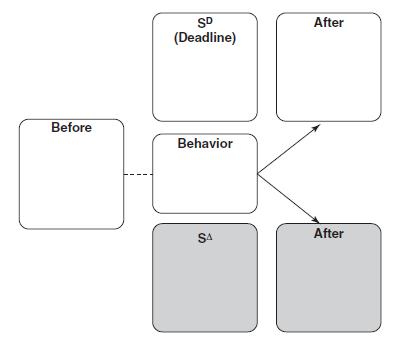
Please diagram the preceding indirect-acting contingency involving studying, public posting, and avoidance of the opportunity to see a good grade.LO1 Before You will lose the opportunity to receive a good grade when the grades are posted. SD (Deadline) Behavior SA After your exam. After After
What is wrong with this description?LO1
What’s the implicit deadline for this other rule?LO1
What’s the contingency?LO1a. Reinforcementb. Analog to reinforcementc. Analog to avoidance of the loss of the opportunity to receive a reinforcer.
Please diagram the contingency.LO1 SD (Deadline) Before Behavior After SA After
Please diagram the avoidance analog for organizing the carpool.LO1 SD (Deadline) Before Behavior After SA After
What is the preceding contingency? Keep in mind that, realistically, the behavior analysts probably didn’t get the Smokey patches to the kids within 60 seconds after they’d brought in a bag of litter.Also, keep in mind that there must have been a deadline, like before the behavior analysts left
Please diagram that contingency.LO1 SD (Deadline) Before Behavior After SA After
Is this a rule-governed analog to reinforcement?LO1
So what kind of contingency is this?LO1
Please diagram the contingency.LO1 SD (Deadline) Before Behavior After SA After
Showing 1200 - 1300
of 1712
First
4
5
6
7
8
9
10
11
12
13
14
15
16
17
18
Step by Step Answers

 Get 50% OFF
Claim Now
Get 50% OFF
Claim Now