New Semester
Started
Get
50% OFF
Study Help!
--h --m --s
Claim Now
Question Answers
Textbooks
Find textbooks, questions and answers
Oops, something went wrong!
Change your search query and then try again
S
Books
FREE
Study Help
Expert Questions
Accounting
General Management
Mathematics
Finance
Organizational Behaviour
Law
Physics
Operating System
Management Leadership
Sociology
Programming
Marketing
Database
Computer Network
Economics
Textbooks Solutions
Accounting
Managerial Accounting
Management Leadership
Cost Accounting
Statistics
Business Law
Corporate Finance
Finance
Economics
Auditing
Tutors
Online Tutors
Find a Tutor
Hire a Tutor
Become a Tutor
AI Tutor
AI Study Planner
NEW
Sell Books
Search
Search
Sign In
Register
study help
business
systems analysis and design
Head First PMP 3rd Edition Jennifer Greene, Andrew Stellman - Solutions
3. What's the most effective approach to conflict resolution? A. Smoothing B. Confronting C. Compromise D. Withdrawal
2. Everybody does what Tom says because he and president of the company are golfing buddies. What kind of power does he hold over the team? A. Legitimate B. Reward C. Punishment D. Referent
1. ARACI Matrix is one way to show roles and responsibilities on your project. What does RACI stand for? A. Responsible, Approve, Consult, Identify B. Responsible, Accountable, Consult, Inform C. Retain, Approve, Confirm, Inform D. Responsible, Accountable, Confirm, Inform
I was looking through the PMBOK® Guide, but I couldn’t find anything about conflict resolution, motivational theories, or different kinds of power. Do I really need to know this stuff?
It sounds like compromise is a bad thing. But I’ve always been told that when people are fighting, I should always look for a middle ground!
How do I know what form of power to use?
Take a look at each of these attempts to resolve a conflict and figure out which conflict resolution technique is being used.1. “I don’t really have time for this–let’s just do it your way and forget I ever brought up the problem.”2. “Look Sue, Joe’s already filled me in on your
What’s the best way to deal with a conflict between two people on your project team?
It looks like Brian and Amy are having a serious conflict, and it could have a big impact on the project if Mike doesn’t get it under control! What usually causes conflicts in projects, and what can the project manager do about it when those conflicts happen?
5. A project manager is having a lot of trouble motivating the team. He tries setting up rewards and a good working environment. But the team remains difficult to motivate—mostly because their paychecks all bounced last week, and everyone is angry at the CEO because they didn’t get bonuses
4. Joe’s a functional manager, and his team is very efficient. He spot-checks their work, but for the most part he sets realistic performance goals and trusts them to meet it—he only pulls people aside if he finds that there’s a specific problem that has to be corrected. Write down which
3. Eric’s a functional manager, but his team seems to move really slowly. It turns out that everyone who reports to him has to hand him their work first, before they can give it to anyone else. He goes through it line by line, which sometimes takes hours! He doesn’t trust his team to release
2. There was a break-in in the office, and now people are really jittery. Plus, the heating system has been broken for weeks, and it’s freezing! No wonder nobody’s getting any work done. Write down which theory each scenario describes.
1. Bob is a programmer on the team, but he doesn’t really feel like he’s “one of the guys.” He doesn’t really have a lot of control over the work he’s assigned. Recently, Bob put in a long weekend to get his work done, but nobody really seemed to take notice. Write down which theory
These tools and techniques do a lot to help you manage your team. But do they really establish you as a leader? What’s the difference between management and leadership?
Do you think Mike’s idea will work? Why is it a good idea to make the bonus contingent on meeting specific goals? Can this plan backfire?
Once I know what roles need to be filled on my project, how do I actually get the team on board?
Can the “halo effect” really affect my projects?
Is that RACI chart really necessary?
still don’t get the resource histogram. Am I supposed to make this myself, or does it come from somewhere
The inputs, tools & techniques, and outputs of Human Resource Planning should seem pretty familiar! Write down what you think you’d use each of them for. Notice that there are a few that you haven’t seen before—take an educated guess at those.INPUTS Enterprise Environmental Factors
What can you do to make sure that you get the right people for your team exactly when you need them? What can you do before the project starts to make sure they stay motivated?
How can Mike solve his problem? What can he do to make sure that he gets the team members he needs when he needs them?
How would you improve the form in Figure 11-4?
What is distributed object computing?
What are the three competing approaches for supporting distributed object computing?
What additional hardware- and software-associated costs may need to be included on the hardware and software specification?
Are some nonfunctional requirements more important than others in influencing the architecture design and hardware and software specification?
Describe how object orientation impacts testing.
How are the test cases developed for unit tests?
What are the cultural issues of which developers should be aware?
Explain the trade-offs among selecting between the types of conversion in questions 4, 5, and 6.
What is the role of the operations group in system development?
Compare and contrast two major ways of providing system support.
Some experts argue that change management is more important than any other part of system development.Do you agree or not? Explain.
Critical Chain sounds complicated. Do I need to know how to do it?
When I create performance reports, who uses them?
What’s schedule model data used for?
Do people really do Monte Carlo Analysis to figure out their schedules? I have never heard of that before.
We always want to do our projects as quickly as we can. Why don’t we always fast-track and crash our schedules?
Don’t we need to go through change control before we update the resource requirements or the activity attributes?
I can see how the critical path is useful on its own, but what does it have to do with the rest of time management?
Okay, but what about late start, early finish, and those other numbers?Do those do me any good?
What about the other numbers?How do I use float?
One of the tools is Project Management Software. Do I need to know how to use software in order to pass the exam?
How often am I supposed to update the project calendar?
What do I do with the progress reports and performance measurements?
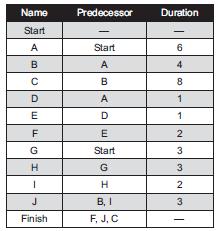
9. What is the critical path in the activity list to the right? A. Start-A-B-C-Finish B. Start-A-D-E-F-Finish C. Start-G-H-I-J-Finish D. Start-A-B-J-Finish Name Predecessor Duration Start A Start 6 BCDEFGH ABA 4 8 1 D 1 E G Start H G 1 H J B, 1 23323 Finish F, J, C
8. Which of the following tools is used for adding buffers to a schedule? A. Three-point estimates B. Critical chain method C. Expert judgment D. Critical path analysis
7. Three members of your project team want to pad their estimates because they believe there are certain risks that might materialize. What is the BEST way to handle this situation? A. Estimate the activities honestly, and then use a contingency reserve to cover any unexpected costs B. Allow more
6. Which of the following is NOT an input to Schedule Development? A. Activity list B. Project schedule network diagrams C. Resource calendars D. Schedule baseline
5. You're managing an industrial design project. You've come up with the complete activity list, created network diagrams, assigned resources to each activity, and estimated their durations. What's the next thing that you do? A. Use Rolling Wave Planning to compensate for the fact that you don't
4. You are managing a software project. Your QA manager tells you that you need to plan to have her team start their test planing activity so that it finishes just before testing begins. But other than that, she says it can start as late in the project as necessary. What's the relationship between
3. Given this portion of the network diagram to the right, what's the LF of activity F? A 10 B. 11 C. 16 D. 17
1. You're managing a project, when your client tells you that an external problem happened, and now you have to meet an earlier deadline. Your supervisor heard that in a situation like this, you can use schedule compression by either crashing or fast-tracking the schedule, but he's not sure which
2. Given this portion of the network diagram to the right, what's the ES of activity F? A. 9 B. 10 C. 12 D. 13
Would I really use this critical path stuff in real life, or is it just something I need to memorize for the PMP exam?
What if there’s a path that’s not critical, but where even a small slip in one activity would delay the project?
What’s the advantage of thinking about activity definition and sequencing separately?
When do you use ADM and when do you use PDM diagrams?
What about Start to Finish predecessors?
Where do you get the predecessor information to figure out your network diagram?
Can you see benefits to using an ADM diagram over a PDM diagram? When might you use one instead of the other?
I still don’t get planning packages and control accounts.
How would you use experts to help you define tasks?
Time Management is all about breaking the work down into activities, so you can put them in order and come up with estimates for each of them.What do you need to know before you can figure what activities are needed for a project?
What should Kathleen do first to make sure they have time to get everything done?
What do you need to know about a project before you can assign resources?
In my company, I’m given my resources—I don’t get to assign them myself. How do these tools help me?
Is choosing a consultant, contractor, or vendor to do project work part of resource estimation?
Where do the duration numbers come from on each activity?
Can you think of a situation where a delay in an activity early on in a project can lead to a problem in a later activity, which leads to another problem in another activity, leading to a cascade of problems that makes the project late?
It’s not easy to plan for a lot of resources when they have tight time restrictions and overlapping constraints. How would you figure out a schedule that makes everything fit together?
What’s the difference between a duration estimate and an effort estimate?
Since reserve analysis lets me use buffers, why can’t I just put everything I don’t know about into the reserve?
When you use parametric estimation, how does the program or formula know how much to estimate?
Each of these scenarios describes a different tool or technique from Activity Duration Estimating.Write down which tool or technique is being described.1. Kathleen comes up with three estimates (one where everything goes wrong, one where some things go wrong, and one where nothing goes wrong) for
You’ll need to understand the various inputs and outputs for each process for the exam. Write down what you think each of the inputs to the Activity Duration Estimating process will be used for when you actually sit down and estimate how long each activity will take.1. Activity List and Activity
What if I need a resource that isn’t available when my project needs it?
10. You are managing a project laying underwater fiber optic cable. The total cost of the project is $52/meter to lay 4 km of cable across a lake. It's scheduled to take 8 weeks to complete, with an equal amount of cable laid in each week. It's currently week 5, and your team has laid 1,800 meters
10. What is the float for activity F in the activity list to the right? A. 0 B. 7 C. 8 D. 10
20. You are managing a project with a BAC of $93,000, EV (BCWP) of $51,840, PV (BCWS) of $64,800 and AC (ACWP) of $43,200. What is the CPI? A. 1.5 B. 0.8 C. 1.2 D. $9,000
6. Your company has asked you to provide a cost estimate that includes maintenance, installation, support, and upkeep costs for as long as the product will be used. What is that kind of estimate called? A. Benefit Cost Ratio B. Depreciation C. Net Present Value D. Lifecycle Costing
5. Your company has 2 projects to choose from. Project A is a billing software project for the Accounts payable department; in the end it will make the company around $400,000 when it has been rolled out to all of the employees in that department. Project B is a payroll application that will make
4. You are working on a project with a PV of $56,733 and an SPI of 1.2. What's the Eamed Value of your project? A. $68,079.60 B. $47,277.50 C. $68,733 D. .72
3. You are managing a project for a company that has previously done three projects that were similar to it. You consult with the cost baselines, lessons learned, and project managers from those projects, and use that information to come up with your cost estimate. What technique are you using? A.
2. You're working on a project that has an EV of $7362 and a PV (BCWS) of $8232. What's your SV? A. B. $870 -$870 C. 0.89 D. Not enough information to tell
1. You are creating your cost baseline. What process are you in? A. Cost Budgeting B. Cost Control C. Cost Estimating D. Cost Baselining
Aren’t Net Present Value and Benefit Cost Ratios really about project selection methods?
Wow, there are a lot of Earned Value formulas! Is there an easy way to remember them?
Is that really the best way to estimate costs?What if things change between now and the end of the project?
7. You are working on a project with an SPI of .72 and a CPI of 1.1. Which of the following BEST describes your project? A. Your project is ahead of schedule and under budget B. Your project is behind schedule and over budget C. Your project is behind schedule and under budget D. Your project is
8. Your project has a BAC of $4,522 and is 13% complete. What is the earned value (EV)? A $3934.14 B. There is not enough information to answer C. $587.86 D. $4522
9. You are starting to write your preliminary scope statement with your project sponsor when the senior managers ask for a time and cost estimate for the project. You have not yet gathered many of the project details. What kind of estimate can you give? A. Analogous Estimate B. Rough Order of
19. You are managing a software project, when one of your stakeholders needs to make a change that will affect the budget. You follow the procedures to implement the change. Which of the following must get updated to reflect the change? A. Project management plan B. Project cost baseline C. Cost
18. You are managing a software project, when one of your stakeholders needs to make a change that will affect the budget. What defines the processes that you must follow in order to implement the change? A Cost change control system B. Monitoring & Controlling process group C. Change control board
17. What is the range of a Rough Order of Magnitude Estimate? A. -5% to +10% B. -25% to +75% C. -50% to +100% D. -100% to +200%
16. Project A has a NPV of $75,000, with an internal rate of return of 1.5% and an initial investment of $15,000. Project B has a NPV of $60,000 with a BCR of 2:1. Project C has a NPV of $80,000, which includes an opportunity cost of $35,000. Based on these projects, which is the BEST one to
15. You are working on the project plan for a software project. Your company has a standard spreadsheet that you use to generate estimates. To use the spreadsheet, you meet with the team to estimate the number of functional requirements, use cases and design wireframes for the project. Then you
14. You are managing an industrial architecture project. You've spent $26,410 so far to survey the site, draw up preliminary plans, and run engineering simulations. You are preparing to meet with your sponsor, when you discover that there a new local zoning law will cause you to have to spend an
Showing 2600 - 2700
of 7343
First
20
21
22
23
24
25
26
27
28
29
30
31
32
33
34
Last
Step by Step Answers

 Get 50% OFF
Claim Now
Get 50% OFF
Claim Now