New Semester
Started
Get
50% OFF
Study Help!
--h --m --s
Claim Now
Question Answers
Textbooks
Find textbooks, questions and answers
Oops, something went wrong!
Change your search query and then try again
S
Books
FREE
Study Help
Expert Questions
Accounting
General Management
Mathematics
Finance
Organizational Behaviour
Law
Physics
Operating System
Management Leadership
Sociology
Programming
Marketing
Database
Computer Network
Economics
Textbooks Solutions
Accounting
Managerial Accounting
Management Leadership
Cost Accounting
Statistics
Business Law
Corporate Finance
Finance
Economics
Auditing
Tutors
Online Tutors
Find a Tutor
Hire a Tutor
Become a Tutor
AI Tutor
AI Study Planner
NEW
Sell Books
Search
Search
Sign In
Register
study help
business
systems analysis and design
Head First PMP 3rd Edition Jennifer Greene, Andrew Stellman - Solutions
What homework do you need to do before you make a change to the scope by adding or removing project work? Why?
I know how to make scope changes during planning. What do I do if I run into scope changes during execution?
How do I know when I have decomposed the work to a small enough work package?
How do I know if I should use phases or deliverables for my WBS?
How can you know all of this up front?
Wait a minute. Doesn’t that mean I need to do change control and update the baseline every time I make any change to the document while I’m writing it? That’s going to make it really hard to write the first version of anything!
Do I really need to create a baseline?
What happens if I need to change the scope?
What if I don’t know enough to estimate the cost of a work package?What do I add to the WBS Dictionary?
What if one work package depends on another one?
Does the work breakdown structure need to be graphical? It looks like a lot of work. Can’t I just write out a list of tasks?
Can you think of a reason that Mike would break Cows Gone Wild III work down by phase?Can you think of why he’d break it down by deliverable?
Why would you break the project down by phase rather than deliverable? Why would you want to break it down by deliverable?
36. You are the project manager for a building contracting project. You schedule a meeting with your customer and stakeholders to give them an update on the progress of the project. At that meeting, they tell you that certain deliverables need to be changed before they can be accepted. Which is the
What if a stakeholder can’t tell me how to measure his needs?
What if there is only one way to do something? Do I still need to do alternatives identification?
Is product analysis the same as requirements gathering?
How will this scope management plan prevent the kinds of problems that affected the team’s last project from happening on Cows Gone Wild III?
What’s the first thing Mike should do to make sure that Cows Gone Wild III goes well?
Does that mean the project manager doesn’t care about the product scope at all, just the project scope?
Won’t the team care more about what they are making than how they are making it?
Does the scope include all of the stuff that I make, like a project schedule or a budget? What about things that are used to build the product but not actually delivered to the people who use it?
How would you solve these problems that happened in Cows Gone Wild II so they don’t cause the same kind of trouble on CGW III?
The Cows Gone Wild II team ran into a lot ofchanges throughout the project. Could they have done something to avoid that problem?
25. Which of the following is NOT an output of Integrated Change Control?Approved change requests Rejected change requests Validated defect repair Recommended change requests
24. You are the project manager on a network engineering project. Two weeks ago, your team began executing the project. The work has been going well, and you are now a day ahead of schedule. Two stakeholders just approached you to tell you that they have an important change that needs to be made.
23. Which of the following is NOT an example of a project selection method? A. A murder board B. A mathematical model for predicting project success C. Expert judgment D. Cost-benefit analysis
22. Which is NOT true about the project charter: A. The project manager must be consulted before the charter is finalized B. The charter is issued by the project sponsor C. The project manager's authority to manage the project is granted by the charter D. The charter describes how stakeholders
21. You are a project manager starting a new project. Your manager warns you that previous projects ran into trouble. Which of the following would be BEST for you to rely on to help plan your project: A. Our project management expertise B. Historical information C. The change control system D.
20. Which of the following is NOT an output of Direct and Manage Project Execution? A. Work performance information B. Deliverables C. Implemented change requests D. Forecasts
18. You have just verified that all of the work on your project is completed. Which of these things is NOT part of the Closing process? A. Update historical information by documenting lessons leamed B. Document the work performance information to show the deliverables that have been completed and
19. Which of the following is NOT true about the preliminary scope statement? A. The preliminary scope statement is refined into a more detailed scope statement later on in the project B. The preliminary scope statement will serve as the basis for directing the project work C. The preliminary scope
17. Which of the following is NOT true about the project charter? A. The project charter defines the requirements that satisfy customer needs B. The project charter defines the work authorization system C. The project charter makes the business case that justifies the project D. The project charter
16. You are the project manager on a construction project, and you have just received a change request. You consulted the project management plan, and followed the procedures laid out in the Change Control System. You are in the process of reviewing the change and documenting its impact. Your
15. You're a project manager on a software project. Your team is busy executing the project and creating the deliverables, but there have been several changes requested by stakeholders over the past few weeks. Each time you got one of these changes, you called a meeting with your team and the
14. You are a project manager on a software project. There are several changes that need to be made, and you need to decide how to apply project resources in order to implement them. What do you do? A. Decide the priority of the changes and announce them to the team B. You should call a team
13. You are managing a software project, when you find out that a programming team who you were supposed to have access to has been reassigned to another project. What is the first thing that you should do? A. Figure out the impact that this will have on your project B. Bring a copy of your
12. You are the project manager for a software project, when the sponsor pulls the plug and cancels the project. What do you do? A. Give the team the day off to recuperate from the bad news B. Create a budget summary for the remaining unspent budget C. Create the closure procedures and update the
11. You are holding a formal, approved document that defines how the project is executed, monitored and controlled. You are holding: A The project management plan B. The preliminary scope statement C. The project charter D. The work breakdown structure
10. One of your team members has discovered a defect in a deliverable and has recommended that it be repaired. Which of the following is NOT true: A The project charter has authorized you to perform the work B. Your project is in Monitor and Control Project Work process C. The defect repair must be
9. You're on the project selection committee. A potential project is being presented by its sponsor. Everyone else in the room is asking questions intended to discover its potential value, its likelihood of success and to expose weaknesses and flaws in the project. What BEST describes this meeting?
8. You are a project manager on a software project. When you planned the project, your Enterprise Environmental Factors included a policy that all changes that cost over 2% of the budget need to be approved by the CFO, but smaller changes could be paid for by a management contingency fund. One of
7. You're the project manager at a telecommunications company. You recently had stakeholders approach you with changes. You figured out that the changes would cost additional time and money. The stakeholders agreed, you were given additional time and budget, and the changes were approved. Now you
6. The work authorization system: A. Ensures that every work package is performed at the right time and in the proper sequence B. Authorizes the project manager to spend money on work C. Is a set of processes and tools that aids project manager in effectively guiding the project to completion D. Is
5. You're a project manager on a construction project. The electrician has started laying out the wiring, when the client comes to you with a change request. He needs additional outlets, and you think that will increase the cost of the electrical work. What is the first thing you do? A. Refuse to
4. You're managing a graphic design project. One of your team members reports that there is a serious problem, and you realize that it will cause a delay that could harm the business of the stakeholders. Even worse, it will take another two days for you to fully assess the impact-until then, you
3. What is the output of Direct and Manage Execution? A. Approved change requests B. Project management processes C. Deliverables D. Forecasts
1. You've just received a change request. This means: A. The project charter is complete, but the work cannot begin yet because you need to make a change to the preliminary scope statement. B. You are in the Direct and Manage Execution process, and you can implement the change now. C. The change
2. Which of these is not an input to Develop Project Charter? A. Enterprise environmental factors B. Preliminary scope statement C. Contract D. Project statement of work
Think about a major project you’ve heard of that did not end well, like one that was shut down before the work was done. What lessons could have been learned from that project?How can the project manager use the Close Project process to make sure that something good comes out of early termination?
What about changes that don’t affect schedule, cost, scope or quality?
Once a change is approved, what do I do with it?
What if there’s a problem outside my project, and I’m not sure that it affects me?
Who approves changes?
Sometimes my team members come to me and tell me that the project could have problems later. What do I do with that?
I still don’t get what Enterprise Environmental Factors are.
What about things that I don’t think about? And sometimes, I know there could be problems in a certain area, but I’m not sure what they’ll be until the project gets going.
Does the project manager create the project management plan all by himself?
How far should I go when trying to anticipate every possible problem and list it in the project management plan?
Not all preliminary scope statements have all of the information that's shown here. For the teachers' trip to Asia, which sections would make sense to fill out? Would all of those sections be helpful for this particular project?
I’m still not clear on who the sponsor is. How’s that different than the customer?
I don’t get some of these terms on the charter. What’s a business case, constraint, or assumption?
Wait a minute! How can I be the one writing the charter, when it’s what gives me all of my authority and I might not even be assigned to the project yet?
I’ve never had a project charter. Is it really necessary?
Take a look at the charter for the teachers’ trip, and write down what you think each of the following sections of a typical project charter is used for.Project Description:Project Requirements:Assigned Project Manager and Authority Level:Summary Milestone Schedule:External Assumptions and
5. Dynamic programming maximizes the present value of a project by subjecting the investment to known constraints. A. Benefit measurement B. Mathematical model
4. Peer review has people within the organization review the candidate projects and give their opinions on them. The opinions are compiled and compared. A. Benefit measurement B. Mathematical model
3. Benefit-to-cost ratios compare projects by evaluating the benefit of the project versus its projected costs. A. Benefit measurement B. Mathematical model
2. Linear programming involves predicting a project's success by optimizing a formula based on linear constraints. A. Benefit measurement B. Mathematical model
1. Murder boards are meetings where people ask a bunch of questions about how the project can go wrong, and try and figure out if a project is really worth doing. Which model is a murder board? A. Benefit measurement B. Mathematical model
10. You're a project manager working in a weak matrix organization. Which of the following is NOT true? A. Your team members report to functional managers. B. You are not in directly charge of resources. C. Functional managers make decisions that can affect your projects. D. You have sole
9. You're the project manager for an industrial design project. Your team members report to you, and you're responsible for creating the budget, building the schedule, and assigning the tasks. When the project is complete, you release the team so they can work on other projects for the company.
8. Which of the following is NOT true about the triple constraint? A. The project manager needs to pay attention to all three constraints. B. You can increase quality by increasing scope. C. A change in one of the three constraints often leads to a change in the other two. D. Any change in time,
7. Which of the following is NOT one of the triple constraints? A. Time B. Scope C. Cost D. Quality
6. Which of the following is NOT a project? A. Repairing a car B. Building a highway overpass C. Running an IT support department D. Filming a motion picture
5. Which process group contains the Develop Project Charter process and the Develop Preliminary Project Scope Statement process? A. Initiating B. Executing C. Monitoring and Controlling D. Closing
4. You're a project manager for a construction project. You don't control the project budget, the team doesn't report to you, and you routinely have to request their time from their manager. What kind of organization do you work in? A. Functional B. Weak matrix C. Strong matrix D. Projectized
3. Which of the following is NOT a characteristic of a project? A. A project is unique. B. A project is temporary. C. A project is progressively elaborated. D. A project always critical to the company.
2. Which of the following is not a stakeholder? A. The project manager who is responsible for building the project B. A project team member who will work on the project C. A customer who will use the final product D. A competitor whose company will lose business because of the product
1. You're a project manager working on a software engineering project. The programmers have started building the software, and the testers have started to create the test environment. Which process group includes these activities? A. Initiating B. Planning C. Executing D. Closing
It seems like the Initiating and Planning process groups would be the same. How are they different?
Is every knowledge area in only one process group?
So what’s the difference between process groups and knowledge areas?
Can you use the same input in more than one process?
Do you do all of the processes in every project
Can a process be part of more than one process group?
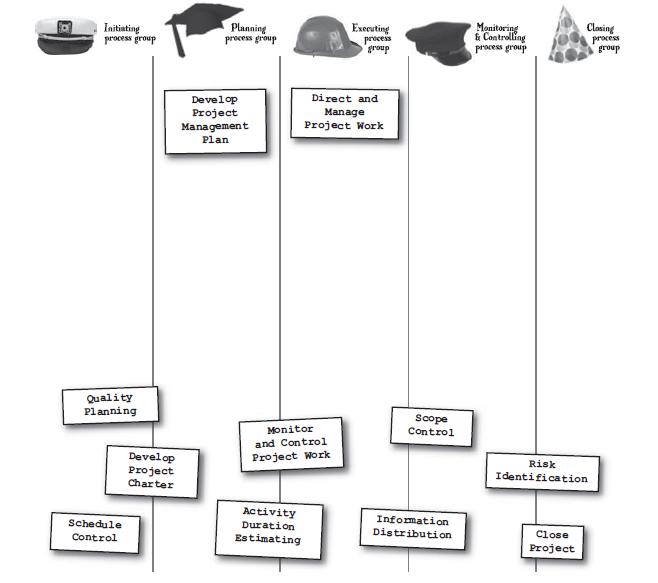
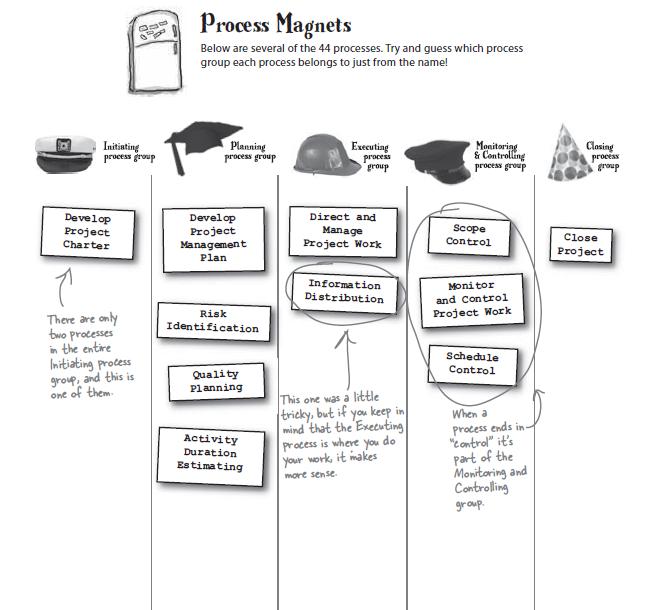
Below are several of the 44 processes. Try and guess which process group each process belongs to just from the name. We’ve done the first two for you Initiating process group Quality Planning Schedule Control Planning process group Executing process group Develop Project Management Plan Direct
Kate spilled a hot cup of Starbuzz half caff nonfat latte on her job hunting checklist. Can you match the notes she scribbled at the bottom of the page to what’s covered up by coffee stains?
I’m still not clear on the difference between a project coordinator and a project expeditor.
In a functional organization, which is what Kate works in, project managers don’t have the authority to make major decisions on projects. Projectized organizations give all of the authority to the PM.Can you work out which description goes with which organization type?Functional Organization
Kate spilled a hot cup of Starbuzz half caff nonfat latte on her job hunting checklist. Can you match the notes she scribbled at the bottom of the page to what’s covered up by coffee stains? What would you look for in your perfect job? Does your wish list look anything like Kate’s?
I’ve heard that there are a whole bunch of formulas you have to memorize for the PMP exam. Will I have to do that?
Aren’t certification exams just an excuse that consultants use so that they can charge their clients more money?
What if I don’t do all of this stuff in my job?
How can the PMBOK® Guide claim to be the entire body of knowledge for project management?
The PMBOK® Guide is really just a collection of things that you probably already know a lot about. It defines four major areas of responsibility for a project manager. We’ve listed these four areas below; your job is to write down what you think each area of responsibility means 1. Identify the
What’s the difference between the way teams are run in a functional organization and a projectized one?
Can I be an effective PM in a functional organization?
Does the PMP exam favor any kind of organization?
What if I know that a change will impact just scope, but not schedule or cost. Can I go ahead and make it?
Showing 2800 - 2900
of 7343
First
22
23
24
25
26
27
28
29
30
31
32
33
34
35
36
Last
Step by Step Answers

 Get 50% OFF
Claim Now
Get 50% OFF
Claim Now