New Semester
Started
Get
50% OFF
Study Help!
--h --m --s
Claim Now
Question Answers
Textbooks
Find textbooks, questions and answers
Oops, something went wrong!
Change your search query and then try again
S
Books
FREE
Study Help
Expert Questions
Accounting
General Management
Mathematics
Finance
Organizational Behaviour
Law
Physics
Operating System
Management Leadership
Sociology
Programming
Marketing
Database
Computer Network
Economics
Textbooks Solutions
Accounting
Managerial Accounting
Management Leadership
Cost Accounting
Statistics
Business Law
Corporate Finance
Finance
Economics
Auditing
Tutors
Online Tutors
Find a Tutor
Hire a Tutor
Become a Tutor
AI Tutor
AI Study Planner
NEW
Sell Books
Search
Search
Sign In
Register
study help
business
systems analysis and design
Radar Systems Analysis And Design Using MATLAB Advances In Applied Mathematics 3rd Edition Bassem R. Mahafza - Solutions
2.25. A radar has the following parameters: Peak power P, = 65KW; total losses L = 5dB; operating frequency fo = 8GHz; PRFf, = 4KHz; duty cycled, = 0.3; circular antenna with diameter D = 1m; effective aperture is 0.7 of physical aperture; noise figure F = 8dB. (a) Derive the various parameters
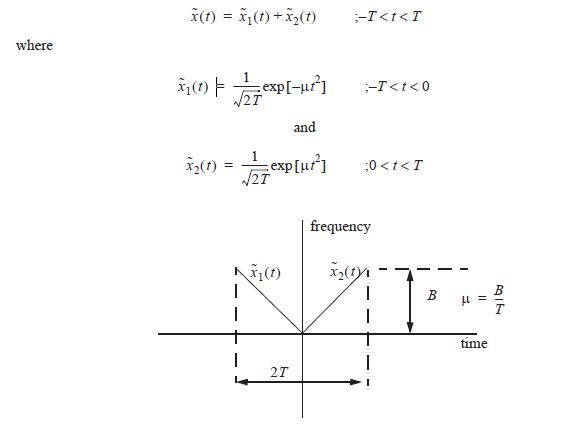
Derive an expression for the ambiguity function of a V-LFM waveform, illustrated in figure below. In this case, the overall complex envelope is x(t) = x(t) + x2(t) -T
(a) Write an expression for the ambiguity function of an LFM signal with bandwidth B = 10MHz, pulse width t' = 1s, and wavelength = 1cm. (b) Plot the zero Doppler cut of the ambiguity function. (c) Assume a target moving toward the radar with radial velocity v = 100m/s. What is the Doppler shift
(a) Write an expression for the ambiguity function of an LFM waveform, where t' = 6.4s and the compression ratio is 32. (b) Give an expression for the matched filter impulse response.
A radar system uses LFM waveforms. The received signal is of the form s,(t) = As(t-t)+n(t), where t is a time delay that depends on range, s(t) = Rect(t/t') cos(2foto(t)), and (t) = -B/T'. Assume that the radar band- width is B = 5MHz, and the pulse width is t' = 5s. (a) Give the quadrature
An closed form expression for the SNR at the output of the matched filter when the input noise is white was developed in Section 4.1.1. Derive an equivalent formula for the non- white noise case.
Repeat the example in Section 4.1 using x(t) = u(t) exp(-at).
Compute the frequency response for the filter matched to the signal (a) x(t): = exp 2T (b) x(t) = u(t)exp(-at) where a is a positive constant.
Assume that a certain sequence is determined by its FFT. If the record length is 2ms and the sampling frequency is f = 10KHz, find N.
A certain band-limited signal has bandwidth B = 20KHz. Find the FFT size required so that the frequency resolution is Af = 50Hz. Assume radix 2 FFT and a record length of 1 second.
(a) Give an expression for the ambiguity function for a pulse train consisting of 4 pulses, where the pulse width is t' = 1s and the pulse repetition interval is T = 10s. Assume a wavelength of = 1cm. (b) Sketch the ambiguity function contour.
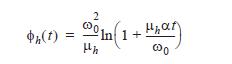
Hyperbolic frequency modulation (HFM) is better than LFM for high radial velocities. The HFM phase iswhere , is an HFM coefficient and a is a constant. (a) Give an expression for the instanta- neous frequency of an HFM pulse of duration t'h. (b) Show that HFM can be approximated by LFM. Express the
Consider a sonar system with range resolution AR = 4cm. (a) A sinusoidal pulse at frequency fo=100KHz is transmitted. What is the pulse width, and what is the bandwidth? (b) By using an up-chirp LFM, centered at fo, one can increase the pulse width for the same range resolution. If you want to
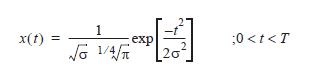
Derive an expression for the ambiguity function of a Gaussian pulse defined bywhere T is the pulsewidth and s is a constant. 1 x(t) == exp ;0
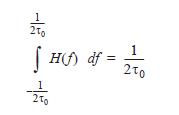
From Eq. (5.15) one can deduce that the transfer function of the matched filter is given = by H(f) sin((of)/(of)). Show that 250 H(f) df = 250 1 250
Using the range-Doppler coupling definition given in Eq. (4.125), develope an expression for the range-Doppler coupling for the following cases: (a) Linear FM pulse with a Gaussian envelope, and (b) parabolic FM signal.
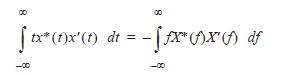
Show thatwhere X(), is the FT of x(t) and x' (t) is its derivative with respect to time. The function X' (f) is the derivative of X(f) with respect to frequency. 00 [ tx*(t)x'(t) dt = [X* (f\X'(F) d
Repeat the previous problem for x(t) = exp(-1/2)cos2fot.
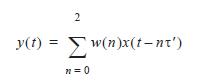
A pulse train y(t) is given bywhere x(t) = exp(-1/2) is a single pulse of duration t' and the weighting sequence is {w(n)} {0.5, 1, 0.7}. Find and sketch the correlations R, R, and R.,. = 2 y(t) = w(n)x(t-nt') 1=0
You are given a sequence of samples {x(kT), k = -, } where the sampling interval T corresponds to twice the Nyquist rate. Give an expression to compute the samples of x(t) at a new sampling rate corresponding to T' = 0.77.
Write a MATLAB program to decimate any sequence of finite length and demon- strate it using the previous problem.
Generate 512 samples of the signal x(t) = 2.0et sin (4t), using a sampling inter- val equal to 0.002. Compute the resultant spectrum and then truncate the spectrum at 15Hz. Generate the time-domain sequence for the truncated spectrum. Determine the sampling rate of the new sequence.
What is the power spectral density for the signal x(t) = Acos (2fot+00)?
Show that (a) Rx(t) = R(t). (b) If x(t) = f(t)+m and y(t) = g(t)+m2, show that Rxy(t) = mm, where the average values for f(t) and g(f) are zeroes.
Derive Eq. (3.52).
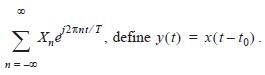
If the Fourier series isCompute an expression for the complex Fourier series expansion of y(t) X/7, 2nt/T, define y(t) = x(t-to)- 11=-00
A periodic signal x(t) is formed by repeating the pulse x(t) = 2A((t-3)/5) every 10 seconds. (a) What is the Fourier transform of x(t)? (b) Compute the complex Fourier series of xp(f). (c) Give an expression for the autocorrelation function Rx,(t) and the power spectrum density 5x, (c).
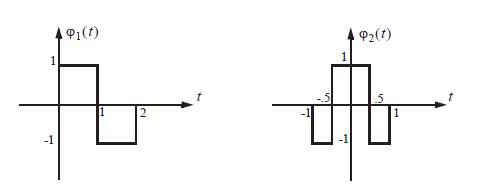
(a) Prove that o(t) and 2(t), shown in the figure below, are orthogonal over the interval (-212). (b) Express the signal x(t) = t as a weighted sum of o(t) and Q2(t) over the same time interval. 1 1(t) -1 1 2 -1 Q2(t) S 1
Compute the energy associated with the signal x(t) = ARect(t/t).
Define {x1(n) = 1, -1, 1} and {xo(n) = 1, 1, -1}. (a) Compute the discrete correla- tions: Rx Rx Rxx and Rxx (b) A certain radar transmits the signal s(t) = x(t)cos2fot-xo(t) sin2fot. Assume that the autocorrelation s(t) is equal to y(t) = y(t)cos2fot-yo(t) sin2fot. Compute and sketch y(t) and
Compute the discrete convolution y(n)x(m) h(m) where {x(k), k-1, 0, 1, 2} = [-1.9, 0.5, 1.2, 1.5] {h(k), k = 0, 1, 2} = [-2.1, 1.2, 0.8] .
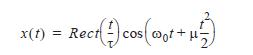
A certain radar system uses linear frequency modulated waveforms of the formWhat are the quadrature components? Give an expression for both the modulation and instan- taneous frequencies. x(t) = Rect +
(a) Write an expression for the FT of x(t) = Rect(t/3). (b) Assume that you want to compute the modulus of the FT using a DFT of size 512 with a sampling interval of 1 sec- ond. Evaluate the modulus at frequency (80/512) Hz. Compare your answer to the theoretical value and compute the error.
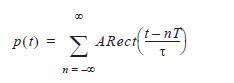
In Fig. 3.9, letGive an expression for X,(60). 8 p(t) = ARect(-n)
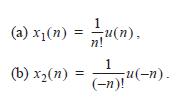
Compute the Z-transform for 1 (a) x(n) = u(n) (b) x2(n) == mu(n) 1 (-n)! (- u(-n).
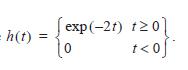
An LTI system has impulse response(a) Find the autocorrelation function R,(t). (b) Assume the input of this system is x(t) = 3 cos (100+). What is the output? h(t) exp(-2t) t0 = 1
Write an expression for the autocorrelation function R,(t), whereGive an expression for the density function S, (c). 5 y(t) = Rect(-5) and {Y} = {0.8, 1, 1, 1, 0.8}. 2 n = 1
Prove that the effective duration of a finite pulse train is equal to (T,To)/T, where To is the pulse width, T is the PRI, and T, is as defined in Fig. 3.5.
Derive Eq. (3.139).
If x(t) = x(t)-2x(1-5)+x(1-10), determine the autocorrelation functions R(t) and Rx(t) when x(t) = exp(-1/2)|
Determine the quadrature components for the signal -21 h(t)=5(t)- e sin(coot) for t0.
In reference to Fig. 1.16, compute the Doppler frequency for, , and . Assume that .
Starting with a modified version of Eq. (1.24), derive an expression for the Doppler shift associated with a receding target.
A certain L-band radar has center frequency , and PRF. What is the maximum Doppler shift that can be measured by this radar?
Compute the Doppler shift associated with a closing target with velocity 100, 200, and 350 meters per second. In each case compute the time dilation factor. Assume that .
An X-band radar uses PRF of . Compute the unambiguous range, and the required bandwidth so that the range resolution is . What is the duty cycle?
For the same radar in Problem 1.1, assume a duty cycle of 30% and peak power of . Compute the average power and the amount of radiated energy during the first .
(a) Calculate the maximum unambiguous range for a pulsed radar with PRF of and ; (b) What are the corresponding PRIs?
10.22. Reproduce Fig. 10.26 for a 3-pulse and a 4-pulse MTI system, and briefly discuss your output in terms how much phase noise affects the performance of each system,
10.21. Starting with Eq. (10.94), derive a closed form expression for the phase noise of an FM modulated waveform.
10.20. A certain radar uses three PRFs to resolve range ambiguities. The desired unambig- uous range is R = 250Km. Select N = 43. Compute the corresponding fri fr2= fr3 Rul Ru2, and R3.
10.19. A certain radar uses two PRFs to resolve range ambiguities. The desired unambig- uous range is R = 150Km. Select a reasonable value for N. Compute the corresponding fri fr2 Rul and R2-
10.18. Consider an X-band radar with wavelength = 3cm and bandwidth B = 10MHz. The radar uses two PRFs, fr1 = 50KHz and fr2 = 55.55KHz. A target is detected at range bin 46 forf, and at bin 12 for fr2. Determine the actual target range.
10.17. A certain radar operates at two PRFS, f1 and fr2, where T, = (1/f+1) = T/5 and T2 = (1/2) = T/6. Show that this multiple PRF scheme will give the same range ambiguity as that of a single PRF with PRI T.
10.16. Repeat Problem 10.13 when the target is 15 off the radar line of sight. ==
10.15. Consider a medium PRF radar on board an aircraft moving at a speed of 350 m/s with PRFs f,1 = 10KHz, fr2 = 15KHz, and fr3 = 20KHz; the radar operating frequency is 9.5GHz. Calculate the frequency position of a nose-on target with a speed of 300 m/s. Also calculate the closing rate of a
10.14. Develop an expression for the clutter improvement factor for single and double line cancelers using the clutter autocorrelation function.
10.12. The quadrature components of the clutter power spectrum are given in Problem 9.3. Let = 10Hz and f = 500Hz. Compute the improvement of the signal-to-clutter ratio when a double delay line canceler is utilized.
10.11. A certain filter used for clutter rejection has an impulse response h(n) = (n)-38(n-1)+3(n-2)-(n-3). (a) Show an implementation of this filter using delay lines and adders. (b) What is the transfer function? (c) Plot the frequency response of this filter. (d) Calculate the output when the
10.10. Using PRI ratios 25:30:27:31, generate the MTI response for a 3-pulse MTI.
10.9. A certain radar uses two PRFS with a stagger ratio 63/64. If the first PRF is = fr1 500Hz. Compute the blind speeds for both PRFS and for the resultant composite PRF. Assume 3cm.
10.7. Repeat Problem 9.10 for a double delay line canceler.
10.6. Develop an expression for the improvement factor of a double delay line canceler.
10.5. Consider a single delay line canceler. Calculate the clutter attenuation and the improvement factor. Assume that = 4Hz and PRF f = 450Hz.
10.3. Plot the frequency response for the filter described in the previous problem for K-0.5, 0, and 0.5.
10.1. (a) Derive an expression for the impulse response of a single delay line canceler. (b)Repeat for a double delay line canceler.
A pulsed radar system has a range resolution of . Assuming sinusoid pulses at , determine the pulse width and the corresponding bandwidth.
9.6. Prove that the Weibull distribution a is given by = value for b where is the median In 2
9.5. A certain radar has range resolution of 300m and is observing a target somewhere in a line of high towers each having RCS tower = 10m. If the target has RCS , = 1m, (a) how much signal-to-clutter ratio should the radar have? (b) Repeat part (a) for range resolution of 30m.
9.4. A certain radar has the following specifications: pulse width t' = 1s, antenna beam width = 1.5, and wavelength=3cm. The radar antenna is 7.5m high. A certain target is simulated by two point targets (scatterers). The first scatterer is 4m high and has RCS = 20m. The second scatterer is 12m
9.2. Repeat the example of Section 9.3 for target RCS , = 0.15m, pulse width t = 0.1s, antenna beam width 0 = 0 = 0.03radians; the detection range is R = 100Km, and = 1.6 10 (m/m).
9.1. Compute the signal-to-clutter ratio (SCR) for the radar described in Section 9.2.1. In this case, assume antenna 3dB beam width 3dB = 0.03rad, pulse width = 10s, range R = 50Km, grazing angle w = 15, target RCS , = 0.1m, and clutter reflection coeffi cient = 0.02(m/m).
8.17. Derive Eq. (8.117) from Eq. (8.116). = 2cm. In your analysis
8.16. Starting with Eq. (8.114), derive Eq. (8.115), assume Vo you may assume that 41
8.15. Modify the MATLAB program "multipath.m" so that it accounts for the radar antenna.
8.14. Modify the MATLAB program "multipath.m" so that it uses the true spherical ground range between the radar and the target.
8.13. Derive Eq. (8.103).
8.12. Assume a radar at altitude h, 10m and a target at altitude h, 300m, and assuming a spherical earth, calculate 71, 72, and g
8.11. In the previous problem, assuming that you may be able to use the small grazing angle approximation. (a) Calculate the ratio of the direct to the indirect signal strengths at the target. (b) If the target is closing on the radar with velocity v = 300m/s, calculate the Dop- pler shift along
8.10. In reference to Fig. 8.18, assume a radar height of h, = 100m and a target height of h = 500m. The range is R = 20Km. (a) Calculate the lengths of the direct and indirect paths. (b) Calculate how long it will take a pulse to reach the target via the direct and indirect paths.
8.9. Calculate the range to the horizon corresponding to a radar at 5Km and 10Km of alti- tude. Assume 4/3 earth.
8.8. Starting with Eq. (8.60), derive Eq. (8.61).
8.7. Derive an asymptotic form for I, and I, when the grazing angle is very small.
8.6. Reproduce Figs. 8.11 and 8.12 by using f = 8GHz and (a) e' = 2.8 and " = 0.032 (dry soil); (b) ' = 47 and "19 (seawater at 0C); (c) ' = 50.3 and e" = 18 (lake water at 0C).
8.4. Derive Eq. (8.24).
8.3. Validate Eq. (8.20) and Eq. (8.25).
8.1. Using Eq. (8.50), determine h when h, = 15m and R = 35Km.
7.7. Using MATLAB, generate the waterfall plot corresponding to Fig.7.20.
7.6. Reproduce Fig. 7.19 for v = 10, 50, 100,-150, 250 m/s. Compare your outputs. What are your conclusions?
7.5. Derive Eq. (7.60).
7.2. Using MATLAB, generate a baseband (complex-valued) LFM waveform having a time duration of 10s and bandwidth of 200MHz using a sampling step of 1ns. Plot the real part, imaginary part, and the modulus of the FFT of this waveform.
7.1. Starting with Eq. (7.17) derive Eq. (7.21).
Generate a Frank code of length 8, i.e., Fs.
The smallest positive primitive root of q = 11 is y = 2; for N = 10, generate the corresponding Costas matrix.
A certain pulsed radar uses pulse width . Compute the corresponding range resolution.
Repeat the previous problem for N = 13 and k = 6. Use a Barker code of length 13.
(a) Perform the discrete convolution between the sequence R defined in Eq. (6.31), and the transversal filter impulse response; and (b) sketch the corresponding transversal filter output.
Consider the 7-bit Barker code, designated by the sequence x(n). (a) Compute and plot the autocorrelation of this code. (b) A radar uses binary phase-coded pulses of the form s(t) = r(f) cos(2nfot). where r(t) = x(0), for 0
Show that the zero Doppler cut for the ambiguity function of an arbitrary phase coded pulse with a pulse width t is given by Y(f) = |sinc(ftp)|2 -
The radar uncertainty principle establishes a lower bound for the time bandwidth product. More specifically, if the radar effective duration is to and its effective bandwidth is Be show that B(1-PRDC), where PRDC is the range-Doppler coupling coefficient defined in Chapter 4. 2 2
Showing 2300 - 2400
of 7343
First
17
18
19
20
21
22
23
24
25
26
27
28
29
30
31
Last
Step by Step Answers

 Get 50% OFF
Claim Now
Get 50% OFF
Claim Now