







Question: Using the data in Problem P16-11B, a. Plot the internal-age distribution I(t) as a function of time. b. What is the mean internal age m?
Using the data in Problem P16-11B,
a. Plot the internal-age distribution I(t) as a function of time.
b. What is the mean internal age αm?
c. The activity of a “fluidized” CSTR is maintained constant by feeding fresh catalyst and removing spent catalyst at a constant rate. Using the preceding RTD data, what is the mean catalytic activity if the catalyst decays according to the rate law 
d. What conversion would be achieved in an ideal PFR for a second-order reaction with kCA0 = 0.1 min–1 and CA0 = 1 mol/dm3?
e. Repeat (d) for a laminar-flow reactor.
f. Repeat (d) for an ideal CSTR.
g. What would be the conversion for a second-order reaction with kCA0 = 0.1 min–1 and CA0 = 1 mol/dm3 using the segregation model?
h. What would be the conversion for a second-order reaction with kCA0 = 0.1 min–1 and CA0 = 1 mol/dm3 using the maximum mixedness model?
Problem P16-11B
The volumetric flow rate through a reactor is 10 dm3/min. A pulse test gave the following concentration measurements at the outlet: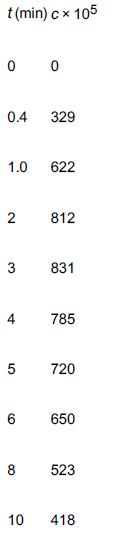
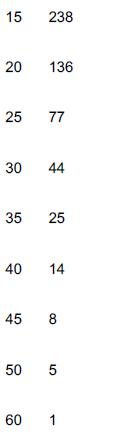
a. Plot the external-age distribution E(t) as a function of time.
b. Plot the external-age cumulative distribution F(t) as a function of time.
c. What are the mean residence time tm and the variance, σ2?
d. What fraction of the material spends between 2 and 4 minutes in the reactor?
e. What fraction of the material spends longer than 6 minutes in the reactor?
f. What fraction of the material spends less than 3 minutes in the reactor?
g. Plot the normalized distributions E(Θ) and F(Θ) as a function of Θ.
h. What is the reactor volume?
i Plot the internal-age distribution I(t) as a function of time.
j. What is the mean internal age αm?
-dix adxt-kDx a2x with KD=0.1[xs-1?
Step by Step Solution
3.40 Rating (159 Votes )
There are 3 Steps involved in it
a b c d e f g h ... View full answer

Get step-by-step solutions from verified subject matter experts
 Study Help