New Semester
Started
Get
50% OFF
Study Help!
--h --m --s
Claim Now
Question Answers
Textbooks
Find textbooks, questions and answers
Oops, something went wrong!
Change your search query and then try again
S
Books
FREE
Study Help
Expert Questions
Accounting
General Management
Mathematics
Finance
Organizational Behaviour
Law
Physics
Operating System
Management Leadership
Sociology
Programming
Marketing
Database
Computer Network
Economics
Textbooks Solutions
Accounting
Managerial Accounting
Management Leadership
Cost Accounting
Statistics
Business Law
Corporate Finance
Finance
Economics
Auditing
Tutors
Online Tutors
Find a Tutor
Hire a Tutor
Become a Tutor
AI Tutor
AI Study Planner
NEW
Sell Books
Search
Search
Sign In
Register
study help
computer science
artificial intelligence structures
Artificial Intelligence Structures And Strategies For Complex Problem Solving 6th Edition George Luger - Solutions
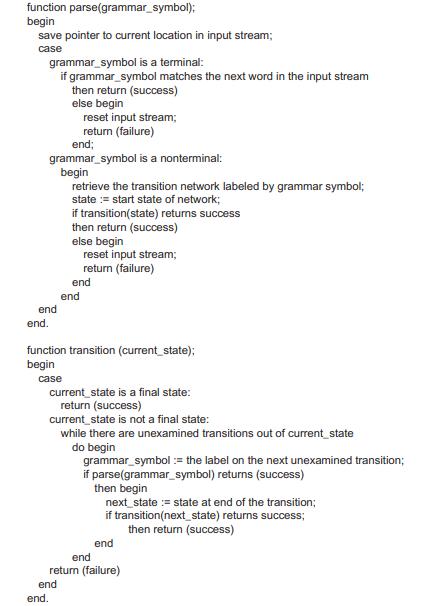
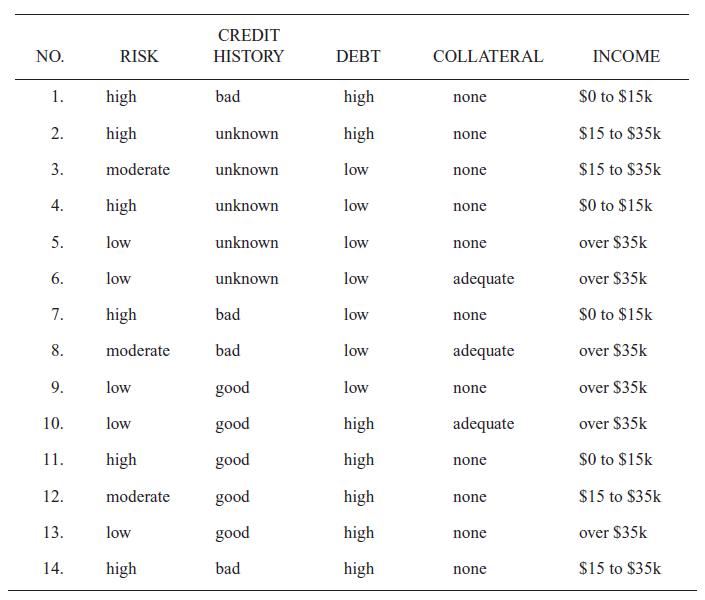
Implement ID3 in a language of your choice and run it on the credit history example from the text. If you use LISP, consider the algorithms and data structures developed in Section 15.13 for suggestions.Data From Section 15.13: function parse(grammar_symbol); begin save pointer to current location
Develop a simple table of examples in some domain, such as classifying animals by species, and trace the construction of a decision tree by the ID3 algorithm.
Using Shannon’s formula, show whether or not a message about the outcome of a spin of a roulette wheel has more information than one about the outcome of a coin toss. What if the roulette wheel message is “not 00”?
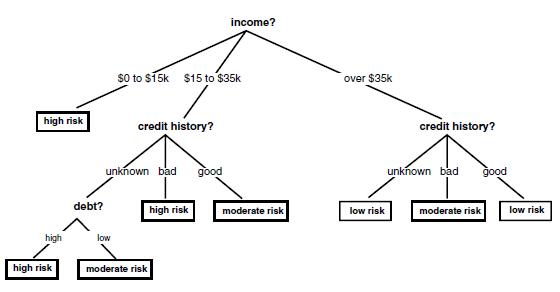
Using the information theoretic selection function of Section 10.4.3, show in detail how ID3 constructs the tree of Figure 10.14 from examples in Table 10.1. Be sure to show the calculations used in computing the information gain for each test and the resulting test selections.Figure 10.14Table 10.1
Build the version space search algorithms in Prolog, or the language of your choice. If you use Prolog or Java, see hints for version space search in the auxiliary materials.
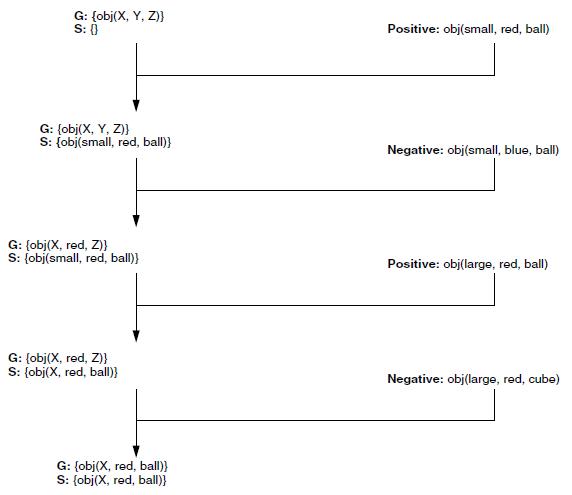
The run of the candidate elimination algorithm shown in Figure 10.9 does not show candidate concepts that were produced but eliminated because they were either overly general, overly specific, or subsumed by some other concept. Re-do the execution trace, showing these concepts and the reasons each
Create cliques and a junction tree for the following situation (seen in Figure 9.23). Robbery, vandalism and an earthquake can all set off (cause) a house alarm. There is also a measure of the potential dangers in the neighborhood of the house.
Create an algorithm for Bayesian belief propagation and apply it to the slippery sidewalk domain of Section 9.3.2. You might use Pearl’s (1988) message passing approach or the clique triangulation method proposed by Lauritzen and Spiegelhalter (1988).
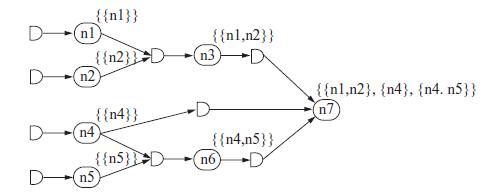
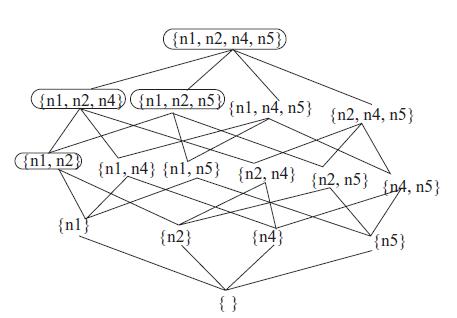
Create another reasoning network similar to that of Figure 9.4 and show the dependency lattice for its premises, as was done in Figure 9.5.Figure 9.4Figure 9.5
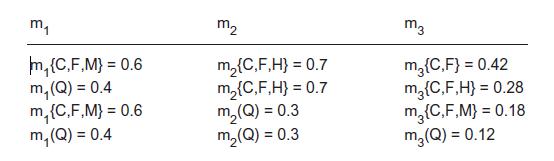
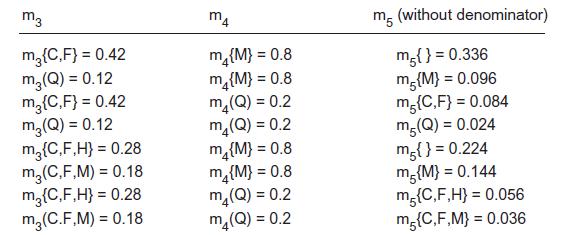
Create a new example of diagnostic reasoning and use the Dempster–Shafer equations of Section 9.2.3 to obtain belief distributions as in Table 9.1 and 9.2Table 9.1Table 9.2
Given the following rules in a “back-chaining” expert system application:A ∧ not (B) ⇒ C (.9)C v D ⇒ E (.75)F⇒A (.6)G⇒ D (.8)The system can conclude the following facts (with confidences):F (.9)B (−.8)G (.7)Use the Stanford certainty factor algebra to determine E and its
Identify three application domains where reasoning under conditions of uncertainty is necessary. Pick one of these areas and design six inference rules reflecting reasoning in that domain.
In Section 8.4.3 we presented a planner created by Nilsson and his students at Stanford (Benson and Nilsson 1995). Teleo-reactive planning allows actions described as durative, i.e., that must continue to be true across time periods. Why might teleo-reactive planning be preferred over a STRIPS-like
Read the ABSTRIPS research (Sacerdotti 1974) and show how it handles the linearity (or incompatible subgoal) problem in planning.
There were a number of important issues presented near the end of Section 7.4 related to the creation of an agent-oriented solutions to problems. Pick one of these and discuss the issue further.
At the end of Section 7.3.1, there are five potential issues that Brooks’ subsumption architecture (1991a) must address to offer a successful general-purpose approach to problem-solving. Pick one or more of these and comment on it (them).
Each of the following sequences of characters is generated according to some general rule. Describe a representation that could be used to represent the rules or relationships required to continue each sequence:a. 2,4,6,8, . . .b. 1,2,4,8,16, . . .c. 1,1,2,3,5,8, . . .d. 1, a,2, c,3, f,4, . . .e.
Presented the general conflict resolution strategies of refraction, recency, and specificity. Propose and justify two more such strategies.
Consider the financial advisor problem discussed in Chapters 2, 3, and 4. Using predicate calculus as a representation language:a. Write the problem explicitly as a production system.b. Generate the state space and stages of working memory for the data-driven solution to the example in Chapter 3.
Using the rule in Example 6.2.3 as a model, write the eight move rules needed for the full 8 × 8 version of the knight’s tour.Data from Example 6.2.3We may generalize the knight’s tour solution to the full 8 × 8 chessboard. Because it makes little sense to enumerate moves for such a complex
Write the pseudo-code definition for a breadth-first version of pattern search. Discuss the time and space efficiency of this algorithm.
Using the move and path definitions for the knight’s tour of Section 6.2.2, trace the execution of pattern search on the goals:a. Path (1,9).b. Path (1,5).c. Path (7,6).When the move predicates are attempted in order, there is often looping in the search. Discuss loop detection and
Using the move and path definitions for the knight’s tour of Section 6.2.2, trace the execution of pattern search on the goals:a. Path (1,9).b. Path (1,5).c. Path (7,6).When the move predicates are attempted in order, there is often looping in the search. Discuss loop detection and
What is the probability of being dealt the following hands in a five card poker game (from the normal deck of fifty-two cards)?a. A “flush” or all cards from the same suit.b. A “full house” or two cards of the same value and three cards of another value.c. A “royal flush” or the ten,
In a survey of 250 television viewers, 88 like to watch news, 98 like to watch sports, and 94 like to watch comedy. 33 people like to watch news and sports, 31 like to watch sports and comedy, and 35 like to watch news and comedy. 10 people like to watch all three. Suppose a person from this group
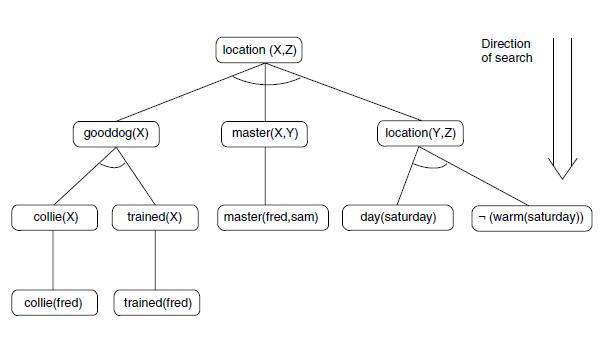
Trace the goal-driven good-dog problem of Example 3.3.4 in a data-driven fashion.Data from Example 3.3.4This example is taken from the predicate calculus and represents a goal-driven graph search where the goal to be proved true in this situation is a predicate calculus expression containing
An alternative semantic model for logic programming is that of Flat Concurrent Prolog. Compare Prolog as seen in Section 14.3 with Flat Concurrent Prolog (Shapiro 1987).Use factoring and resolution to produce a refutation for the following clauses: p(X) ∨ p(f(Y)) and ¬ p(W) ∨ ¬ p(f(Z)). Try
When we go out to dinner, we always like to park as close as possible to the restaurant. Assume the restaurant is situated on a very long street running east to west, which allows parking on one side only. The street is divided into one-car-length sections. We approach the restaurant from the east,
Consider the general domain of grid-world navigation tasks, where there is a goal state, obstacles, and a discount factor γ < 1. The actions are stochastic, so the agent may slip into a different cell when trying to move. There are five possible actions: go north, south, east, west, or stay in the
Create a hidden Markov model to predict the half inning score sequence of an American baseball game. Suppose the half inning sequence is 0, 0, 0, 1, 0, 1, 1, 2, 2, 0, 0, 0, 0, 2, 0, 0, 0, 0. For simplicity, constrain the scoring for each team to 0, 1, or 2 runs during their half inning at
Discuss the role of techniques such as gray coding for shaping the search space of the genetic algorithm. Describe two other areas where similar techniques may be important.
Prove A* is admissible. The proof should show that:a. A* search will terminate.b. During its execution there is always a node on open that lies on an optimal path to the goal.c. If there is a path to a goal, A* will terminate by finding the optimal path.
Does admissibility imply monotonicity of a heuristic? If not, can you describe when admissibility would imply monotonicity?
A Caesar cipher is an encryption scheme based on cyclic permutations of the alphabet, with the i-th letter of the alphabet replaced by the (i + n)-th letter of the alphabet. For example, in a Caesar cipher with a shift of 4, “Caesar” would be encrypted as “Geiwev.”a. Give three heuristics
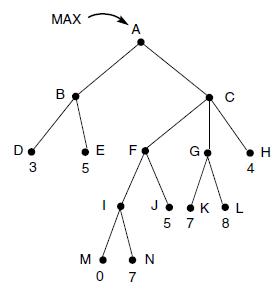
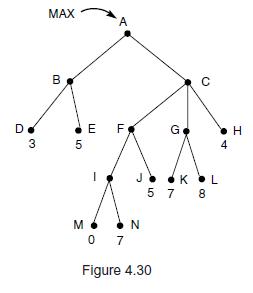
Perform minimax on the tree shown in Figure 4.30.Figure 4.30 DO 3 MAX B A • E F 5 MO N 07 G C KL 5 7 8 4 H
Consider three-dimensional tic-tac-toe. Discuss representational issues; analyze the complexity of the state space. Propose a heuristic for playing this game.
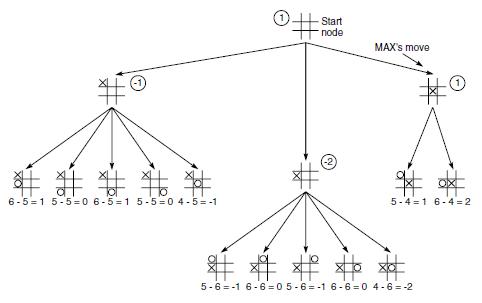
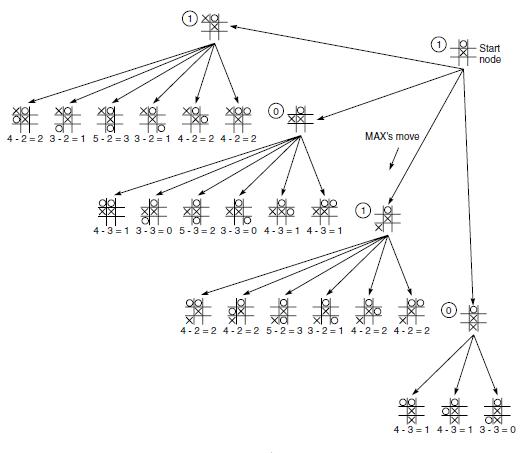
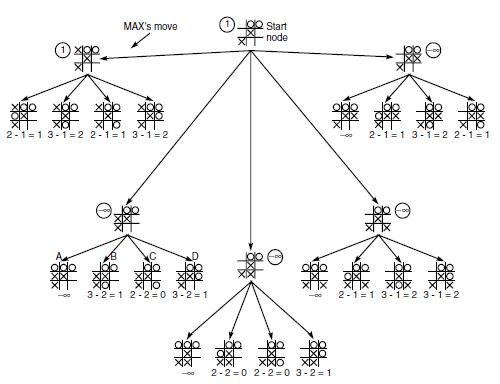
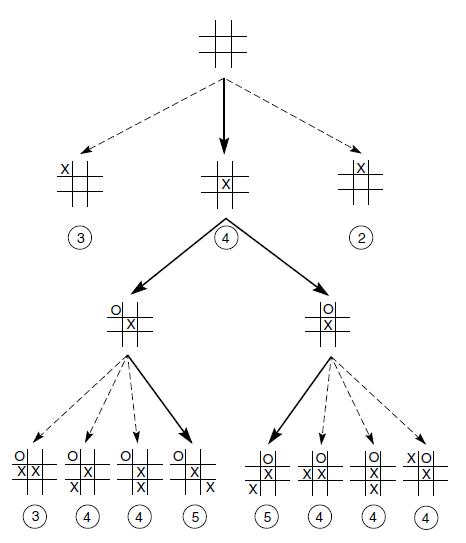
Perform alpha-beta pruning on the tic-tac-toe search of Figures 4.23, 4.24, and 4.25. How many leaf nodes can be eliminated in each case?Figures 4.23Figures 4.24,Figures 4.25 我 6-5=1 5-5-0 6-5=1 5-5-0 4-5=-1 # Start node MAX's move ① 啉 OX 5-4-1 6-4=2 进状 5-6 -1 6-6-0 5-6=-1 6-6=0 4-6=-2
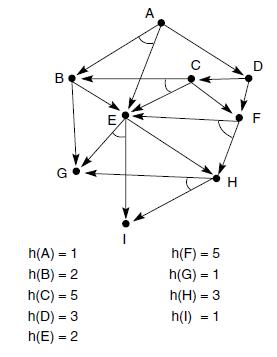
a. Create an algorithm for heuristically searching and/or graphs. Note that all descendants of an and node must be solved to solve the parent. Thus, in computing heuristic estimates of costs to a goal, the estimate of the cost to solve an and node must be at least the sum of the estimates to solve
A fair six-sided die is tossed five times, and the numbers up are recorded in a sequence. How many different sequences are there?
Find the number of distinguishable permutations of the letters in the word MISSISSIPPI, of the letters of the word ASSOCIATIVE.
Suppose that an urn contains 15 balls, of which eight are red and seven are black. In how many ways can five balls be chosen so that:a. All five are red? all five are black?b. Two are red and three are black.c. At least two are black.
How many ways can a committee of three faculty members and two students be selected from a group of five faculty and seven students?
Two dice are tossed. Find the probability that their sum is:a. 4.b. 7 or an even number.c. 10 or greater.
A card is drawn from the usual fifty-two card deck. What is the probability of:a. Drawing a face card (jack, queen, king or ace).b. Drawing a queen or a spade.c. Drawing a face card or a club.
In an ancient Hindu tea ceremony, there are three participants: an elder, a servant, and a child. The four tasks they perform are feeding the fire, serving cakes, pouring tea, and reading poetry; this order reflects the decreasing importance of the tasks. At the beginning of the ceremony, the child
Read “What’s in a Link” by Woods (1985). Section IV of this article lists a number of problems in knowledge representation. Suggest a solution to each of these problems using logic, conceptual graphs, and frame notations.
Create a model-based reasoning system for a simple electronic device. Combine several small devices to make a larger system. You can use if... then... rules to characterize the system functionality.
Read one of the early papers using model-based reasoning to teach children arithmetic (Brown and Burton 1978) or electronic skills (Brown and VanLehn 1980). Comment on this approach.
In Section 8.2 we introduced a set of rules for diagnosing automobile problems. Identify possible knowledge engineers, domain experts, and potential end users for such an application. Discuss the expectations, abilities, and needs of each of these groups.
Critique the shell you used for Exercise 5. What are its strengths and weaknesses? What would you do to improve it? Was it appropriate to your problem? What problems are best suited to that tool?
a. As presented in the text, best-first search uses the closed list to implement loop detection. What would be the effect of eliminating this test and relying on the depth test, g(n), to detect loops? Compare the efficiencies of the two approaches.b. Best_first_search does not test a state to see
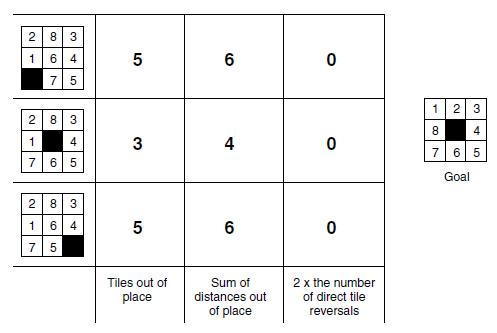
Compare the three 8-puzzle heuristics of Figure 4.14 with the heuristic of adding the sum of distances out of place to 2 times the number of direct reversals. Compare them in terms of:Figure 4.14a. Accuracy in estimating distance to a goal. This requires that you first derive the shortest path
The sliding-tile puzzle consists of three black tiles, three white tiles, and an empty space in the configuration shown in Figure 4.29. The puzzle has two legal moves with associated costs: Figure 4.29A tile may move into an adjacent empty location. This has a cost of 1. A tile can hop over one
Give a heuristic that a block-stacking program might use to solve problems of the form “stack block X on block Y.” Is it admissible? Monotonic?
With the Levenshtein metric of Section 4.1.2, use dynamic programming to determine the minimum edit distance from source strings sensation and excitation to target string execution.
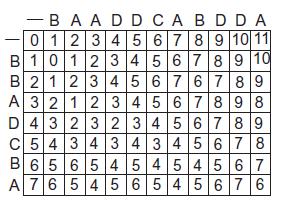
Use the backward component of the dynamic programing algorithm to find another optimal alignment of the characters of Figure 4.6. How many optimal alignments are there?Figure 4.6 BAADD CABD DA 0 1 2 3 4 5 6 7 8 9 10 11 B 101 2 3 4 5 6 7 8 9 10 B2 1 2 3 4 5 6 7 6 789 A 32 1 2 3 4 5 6 7 8 9 D4 3 2 3
Extend the the “most wins” heuristic for tic-tac-toe two plys deeper in the search space of Figure 4.3. What is the total number of states examined using this heuristic? Would the traditional hill-climbing algorithm work in this situation? Why?Figure 4.3 3 4 * X| 4 5 X 5 XX # # 4 X|O| 4
A Hamiltonian path is a path that uses every node of the graph exactly once. What conditions are necessary for such a path to exist? Is there such a path in the Königsberg map?
Give the graph representation for the farmer, wolf, goat, and cabbage problem: A farmer with his wolf, goat, and cabbage come to the edge of a river they wish to cross. There is a boat at the river’s edge, but, of course, only the farmer can row. The boat also can carry only two things (including
Build a finite state acceptor that recognizes all strings of binary digits:(a) That contain “111.(b) That end in “111.(c) That contain “111” but not more than three consecutive “1s.
Give an instance of the traveling salesperson problem for which the nearest-neighbor strategy fails to find an optimal path. Suggest another heuristic for this problem.
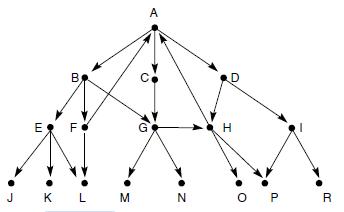
“Hand run” the backtrack algorithm on the graph in Figure 3.29. Begin from state A. Keep track of the successive values of NSL, SL, CS, etc.Figure 3.29 B E FO A C J K L M N D H OPR
Implement a backtrack algorithm in a programming language of your choice.
Determine whether goal-driven or data-driven search would be preferable for solving each of the following problems. Justify your answer.a. Diagnosing mechanical problems in an automobile.b. You have met a person who claims to be your distant cousin, with a common ancestor named John Doe. You
Write a backtrack algorithm for and/or graphs.
Give another example of an and/or graph problem and develop part of the search space.
a. Prove that modus ponens is sound for propositional calculus. Hint: use truth tables to enumerate all possible interpretations.b. Abduction is an inference rule that infers P from P→Q and Q. Show that abduction is not sound (see Chapter 7).c. Show modus tollens ((P→Q) ∧ ¬ Q) →¬ P is
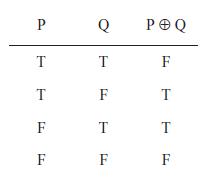
A new operator, ⊕, or exclusive-or, may be defined by the following truth table:Create a propositional calculus expression using only ∧, ∨, and ¬ that is equivalent to P ⊕ Q. Prove their equivalence using truth tables. P T T F F Q T F T F POQ F T T F
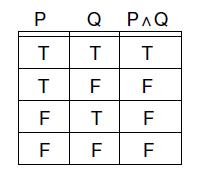
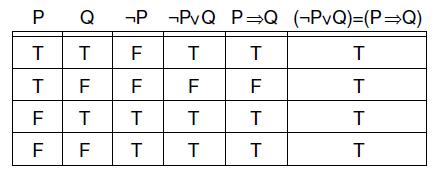
Using truth tables, prove the identities of Section 2.1.2.Data from Section 2.1.2 Q PÂQ T T T T F F F T F F F P FL
The logical operator “↔” is read “if and only if.” P↔Q is defined as being equivalent to (P→Q) ∧ (Q→P). Based on this definition, show that P↔Q is logically equivalent to (P ∨ Q)→ (P ∧ Q):a. By using truth tables.b. By a series of substitutions using the identities on
Prove that implication is transitive in the propositional calculus, that is, that ((P → Q) ∧ (Q → R)) → (P → R).
Attempt to unify the following pairs of expressions. Either show their most general unifiers or explain why they will not unify.a. p (X, Y) and p(a,Z)b. p (X, X) and p(a,b)c. Ancestor (X, Y) and ancestor(bill,father(bill))d. Ancestor(X,father(X)) and ancestor(david,george)e. q(X) and ¬ q(a)
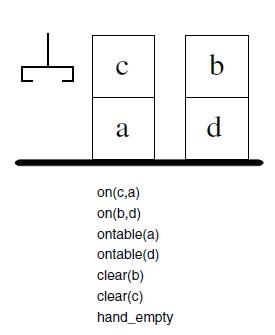
Give two alternative interpretations for the blocks world description of Figure 2.3.Figure 2.3 C a on(c,a) on(b,d) ontable(a) ontable(d) clear(b) clear(c) hand empty b d
a. Compose the substitution sets {a/X, Y/Z} and {X/W, b/Y}.b. Prove that composition of substitution sets is associative.c. Construct an example to show that composition is not commutative.
Jane Doe has four dependents, a steady income of $30,000, and $15,000 in her savings account. Add the appropriate predicates describing her situation to the general investment advisor of the example in Section 2.4 and perform the unifications and inferences needed to determine her suggested
Write a set of logical predicates that will perform simple automobile diagnostics (e.g., if the engine won’t turn over and the lights won’t come on, then the battery is bad). Don’t try to be too elaborate, but cover the cases of bad battery, out of gas, bad spark plugs, and bad starter motor.
The following story is from N. Wirth’s (1976) Algorithms + data structures = programs. I married a widow (let’s call her W) who has a grown-up daughter (call her D). My father (F), who visited us quite often, fell in love with my stepdaughter and married her. Hence my father became my
Create and justify your own definition of artificial intelligence.
Give several other examples of Aristotle’s distinction between matter and form. Can you show how your examples might fit into a theory of abstraction?
Much traditional Western thought has dwelt on the mind–body relationship. Are the mind and body:a. Distinct entities somehow interacting, orb. Is minding an expression of “physical processes”, orc. Is body just an illusion of the rational mind? Discuss your thoughts on the mind–body
Criticize Turing’s criteria for computer software being “intelligent”.
Describe your own criteria for computer software to be considered “intelligent”.
Although computing is a relatively new discipline, philosophers and mathematicians have been thinking about the issues involved in automating problem solving for thousands of years. What is your opinion of the relevance of these philosophical issues to the design of a device for intelligent problem
Given the differences between the architectures of modern computers and that of the human brain, what relevance does research into the physiological structure and function of biological systems have for the engineering of AI programs? Justify your answer.
Pick one problem area that you feel would justify the energy required to design an expert system solution. Spell the problem out in some detail. Based on your own intuition, which aspects of this solution would be most difficult to automate?
Add two more benefits for expert systems to those already listed in the text. Discuss these in terms of intellectual, social, or financial results.
Discuss why you think the problem of machines “learning” is so difficult.
Discuss whether or not you think it is possible for a computer to understand and use a natural (human) language.
List and discuss two potentially negative effects on society of the development of artificial intelligence technologies.
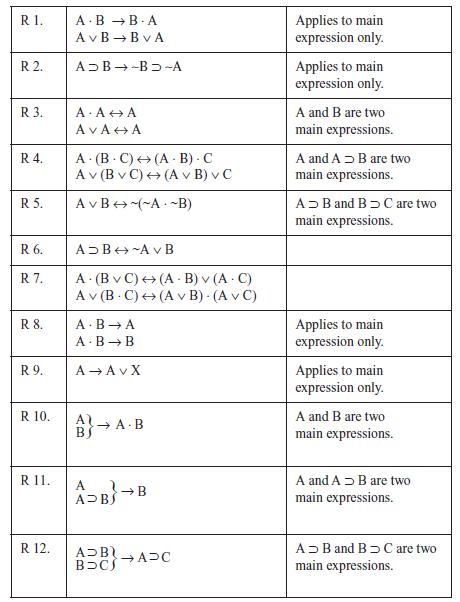
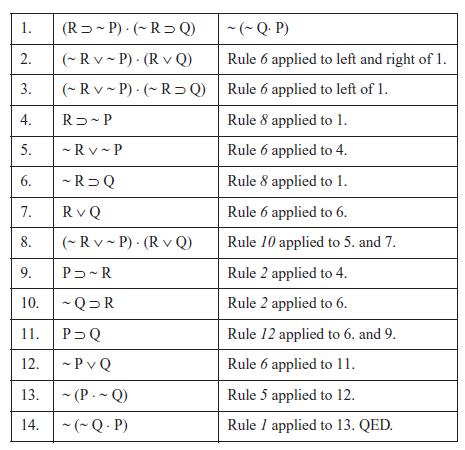
Derive a resolution proof of the theorem of Figure 14.1.Figure 14.1 R 1. R 2. R 3. R 4. R 5. R 6. R 7. R 8. R 9. R 10. R 11. R 12. A B → BA AVB→BVA AB-B-A A A A AVA A A (BC) (A-B). C Av (BVC) → (A v B) v C Av B(AB) ADB A (BVC) Av (B-C) A B → A A B B A → AvX Av B BA-B A ADB ADB BOCJ →
Classify each of the following sentences as either syntactically incorrect, syntactically correct but meaningless, meaningful but untrue, or true. Where in the understanding process is each of these problems detected?Colorless green ideas sleep furiously.Fruit flies like a banana.Dogs the bite man
Parse each of these sentences using the “dogs world” grammar of Section 15.2.1. Which of these are illegal sentences? Why?The dog bites the dog.The big dog bites the man.Emma likes the boy.The man likes.Bite the man.
Produce a parse tree for each of the following sentences. You will have to extend our simple grammars with more complex linguistic constructs such as adverbs, adjectives, and prepositional phrases. If a sentence has more than one parsing, diagram all of them and explain the semantic information
Extend the dogs world grammar to include adjectives in noun phrases. Be sure to allow an indeterminate number of adjectives. Use a recursive rule, adjective_list, that either is empty or contains an adjective followed by an adjective list. Map this grammar into transition networks.
Take the previous problem and put its words, including punctuation, in random order.Data from previous problemExtend the database front end example of Section 15.5.2 so that it will answer questions of the form “How much does Don Morrison earn?” You will need to extend the grammar, the
As a project, build an information extractions system for some knowledge domain to be used on the WWW. See Section 15.5.3 for suggestions.Data from Section 15.5.3The World Wide Web offers many exciting challenges as well as interesting opportunities for artificial intelligence and natural language
From this book’s auxiliary materials, take the structure of the Prolog context free and context sensitive parsers and ad adjectives, adverbs, and propositional phrases to the grammar.
From this book’s auxiliary materials, take the structure of the Prolog probabilistic context free parser and ad adjectives, adverbs, and propositional phrases to the grammar.
What is the probability that a four-digit integer with no beginning zeros:a. Has 3, 5, or 7 as a digit?b. Begins with 3, ends with 5, or has 7 as a digit?
The expectation is the mean or average of the value of a random variable. In throwing a die, for example, it can be calculated by totaling up the resulting values from a large number of throws and then dividing by the number of throws.a. What is the expectation from throwing a fair die?b. The
Showing 100 - 200
of 247
1
2
3
Step by Step Answers

 Get 50% OFF
Claim Now
Get 50% OFF
Claim Now