New Semester
Started
Get
50% OFF
Study Help!
--h --m --s
Claim Now
Question Answers
Textbooks
Find textbooks, questions and answers
Oops, something went wrong!
Change your search query and then try again
S
Books
FREE
Study Help
Expert Questions
Accounting
General Management
Mathematics
Finance
Organizational Behaviour
Law
Physics
Operating System
Management Leadership
Sociology
Programming
Marketing
Database
Computer Network
Economics
Textbooks Solutions
Accounting
Managerial Accounting
Management Leadership
Cost Accounting
Statistics
Business Law
Corporate Finance
Finance
Economics
Auditing
Tutors
Online Tutors
Find a Tutor
Hire a Tutor
Become a Tutor
AI Tutor
AI Study Planner
NEW
Sell Books
Search
Search
Sign In
Register
study help
computer science
cambridge international as & a level computer science
Cambridge Lower Secondary Mathematics Learners Book 8 2nd Edition Lynn Byrd, Greg Byrd, Chris Pearce - Solutions
Work out the missing values in the tables for these function machines. a i b D ii .x 8 10 y 4 61 2 Write each function in part a as an equation. x +9 2 y x -5 - y 22 29
Work out an expression for the nth term for each sequence.a 9, 11, 13, 15, …b 15, 12, 9, 6, …
Work out the first three terms and the 10th term of a sequence with the given nth term.a 1/2 n + 8 1/2 b 5n − 0.75
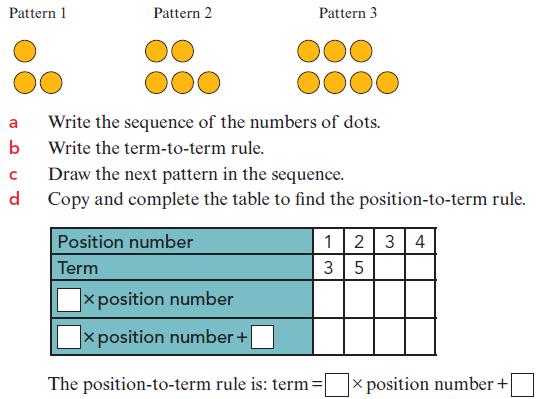
This pattern is made from dots. Pattern 1 Pattern 2 Pattern 3 a Write the sequence of the numbers of dots. 1000 b Write the term-to-term rule. C Draw the next pattern in the sequence. P Copy and complete the table to find the position-to-term rule. Position number Term xposition number xposition
For each of these sequences, write i the term-to-term rule ii the next two terms.a 2, 2 1/3, 2 2/3, 3, …b 6.7, 6.4, 6.1, 5.8, …
Marcus is putting numbers into a two-step function machine.Read what Marcus says.Work out the equation for Marcus’s function. Show all your working. When x=4, y=11. As my x-values increase by 4, my y-values increase by 2.
Work out the equation for this function machine and table of values.Explain how you worked out your answer. x 1 2 3 x y 5 8 11
Sofia and Arun are looking at this function machine and table of values.Is either of them correct? Show all your working. x D x 4 5.5 7 y A 13 19 25 I think the equation for this function is y=3x+1. I think the equation for this function is y=4x-3.
a Copy and complete the function machine for each table of values.b Write each function in part a as an equation. x x -3 0 1.5 6.2 y 6 9 10.5 15.2 D x -5 -1.5 2.5 4.25 y-15-4.5 7.5 12.75
Match each function equation with its inverse function equation.The first one is done for you: A and vYou can draw function machines to help you if you want to. Ax- A x x 6 y y=6x VX- 6 x 216
Copy and complete these inverse function machines and equations. b C x +2 y equation: y=x+2 x -2 y reverse equation: x = .... x 4 y equation: y... x y reverse equation: x = x -3 X y equation: y =8(x-3) y reverse equation: x = ....
Hannah works out the answer to this question.Work out the missing values in the table for this function machine.a What do you think of Hannah’s method?What are the advantages and disadvantages of her method?Discuss your answers.b Use Hannah’s method to answer this question.Work out the missing
a On a piece of paper, draw two function machines of your own, similar to those in Question 4.Draw a table for each function machine and give two x-values and two y-values.On a different piece of paper, write the missing x-values and y-values.Exchange function machines with a partner and work out
Work out the missing values in the tables for these function machines. a b X x X 3 y 8 51 12 D 26 12 72 y Write each function in part a as an equation. === ii x 2 +5 x 4 y 10 81 2 11
Work out the missing values in the tables for these function machines. a i x x 2 y 6 9 12 15 ii x x +4 2 y 358 11 b Compare your answers with those of other learners in the class. Discuss the different methods you used. What do you think is the best method?
a Copy and complete the table of values for each two-step function machine.b Write each function in part a as an equation. x x 2 +3 x 172 01 3 4 y == 2 -3 8 10 15 19 y
a Copy and complete the table of values for each one-step function machine.b Draw a mapping diagram for each function in part a.c Write each function in part a as an equation. +3 y 12 x 12- 45. y ii x 3 x 7 7 8 12
a Copy and complete the table of values for this two-step function machine.b Draw a mapping diagram to show the function in part a.c Write the function in part a as an equation. X 2 +1 x 0 2 3 y
Work out an expression for the nth term for each sequence.a 18, 15, 12, 9, …b 11, 7, 3, −1, …c 7, 2, −3, −8, …
Zara and Arun are trying to work out the expression for the nth term of the sequence 8, 6, 4, 2, …They both start by drawing this table:a What do you think? Explain your answer.b Copy and complete the table. Use it to work out the expression for the nth term of the sequence.c Compare your answers
Work out an expression for the nth term for each sequence. a 91, 91, 91, 10, .... U 1, 1, 1, 0, ... - b 4.6, 5.2, 5.8, 6.4, ... d -0.6, 0.8, 2.2, 3.6, ...
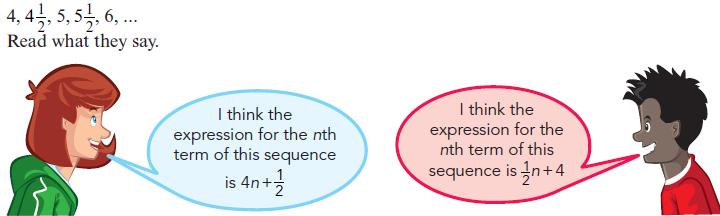
Sofia and Marcus are looking at the number sequence:Is either of them correct? Explain your answer. 4,411, 5, 5, 6, ... Read what they say. I think the expression for the nth term of this sequence is 4n+ I think the expression for the nth term of this sequence is n+4
This pattern is made from rectangles.a Write the sequence of the numbers of rectangles.b Work out an expression for the nth term for the sequence.Draw a table like the one in Question 10 to help you.c Use your nth term expression to find the number of rectangles in the 20th pattern in the sequence.
Work out an expression for the nth term for each sequence.Draw a table like the one in Question 10 to help you.a 6, 8, 10, 12, …b 5, 8, 11, 14, …c 6, 11, 16, 21, …d 3, 7, 11, 15, …e 2, 10, 18, 26, …f 2, 9, 16, 23, …
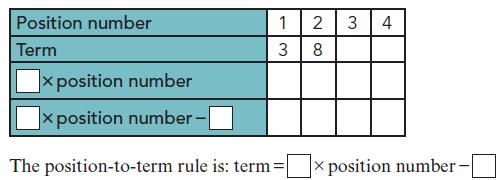
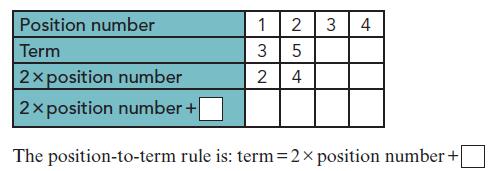
Copy and complete the workings to find the nth term expression for the sequence 8, 10, 12, 14, … Position number (n) 1 2 3 4 Term 8 10 12 14 2xn 2 4 8 10 12 14 2xn+ nth term =2n+
Ian and Lin use different methods to work out the answer to this question.The nth term expression for a sequence is 4n + 3.Is the number 51 a term in this sequence?a Use Ian’s method and Lin’s method to work out the answer to this question.The nth term expression for a sequence is 3n + 5.Is the
Look at this number sequence.24, 18, 12, 6, 0, ...Simply by looking at the numbers in the sequence, explain why you can tell that the nth term expression for this sequence cannot be 2n + 22.
a Work out the first four terms of the sequences with the given nth term.b Discuss with a partner the answers to these questions.What is similar about the sequences in ai and aii?What is similar about the sequences in aiii and aiv?What is different about the sequences in ai and aiii?What is
Work out the first three terms and the 8th term of the sequences with the given nth term. a C n +6 0.2n+1.5 b 5n-2 P 4.5n-0.25
Show that the first four terms of the sequence with nth term 1n+8 are 81, 81, 8 and 9. 4
The cards show one term from two different sequences.Which card has the greater value, A or B? Show your working. A 12th term in the sequence B 7th term in the sequence. nth term is 8n-4 nth term is 11n+16
Match each yellow sequence card with the correct blue nth term expression card. n-4 A 8, 9, 10, 11, ... ii 2n+4 BCDEF 4, 8, 12, 16, ... iii 4n-2 -3, -2, -1, 0, ... iv 4n 7, 14, 21, 28, ... V 7n 6, 8, 10, 12, ... vi n+7 2, 6, 10, 14, ...
Work out the first three terms and the 10th term of the sequences with the given nth term.a n + 6 b n − 3 c 9n d 6n e 2n + 5 f 3n − 1 g 5n + 3 h 4n − 3
Copy and complete the workings to find the first four terms of each sequence. a nth term =2n+1 b nth term 3n-2 1st term 2x1+1=3 1st term 3x1-2=1 2nd term 22+1=| 2nd term 32-2= 3rd term 2x 3+1 = 4th term 24+1=|| 3rd term 33-2= 4th term 34-2=||
a The nth term expression of a sequence is 2n − 1 Work out the first three terms and the tenth term of the sequence.b Work out the nth term expression for the sequence 7, 10, 13, 16, …
Mia is using trapezia to draw a sequence of patterns.There are marks over the first and third patterns in her sequence.How many trapezia will there be in Pattern 18?Show how you worked out your answer. Pattern 1 Pattern 2 Pattern 3 Pattern 4 www
This pattern is made from hexagons.How many hexagons will there be in Pattern 20?Show how you worked out your answer.Discuss the method you used with other learners. Did you use the same method or a different method? What do you think is the best method to use?
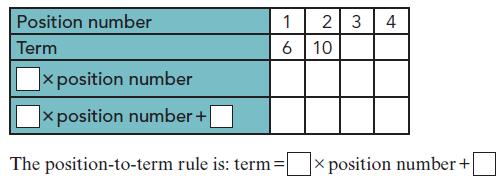
Work out the position-to-term rule for each sequence.a 10, 15, 20, 25, …b 10, 30, 50, 70, …
a Design your own sequence of patterns made from a shape of your choice.Draw the first four patterns in your sequence.Draw a table to show the number of shapes in each of your patterns.Work out the position-to-term rule for your sequence.b Ask a partner to check that your work is correct.
This is part of Harsha’s homework.a Explain the mistake Harsha has made.b Work out the correct answer. Question Work out the position-to-term rule for this sequence of triangles. Answer The sequence starts with 4 and increases by 2 every time, so the position-to-term rule is: term=4x position
This pattern is made from squares.Razi thinks that the position-to-term rule for the sequence of the numbers of green squares is:term = 2 × position number + 3 Is Razi correct? Explain the method you used to work out your answer.Discuss the method you used with other learners. Did you use the same
This pattern is made from rectangles.a Write the sequence of the numbers of rectangles.b Write the term-to-term rule.c Draw the next pattern in the sequence.d Copy and complete the table to find the position-to-term rule.
This pattern is made from dots.a Write the sequence of the numbers of dots.b Write the term-to-term rule.c Draw the next pattern in the sequence.d Explain how the sequence is formed.e Copy and complete the table to find the position-to-term rule.
This pattern is made from squares.a Write the sequence of the numbers of squares.b Write the term-to-term rule.c Draw the next pattern in the sequence.d Explain how the sequence is formed.e Copy and complete the table to find the position-to-term rule. M N
This pattern is made from blue squares.a Write the sequence of the numbers of squares.b Write the term-to-term rule.c Draw the next pattern in the sequence.d Explain how the sequence is formed.e Work out the position-to-term rule. +
The 7th term of a sequence is 442.The term-to-term rule is add 3 then multiply by 2.What is the 4th term of the sequence?Show all your working.
This is part of Tania’s homework.a Explain why Tania’s method is wrong.b Work out the correct answer. Show all your working. Question The 10th term of a sequence is 50. The term-to-term rule is add 4 3 What is the 20th term of the sequence? Answer 2x50 = 100% 20th term = 2x 10th term = 2x!
Sofia works out the terms in this sequence:First term is 8, term-to-term rule is add 10 then divide by 2.Read what Sofia says.Is Sofia correct? Discuss your answers. I will never have a term in my sequence which is greater than 10.
Zara describes a sequence.a Work out the first three terms of the sequence.What do you notice?b Describe two different sequences that are like Zara’s.Compare your answers with a partner’s. My sequence has a first term of 5, and the term-to-term rule is 'Multiply by 3 then subtract 10'
Work out the first three terms in each sequence.a first term is 4, term-to-term rule is: multiply by 3 then subtract 10 b first term is 10, term-to-term rule is: subtract 2 1/2 then multiply by 2 c first term is −6, term-to-term rule is: divide by 2 then add 5
Arun works out the terms in this sequence:First term is 10, term-to-term rule is subtract 6 then multiply by 2.Read what Arun says.Is Arun correct? Show your working. The first term in this sequence which is a negative number is -4.
The first three terms of a sequence are 8, 10, 14, …a Which of these cards, A, B or C, shows the correct term-to-term rule?b Which is the first term in this sequence greater than 50? A multiply by 3 then subtract 14. B divide by 2 then add 6 subtract 3 then multiply by 2
Write the first three terms of each of these sequences.The first one has been started for you.a first term is 8 term-to-term rule is: multiply by 2 then subtract 5b first term is 15, term-to-term rule is: subtract 9 then multiply by 3 c first term is 12, term-to-term rule is: divide by 2 then add 5
How can you answer these questions without working out more of the terms in the sequences?Discuss your answers. a b C In the sequence 0.4, 0.8, 1.2, 1.6, 2, 2.4, ..., what is the first term greater than 10? Is 45 a term in the sequence 5, 7, 10, 12, 15, ...? Is 5 a term in the sequence 30, 26,
Copy these sequences and fill in the missing terms. 10 a 2,4,8 13,15 b 5,8,11,22 [ C 25, 24, 24, 23 d 100, 896847, e 8, , 8.9, 9.2, f , 24, 23.6, 22.4
Write the first three terms of each sequence. Show your working. First Term-to-term rule First Term-to-term rule term term 20 a 1 Add 1.4 b 6 Add 4 C 20 Subtract 2.5 d 40 Subtract 5 e 0.4 Multiply by 2 f 9 Divide by 2
For each of these sequences, write -- i the term-to-term rule ii the next two terms. a C e 5,51,51,52, ... 5.4, 5.8, 6.2, 6.6, ... 10,93,9,8,... b 7, 8, 10, 11,... d 9,8,8,7, ... f 17, 16.2, 15.4, 14.6, ...
Complete the workings to find the term-to-term rule and the next two terms of each sequence. 10 7,101, 14, 171, ... 1 7+3=10, 10 +... = 14, 14+... = 17 2 The term-to-term rule is: add The next two terms are: 17+= + 0 = 10, 9.8, 9.6, 9.4, ... 10-0.2 9.8, 9.8- = 9.6, 9.6-9.4 The term-to-term rule
a Write the term-to-term rule and the next two terms of this sequence.b The first term of a sequence is 4.The term-to-term rule of the sequence is: multiply by 3 and then add 2.Write the first three terms of the sequence. 6,8,10,12,...
Copy these function machines and work out the missing inputs and outputs. a input 2 5 output b input output 7 +4 5 16 15 c input 4 output d input 8 5 10 4 30 output 169
Work out the first four terms in each of these sequences.a nth term = 6n b nth term = n − 1
This pattern is made from squares.c Write the term-to-term rule.d How many squares will there be in Pattern 10? Pattern 1 Pattern 2 Pattern 3 20 a Draw the next pattern in the sequence. b Copy and complete the table to show the number of squares in each pattern. Pattern number Number of squares 1 2
Write the first four terms of the sequence that has a first term of 3 and a term-to-term rule of ‘Multiply by 2’.
For each of these sequences, work out i the term-to-term rule ii the next two terms.a 4, 7, 10, 13, ..., ...b 28, 26, 24, 22, ..., ...
Draw the plan view, front elevation and side elevation of each shape. Use a scale of 1:4 and use 1 cm squared paper. 6cm 12cm 16cm F 8 cm 24cm
The circumference of a circle is 27 cm.Work out the diameter of the circle. Give your answer correct to the nearest millimetre.
Work out the circumference of these circles. Use the button on your calculator.Round your answers correct to 2 decimal places (2 d.p.).a diameter 13 cm b radius=2.7 m
Write True or False for each statement.a A square is a special rectangle.b A trapezium is a special parallelogram.C A rhombus is a special parallelogram.d A rhombus is a special kite.
Copy and complete this sentence.A regular pentagon has ___ sides of equal length. It has ___ lines of symmetry and rotational symmetry of order ___.
The diagram shows a shape drawn on dotty paper.The shape is made from cubes.The width of the shape is shown in the diagram.Accurately draw the plan view, front elevation and side elevation for this shape.Use a scale of 1 : 3 and use 1 cm squared paper. Top Front 18cm Side"
The diagram shows a shape drawn on dotty paper.The shape is made from cubes.The measurements of the shape are shown in the diagram.Accurately draw the plan view, front elevation, and side elevation for this shape.Use a scale of 1 : 2 and use 1 cm squared paper. F P 16cm 4cm 8cm % S
This is part of Marcus’s homework.Which of Marcus’s drawings is incorrect: the plan view, front elevation or side elevation?Explain the mistake he has made. Question Accurately draw the outline of the plan view, front elevation and side elevation of this shape. Do not include any internal
The diagram shows four shapes drawn on dotty paper.The shapes are made from 1 cm cubes.Draw accurately the plan view, front elevation and side elevation for each of the shapes.Use 1 cm squared paper.The arrows in part a show the directions from which you should look at the shapes for the plan view
The diagram shows a shape drawn on dotty paper.The shape is made from 1 cm cubes.This diagram shows the plan view, front elevation and side elevation for the shape.The diagrams have been drawn accurately on 1 cm squared paper.a Which diagram, A, B or C shows the i plan view ii front elevation iii
The diagram shows the dimensions of a village hall.The roof is an isosceles triangular prism.Draw the plan view, the front elevation, and the side elevation of the village hall.Use a scale of 1 : 200 3m 12m 20m 4m
Work with a partner or in a small group to answer these questions.The diagram shows two triangular prisms, A and B.A is a right-angled triangular prism.B is an isosceles triangular prism.a Will the side elevation of prism A be the same from the left side and the right side?Explain your answer.b
The diagram shows the dimensions of a shipping container.Ajani makes a house from three shipping containers.The containers are arranged as shown in the diagram.Draw the plan view, the front elevation, and the side elevation of his house.Use a scale of 1 : 100 6m 2.6m 2.4m
Draw the plan view, the front elevation and the side elevation of this 3D shape.Use a scale of 1 : 10 35 cm 30cm 15 cm 20 cm 60cm 25cm
Work with a partner or in a small group to answer these questions.Li and Seb are drawing the plan view of this shape.a Have either of them, or both of them, drawn the correct plan view?b Have they drawn their plan views to scale?c Discuss your answers to parts a and b with other groups in the
Copy and complete the workings and scale drawings for this question.Draw the top view, front view, and side view of these shapes.Use a scale of 1 : 2 a cube b cuboid C cylinder 7cm 3cm 10cm 6cm Dimensions for drawing: 62= cm 8 cm 5cm Dimensions for drawing: 8-2=cm 3+2= cm 5+2= cm Top view: Top
Work with a partner or in a small group to answer these questions.a Copy and complete this table showing the number of faces, edges, and vertices of these 3D shapes.b What is the connection between the number of faces, vertices and edges for all of the 3D shapes?c Write a formula that connects the
The diagram shows a cuboid.a Write the number of faces, vertices and edges of the cuboid.b Draw accurately the top view, front view and side view of the cuboid.Use a scale of 1 : 5 10cm. 15cm 35cm
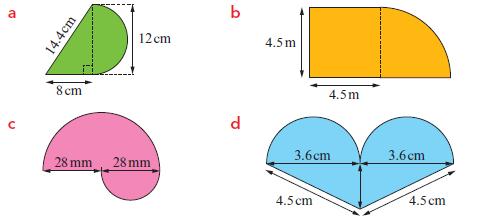
Work out the perimeter of each compound shape.Give your answers correct to two decimal places. C a 14.4cm 8 cm. 12cm b 4.5m 28 mm 28 mm d 4.5m 3.6cm 3.6cm 4.5cm 4.5cm
The diagram shows a semicircle and a quarter-circle.Read what Zara says. 15m 10m I think the perimeter of the semicircle is greater than the perimeter of the quarter-circle.
This is part of Ahmad’s homework.a Use Ahmad’s method to work out the perimeter of a semicircle with:i diameter = 20 cm ii diameter = 15 m iii radius = 8 cm iv radius = 6.5 m Round your answers correct to 2 d.p.b Imagine you have a friend who does not know how to work out the perimeter of a
A circular ring has a circumference of 5.65 cm.Show that the radius of the ring is 9 mm, correct to the nearest millimetre.For questions, use the π button on your calculator.
The circumference of a circular disc is 39 cm.Work out the diameter of the disc.Give your answer correct to the nearest millimetre.For questions, use the π button on your calculator.
For questions, use the π button on your calculator. Fu and Fern use different methods to work out the answer to this question.Work out the diameter of a circle with circumference 16.28 cm.Give your answer correct to 3 significant figures.This is what they write.a Look at Fu and Fern’s methods.Do
Work with a partner or in a group to answer this question.So far in this unit you have used the formula, C = πd In questions 2 and 4, you found the circumference when you were given the radius.Can you write a formula to find the circumference which uses r (radius) instead of d (diameter)?Test your
Work out the circumference of each circle. Use the π button on your calculator.Round your answers correct to 2 decimal places (2 d.p.).a diameter = 9 cm b diameter = 7.25 m c radius = 11 cm d radius = 3.2 m
So far in this unit you have used approximate values for π.You have used π = 3.14 and π = 3.142.There is another approximate value you can use: π = 22/7.A more accurate value for π is stored on your calculator.Can you find the button with the π symbol on it?a Use the π button on your
Copy and complete the workings to find the circumference of each circle.Use π = 3.142. Round your answers correct to 2 decimal places (2 d.p.). 100 II radius=7cm d=2xr =2x7 = 14cm =d = 3.14214 b radius = 2.6 cm d=2xr =2x = cm =d =3.142x C radius=0.9m d=2xr =2x m C=d cm (2 d.p.) cm (2 d.p.) m (2
Copy and complete the workings to find the circumference of each circle.Use π = 3.14. Round your answers correct to 1 decimal place (1 d.p.). a diameter = 6cm C=d b diameter 25 cm C diameter 4.25m =3.146 C=nd = 3.14x C=nd cm (1 d.p.) cm (1 d.p.) m (1 d.p.)
Work out the circumference of a circle with a diameter 3 cm b radius 4 m.Use π = 3.14. Round your answers correct to 1 decimal place (1 d.p.).
This diagram shows the hierarchy of quadrilaterals.In the diagram, a quadrilateral below another is a special case of the one above it.For example, a square is a special rectangle but a rectangle is not a square.Use the diagram to decide if these statements are true or false.a A parallelogram is a
Follow this classification flow chart for each quadrilateral.Write the letter where each shape comes out.a square b rectangle c parallelogram d kite e trapezium f rhombus g isosceles trapezium H yes Two sides the same length? START yes Only one pair of parallel sides? no J yes All angles are 90? no
Marcus is describing a kite to Zara.Has Marcus given Zara the correct information for her to work out that the quadrilateral is a kite? Explain your answer. My quadrilateral has two pairs of sides the same length and two pairs of equal angles. What is the name of my quadrilateral?
Work with a partner or in a small group to discuss these questions.a Is a trapezium always an isosceles trapezium?Is an isosceles trapezium always a trapezium?b Is a kite a rhombus? Is a rhombus a kite?c Is a parallelogram a trapezium? Is a trapezium a parallelogram?Discuss your answers with other
Showing 1300 - 1400
of 2101
First
7
8
9
10
11
12
13
14
15
16
17
18
19
20
21
Last
Step by Step Answers

 Get 50% OFF
Claim Now
Get 50% OFF
Claim Now