New Semester
Started
Get
50% OFF
Study Help!
--h --m --s
Claim Now
Question Answers
Textbooks
Find textbooks, questions and answers
Oops, something went wrong!
Change your search query and then try again
S
Books
FREE
Study Help
Expert Questions
Accounting
General Management
Mathematics
Finance
Organizational Behaviour
Law
Physics
Operating System
Management Leadership
Sociology
Programming
Marketing
Database
Computer Network
Economics
Textbooks Solutions
Accounting
Managerial Accounting
Management Leadership
Cost Accounting
Statistics
Business Law
Corporate Finance
Finance
Economics
Auditing
Tutors
Online Tutors
Find a Tutor
Hire a Tutor
Become a Tutor
AI Tutor
AI Study Planner
NEW
Sell Books
Search
Search
Sign In
Register
study help
computer science
cambridge international as & a level computer science
Cambridge Lower Secondary Mathematics Learners Book 8 2nd Edition Lynn Byrd, Greg Byrd, Chris Pearce - Solutions
The diagram shows a trapezium.a Work out an estimate of the area of the trapezium.b Use a calculator to work out the accurate area of the trapezium. 2.3 cm 4.6cm 9.8 cm
Work with a partner or in a small group to discuss this question.Read what Zara says.Is Zara correct? Explain your answer. If you double the base length of a parallelogram and double the height of the parallelogram, the area of the parallelogram will be doubled.
This is part of Zalika’s homework.a Explain the mistake Zalika has made.b Work out the correct answer. Question What is the difference in area between these two shapes? A 12mm 15 mm B 6cm 9cm Answer Area A = bxh = 15x12 = 180 Area B = 1x (a + b) xh = 1x (6+10) x 9 -x16x9 8x9=72 =11 2 = Difference
Work out the area of each trapezium using the method shown.Look back at Question 4 to check the method. a Sofia's method 3m b Marcus's method C Zara's method 8cm 5m 6cm 6mm 5mm 7m 9 cm 9 mm
Work with a partner to answer this question.Look back at the methods used by Sofia, Marcus and Zara in Question 4.Whose method would it be best to use to find the areas of these trapezia?Explain why.a a = 6 cm, b = 4 cm, h = 3 cm b a = 7 cm, b = 4 cm, h = 6 cm c a = 2 m, b = 3 m, h = 5 m d a = 16
Sofia, Marcus and Zara are discussing the methods they use to find the area of a trapezium. I work out a+b, then divide by 2, then multiply by h. I work out half of h, then work out a+b, then multiply my two answers together. Will they all get the same answer? Explain why. I work out a + b, then
This is part of Bembe’s homework.a Explain the mistake Bembe has made.b Work out the correct answer. Question Work out the area this parallelogram. Answer of Area = bh 7cm = 7x5 = 35 cm 4cm 5cm
Copy and complete the workings to find the area of each trapezium. 6cm b 5 cm 8cm A=(a+b)h(6+8)5 =1/ |5 = X5 = cm 4mm 7 mm 12 mm A=(a+b)h=x+)7 =1/2x7=7 = mm
Copy and complete the workings to find the area of each parallelogram. a 4cm b 8 cm A=bh=84=cm 1.5m 6m A=bh == m
Every car in the USA is fitted with a milometer.The milometer shows the total distance a car has travelled.Evan is a salesman.This is the reading on his car’s milometer at the start of one week.125 465 miles This is the reading on his car’s milometer at the end of the week.126 335 miles a How
Work out the missing numbers in these conversions.Use your preferred method. a 17 miles = km b 33 miles = km C 54 miles = km d 28 km= miles e 42 km= miles f 75 km= miles
Use only the numbers from the cloud to complete these statements a C 120 km = miles km = miles b 105 miles = km d | miles = km
Look at this question:Which is further, 107 km or 70 miles?Discuss with a partner or in a small group:a Do you think it is easier to change 107 km into miles or 70 miles into km without using a calculator? Explain why.b If you could use a calculator, would this change your answer to part a? Explain
Convert each distance to kilometres.a 10 miles b 100 miles c 125 miles d 180 miles
Convert each distance to miles.a 24 km b 48 km c 96 km d 176 km
Read what Sofia says.Discuss a strategy Sofia could use to help her decide when she should multiply by 5/8 and when she should multiply by 8/5 When I convert between miles and kilometres, I never know whether to multiply by or 8
Copy and complete these conversions from miles to kilometres. a 55 miles 55+5=11 b 20 miles 20+5= C 85 miles 85] 11x8= km 8 = km = km
Copy and complete these conversions from kilometres to miles. a 64 km 64-8=8 b 40 km 40-8= C 56km 56 85= miles 5 = miles = miles
Read what Zara says.Is Zara correct?Explain your answer. My brother lives 35 km from my house. My sister lives 35 miles from my house. I live closer to my brother than to my sister.
Write true (T) or false (F) for each statement.a 15 miles is further than 15 km.b 100 km is exactly the same distance as 100 miles.c 2.5 km is further than 2.5 miles.d 6 km is not as far as 6 miles.e In one hour, a car travelling at 70 miles per hour will travel a shorter distance than a car
a Which is greater, 20 miles or 20 km?b Convert 72 kilometres into miles.c Convert 50 miles into kilometres.d Which is further, 200 km or 120 miles?
The diagram shows a cuboid.Work out a the volume of the cuboid b the surface area of the cuboid. 6cm 3cm 4 cm
Work out the area of each shape. 2 12cm 5cm b 7m 8 m
Work out these calculations. a 23 32 81 b 5x32 C 15
Copy this shape onto squared paper.Enlarge the shape using scale factor 3 and the centre of enlargement shown.
The diagram shows shapes A, B and C.Describe the rotation that takes a A to B b A to C. A 4 y B 2 4-3-2-11 C 0 2- 3 4 X 1 2 3
Make two copies of this diagram.a On one copy, reflect the shape in the line x = 7.b On the other copy, reflect the shape in the line y = 3. 6 5 4. 3. 2. 1 0 1 2 3 4 5 6 x 7 8 9 10
The diagram shows shapes M, N, P and Q on a coordinate grid.Write the column vector that translates:a shape M to shape N b shape N to shape Q c shape Q to shape P d shape P to shape M. 14 M -3-2- 4321 2- 1- -2- WA -3 1 2 3 x
Work out the midpoint of the line segment joining each pair of coordinates a (3, 7) and (9, 7) b (2, 8) and (11, 6)
Draw diagrams to show these bearings of B from A.For each one, start with the diagram on the right.a 045° b 170° c 215° d 340° N A
The diagram shows shape ABCD and its image A′B′C′D′. 4- 3- 2- 1 B' C' A' -5-4- BC 13 -2 A 3. D' 4. -5 X
Each diagram shows an object and its image after an enlargement.For each part, write down the scale factor of the enlargement. 12 a y 8 7 65 6 5 image +3 4 3 object 2- 210 0+ 0 1 2 3 4 5 6 7 8 9 10 11 12 13 14 b 8- 8765 7- 6- 5- 4- 32 3. 2- 1- 0 object image 0 1 2 3 4 5 6 7 8 9 10 11 12 13 14
Work with a partner for this question. Read the instructions before you start.a On a coordinate grid, draw a quadrilateral of your choice.b Ask your partner to enlarge your quadrilateral by a scale factor of your choice.Give them the coordinates of the centre of enlargement, which must be somewhere
The vertices of this trapezium are at (3, 2), (7, 2), (5, 4)and (4, 4).a Copy the diagram onto squared paper.Mark with a dot the centre of enlargement at (5, 2).Enlarge the trapezium with scale factor 2 from the centre of enlargement.b Write the coordinates of the vertices of the image.c Write the
Marcus and Arun enlarge this square using scale factor 3.Marcus uses a centre of enlargement at (1, 1).Arun uses a centre of enlargement at (0, 1).Read what Marcus and Arun say.Work with a partner or in a small group to answer these questions.a Make two copies of the grid above and enlarge the
The vertices of this triangle are at (2, 2), (2, 3) and (4, 2).a Copy the diagram on squared paper.Mark with a dot the centre of enlargement at (1, 1).Enlarge the triangle with scale factor 3 from the centre of enlargement.b Write the coordinates of the vertices of the image. y 8 7 6- 5- 4- 3- 2. 1
This is part of Geraint’s homework.a Explain Geraint’s mistake.b Make a copy of the triangle on squared paper.Draw the correct enlargement. Question Enlarge this triangle using a scale factor of 2 and the centre of enlargement shown. Answer
Copy each shape onto squared paper.Enlarge each shape using the given scale factor and centre of enlargement. a scale factor 2 b scale factor 3 C scale factor 4 d scale factor 2 scale factor 3 f scale factor 4
Draw enlargements of the following triangles using the given scale factors and centres of enlargement, marked with a red dot. a scale factor 2 b scale factor 3
9 Describe the rotation that transforms S to T in each diagram. a b 354 5 4- A S T 5 4- 3 2- 1 -5-4-3-2-10 C S Po 3 x 34 33 2- 2- 1- 0 0 1 2 3 4 5 6 x 321O Foo 4x
The diagram shows seven shapes labelled A to G.Here are seven cards labelled i to vii.Each card shows a rotation of one shape to another.For example, card i means rotate shape A to shape B.a Put the cards into groups using one property of the rotations.Describe the property of each group.b Sort the
The diagram shows triangles R, S, T, U, V and W on a coordinate grid.Describe the rotation that transforms a triangle R to triangle S b triangle S to triangle T c triangle T to triangle U d triangle U to triangle V e triangle V to triangle W. y 4 R3 32 T S. 1 -4-3-2-1 0 1 2 3 4 X 34
The diagram shows seven triangles.Match each rotation with the correct description.a A to B i 90° clockwise, centre (3, 5)b B to C ii 180°, centre (4, 1)c C to D iii 180°, centre (6, 5)d C to E iv 90° anticlockwise, centre (3, 8)e F to G v 180°, centre (4, 4) y 8- A 7- 6- 5- B 543 C E D 2- F
This is part of Marcus’s homework.Read what Sofia and Zara say to Marcus.Discuss the answers to these questions in pairs or groups.a Are Sofia and Zara correct? Explain your answers.b Look again at part a of Marcus’s homework.You can see that the centre of rotation is at (1, 1)because this
This is part of Rohan’s classwork.a What is wrong with Rohan’s answer?b Copy the object onto squared paper and draw the correct image. Question Rotate this parallelogram 90 anticlockwise about centre (2, 3). Answer I have used a dotted line to show the image. - 4- 3- 2- 1 4-3-2- 2 3 4 x -2- -3-
a Copy each diagram and rotate the shape using the given information.Do not use tracing paper.b Use tracing paper to check your answers to part a. i ii === 5- 4 +32- 2- 2 3 4 5 x 0- 0 1 2 3 4 5 x 1- -3-2-10 12x -2- 1- -3-2-19 -2. -3- -5- 90 clockwise centre (2, 2) 90 anticlockwise centre (1, 1)
Copy each diagram and rotate the shape using the given information. (0 90 clockwise centre (2,1) y b 90 anticlockwise centre (-2, 2) y 4- 321 3- 2- 1. 1432- 0- 0 1 2 3 4 5 x -4-3-2-1 C 180 centre (-1, -2) y 2- 1- 4-3-2-1,0 2 ~- X
a Draw the image of this shape after a rotation 90° clockwise about the centre of rotation (−2, −1).b Describe the rotation that takes shape A to shape B. 4- 3- 2- 1 -5-4-3-2-10 123x -2-
a Write the steps you took to draw the reflection of the shape.You might begin with: Step 1: Draw the mirror line.Step 2:b Look back at Question 6ciii. Write the steps you took to draw the reflection of this shape.c Which steps were the same or different for these two questions? Explain why.
The diagram shows eight triangles, labelled A to H.Identify which of the following are reflections.For each one that is a reflection, write the equation of the mirror line.a triangle A to triangle B b triangle A to triangle C c triangle B to triangle F d triangle B to triangle E e triangle D to
The diagram shows shapes J, K, L, M, N and P.Choose the correct equation of the mirror line for each of these reflections.a J and K A x = 1 B y = 3 C x = 3 b J and M A x = 4 B y = 4 C x = 5 c M and N A y = 3 B y = 4 C y = 3.5 d K and L A x = 3 B y = 1 C y = 2 e L and P A x = 5.5 B y = 5.5 C x = 8 y
Work with a partner for this question.Make a copy of these coordinate axes on a piece of squared paper.Draw a rectangle inside the shaded region.Exchange your diagram with a partner.Reflect their rectangle in the line y = x. Label it A.Reflect their rectangle in the line y = −x. Label it
The diagram shows triangle PQR on a coordinate grid.It also shows the line y = −x.a Write the coordinates of the points P, Q and R.When shape PQR is reflected in the line y = −x, the image is P′Q′R′.b Use your rule from Question 9, part d to write the coordinates of the points P′, Q′
The diagram shows shape ABCD on a coordinate grid.It also shows the line y = −x.a Make a copy of the diagram. Reflect ABCD in the line y = −x and label the image A′B′C′D′.b The table shows the coordinates of the vertices of the object and its image.Copy and complete the table.c What do
The diagram shows shape ABCD on a coordinate grid.It also shows the line y = x.a Write the coordinates of the points A, B, C and D.When shape ABCD is reflected in the line y = x, the image is A′B′C′D′.b Use your rule from Question 7, part c to write the coordinates of the points A′, B′,
Work with a partner, or in a small group, to answer this question.Alicia reflects trapezium ABCD in the line y = x.The diagram shows the object, ABCD, and its image, A’B’C’D’.a The table shows the coordinates of the vertices of the object and its image.Copy and complete the table.b What do
Work with a partner, or in a small group, to answer this question.The diagram shows a rectangle.It also shows the line y = x.a Reflect the rectangle in the line y = x.b Compare your answer with other groups in your class and discuss the methods used.c Use your preferred method to reflect these
This is part of Oditi’s homework.a Make a copy of this grid.Use Oditi’s method to draw these reflections.i Reflect the triangle in the line x = 4 ii Reflect the parallelogram in the line y = 5 iii Reflect the kite in the line x = 8b What do you think of Oditi’s method?Is it easy to follow?
The diagram shows shape B on a coordinate grid.Draw the image of shape B after reflection in the line a x = −1 b y = −2 c x = 0.5 d y = −0.5 y 4- +3 3- 2- B 1 4-3-2-1 -2- 1 2 2 3 4 5 x -3- 4- -5- -6- -7-
This is part of Gille’s homework.a Explain the mistake Gille has made.b Copy the diagram of shape A and draw the correct Question Reflect shape A in the line y = -1. Label the shape A Answer Mirror line y 1 3 N A' 54-3-2- 0 +2 3 A 1 2 3 4 x
Copy each diagram and reflect the shape in the mirror line with the given equation. a mirror line x=4 b mirror line x 3 C mirror line x=2 y 7 6- 5- 4- 3- 2- 1 6- 976 50 4. 3- 2- 1- 0- y 7- 6- 37 6 5 4 3 210 5- 4- 3- 2- 1- 0- 0 1 3 4 5 6 7 x 0 1 2 3 4 5 6 7 x e mirror line y=2 f mirror line y=4 0. 0
Copy each diagram and reflect the shape in the mirror line with the given equation. a mirror line x=3 b mirror line x=4 C mirror line x=2.5 4. 3. 2- 7 6- 5. 4- 3. 2- y 7- 65+ 6- 5- 4- 32 3- 2- 1 0+ 0 1 2 3 4 5 6 7 x d mirror line y=4 7 6- 5- 4- 3- 2- 321 + 10 1 0- 0 1 2 3 4 5 6 7 e mirror line y 3
Draw a reflection of this triangle in the lines a x = 4 b y = 4 y 6- 5- 4- 3- 443 2- 1- 0+ 0 1 2 3 4 4 5 6 7 x X
This is part of Joule’s classwork.She has spilt some juice on her work.a Work out the coordinates of vertices i F′ ii G iii H b Explain how you worked out the answers to part a. Question A square EFGH has vertices at the points E (-5, -1), F (3,-1), G (,) and H (4,6) EFGH is translated using
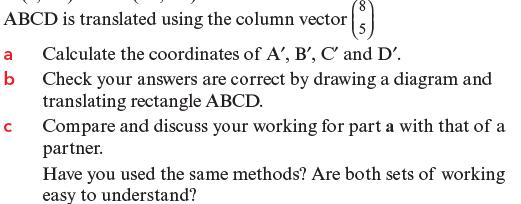
A rectangle ABCD has vertices at the points A (−2, 3), B (4, 3), C (4, −2) and D (−2, −2). ABCD is translated using the column vector a Calculate the coordinates of A', B', C' and D'. b Check your answers are correct by drawing a diagram and translating rectangle ABCD. Compare and discuss
The diagram shows shapes L, M, N, P and Q on a coordinate grid. Write the column vector that translatesa shape N to shape L b shape N to shape P c shape N to shape Q d shape N to shape M e shape L to shape P f shape P to shape M. M N 4-3-2-1 Q 432 y 3- L 1P P2/3 4 x
The diagram shows two shapes, P and Q.Choose the column vector (A, B or C) that translates 35 432 P 1 0 1 2 3 4 5 6 x
The diagram shows triangle DEF.∠DEF = 90°, ∠DFE = 45° and ∠EDF = 45°DF has a length of 4 units. E 5- 4- 3-D 2- 1 F 0 1 2 3 4 5 6 7 8 x different equal shorter longer congruent smaller not congruent bigger
Look at this question in pairs or groups, then discuss the answers to parts a, b and c.Read what Zara says. If I translate a shape using the column vector (3), I can translate the shape back to its original position using the column vector (
This is part of Fin’s homework.a Is Fin’s answer correct? Explain your answer.b How could Fin check whether his answer is correct? Question A triangle ABC is translated using the column vector The image of ABC is A'B'C'. (32) Write the column vector that translates A'B'C' back to ABC. Answer 2
The diagram shows shape A on a coordinate grid.Copy the grid, then draw the image of shape A after each translation. y 4 3- 2- 1 A 4-3 1 2 3 4 x -2- -3- 4-
The diagram shows triangle P on a coordinate grid.Copy the grid, then draw the image of triangle P after each translation. 8- 48 7- 6- 5- 4- 5430 2- 3- 1 0- 0 1 2 3 4 5 5 6 7 8 x
The yellow cards show translations.The blue cards show column vectors.Match each yellow card with the correct blue card.The first one is done for you: A and iii A 4 squares left, 1 square up B 4 squares left, 1 square down D i (4) ii 4 squares right, 1 square down 4 squares right, 1 square up (6)
The diagram shows triangle T on a coordinate grid.Draw the image of triangle T after each translation. y 4 3. 2. T 4-3-2 1 2 3 4 x -2- -3- 4-
14 Here are six cards showing the coordinates of the points A to F.Three line segments are made using the six cards.The midpoint of all three line segments is (−1, 1).What are the three line segments? Show how you worked out your answers. A (2, 0) B (-3,-2) C (-7,5) D (1,4) E (5,-3) FL (-4,2)
The midpoint of a line segment is (7, 2). One end of the line segment is (−1, 6).Work out the coordinates of the other end of the line segment.
The midpoint of a line segment is (4, 1). One end of the line segment is (2, 5).a Work out the coordinates of the other end of the line segment.b Compare the method you used to answer part a with a partner’s method.Did you both use the same method? Did you use different methods?c Discuss the
A quadrilateral has vertices at (−2, 1), (0, 4), (5, 2) and (1, −1).Do the diagonals have the same midpoint? Justify your answer.
Calculate the coordinates of the midpoint of each side of this triangle. E y 40- 30- 20 10- D 4-3-2-1123 2 3 4 x 10- -20- -30- F 40-
A parallelogram has vertices at P (2, 5), Q (−2, 3), R (2, −1) and S (6, 1).The diagonals are PR and QS. Show that the diagonals have the same midpoint.
Calculate the midpoint of the line segment between a (5, −2) and (2, −6) b (−4, 5) and (3, 0) c (−7, 5) and (−10, 10).
Discuss the answers to these questions with a partner or in a small group.Shen and Hassan calculate the midpoint of the line joining the points (−5, −8)and (−1, 9).This is what they write.a Who, out of Shen and Hassan, has the correct midpoint?Explain the mistake the other student has made.b
a E is the point (6, 0), F is the point (14, 8) and G is the point(3, 15).Work out the midpoint of the line segments i EF ii EG iii FG b Draw a coordinate grid. Plot the points E, F and G.Check your answers to part a by finding the midpoints on your diagram.
Copy and complete the workings to calculate the midpoint of the line segment joining each pair of points. a (2, 3) and (6, 7) (26, 3+7)=(2, 120) = (4,) (8,0) and (12, 6) (8+12, 06)=(20, 9)=, b C d (5, 2) and (8, 10) (5+8, 2+10)=(1, (0, 4) and (7.11) (07411)-(4)-(08-8) =
You can calculate the midpoint of a line segment by finding the means of the x-coordinates and the y-coordinates of the end points.The diagram shows the line segment PQ.Calculate the coordinates of the midpoint of PQ. 6- P (10, 4) +2 4- 2- -8-6-4-20 4 -d 2 Q(4,-6) -6- 4 6 8 10 x
Work out the midpoint of the line segment joining each pair of points.Write whether A, B or C is the correct answer.Use your preferred method. 1000 a (7, 1) and (7, 7) A (7,6) B (7,3) C (7,4) b (4, 2) and (10, 2) A (7,2) B (6,2) C (5,2) C (4, 11) and (4, 2) A (4,9) B (4,6) C (4,4) d (8, 15) and
Discuss the answers to these questions with a partner or in a small group.Zalika and Maha use different methods to find the midpoint of the line segment AB where A is (3, 4) and B is (11, 4).a Write the advantages and disadvantages of Zalika’s method.b Explain how Maha’s method works.c Write
Match each line segment with the correct midpoint.An example is done for you.Line segment AB and iii. i (1,-2) iii (2, 3) V (-3, -3) vii (-3,-1) ii (-1, -6) iv (-5,4) vi (2,5) viii (5, (5,-21)
Write the coordinates of the midpoint of each line segment. y 4- 321 A N- w- B 54 4 5 x 0 E d Fon Fol D Fin ++ 2 1. 0- 0 - -~ F +. Fin y 5432 1- 0- 0 w- G H 45x
The diagram shows two line segments, LM and PQ.a Write the coordinates of the midpoint of LM.b Work out the coordinates of the midpoint of PQ. y 64 4- 32 2- 1. 4-3-2-1 -2- P 3- 4. L M .Q 2 3 4 5 x
This is part of Sofia’s homework.Sofia uses alternate angles to work out the bearing of Q from P.For each diagram i write the bearing of P from Q ii use Sofia’s method to work out the bearing of Q from P. Question i Write the bearing of P from Q. Work out the bearing of Q from P. Answer i
This is part of Marcus’s homework.Marcus uses alternate angles to work out the bearing of A from B.For each diagram i write the bearing of B from A ii use Marcus’s method to work out the bearing of A from B. Question i Write the bearing of B from A. Work out the bearing of A from B. N 127 N
Work with a partner or in a small group to answer these questions.a For each diagram, write the bearing of Y from X and X from Y.b Draw two different diagrams of your own, plotting two points X and Y.In each diagram, the bearing of Y from X must be less than 180°.For each of your diagrams, write
Arun goes for a walk.The diagram shows Arun’s initial position (A), a farm (F), a pond (P), a tree (T) and a bridge (B).Write the bearing Arun follows to walk from a A to F b F to P c P to T d T to B e B to A. B N T N N F N A N P
The diagram shows the position of a tree and a lake.Seren, Taylor and Ros are standing at the tree.Seren walks straight from the tree to the lake.a On what bearing must she walk?Taylor walks north from the tree. After a short distance she then walks to the lake.b Is the bearing she walks on to the
The diagram shows the positions of a shop and a school.a Write the bearing of the shop from the school.b Write the bearing of the school from the shop. N School N Shop
a Draw four diagrams similar to those in Question 1, to show different bearings of B from A.On a different piece of paper, write the bearings you have drawn.b Exchange diagrams with a partner. Measure the bearings they have drawn.c Exchange back and check each other’s answers. Discuss any
This is part of Freya’s homework.Is Freya correct? Explain your answer. Question Write the bearing of B from A in this diagram. Answer: The angle is 32, so the bearing of B from A is 32. N B
Draw diagrams similar to those in Question 1, to show these bearings of B from A.a 025° b 110° c 195° d 330°
Showing 1000 - 1100
of 2101
First
4
5
6
7
8
9
10
11
12
13
14
15
16
17
18
Last
Step by Step Answers

 Get 50% OFF
Claim Now
Get 50% OFF
Claim Now