New Semester
Started
Get
50% OFF
Study Help!
--h --m --s
Claim Now
Question Answers
Textbooks
Find textbooks, questions and answers
Oops, something went wrong!
Change your search query and then try again
S
Books
FREE
Study Help
Expert Questions
Accounting
General Management
Mathematics
Finance
Organizational Behaviour
Law
Physics
Operating System
Management Leadership
Sociology
Programming
Marketing
Database
Computer Network
Economics
Textbooks Solutions
Accounting
Managerial Accounting
Management Leadership
Cost Accounting
Statistics
Business Law
Corporate Finance
Finance
Economics
Auditing
Tutors
Online Tutors
Find a Tutor
Hire a Tutor
Become a Tutor
AI Tutor
AI Study Planner
NEW
Sell Books
Search
Search
Sign In
Register
study help
computer science
cambridge international as & a level computer science
Physics For Cambridge O Level 2nd Edition Pauline Anning - Solutions
3. During which of the following changes does a gas become a liquid?(a) boiling(b) condensing(c) freezing(d) melting
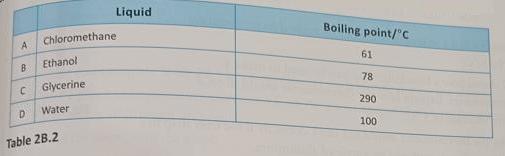
2. Which of the following liquids is likely to evaporate the quickest when exposed to air? Liquid Boiling point/"C A Chloromethane B Ethanol C Glycerine D Water Table 2B.2 61 78 290 100
1. Why do wet clothes on a washing line dry more quickly in a breeze than in still air?(a) The breeze raises the temperature of the wet clothes(b) The breeze continually removes water vapour from the air surrounding the clothes(c) The breeze causes the wet clothes to hang at an angle to the
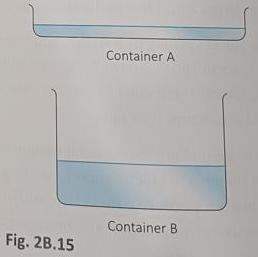
An equal volume of water was placed in two containers, A and B.Container A was placed on a sunny window ledge by an open window on a breezy day. Container B was placed in a refrigerator. Explain, in terms of the movement of water molecules, why the water in Container A evaporated much more quickly
Fig. 28.13 shows a pot-in-pot refrigerator or zeer. It is simple way of keeping food cool so it stays fresh longer. It consists of a porous outer earthenware pot and a glazed inner pot. The gap between the pots is filled with sand which is kept wet by adding water twice each day. Explain how a zeer
An experiment was carried out to find the specific heat capacity of paraffin using apparatus similar to Fig. 28.11. The copper calorimeter had a mass of 300 g and the mass of paraffin used was 240 g. The power of the heater was 60 W. The initial temperature of the calorimeter and paraffin was 20.5
The specific heat capacity of olive oil was found using apparatus similar to that shown in Fig. 28.11. The following data was collected:Mass of copper calorimeter = 320 g Mass of olive oil = 250 g Initial temperature of calorimeter and olive oil = 21 °C Final temperature of calorimeter and olive
An experiment was carried out to find the specific heat capacity of aluminium using apparatus similar to Fig. 28.10. The aluminium block used had a mass of 675 g. The power of the heater was 50 W. The initial temperature of the block was 23.5 °C. After the heater had been turned on for exactly
The specific heat capacity of brass was found using apparatus similar to that shown in Fig. 28.10. The following data was collected Mass of the brass block = 1075 g Initial temperature of the block = 21°C Final temperature of the block = 44 °C Power rating of heater = 50 W Time heater switched on
It requires 6075 J of energy to raise the temperature of a block of an unknown metal of mass 300 g from 25 °C to 70 °C.a) What is the specific heat capacity of the metal in J/kg °C?b) Identify the metal by looking at the data given in Table 28.1.
It requires 6750 J of energy to raise the temperature of a block of aluminium of mass 250 g from 25 °C to 55 °C. What is the specific heat capacity of aluminium in J/kg °C?
3. Liquid nitrogen boils at 77 K. What is this temperature in degrees Celsius?
2. The boiling point of oxygen is -183 °C. What is this temperature in kelvin?
1. The boiling point of water is 100 °C. What is this temperature in kelvin?
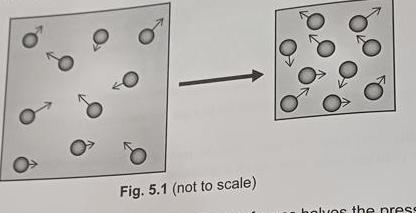
Explain what would happen if the air in the fla in Fig. 2B.9 was cooled by placing water around it. a flask of iced
(a) Use the relationship between pressure, force and area to explain why it is harder to out something with a blunt knife than with a sharp knife.(b) Experimental measurements on gas pressures were made by Robert Boyle.He showed that p. V. p. V, where p, and P, are the initial and final pressures
10. Iodine is a solid which melts at 114 °C.A glass jar containing iodine crystals and sand was placed on a window ledge.After a few days small crystals of iodine had appeared at the top of the jar.(a) How is it certain that the iodine did not melt?(b) State the changes of state that must have
9. On a heating curve, why does the graph become horizontal when a solid becomes a liquid?(a) The kinetic energy of the particles in the solid decreases(b) The particles in the solid stop vibrating(c) The energy supplied is absorbed by the container holding the solid(d) The energy supplied is used
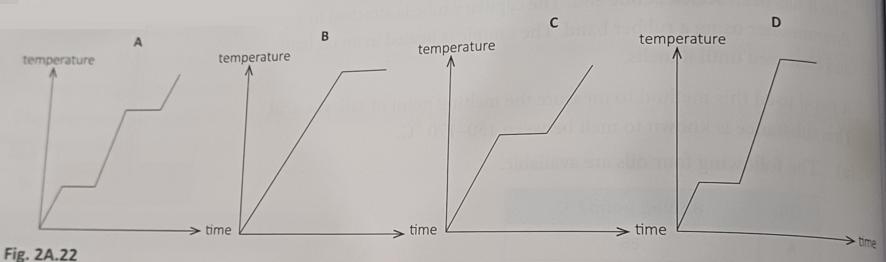
8. Which of the following correctly shows the shape of a heating curve for a solid heated from below its melting point in an open container? D B temperature temperature temperature temperature time time time Fig. 2A.22 time
7. Which of the following does not increase when a gas is heated in a sealed container?(a) Average kinetic energy of particles(b) Pressure inside the container(c) Size of the gas particles(d) Temperature of the gas
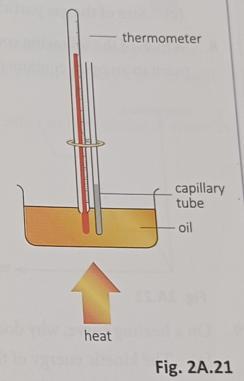
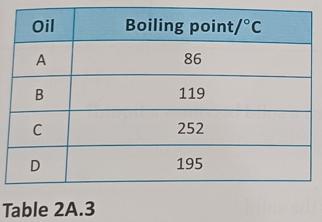
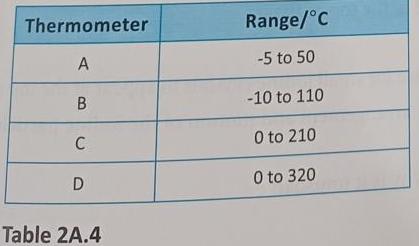
6. Fig. 24.21 shows a method used to determine the melting point of a solid.A small sample of the solid is placed at the bottom of the capillary tube which has been sealed at one end. The capillary tube is attached to a thermometer using a rubber band. The sample is heated in an oil bath and
5. A gas sample in a container of volume 0.15 m³ produces a pressure of 150 kPa. The volume of the container is increased to 0.45 m³.(a) Calculate the new pressure in the gas.(b) State any assumptions made in part (a).
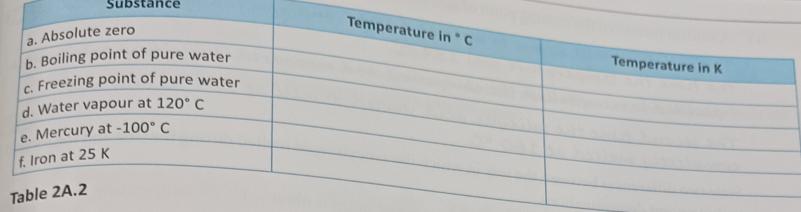
Copy and complete the table of temperature. Substance a. Absolute zero b. Boiling point of pure water c. Freezing point of pure water d. Water vapour at 120 C e. Mercury at -100 C f. Iron at 25 K Table 2A.2 Temperature in c Temperature in K
3. A syringe contains 100 cm³ of gas. The end is sealed and the plunger pushed in so that the volume of the gas is now only 50 cm³. Which of the following is true?(a) The gas particles move more slowly.(b) The gas particles become smaller.(c) The gas particles strike the inner wall of the syringe
2. Which of the following is a feature of solids but not liquids and gases?(a) easily squashed(b) fixed shape(c) particles vibrate(d) takes shape of container
1. Which of the following best describes the particles in a solid?(a) fixed in the same position and not moving(b) spread out and moving very quickly(c) touching each other but able to move position(d) unable to move but vibrate about fixed positions
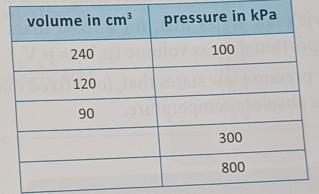
1. A gas sample in a container of volume 1.2 m³ produces a pressure of 120 kPa. The volume of the container is decreased to 0.2 m³ while keeping the temperature of the gas and mass of the sample the same. Calculate the new pressure in the gas.2. The table shows the pressure and volume of a fixed
A sealed container of gas has a sample of gas with a volume of 60 cm³ and pressure of 100 kPa.1. The gas is compressed until the pressure reaches 150 kPa. What is the new volume of the gas?2. What will the pressure of the gas be if it is compressed to a volume of 12 cm³?
1. Draw diagrams to show how particles are arranged in a:a) solidb) liquidc) gas.2. Explain each of the following in terms of the arrangement and motion of particles.a) Liquids take the shape of their container but solids do not.b) Gases can be easily squashed but solids cannot.c) When a small
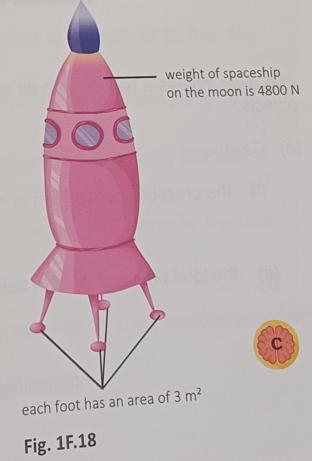
9. Fig. 1F.18 shows a spaceship which is going to land on the Moon. Its weight on the Moon is 4800 N.After landing, it will sit on four legs which have circular feet. Each foot covers an area of 3 m².(a) i) What is the total area of the four feet in m³?(ii) Calculate the pressure exerted by the
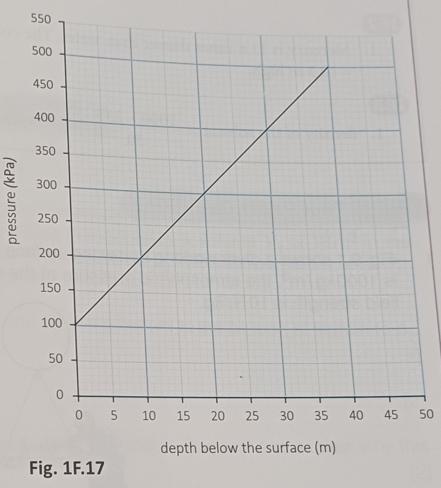
8. Fig. 1F.17 shows how pressure increases with depth below the surface of the sea.(a) Why is the pressure 100 kPa on the surface of the sea?(b) What is the pressure 45 m below the surface? 550 500 450 400 350 300 pressure (kPa) 250 200 150 100 50 50 O 05 10 15 20 25 30 35 40 40 depth below the
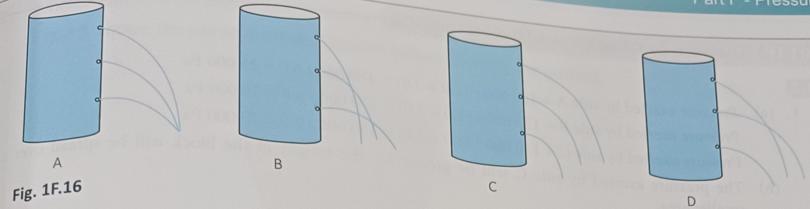
7. A can has three holes at different heights down the side. When the can is filled with water, jets squirt out of the holes. Which of the following diagrams correctly shows the directions of the jets? Fig. 1F.16 B
6. How many of the following statements are true when a drawing pin is pushed into a board?The force at the pointed end is less than the force at the flat end The surface area at the pointed end is less than the surface are a at the flat end The pressure at the pointed end is less than the pressure
5. Pressure may be measured in pascals. 1 Pa is equivalent to:(a) 1 kg/cm²(b) 1 kg/m²(c) 1 N/cm²(d) 1 N/m²
4. Snow shoes prevent people sinking into snow as they walk along because:(a) they reduce the person's mass(b) they reduce the person's weight(c) they spread the person's mass over a large area(d) they spread the person's weight over a large area
3. What would be the water pressure at a depth of 30 m?(a) 2 atmospheres(b) 3 atmospheres(c) 4 atmospheres(d) 5 atmospheres
2. Which of these instruments is used to measure atmospheric pressure?(a) anemometer(b) barometer(c) thermometer(d) wind sock
1. Which of the following would produce the largest pressure?(a) a large force acting on a large area(b) a large force acting on a small area(c) a small force acting on a large area(d) a small force acting on a small area
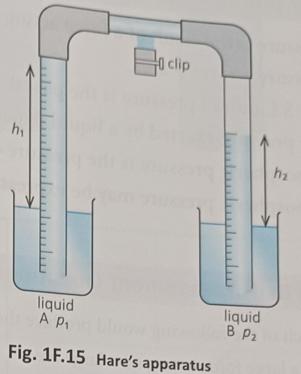
Fig. 1F.15 shows Hare's apparatus. It is used to compare the densities of miscible liquids. Some air is drawn out at the clip and liquids of different densities rise up the tubes by different amounts.When a solvent and water were placed in the tubes and some air removed, the solvent rose up one
If water was substituted for mercury in a liquid barometer, what height of water would normal atmospheric pressure support? (Densities: water = 1.0 g/cm³; mercury 13.6 g/cm³)
The mass of an elephant is 4800 kg. The surface area of each of its feet is 800 cm². Calculate the pressure exerted by each foot if the weight of the elephant is distributed evenly over its four legs. (g = 10N / k * g)
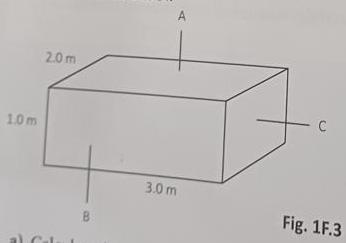
1. Fig. 1F.3 represents a concrete block of dimensions 3.0 mx 2.0 m x 1.0 m. The weight of the block is 150 000 Ν.a) Calculate the pressure exerted by the block on the ground if it is stood on side A, on side B and on side C.b) The weight of the block is constant. Explain why, if the block is
Calculate the kinetic energy of a motor car of mass 600 kg, travelling at 4 m/s.
3. A statue on a pedestal 4.0 m above the ground has a gravitational potential energy of 7800 J. What is the mass of the statue? Take g = 9.8N / k * g for each question.
2. The mass of a person is 55 kg. How high above the ground would the person need to be in order to have a change in gravitational potential energy of 1000 J? Take g = 9.8N / k * g for each question.
1. A pot of paint of mass 0.70 kg is lifted onto a table 0.80 m above the ground. Calculate the change in gravitational potential energy of the pot of paint? Take g = 9.8N / k * g for each question.
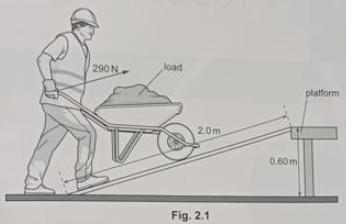
2 The total mass of a wheelbarrow and its load is 90kg. A worker pushes the wheelbarrow and load up a plank of length 2.0m on to a platform, as shown in Fig. 2.1. The platform is at a height of 0.60 m above the ground.The worker exerts a force of 290N on the wheelbarrow in the direction in which
1 In a coal-fired power station, coal is burnt and electrical energy is produced.(a) State the form of energy in the coal that is transferred to electrical energy.(b) (i) State the principle of the conservation of energy.(ii) The quantity of electrical energy produced by the power station is much
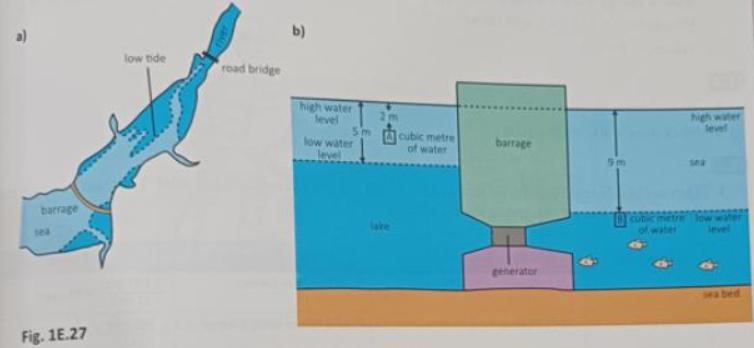
14. Fig. 1E27 (a) shows where a tidal barrage could be built across a river estuary. This would make a lake with a surface area of about 200 km² (200 million m²).Fig. 1E.27 (b) shows that the sea level could change by 9 m between low tide and high tide but the level in the lake would only change
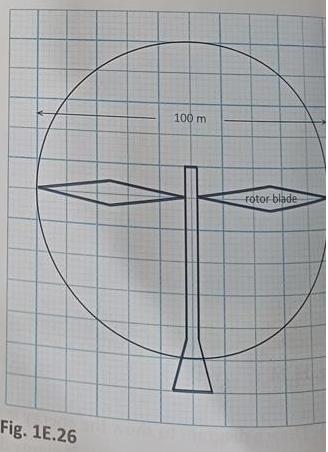
13. Fig. 16.26 shows a wind turbine which has a rotor 100 m across.(a) Estimate the total area of the rotor blades. One small square on the graph paper is equal to 4 m².(b) The wind has a velocity of 10 m/s. The force it can cause on a surface of 1 m² is 90 N.i) How much work can this wind do on
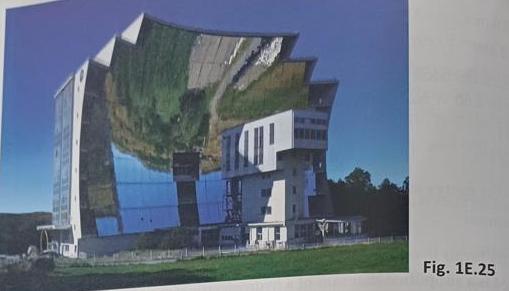
12. Fig. 18.25 shows the solar power station at Odeillo in France. It uses energy from the Sun to convert water into steam in a solar furnace.(a) Explain whether this power station uses a non-renewable or renewable source of energy.(b) Suggest why:i) the reflecting mirrors are mounted in a curved
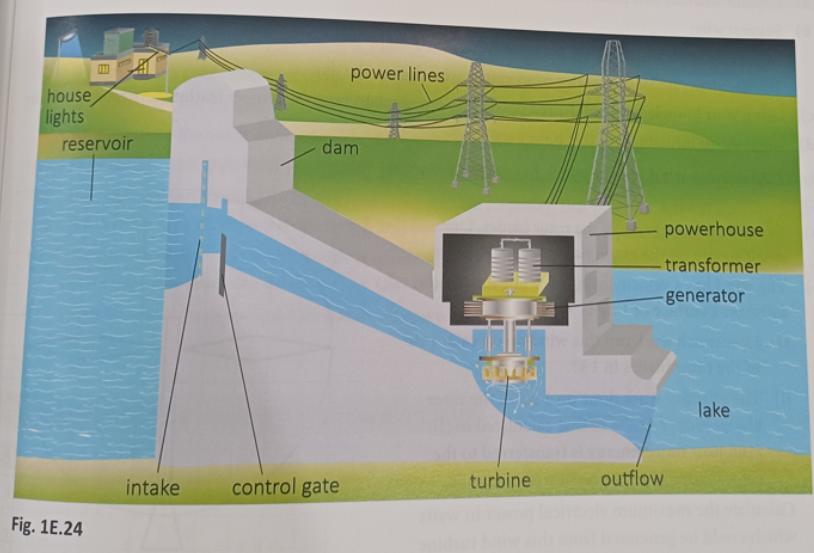
11. Fig. 1E.24 is a simplified diagram of a hydroelectric plant. The average distance in height between the reservoir and the lake is 400 m. Water flows from the reservoir to the lake driving turbines which, in turn, drive generators.(a) Draw a diagram to show the energy transfers that result in
10. What is the energy store in a fuel such as wood?(a) chemical(c) kinetic(b) electrostatic(d) thermal
9. How much electrical energy is transformed into light energy each minute by a 60 W bulb if the efficiency of a bulb is 10%?(a) 60)(c) 600](b) 360 J(d) 3600 J
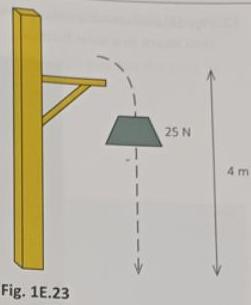
8. Fig. 1E.23 shows a stationary weight of 25 N was pushed off a shelf 4 m from the ground. Assuming no work was done against friction as the weight fell through the air, what was the velocity of the weight as it hit the ground correct to one decimal place? (acceleration due to gravity = 9.8m / (s
2. A winch is able to haul a bag of cement of mass 50 kg to a platform 3.0 m above the ground in 10 s. What is the power of the winch?
1. The frictional force acting on a crate as it is dragged is 600 Ν.A person pulls it 2.0 m across a floor in 5.0 s. What is the power of the person?
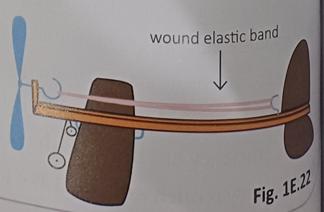
Fig. 1E.22 shows a model aeroplane. It is powered by a wound elastic band. When it is released, it will fly for a short distance.What is the energy store in the elastic band?(a) elastic strain energy(b) nuclear energy(c) kinetic energy(d) gravitational potential energy wound elastic band Fig. 1E.22
6. A woman has a mass of 50 kg. How much work does she do climbing a flight of stairs 5 m high?(a) 10](b) 250 J(c) 500 J(d) 2500)
5. How much power is generated when a machine raises a load of 100 N a distance of 1.5 m in the air in 5s!(a) 750 W(b) 300 W(c) 150 W(d) 30 W
4. What form of electromagnetic radiation can be detected by the skin?(a) heat(b) visible light(c) magnetism(d) sound
3. A machine has an efficiency of 35%. If the energy input is 500 J, how much useful ene. gy will be output?(a) 351(b) 175)(c) 325 J(d) 17 500 J
2. In which of the following devices is chemical energy transferred to heating and light waves?(a) candle(b) electric kettle(c) motorcycle(d) radio
1. Which of the following is a non-renewable source of energy?(a) geothermal energy(b) flowing water(c) natural gas(d) sunlight
1. The following shows what happens to every 100 J of energy released when a fuel is burnt in a power station.• Transferred to the thermal energy store of the environment = 60J• Transferred to the thermal energy store of the power station = 5]• Transferred to thermal energy of the power lines
2. How much work is done by a 400 N force pulling a box a distance of 2.5 m across a floor?
1. How much work is done raising a bag of groceries weighing 18 N from the ground onto a table 0.65 m high?
2. How much work does a person of mass 50 kg do climbing a flight of stairs 3.0 m high?
1. How much work is done raising a weight of 5.0 N from the ground to a height of 1.8 m?
1. A metal ball of mass 0,50 kg is dropped from a window 4.5 m above the ground. Assuming the no energy is lost through friction, calculate the velocity of the ball as it hits the ground.
2. The combined mass of a cyclist and her bicycle is 50 kg. How fast does she need to travel to have a kinetic energy of 200 J?
1. Calculate the kinetic energy of a bullet of mass 50 g travelling at 100 m/s.
33. A bullet of mass 0.01 kg is fired from a gun of mass 1.0 kg. The bullet leaves the gun at a velocity of 350 m/s Calculate the recoil velocity of the gun.
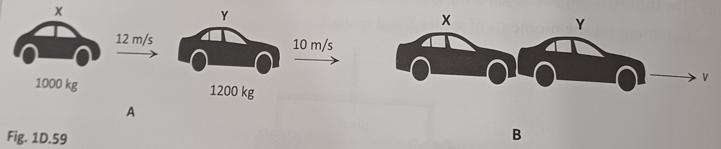
32. Two cars are travelling along a road in the same direction as shown in Fig. 10.59 part A. Car X collides car Y and the two cars stick together but continue to move forwards as shown in Fig. 10.59 part B.Calculate the velocity v of the cars immediately after the collision. 1000 kg Fig. 1D.59 12
31. A car of mass 1200 kg travels along a straight road at a velocity of 8.0 m/s. Calculate its momentum.
30. (a) State what is meant by the term 'closed system.(b) State the principle of conservation of momentum.
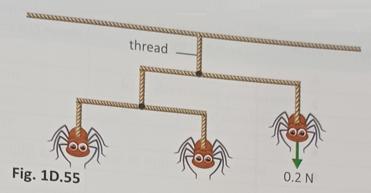
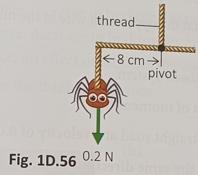
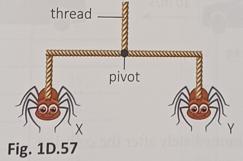
29. Fig. 1D.55 shows a mobile. There are three toy spiders hanging by cotton thread on a thin wire frame.(a) The weight of each spider is 0.2 N. What is the mass of each toy spider? (g = 10N / k * g)(b) Fig. 10.56 shows part of the mobile.Calculate the moment of the spider about the pivot and state
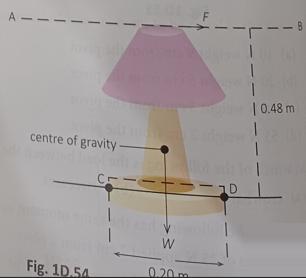
28. Fig. 10.54 shows a wooden table lamp. The mass of the lamp is 1.8 kg.(a) Calculate the weight of the lamp (g = 10 N/kg).(b) Calculate the moment of the weight about point D.(c) A force F is applied along the line AB. Find the least force needed to topple the lamp.(d) A hole is drilled in the
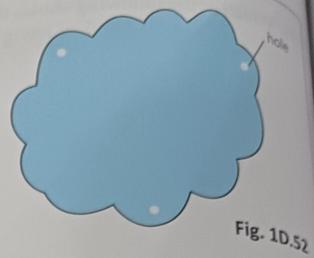
26. Fig. 10.52 shows an irregular lamina. It has three holes at different positions along its edge.(a) Describe, with the help of suitable diagrams, how you would find the centre of gravity of this lamina.(b) Explain the significance of centre of gravity in considering the stability of an object.
25. Which of the following has the same moment as a force of 20 N applied 8 cm from a pivot?(a) A force of 25 N applied 2 cm from a pivot(b) A force of 35 N applied 6 cm from a pivot(c) A force of 15 N applied 10 cm from a pivot(d) A force of 40 N applied 4 cm from a pivot
24. In which of the following is the load between the pivot and the effort?(a) crowbar(b) tweezers(c) wheelbarrow(d) forearm
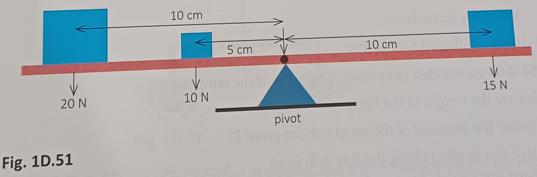
23. Which of the following should be placed on the right of the pivot to balance the beam?(a) 10 N weight 9 cm from the pivot(b) 20 N weight 5 cm from the pivot(c) 40 N weight 3 cm from the pivot(d) 55 N weight 2 cm from the pivot 20 N Fig. 1D.51 10 cm 5 cm 10 cm 10 N pivot 15 N
22. A spring extends by 6 cm when a load of 10 N is hung on it. The spring returns to its original length when the load is removed. By how much would the spring extend if a load of 7 N was hung on it?(a) 3 cm(b) 4.2 cm(c) 5.6 cm(d) 7 cm
21. Which of the following has the greatest moment?(a) A large force close to a pivot(b) A large force far away from a pivot(c) A small force far away from a pivot(d) A small force close to a pivot
20. A seesaw is level when:(a) equal forces act on both sides.(b) equal masses are placed on both sides(c) forces are applied at equal distances from the pivot(d) the sum of the clockwise moments is equal to the sum of the anticlockwise moments
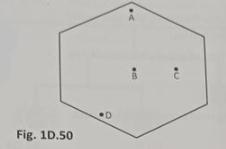
19. Which of the following shows the centre of gravity of a regular hexagonal lamina? Fig. 10.50 D
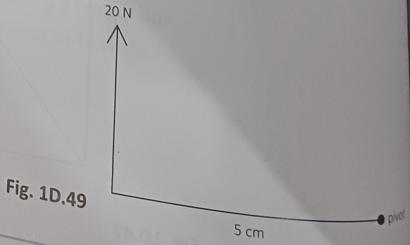
18. A force of 20 N acts 5 cm from a pivot.The moment of this force is:(a) 0.25 N cm(b) 4 N cm(c) 25 N cm(d) 100 N cm 20 N Fig. 1D.49 5 cm pivo
17. Two people of different weight are on a seesaw. For the anticlockwise moment to be equal to the clockwise moment:(a) the heavier person must be nearer to the pivot(b) the lighter person must be nearer to the pivot(c) they must be an equal distance from the pivot(d) they must be on the same side
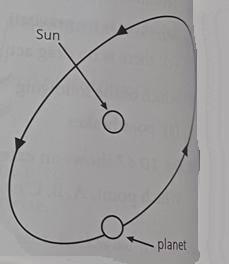
16. Fig. 10.48 shows a planet in orbit around the Sun.(a) What provides the force needed to keep the planet in orbit around the Sun?(b) In which direction does the force act?(c) Explain what would happen to the size of the force needed to keep the planet in orbit if the planet moved further away
12. An object is moving in a circle.The object must be:(a) accelerating towards the centre of the circle(b) changing speed(c) experiencing a resultant force away from the centre of the circle(d) moving at a constant velocity
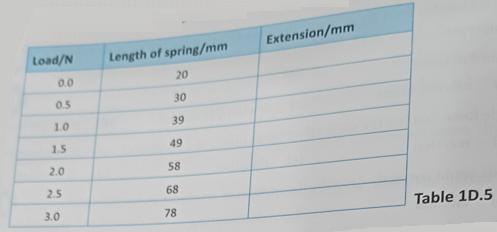
11. In an experiment, a spring was hung vertically from the end of a bench. Different weights were suspend from the spring and its length was measured each time. The results are given in Table 10.5.(a) Copy and complete Table 10.5 by calculating the extension for each load.(b) Plot a graph of
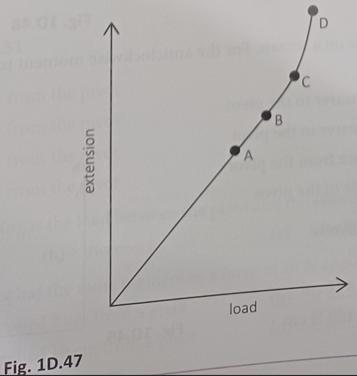
10. Fig. 10.47 shows an extension-load graph for a spring.Which point, A, B, C or D, marks the limit of proportionality for the spring? Fig. 1D.47 extension ^ load A B C D
9. Which of the following affects both the thinking distance and the braking distance of a vehicle?(a) poor brakes(b) speed(c) new tyres(d) wet roads
8. Terminal velocity is the speed an object has when:(a) there is no gravitational force acting on it(c) there is no drag acting on it(b) the forces on it are balanced(d) there are no forces acting on it
7. Friction can cause objects to:(a) accelerate only(b) decelerate only(c) both accelerate and decelerate(d) neither accelerate nor decelerate
6. An object of mass 300 kg accelerates at 2 m/s². What is the force acting on the object?(a) 0.067 N(b) 150 N(c) 500 N(d) 600 N
5. Which equation correctly shows the relationship between force, mass and acceleration?(a) force mass / acceleration(b) acceleration = mass/force(c) acceleration = force x mass(d) force mass x acceleration
4. Which of the following words could correctly describe the motion of an object in equilibrium?(a) accelerating(b) circular(c) decelerating(d) stationary
3. What name is given to a single force that has the same effect on an object as a number of forces acting together?(a) action(b) reaction(c) resultant(d) difference
2. Which of the following is a unit of force?(a) newton(b) newton metre(c) newton per second(d) metre per second
Showing 700 - 800
of 2101
1
2
3
4
5
6
7
8
9
10
11
12
13
14
15
Last
Step by Step Answers

 Get 50% OFF
Claim Now
Get 50% OFF
Claim Now