New Semester
Started
Get
50% OFF
Study Help!
--h --m --s
Claim Now
Question Answers
Textbooks
Find textbooks, questions and answers
Oops, something went wrong!
Change your search query and then try again
S
Books
FREE
Study Help
Expert Questions
Accounting
General Management
Mathematics
Finance
Organizational Behaviour
Law
Physics
Operating System
Management Leadership
Sociology
Programming
Marketing
Database
Computer Network
Economics
Textbooks Solutions
Accounting
Managerial Accounting
Management Leadership
Cost Accounting
Statistics
Business Law
Corporate Finance
Finance
Economics
Auditing
Tutors
Online Tutors
Find a Tutor
Hire a Tutor
Become a Tutor
AI Tutor
AI Study Planner
NEW
Sell Books
Search
Search
Sign In
Register
study help
computer science
cambridge international as & a level computer science
Physics For Cambridge O Level 2nd Edition Pauline Anning - Solutions
9. Ultrasound waves travel:(a) faster than audible sound waves(b) slower than audible sound waves(c) at different speeds depending on their frequency(d) at the same speed as audible sound waves.
8. The range of frequencies that can be heard by a human is:(a) 20-2000 Hz(b) 2-20 000 Hz(c) 20-20 000 Hz(d) 200-200 000 Hz.
7. Through which of the following substances would sound travel fastest?(a) helium gas(b) water(c) wood(d) melted chocolate
6. A sound wave has a frequency of 1020 Hz. The speed of sound in air is 340 m/s. What is the wavelength of the sound wave in metres?(a) 0.33(b) 3.0(c) 1 360(d) 347 000
5. Which of the following are two properties of sound waves that are related?(a) pitch and amplitude(b) pitch and frequency(c) amplitude and frequency(d) amplitude and wavelength
4. An echo is caused when sound waves:(a) combine(b) disperse(c) reflect(d) refract
3. Which of the following is not true for sound waves?(a) They can travel through gas.(c) They can travel through a solid.(b) They can travel through a liquid.(d) They can travel through a vacuum.
2. Rarefactions are areas of:(a) low pressure(b) high pressure(c) equal pressure(d) zero pressure
1. Which of the following correctly describes the wavelength of a sound wave?(a) The distance between a compression and rarefaction.(b) The distance between a peak and a trough.(c) The distance between two adjacent compressions.(d) The amplitude of the wave.
Two students are measuring the speed of sound by timing how long it takes to hear an echo. They are standing 75 m from a wall and record a time of 0.45 seconds to hear the echo. Calculate the speed of the sound wave.
The speed of sound in a material is given as 1750 m/s. Is the material likely to be a solid, liquid or gas?
10. White light is split into its constituent colours by:(a) reflection(b) refraction(c) combining(d) total internal reflection
9. Electromagnetic waves are used in medical imaging.(a) Both gamma rays type of imaging. and X-rays are used in medical imaging. Explain the main differences between each(b) Describe a possible hazard associated with using electromagnetic waves in medical imaging.
15. Different colours of visible light have different frequencies.(a) Which colour of light has the longest wavelength?(b) State one thing all colours of light have in common.(c) Explain which colour of light transfers the most energy.
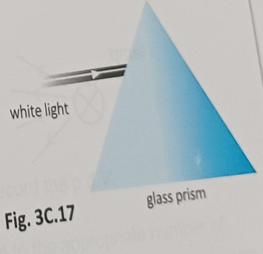
14. Fig. 3C.17 shows a ray of white light incident on the surface of a triangular prism.(a) Complete the diagram to show what happens to the light as it enters and leaves the prism.(b) Explain which colour of light is refracted the most. white light Fig. 3C.17 glass prism
13. Which of the following colours in the visible spectrum has the shortest wavelength?(a) blue(b) green(c) indigo(d) orange
12. Which of the following parts of the visible spectrum has the highest frequency?(a) blue(b) red(c) violet(d) yellow
11. Which of the following parts of the visible spectrum undergoes the biggest change in direction as it passes through a triangular prism?(a) blue(b) green(c) red(d) violet
5. Which of the following electromagnetic waves cannot be used to sterilise medical equipment?(a) gamma rays(b) radio waves(c) ultraviolet(d) X-rays
4. Which of the following statements about the relationship between wavelength and frequency is correct?(a) The greater the wavelength, the greater the frequency.(b) The greater the wavelength, the lower the frequency.(c) The lower the wavelength, the lower the frequency.(d) The wavelength is equal
3. Which of the following statements about electromagnetic waves is not true?(a) They all travel at the same speed in air.(b) They can all travel through a vacuum.(c) They are all emitted by hot objects.(d) They exist in a continuous spectrum.
2. An electromagnetic wave has a wavelength of 3m; what is its frequency?(a) 100 000 000 Hz(b) 900 000 000 Hz(c) 300 000 000 Hz(d) 600 000 000 Hz
1. Which of the following electromagnetic waves has the highest frequency?(a) infrared(b) microwaves ultraviolet (c)(d) visible light
3. At what speed do all electromagnetic waves travel through space?
2. Explain why ultraviolet waves transfer more energy than infrared waves.
1. List the components of the electromagnetic spectrum in order of increasing frequency.
2. Calculate the wavelength of a microwave with a frequency of 10 GHz.
1. A radio wave has a wavelength of 100 m. Calculate the frequency of the wave.
3. State the speed at which all light waves travel through a vacuum?
2. State which colour of light has the highest frequency and which has the lowest?
1. Write out all of the colours of the visible spectrum in order of increasing wavelength?
15. Explain, with the aid of diagrams:(a) Why a person with long sight cannot see nearby objects clearly.(b) How their vision can be corrected.
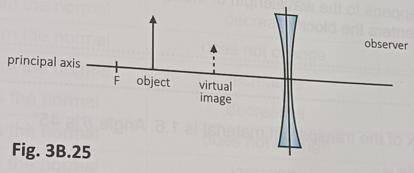
14. (a) Complete the ray diagram to show how the image is formed by the lens.b) Explain why a diverging lens cannot be used as a magnifying glass. ((c) An image is produced by a diverging lens that is 0.25 cm high. The object is 2 cm high. Calculate the magnification. principal axis + F object Fig.
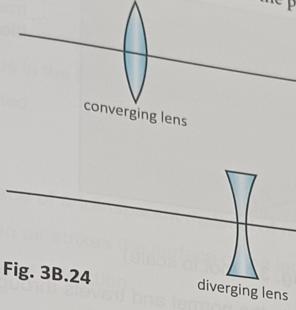
13. (a) Complete both diagrams to show what converging and diverging lenses do to parallel rays of light.(b) Explain what effect using a thicker lens would have on the position of the principal focus. converging lens Fig. 3B.24 diverging lens
12. A diamond has a refractive index of 2.42. The angle of incidence of a ray of light is 40°.(a) Calculate the angle of refraction.(b) The same ray of light now reaches the other side of the diamond at the same angle, 40°. Explain what will happen to the light. Use a calculation to support your
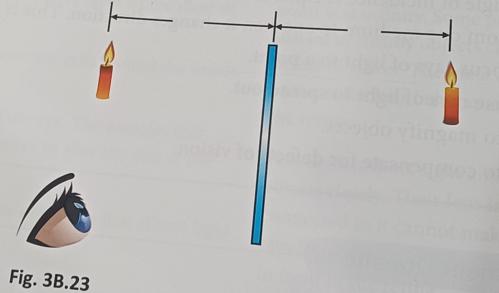
11. (a) Complete the diagram to show how the image of the candle can be seen in the mirror.(b) State the law of reflection.(c) Describe three properties of the image Fig. 3B.23
10. Short sight can be corrected by using a:(a) converging mirror(b) diverging lens (c) converging lens (d) diverging mirror
9. People who cannot see clearly objects that are nearby are said have:(a) short sight(b) long sight(c) near sight(d) focused sight
8. A lens produces an image that is 240 mm high when the object is 80 mm high.What is the magnification?(a) 3(b) 2(c) 0.25(d) 1
7. Which statement describes a virtual image?(a) when there is no image(b) when the image is magnified(c) the image cannot be projected onto a screen(d) the image can only be displayed on a computer
6. Which statement correctly describes what converging lenses do to parallel rays of light?(a) cause them to spread out(b) focus them at a point(c) change their frequency(d) cause them to remain parallel
5. At the critical angle, the angle of refraction is:(a) 0(b) 42 deg(c) 45 deg(d) 90°
4. Light passes from air into glass. If the angle of incidence is 42 deg what is the angle of refraction?(a) less than 42"(b) 42 deg(c) more than 42°(d) 90°
3. Light changing direction when it passes from one medium to another is called:(a) reflection(b) diffraction(c) refraction(d) total internal reflection
1. Images formed in a plane mirror are:(a) laterally inverted(b) upside down(c) magnified(d) real
1. A line drawn at 90° to a surface is called:(a) an incident(b) a normal(c) a reflection(d) a mirror
2. Use a scale drawing to find the focal length of a converging lens that will produce a magnification of 2.0 when an object is at a distance of 5.0 cm.
1. A lens produces a real image that has a height of 56 cm. What is the magnification if the object's height is 8 cm?
2. Silicon has a refractive index of 3.4. Calculate the angle of refraction if the angle of incidence is 30°.
1. Light strikes the surface of a Pyrex jug at an angle of incidence of 64°. If the angle of refraction is 41°, calculate the refractive index of Pyrex.
2. Light reaches the surface of a pond at an angle of incidence of 27°. If the refractive index of the water is 1.33, calculate the angle of refraction.
1. The angle of incidence of a ray of light striking the surface of a window is 56°. If the angle of refraction is 33°, calculate the refractive index of the window.
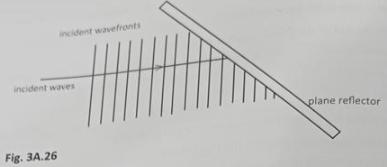
15. Fig. 34. 26 shows plane waves in a ripple tank incident on a plane reflector. The arrow shows the directions travel of the incident waves.The waves are reflected at the plane reflector.(a) Complete the diagram by adding:i) the reflected wavefronts ii) the normal iii) an arrow to show the
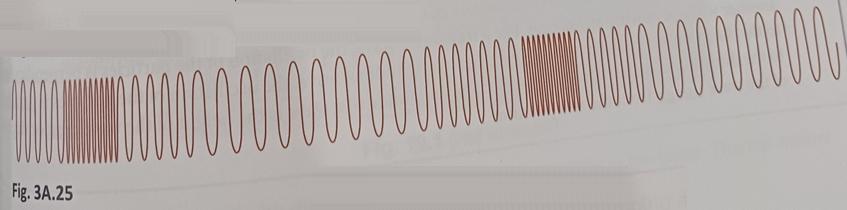
14. Fig. 3A.25 shows a longitudinal wave.Copy and add labels to Fig. 3A.25 to show each of the following for the wave:(a) wavelength(b) compression(c) rarefaction Fig. 3A.25
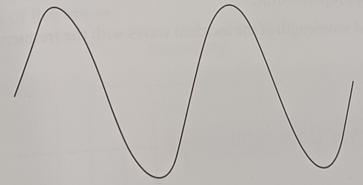
13. Fig. 3A.24 shows a transverse wave.Add labels to Fig. 3A.24 to show each of the following for the wave:(a) wavelength(b) amplitude(c) crest(d) trough
12. 1 cm on the diagram represents 4 cm in the ripple tank.(a) Measure the wavelength of the waves from the diagram and use the scale to find the actual wavelength.(b) The waves are travelling at 24 cm/s. Calculate the frequency of the waves.(c) A sheet of glass is placed in the water in the tank
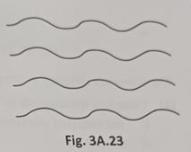
11(a) Explain what is meant by wave motion.(b) Explain, with the aid of diagrams, what is meant by:ⅰ) a transverse wave ii) a longitudinal wave(c) Give two examples of:i) a transverse wave ii) a longitudinal wave Fig. 34.23 shows plane waves travelling across a large ripple tank. Fig. 3A.23
A sound wave travels as a series of:(a) compressions and rarefactions(b) compressions and refractions(c) reflections and rarefactions(d) reflections and refractions
9. The more energy a wave carries, the greater its:(a) amplitude(b) wave period(c) speed(d) wavelength
8. A wave of frequency 10 Hz travels at a speed of 2 m/s. What is its wavelength?(a) 0.2 m(b) 0.5 m(c) 5 m(d) 20 m
7. Some waves pass from deeper water to shallower water as they move up a beach.Which of the following characteristics of the wave change?(a) frequency only(b) velocity and wavelength only(c) velocity, frequency and wavelength(d) wavelength and frequency only
6. Which equation correctly shows the relationship between the frequency, speed and wavelength of a wavel(a) frequency speed/ wavelength(b) frequency wavelength x speed(c) wavelength = frequency/ speed(d) wavelength speed x frequency
5. Which of the following is not an example of a transverse wave?(a) light(b) sound(c) water waves(d) wave on a rope
4. The distance from one crest to the adjacent crest is called the:(a) amplitude(b) displacement(c) frequency(d) wavelength
3. The height of the wave crest from the position at rest is called the:(a) amplitude(b) displacement(c) frequency(d) wavelength
2. Which of the following is a unit of frequency?(a) metre(b) metre per second(c) per second(d) second
1. An imaginary line on a wave that joins all the points that are in the same phase of oscillation is called:(a) an amplitude(b) a normal(c) a wavefront(d) a wavelength
Fill in the blanks.A wave is a ________________ that travels as a series of oscillations. The wave transfers energy from one place to another without moving any ________________.For a transverse wave, the oscillation of the particles is ______________ to the direction in which the wave travels.For
2. A wave has a speed of 1.5 m/s and a frequency of 25 Hz. What is the wavelength of the wave in cm?
1. What is the speed of a wave with a 5.0 Hz and a wavelength of 10 cm? frequency of
2 A wave travels at 400 m/s and its wavelength is 20 m. What is its frequency?
1. What is the speed of a wave with a frequency of 5 Hz and a wavelength of 2 cm?
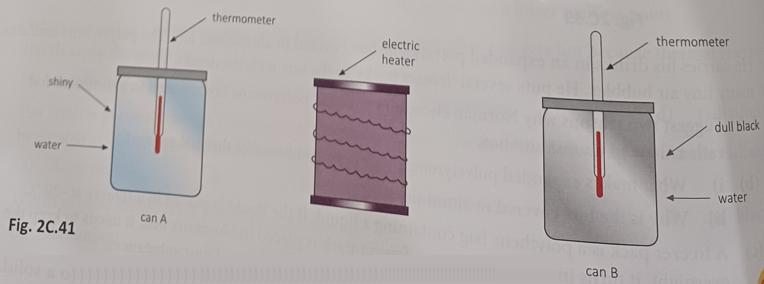
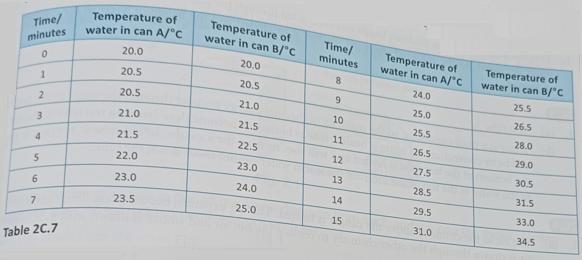
13. An electric heater was placed exactly between two cans holding equal volumes of water. The cans were identical except that one can was shiny silver (can A) and the other had been painted matt black (can B).The temperature of the water in each can was measured every minute for a quarter of an
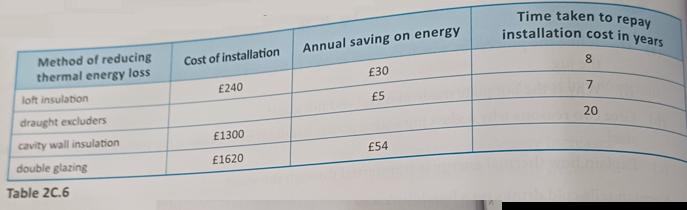
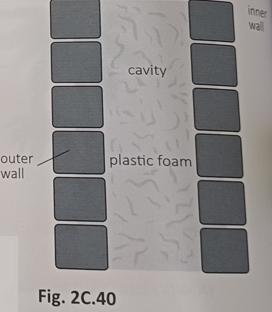
12. Table 2C.6 gives details of four things that can be done to reduce thermal energy losses from a house.(a) Complete the table by adding the missing information.(b) Which method:i) costs the least to install?ii) saves the most money each year?iii) will take the longest time to pay for itself?(c)
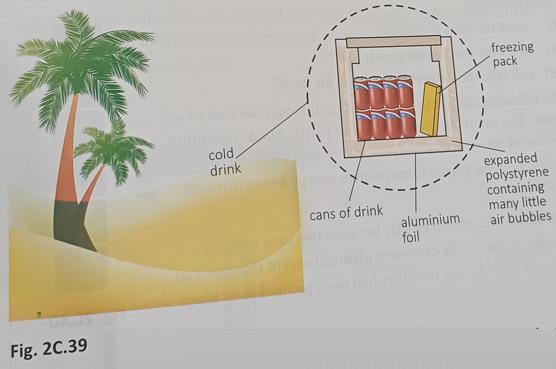
11. Norman sells cold drinks on a beach in Jamaica where it is hot and sunny.He carries his drinks in an expanded polystyrene box covered in aluminium foil. The polystyrene contains many tiny air bubbles. He puts several 'freezer packs' in the box with the drinks.(a) Suggest two reasons why Norman
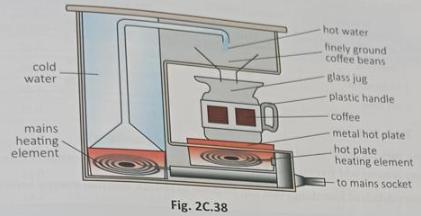
10. Fig. 2038 shows the structure of a coffee maker.(a) i) Name the process by which thermal energy is transferred from the hot plate heating element to the jug.ii) Why is the hot plate made of metal and not glass?(b) Give two reasons why a glass jug with a plastic handle is better than a jug
9. Which of these metals is the best thermal conductor?(a) aluminium(b) copper(c) iron(d) lead
8. Hot water is pumped through a radiator and this heats a room. Which of the following should the radiator be painted in order to radiate most thermal energy?(a) shiny white(b) dull white(c) shiny black(d) dull black
7. When one end of a metal teaspoon is placed in a hot drink; the other end gets hot because thermal energy travels along the spoon by:(a) conduction(b) convection(c) evaporation(d) radiation
6. A plastic spoon and a metal spoon were placed together in a refrigerator overnight. The next morning, although they were the same temperature, the plastic spoon felt warmer. What is the reason for this?(a) plastic is a better insulator(b) plastic has a higher thermal capacity(c) plastic has a
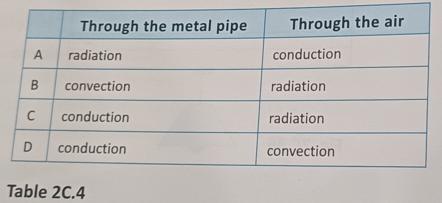
5. A room is heated by pumping hot water through metal pipes. Which of the following best describes how most of the energy is transferred from the hot water, through the metal pipes, to the air in the room? Through the metal pipe Through the air A radiation conduction B convection radiation C
4. Which of the following describes what happens when air is heated?(a) it rises because its density increases(b) it falls because its density increases(c) it rises because its density decreases(d) it falls because its density decreases
3. In countries which receive a lot of sunshine, the houses are often painted light colours in order to:(a) reduce thermal energy conduction(b) reflect radiation(c) increase radiation emission(d) increase thermal energy loss by convection
2. Why are all metals good conductors of thermal energy?(a) they are solids at room temperature(b) they have free electrons(c) they have high densities(d) they are shiny
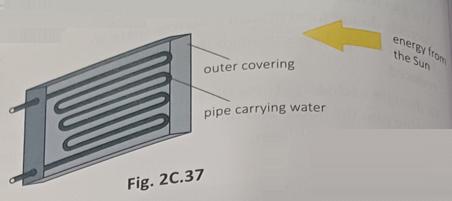
1. Fig. 20.37 shows details of a solar panel which is used for heating water.Which of the following pipes would be the best to use in the panel?(a) copper pipe painted dull black(b) copper pipe painted shiny black(c) plastic pipe painted dull black(d) plastic pipe painted shiny black outer covering
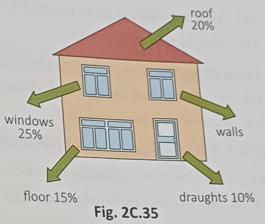
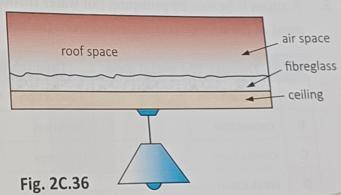
The following diagram shows the percentage of energy lost from different parts of a house.(a) What percentage of energy is lost through the walls?(b) Present this data as a pie chart.(c) The house loses 40 units of energy each day. How much energy is lost through the roof?(d) Explain how fibreglass
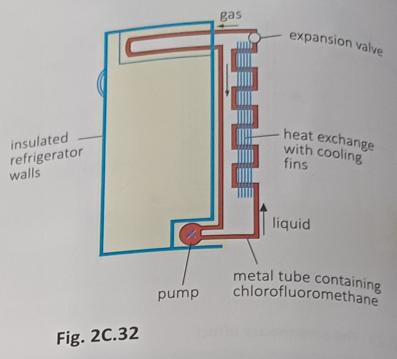
Fig. 20.32 is a diagram of a refrigerator.(a) Explain why the refrigerator walls contains insulating material.(b) Suggest a suitable material for insulating the refrigerator walls.(c) Name the process by which thermal energy is transferred:(i) from the fluid through the metal tube(ii) from the
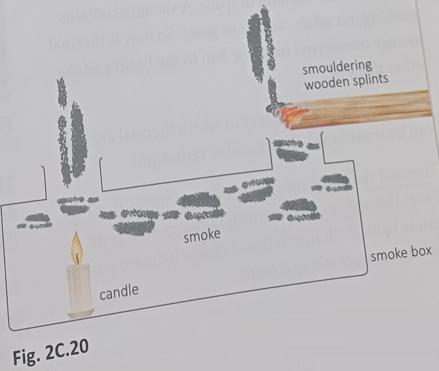
A smoke box consists of a box which has two chimneys. A candle is burnt under one chimney while smoke, from smouldering wooden splints, is introduced at the other.The smoke box has a glass front so the movement of smoke can be observed.(a) Explain why smoke from the smouldering wooden splints is
15. In an experiment, an equal volume of water was placed in four containers and they were left under the same conditions.From which container will the water evaporate quickest? D- B A C D Fig. 2B.22
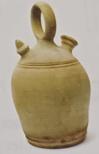
14. A botijos is a porous clay pot traditionally used in Spain to keep water cool. It has a spout through which it can be filled and water can be drunk.Explain how a botijos is able to keep water cool.
13. Explain each of the following observations.(a) Steam at 100 °C damages skin more than water at 100 °C.(b) Pure water may not always boil at exactly 100 °C.(c) If a sealed tube of gas is heated it will eventually explode.(d) Wet clothing spread out on a clothes line dries more quickly than
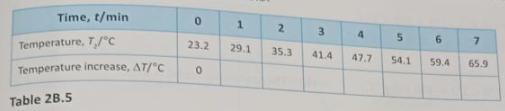
12. A sample of 1 kg of a liquid, X, at an initial temperature, T_{t} = 23.2 deg * C_{n} is heated by an immersion heater in an insulated container. The temperature of the liquid, T_{x} at 1 minute intervals for seven minutes. The results obtained are given in Table 28.5.(a) Copy and complete Table
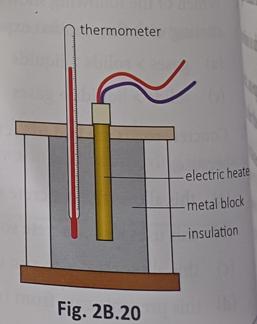
Fig. 28.20 shows the apparatus used in an experiment to determine the specific heat capacity of a metal. Here is some additional information about the experiment:Power of the heater = 50 W i.e. it supplies 50 J of heat energy each second Mass of block = 2.125 kg Time heater was used = 6.5 minutes
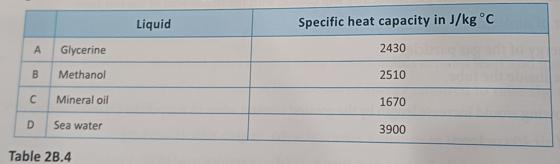
10. The following table gives the specific heat capacities of four liquids. If equal masses of the four liquids were given the same amount of energy, which liquid would heat up the most? Liquid Specific heat capacity in J/kg C 2430 A Glycerine B Methanol 2510 C Mineral oil 1670 D Sea water 3900
9. A mass of 2 kg of lead, which has a specific heat capacity of 130 k * g ^ (- 1 deg) * C ^ - 1 was heated for 52 s by a heater of power 25 W. By how many degrees did the temperature of the lead increase?(a) 5 deg * C(b) 10 °C(c) 15 deg * C(d) 20 °C
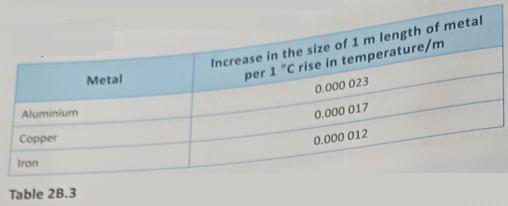
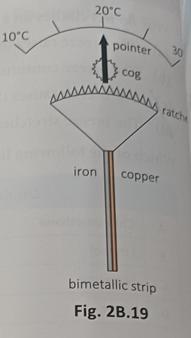
Table 28.3 shows how much I m lengths of different metals will increase in length per 1 °C rise in temperature.(a) By how much will a 1 m length of copper increase if its temperature increases by 5 °C?(b) Fig. 28.19 shows how a bimetallic strip can be used to make a simple thermometer. Explain
7. Concrete roads are laid in sections with gaps of a few centimetres left between the sections. The gaps are left because:(a) this allows the concrete sections to expand in hot weather(b) this uses less concrete so the roads are cheaper to build(c) this allows water to run off the road more easily
6. Which of the following shows the order in which materials expand for a given increase in temperature starting with the one that expands the most?(a) gases > solids > liquids(b) gases > liquids > solids(c) solids > liquids > gases(d) solids > gases > liquids
5. Which of the following would increase length by the greatest amount when its temperature is increased by 10 °C?(a) a column of air 10 cm long(b) a glass tube 10 cm long(c) a thread of mercury 10 cm long(d) a copper wire 10 cm long
4. A sample of a gas in a sealed test tube is cooled. Describe what happens to:(a) the speed at which the molecules move(b) the size of the molecules(c) the frequency with which the gas molecules will collide with the inside wall of the test tube(d) the number of molecules(e) the total energy of
Showing 600 - 700
of 2101
1
2
3
4
5
6
7
8
9
10
11
12
13
14
15
Last
Step by Step Answers

 Get 50% OFF
Claim Now
Get 50% OFF
Claim Now