New Semester
Started
Get
50% OFF
Study Help!
--h --m --s
Claim Now
Question Answers
Textbooks
Find textbooks, questions and answers
Oops, something went wrong!
Change your search query and then try again
S
Books
FREE
Study Help
Expert Questions
Accounting
General Management
Mathematics
Finance
Organizational Behaviour
Law
Physics
Operating System
Management Leadership
Sociology
Programming
Marketing
Database
Computer Network
Economics
Textbooks Solutions
Accounting
Managerial Accounting
Management Leadership
Cost Accounting
Statistics
Business Law
Corporate Finance
Finance
Economics
Auditing
Tutors
Online Tutors
Find a Tutor
Hire a Tutor
Become a Tutor
AI Tutor
AI Study Planner
NEW
Sell Books
Search
Search
Sign In
Register
study help
computer science
computer architecture
The Architecture of Computer Hardware, Systems Software and Networking An Information Technology App 5th edition Irv Englander - Solutions
Discuss the similarities and differences between memory management fragmentation and disk fragmentation.
Nearly every operating system separates the file system from the I/O services. What is the advantage in doing so?
What is the difference between the logical description of a file and the physical description?
An operating system is described as an event-driven program. What is meant by event driven? Explain how the dispatching operation fits this description.
Describe the two methods that are used to provide concurrent operation of multiple processes on a single CPU. What are the advantages of each method? What is the advantage of providing concurrent operation?
You are probably familiar with the standard Windows interface. Suppose you could replace the Windows shell with a different interface shell. What might be the advantages and disadvantages of selecting a different command shell as a replacement for the standard Windows interface?
What are the limitations of providing a BIOS in ROM?
Concurrency, of course, is a requirement for modern operating systems. What are the major challenges that an OS designer faces in supporting efficient concurrency that she would not face if the operating system could just run one program at a time?
For each of the most popular commands in Windows (or Linux if you prefer), identify the type of operating system service that is being provided, and identify the basic module or modules that are involved. Which commands would you assume are memory resident and which loaded as required? Explain your
What are the specific limitations of a computer system that provides no operating system? What must be done to load and execute programs?
a. What is the binary sequence represented by the 4B/5B encoded sequence11110011111101111110?b. What is the binary sequence represented by the 4B/5B encoded sequence10101010101010101011?
The Little Prince Computer (LPC) is a mutant variation on the LMC. (The LPC is so named because the differences are a royal pain.) The LPC has one additional instruction. The extra instruction requires two consecutive words:0XX0YYThis instruction, known as move, moves data directly from location XX
a. Consider a CPU with two parallel integer execution units. An addition instruction requires 2 clock pulses to complete execution, and a multiplication requires 15 clock pulses. Now assume the following situation: the program is to multiply two numbers, located in registers R2 and R4, and store
Write a program in your favorite language that will convert all ASCII uppercase and lowercase letters to EBCDIC code. For an additional challenge, also convert the punctuation symbols, indicating with a failure-to-convert message, those symbols that are not represented in the EBCDIC system.
Approximately how many pages of pure 16-bit Unicode text can a 650MB CD-ROM hold?
What are the 16-bit 1’s and 2’s complements of the following binary numbers?a. 10000b. 100111100001001c. 0100111000100100
Add the following 16’s complement hexadecimal numbers 4F09D3A5Is your result positive or negative? How do you know? Convert each number to binary and add the binary numbers. Convert the result back to hexadecimal. Is the result the same?
In the Pink-Lemon-8 computer, real numbers are stored in the formatSEEM M M M8where all the digits, including the exponent, are in octal. The exponent is stored excess-408. The mantissa is stored as sign and magnitude, where the sign is 0 for a positive number and 4 for a negative number. The
a. Convert the decimal number 19557 to floating point. Use the format SEEMMMM. All digits are decimal. The exponent is stored excess-40 (not excess-50). The implied decimal point is at the beginning of the mantissa. The sign is 1 for a positive number, 7 for a negative number. Note carefully the
a. Convert the number 123.57 × 10¹⁵ to the format SEEM M M M, with the exponent stored excess-49. The implied decimal point is to the right of the first mantissa digit.b. What is the smallest number you can use with this format before underflow occurs?
Real numbers in the R4–D4 computer are stored in the formatSEEM M M M M4where all the digits, including the exponent, are in base 4. The mantissa is stored as sign and magnitude, where the sign is 0 for a positive number and 3 for a negative number. The implied quadrinary (base 4!) point is at
Convert the following binary and hexadecimal numbers to floating point format. Assume a binary format consisting of a sign bit (negative = 1), a base 2, 8-bit, excess-128 exponent, and 23 bits of mantissa, with the implied binary point to the right of the first bit of the mantissa.a.
Represent the decimal number 171.625 in 32-bit IEEE 754 format.
Show the packed decimal format for the decimal number − 129975.
The following decimal numbers are stored in excess-50 floating point format, with the decimal point to the left of the first mantissa digit. Add them. A 9 is used as a negative sign. Present your result in standard decimal sign-and-magnitude notation.a.0522573104833300b.0501250095325750
Using the same format found in Exercise 5.19, add and multiply the following floating point numbers. Present your answers in both floating point and sign-and-magnitude formats.3DEC000016C24C000016Data from Exercise 5.19Convert the following binary and hexadecimal numbers to floating point format.
What are the criteria that define a von Neumann architecture? How does the example in this chapter in which we enter and add two numbers illustrate each of the criteria?
Consider the example in this chapter in which we enter and add two numbers. Suppose we had stored the first input entry in mailbox location 00. Would the program have produced the same result? What would have happened if the program were executed a second time? What characteristic of the computer
Write a Little Man program that accepts three values as input and produces the largest of the three as output.
Write a Little Man program to accept an indefinite number of input values. The output value will be the largest of the input values. You should use the value 0 as a flag to indicate the end of input.
Write a Little Man program that accepts three values as input and outputs them in order of size, largest to smallest.
Write a Little Man program that adds a column of input values and produces the sum as output. The first input value will contain the number of values that follow as input to be added.
Write a Little Man program that prints out the odd numbers from 1 to 99. No input is required.
Write a Little Man program that prints out the sums of the odd values from 1 to 39. The output will consist of 1, 1 + 3, 1 + 3 + 5, 1 + 3 + 5 + 7 . . . . No input is required. As an aside, do you notice anything interesting about the output results that are produced by this series? (This series is
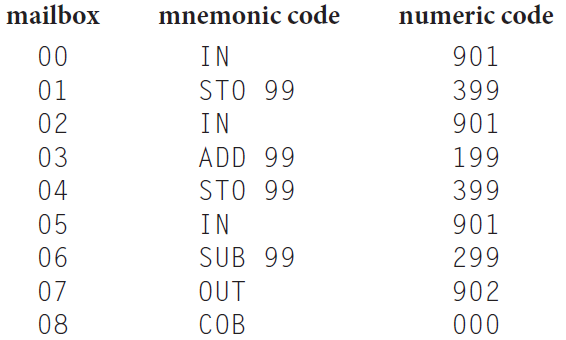
The following Little Man program is supposed to add two input numbers, subtract a third input number from the sum, and output the result, i.e.,OUT = IN1 + IN2 ˆ’ IN3What is wrong with this program? Modify the program so that it produces the correct result. mailbox mnemonic code numeric
Suppose we have a need to handle both negative and positive data beyond the simple test in the various conditional branch instructions. One way to do this would be to replace the subtract instruction with a 10’s complement instruction. The COMP instruction complements the value in the calculator
Consider a more realistic alternative:Suppose a small program is permanently stored in the last few mailbox locations. A BRANCH instruction at location 00, also permanent, will start this program. This program will accept input values and will store them at consecutive mailbox locations, starting
Show carefully how you would implement an IF-ELSE statement using Little Man instructions.
Show how you would implement a DO-WHILE statement using Little Man instructions.
The input data values in our problems have always been entered in the order that they were to be used. This is not always possible or convenient. Can you think of a simple way to accept input data in the wrong order and still use it correctly?
Suppose the Little Man Computer had been implemented as a 16-bit binary machine. Assume that the binary LMC provides the same instruction set, with the same op codes (in binary, of course), and the same instruction format (op code followed by address). How many bits would be required for the op
The original version of the Little Man Computer used op code 7 (i.e., instruction 700) for a COFFEE BREAK instruction instead of op code 0. What is the advantage of using 000 for the COB instruction instead of 700? (Consider what happens if the programmer forgets to put a COB instruction at the end
When we discussed conditional branching we claimed that a BRANCH NEGATIVE instruction is not necessary. Show a sequence of BRANCH instructions that will cause a program to branch to location 50 if the value in the calculator is negative.
Show a sequence of instructions that will cause a program to branch to location 75 if the value in the calculator is greater than zero.
Suppose that the following instructions are found at the given locations in memory:a. Show the contents of the IR, the PC, the MAR, the MDR, and A at the conclusion of instruction 20.b. Show the contents of each register as each step of the fetch–execute cycle is performed for instruction 21.
One large modern computer has a 48-bit memory address register. How much memory can this computer address?
Why are there two different registers (MAR and MDR) associated with memory? What are the equivalents in the Little Man Computer?
Show the steps of the CPU fetch–execute cycle for the remaining instructions in the Little Man instruction set.
Most of the registers in the machine have two-way copy capability; that is, you can copy to them from another register, and you can copy from them to another register. The MAR, on the other hand, is always used as a destination register; you only copy to the MAR. Explain clearly why this is so.
a. What is the effect of shifting an unsigned number in a register 2 bits to the left? 1 bit to the right? Assume that 0s are inserted to replace bit locations at the end of the register that have become empty due to the shift.b. Suppose the number is signed, that is, stored using 2’s complement.
If you were building a computer to be used in outer space, would you be likely to use some form of flash memory or RAM as main memory? Why?
Many older computers used an alternative to the BRANCH ON CONDITION instruction called SKIP ON CONDITION that worked as follows: if the condition were true, the computer would skip the following instruction and go on to the one after; otherwise, the next instruction in line would be executed.
Suppose that the instruction format for a modified Little Man Computer requires two consecutive locations for each instruction. The high-order digits of the instruction are located in the first mail slot, followed by the low-order digits. The IR is large enough to hold the entire instruction and
As computer words get larger and larger, there is a law of diminishing returns: the speed of execution of real application programs does not increase and may, in fact, decrease. Why do you suppose that this is so?
Most modern computers provide a large number of general-purpose registers and very few memory access instructions. Most instructions use these registers to hold data instead of memory. What are the advantages to such an architecture?
Create the fetch–execute cycle for an instruction that moves a value from general purpose register-1 to general-purpose register-2. Compare this cycle to the cycle for a LOAD instruction. What is the major advantage of the MOVE over the LOAD?
What are the trade-offs in using a serial bus versus a parallel bus to move data from one place to another?
Until recently, most personal computers used a parallel PCI bus as a back plane to interconnect the various components within the computer, but the PCI bus was rarely, if ever, used to connect external devices to the computer. Modern computers often use a serial adaptation of the PCI bus called PCI
Explain why skew is not a factor in a serial bus.
Point-to-point buses generally omit lines for addressing. Why is this possible? Suppose a point-to-point bus is used to connect two components together where one of the components actually represents multiple addresses. How could a bus with no address lines be used to satisfy the requirement for
Find a good reference that describes the x86 chip. Discuss the features of the architecture that make super scalar processing possible in this chip. What limitations does the Pentium architecture impose on its super scalar processing?
Suppose that a CPU always executes the two instructions following a branch instruction, regardless of whether the branch is taken or not. Explain how this can eliminate most of the delay resulting from branch dependency in a pipe lined CPU. What penalties or restrictions does this impose on the
Some systems use a branch prediction method known as static branch prediction, so called because the prediction is made on the basis of the instruction, without regard to history. One possible scenario would have the system predict that all conditional backward branches are taken and all forward
How would you modify the Little Man Computer to implement the pipe lined instruction fetch–execution unit model that was described in this chapter? What would it take to supply multiple execution units? Describe your modified LMC in detail and show how an instruction flows through it.
a. Suppose we are trying to determine the speed of a computer that executes the Little Man instruction set. The LOAD and STORE instructions each make up about 25% of the instructions in a typical program; ADD, SUBTRACT, IN, and OUT take 10% each. The various branches each take about 5%. The HALT
The goal of scalar processing is to produce, on average, the execution of one instruction per clock tick. If the clock ticks at a rate of 2 GHz, how many instructions per second can this computer execute? How many instructions would a 2 GHz super scalar processor that processes three instructions
Consider a cache memory that provides three hundred 16-byte blocks. Now consider that you are processing all the data in a two-dimensional array of, say, four hundred rows by four hundred columns, using a pair of nested loops. Assume that the program stores the array column by column. You can write
Carefully discuss what happens when a cache miss occurs. Does this result in a major slowdown in execution of the instruction? If so, why?
What is the purpose of the tag in a cache memory system?
Describe the trade-offs between the memory cache write-through and write-back techniques.
Carefully describe the advantages and disadvantages of master–slave multiprocessing and symmetrical multiprocessing. Which would you select for fault-tolerant computing? Why?
Locate information about the Cell Processor. Describe the tasks performed by the various slave processors. What is the primary role of the master processor? Explain the advantages of master–slave multiprocessing over other forms of processing for this application. Can you think of some other
As you know, a single CPU processes one instruction at a time. Adding a second CPU (or core, in current terminology) allows the system to process two instructions at a time, simultaneously, effectively doubling the processing power of the system. A third core will offer triple the processing power
Why would DMA be useless if the computer did not have interrupt capability?
What is the advantage of using a disk controller to control the hard disk? How else could you do the job that the disk controller does?
DMA is rarely used with dumb computer terminals. Why?
Consider the interrupt that occurs at the completion of a disk transfer.a. “Who” is interrupting “whom”?b. Why is the interrupt used in this case? What would be necessary if there were no interrupt capability on this computer?c. Describe the steps that take place after the interrupt occurs.
Suppose you wish to send a block of data to a tape drive for storage using DMA. What information must be sent to the tape controller before the DMA transfer can take place?
What is polling used for? What are the disadvantages of polling? What is a better way to perform the same job?
To use a computer for multimedia (moving video and sound), it is important to maximize the efficiency of the I/O. Assume that the blocks of a movie are stored consecutively on a CD-ROM. Describe the steps used to retrieve the blocks for use by the movie display software. Discuss ways in which you
Consider the interface between a computer and a printer. For a typical printout, it is clearly impractical to send output data to the printer one byte or one word at a time (especially over a network!). Instead data to be printed is stored in a buffer at a known location in memory and transferred
The UNIX operating system differentiates between block-oriented and character oriented devices. Give an example of each, explain the differences between them, and explain how the I/O process differs for each.
Describe a circumstance where an interrupt occurs at the beginning of an event. Describe a circumstance where an interrupt occurs at the completion of an event. What is the difference between the types of events?
In general, what purpose does an interrupt serve? Stated another way, suppose there were no interrupts provided in a computer. What capabilities would be lost?
What is the difference between polling and polled interrupt processing?
Describe the steps that occur when a system receives multiple interrupts.
Explain why it is easy to perform read and write in place on a disk but not on a tape.
What are the advantages of flash memory over hard disk storage? What are the advantages of hard disk over flash memory storage? What are the advantages of both hard disk and flash memory storage over RAM? What is the major advantage of RAM over other types of storage?
A multiplattered hard disk is divided into 1100 sectors and 40,000 cylinders. There are six platter surfaces. Each block holds 512 bytes. The disk is rotating at a rate of 4800 rpm. The disk has an average seek time of 12 msec.a. What is the total capacity of this disk?b. What is the disk transfer
For a motion picture image it may be necessary to change every pixel in the image as many as thirty times per second, although usually the amount of change is somewhat smaller. This means that without data compression or other tricks that a large number of pixel values must be moved from main
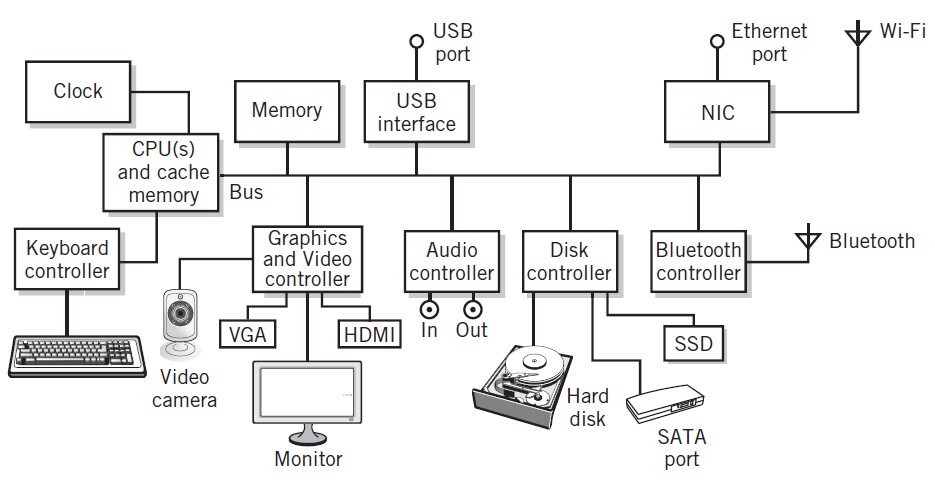
Find a current computer ad in a magazine or newspaper or online. Identify each of the featured items in the ad, show its position in the system block diagram of Figure 11.1, explain how it operates, and define its purpose in the system.Figure 11.1 Ethernet USB Wi-Fi port port Clock USB Memory NIC
Cloud computing is a recent technology being marketed and used as a means to provide off-site computing power to an organization. Locate information about cloud computing and compare cloud computing with grid computing. In what ways are they similar? How do they differ?
Many phone companies are replacing the wire in their phone systems with fiber-optic cable. What do they expect to gain from doing so?
In recent years, much of the storage and communication of data has been in digital form, even if the source data is actually analog. Even most television is now transmitted digitally. What benefits and advantages are gained by using digital storage and signaling?
Consider a communication system that converts a digital signal to analog form for transmission, then recovers the digital signal at the receiving end. Another system starts with an analog signal, which it then converts to digital form for transmission, and recovers the analog signal at the
Discuss the trade-offs between coaxial wire and fiber-optics in a network made up of fifty computer stations all located within 1000 feet of each other.
What effect does time-division multiplexing have on the bandwidth requirements of a channel?
Describe the advantages that repeaters have over amplifiers.
Discuss the trade-offs between fiber-optic and satellite communication in terms of costs, signal capacity, signaling method, interference, likelihood of failure and repair issues, multi-point capability, reconfiguration capability, and noise.
What effect would you expect a wider bandwidth to have on the noise in a channel?
Showing 1100 - 1200
of 1390
1
2
3
4
5
6
7
8
9
10
11
12
13
14
Step by Step Answers

 Get 50% OFF
Claim Now
Get 50% OFF
Claim Now