New Semester
Started
Get
50% OFF
Study Help!
--h --m --s
Claim Now
Question Answers
Textbooks
Find textbooks, questions and answers
Oops, something went wrong!
Change your search query and then try again
S
Books
FREE
Study Help
Expert Questions
Accounting
General Management
Mathematics
Finance
Organizational Behaviour
Law
Physics
Operating System
Management Leadership
Sociology
Programming
Marketing
Database
Computer Network
Economics
Textbooks Solutions
Accounting
Managerial Accounting
Management Leadership
Cost Accounting
Statistics
Business Law
Corporate Finance
Finance
Economics
Auditing
Tutors
Online Tutors
Find a Tutor
Hire a Tutor
Become a Tutor
AI Tutor
AI Study Planner
NEW
Sell Books
Search
Search
Sign In
Register
study help
engineering
fundamentals of solid state engineering
Fundamentals Of Solid State Engineering 4th Edition Manijeh Razeghi - Solutions
In your own words, describe the meaning of the phonon density of states.
Reflection high-energy electron diffraction (RHEED) has become a commonplace technique for probing the atomic surface structures of materials. Under vacuum conditions an electron beam is made to strike the surface of the sample under test at a glancing angle (θ < 10o). The beam reflects off the
(a) What are the interplanar spacings d for the (100), (110), and (111) planes of Al (a ¼ 4.05 Å)?(b) What are the Miller indices of a plane that intercepts the x-axis at a, the y-axis at 2a, and the z-axis at 2a?
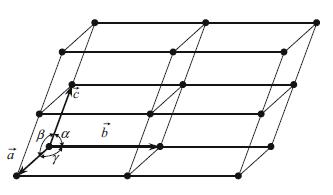
Figure 3.6 illustrates the definition of the angles and unit cell dimensions of the crystalline material. If a unit cell has a characteristic of a ¼ b ¼ c and α ¼ β ¼ γ ¼ 90o, it forms a cubic crystal system, which is the case of Si and GaAs.Figure 3.6(a) How many Bravais lattices are
Determine the Debye temperature ΘD, Debye wavelength, and the Debye frequency ωD for diamond given that the lattice constant for this material is 3.56 Å, the density of diamond is 3.52 × 10³ kg.m-3, and the speed of sound in diamond is 12,000 m.s-1.
The one-dimensional monatomic harmonic crystal (Sect. 6.1.3) is in fact a particular case of the diatomic model described in Sect. 6.1.4, for which the two atoms are identical. To prove this, show that the expression for the diatomic harmonic crystal can be transformed into an expression similar to
In your own words, describe the meaning of the Debye frequency and the Debye temperature. Develop a simple equation relating the Debye frequency, Debye temperature, and Debye wavelength.
Explain why there is no optical phonon in the dispersion curve for the one-dimensional monatomic chain of atoms.
Number of conduction electrons in a Fermi sphere of known radius. In a simple cubic quasi-free electron metal, the spherical Fermi surface just touches the first Brillouin zone. Calculate the number of conduction electrons per atom in this metal as a function of the Fermi-Dirac integral. Consider
Density of states of a piece of Si. Calculate the number of states per unit energy in a 100 by 100 by 10 nm piece of silicon (m* = 1.08 m0) 100 meV above the conduction band edge. Write the results in units of eV-1.
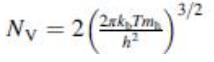
Numerical evaluation of the effective densities of states of Ge, Si, and GaAs. Calculate the effective densities of states in the conduction and valence bands of germanium, silicon and gallium arsenide at 300 K. Note in analogy to Eq. (5.55) we have Ny = 2( 3/2 2xk Tm
Plot of the Fermi distribution function at two different temperatures. Calculate the Fermi function at 6.5 eV if EF = 6.25 eV and T = 300 K. Repeat for T =950 K assuming that the Fermi energy does not change. Plot the energy dependence of the electron distribution function at T = 300 K and at T =
Position of the Fermi level in intrinsic semiconductors. Assume that the density of states is the same in the conduction band (NC) and in the valence band (NV). Then, the probability p that a state is filled at the conduction band edge (EC) is equal to the probability p that a state is empty in the
Origin of electronic bands in materials. Explain how electronic energy bands arise in materials. The periodic potential in a one-dimensional lattice of spacing a can be approximated by a square wave which has the value U0 =-2 eV at each atom and which changes to zero at a distance of 0.1a on either
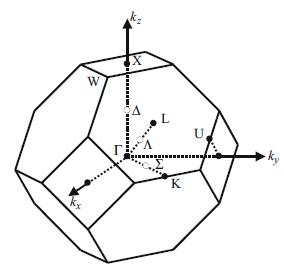
Calculate the coordinates of the high-symmetry point U in Fig. 5.15. W L. K
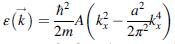
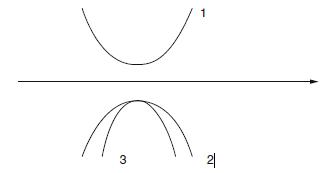
Effective mass. For some materials, the band structure of the conduction band around k = 0 can be represented by What is the effective mass of a free electron under these conditions? On the figure, name the different bands and point out which one of the two in the lower band has the higher
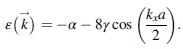
A single electron is placed at k = 0 in an otherwise empty band of a bcc solid. The energy versus k relation of the band is given by:At t = 0, a uniform electric field E is applied in the x-axis direction. Describe the motion of the electron in k-space. Use a reduced-zone picture. Discuss themotion
The period of the Bloch oscillations. Consider an electron that is subjected to an electric field. The electric field exerts a force F=-qE on the electron. Assume that the electron is initially not in motion, i.e., k = 0. Upon application of the electric field, the k value of the electron increases
Equations of motion of an electron in the presence of an electric field.(a) Calculate the velocity of the electron at k = π/a.(b) If the electric field E is applied in the -x direction, derive the time dependence of k for an electron initially at k = π/a and position x = 0.(c) Derive the time
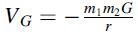
Calculate the first-order correction to the energy of an electron in electron volts eV, in the ground state of hydrogen due to the gravitational potential of the nucleus given by where m1 and m2 are electron and proton masses, respectively, and G is the gravitational constant given by G=
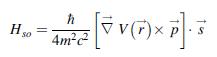
We have seen that in a magnetic field, the magnetic moment of an electron couples to an external magnetic field B to give the so-called Zeeman term HZ=-gμB. Bzsz where for free electrons the factor g we have introduced is called the g-value and is given without quantum field corrections by g=-2
The one-dimensional harmonic oscillator Eq. (4.62) is subject to an electric field F which produces an extra term qFx in the Hamiltonian. Calculate the new wavefunctions and energy levels using the zero field solutions. How does the field affect the symmetry of the charge distribution in the ground
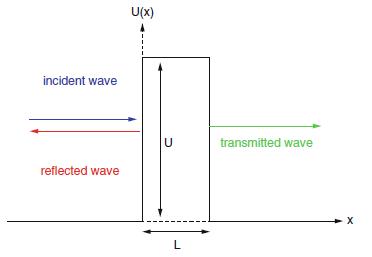
A particle of energy E traveling from the left hits a barrier of height U > E and thickness L. Calculate the transmission coefficient.Student can find a simulation of this problem at http://www.kfunigraz.ac.at/ imawww/thaller/visualization/vis.html http://www.sgi.com/fun/java/john/
Using the Heisenberg equation of motion Eq. (4.30) and the Hamiltonian of a free particle in a magnetic field given by Eq. (4.171), evaluate the velocity operators vx, vy, and vz. Note how the magnetic field has modified one of the velocities. How does the presence of an electric field, if at all,
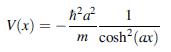
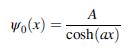
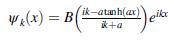
Consider a particle of mass m moving in the potential:Show that this potential has a bound eigenstate described by the wavefunction:and find the corresponding eigenenergy. Normalize ψ0 and sketch it. This turns out to be the only bound state for this potential.(b) Show that the wavefunction
In this exercise, we will apply the material in Sect. 4.4.4 (page144) to calculate the factor of confinement of a particle in a finite well. For convenience we consider symmetric case, we will translate the x-axis so that the potential equals to 0 in the region: a/2 < x < a/2.(a) Rewrite the
In examining the finite potential well solution, suppose we restrict our interest to energies where ζ = E/Uo < 0.01 and permit “a” to become very large such that in Eq. (3.61), α0aζmax½ > > π. Present an argument which concludes that the energy states of interest will be very
An electron is confined to a 1 micron layer of silicon. Assuming that the semiconductor can be adequately described by a one-dimensional quantum well with infinite walls, calculate the lowest possible energy within the material in units of electron volt. If the energy is interpreted as the kinetic
A particle of mass m is prepared in the ground state of an infinite-potential box of size a extending from x = 0 to x = a. Suddenly, the wall at x = a is moved to x = 2a within a time Δt doubling the box size. You may assume that the wavefunction is the same immediately after the change, if the
A particle with mass 6.65 × 10⁻²⁷ kg is confined to an infinite square well of width L. The energy of the third level is 2.00 × 10⁻²⁴ J. Calculate the value of L.
(a) Confirm, as pointed out in the text, that = 0 for all energy states of a particle in a l-D box.(b) Verify that the normalization factor for wavefunctions describing a particle in a l-D box is An = (2/a)1/2.
What is the deBroglie wavelength of an automobile (2000 kg) traveling at 25 miles per hour? A dust of radius 1 μm and density 200 kg.m-3 being jostled by air molecules at room temperature (T = 300 K)? An 87Rb atom that has been laser cooled to a temperature of T = 100 μK? An electron and a proton
Ultraviolet light of wavelength 350 nm falls on a potassium surface. The maximum energy of the photoelectrons is 1.6 eV. What is the work function of potassium? Above what wavelength will no photoemission be observed?
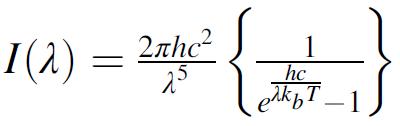
From the expression of the distribution of energy radiated by a blackbody, Eq. (4.2c) shows that the product λMT is a constant, where λM is the wavelength of the peak of distribution at the temperature T
(a) The thermal energy scale is kbT, where kb = 1.38 × 10⁻²³ J/K is the Boltzmann constant and T is the absolute temperature. What energy does room temperature correspond to? What would be the frequency and wavelength of the corresponding photons? Is it reasonable that a hot body starts to glow
An adapted human eye (person that has spent 30 min in the dark) can see 1 ms flashes of power 4×10-14 W at 510 nm with 60% reliability. Assuming that 10% of the incident power reaches the retina, how many photons at the receptors generate the signal that the test person recognizes as flash of
According to the quantum mechanics, electromagnetic radiation of frequency ν can be regarded as consisting of photons of energy hν where h = 6.626 × 10⁻³⁴ J.s is the Planck’s constant.(a) What is the frequency range of visible photons (400 nm to 700 nm)? What is the energy range of
Show that the packing factor for the diamond structure is 46% of that in the fcc structure.
Show that the packing factor in a hexagonal close-packed structure is 0.74.
GaAs is a typical semiconductor compound that has the zinc blende structure.(a) Draw a cubic unit cell for the zinc blende structure showing the positions of Ga and As atoms.(b) Make a drawing showing the in-plane crystallographic directions and the positions of the atoms for the (111) lattice
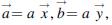
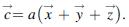
For cesium chloride, take the fundamental lattice vectors to beand Describe the parallelepiped unit cell and find the cell volume. a= a x,b= a y, а х а у
Determine if the plane (111) is parallel to the following directions: [100], [211], and [110
Show that the C5 group is not a crystal point group. In other words, show that, in crystallography, a rotation about an axis and through an angle θ ¼2π/5 cannot be a crystal symmetry operation.
Draw the four Bravais lattices in orthorhombic lattice system.
Calculate the dispersion equation in Appendix 2 example for a 3 dimensional crystal. This equation is used in this chapter in (2.4).
What is Hund’s rule coupling?
Explain how can we calculate the bonding energy between different atoms given the atomic orbital energies of each orbitals.
Explain how sp3 and sp2 hybridizations work? How does hybridization work in Si, Ge and in III–V compounds? In an ab initio band structure calculation, the concept of hybridization does not arise; explain the difference.
Illustrate the various bonding configurations that carbon can adopt and give examples of materials for each case. Where do you think organic carbon technology can become superior to inorganic technology?
Why do none of the noble or inert gases (elements in the rightmost group) have electron affinity values listed in Appendix A.3 Fig. A.?
Arrange the following groups of atoms in order of increasing size (without resorting to the tables in the appendices).a. Li, Na, Kb. P, S, Clc. In, Sn, Tld. Sb, S, Cl, F
Which atom has the higher ionization energy, zinc or gallium? Explain.
Which group of the periodic table would you expect to have the largest electron affinities?
Consider the van der Waals bonding in solid argon. The potential energy as a function of interatomic separation can generally be modeled by the Lennard-Jones 6–12 potential energy curve, that is, E(r) ¼ –Ar-6 + Br-12 where A and B are constants. Given that A ¼ 1.037 - 10-77 J-m6 and B ¼
The interaction energy between Na+ and Cl- ions in the NaCl crystal can be written aswhere the energy is given in joules per ion pair and the interionic separation r is in meters. The numerator unit of the first term is J-m and the second term is J-m8. Calculate the binding energy and the
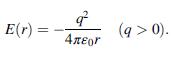
Calculate the total coulombic potential energy of a Na+ in a NaCl crystal by considering only up to the fourth nearest neighbors of Na+. The coulombic potential energy for two ions of opposite charges separated by a distance r is given by: E(r) = (q > 0). 4reor
What is the full electronic configuration of Li? Since the ionization energy of Li is 5.39 eV, how much is the effective nuclear charge? What can you say about the screening of the other electrons?
What is Hund’s rule? Show how it is used to specify in detail the electron configurations of the elements from Li to Ne.
Since an electron on a circular orbit around a proton has a centripetal acceleration, it should radiate energy according to the Larmor relation dE/dt¼-2/3 (q2/4πε0) (a2/c3) where q, a, ε0, and c are, respectively, the electron charge, its acceleration, the vacuum permittivity, and the velocity
The human eye is more sensitive to the yellow-green part of the visible spectrum because this is where the irradiance of the sun is maximum. Since the sun can be considered as a blackbody with a temperature of approximately 5800 K, use Planck’s relation for the irradiance of a blackbody to
The He+ ion is a one-electron system similar to hydrogen, except that it has two protons. Calculate the wavelength of the longest wavelength line in each of the first three spectroscopic series (n ¼ 1, 2, 3).
Using Bohr’s model, deduce an analytical expression for the Rydberg constant as a function of universal constants.
What are the radii of the orbits and the linear velocities of the electrons when they are in the n ¼ 1 and n ¼ 2 orbits of the hydrogen atom?
Using the Rydberg formula, calculate the wavelength and energy of the photons emitted in the Lyman series for electrons originally in the orbits n ¼ 2, 3, and 4. Express your results in cm, eV, and J. In which region of the electromagnetic spectrum are these emissions?
The size of an atom is approximately 10-8 cm. To locate an electron within the atom, one should use electromagnetic radiation of wavelength not longer than 10-9 cm. What is the energy of the photon with such a wavelength (in eV)?
Showing 100 - 200
of 165
1
2
Step by Step Answers

 Get 50% OFF
Claim Now
Get 50% OFF
Claim Now