New Semester
Started
Get
50% OFF
Study Help!
--h --m --s
Claim Now
Question Answers
Textbooks
Find textbooks, questions and answers
Oops, something went wrong!
Change your search query and then try again
S
Books
FREE
Study Help
Expert Questions
Accounting
General Management
Mathematics
Finance
Organizational Behaviour
Law
Physics
Operating System
Management Leadership
Sociology
Programming
Marketing
Database
Computer Network
Economics
Textbooks Solutions
Accounting
Managerial Accounting
Management Leadership
Cost Accounting
Statistics
Business Law
Corporate Finance
Finance
Economics
Auditing
Tutors
Online Tutors
Find a Tutor
Hire a Tutor
Become a Tutor
AI Tutor
AI Study Planner
NEW
Sell Books
Search
Search
Sign In
Register
study help
engineering
mechanical and electrical systems in architecture engineering and construction
Mechanical And Electrical Systems In Architecture Engineering And Construction 5th Edition Frank R Dagostino, Joseph B Wujek - Solutions
Determine the hot water consumption and the equipment sizes required for a 150-room motel based on the following information:• Hot water required: 30 gal per day per person• Occupancy rate: 2.4 persons per room, 100% occupied• Storage capacity (tank): 60% of total daily use (of which 75% is
A pump with an 8-in diameter impeller is operating at 1750 rpm and delivering 40 gpm with a total dynamic head of 55 ft. The pump’s BHP is 1.2 hp under these conditions. Approximate the capacity (Q), total dynamic head (ΔPTDH), and BHP if impeller size is increased to 10 in and pump speed is
Design conditions for a piping system are that the pump must deliver water at a flow rate of 180 gpm and generate 50 ft of total dynamic head to overcome the static head and friction head of the piping system.a. Based on pump performance curves in Figure 13.23, size a pump impeller and drive that
A pump with a 150-mm diameter impeller is operating at 1750 rpm and delivering 3.2 L/s with a total dynamic head of 16 meters. The pump's BHP is 3.4 kW (0.45 hp) under these conditions. Assume constant efficiency.a. Approximate the pump's capacity if impeller size is increased to 200 mm.b.
A pump with a 150-mm diameter impeller is operating at 1750 rpm and delivering 3.2 L/s with a total dynamic head of 16 meters. The pump's BHP is 3.4 kW (0.45 hp) under these conditions. Approximate the capacity (Q), total dynamic head (ΔPTDH), and BHP if impeller size is increased to 200 mm and
What is a trap, where is it located, and how does it work?
Why are vents required on the waste system? Where are they located in reference to the fixture?
What is a wet vent, and how does it differ from other types of vents?
What is the difference between a stack vent and a vent stack? Using a sketch, show the location of a stack vent and a vent stack in a multistory design.
What is the difference between a soil stack and a waste stack?
Sketch and locate the house (building) drain and the sewer.
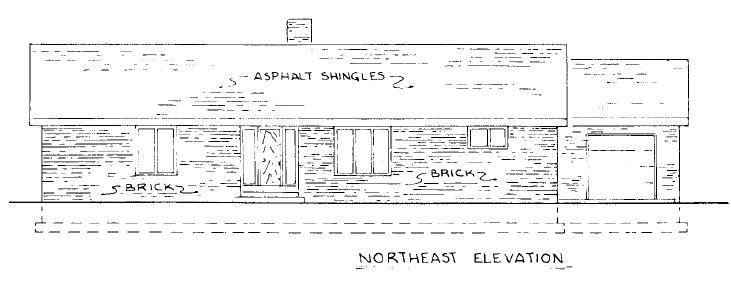
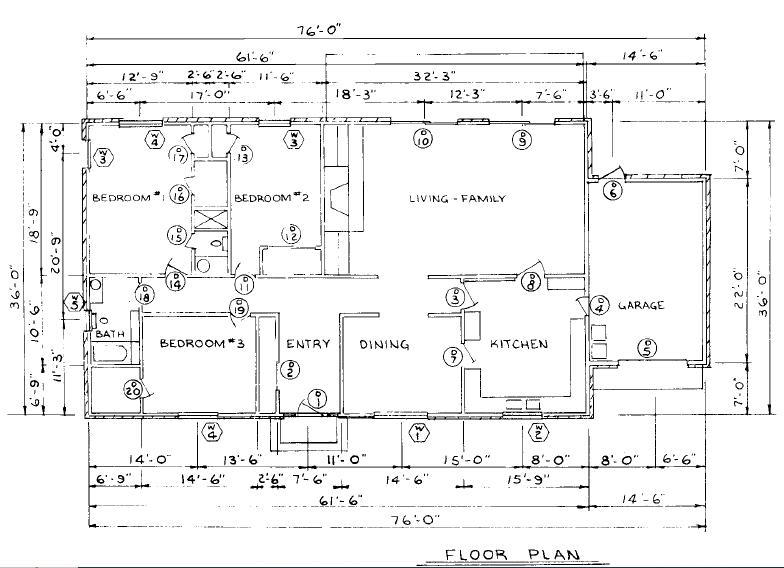
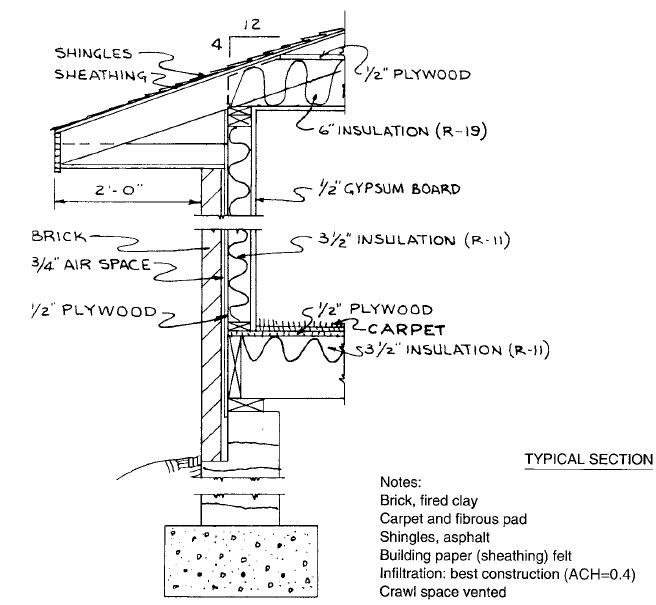
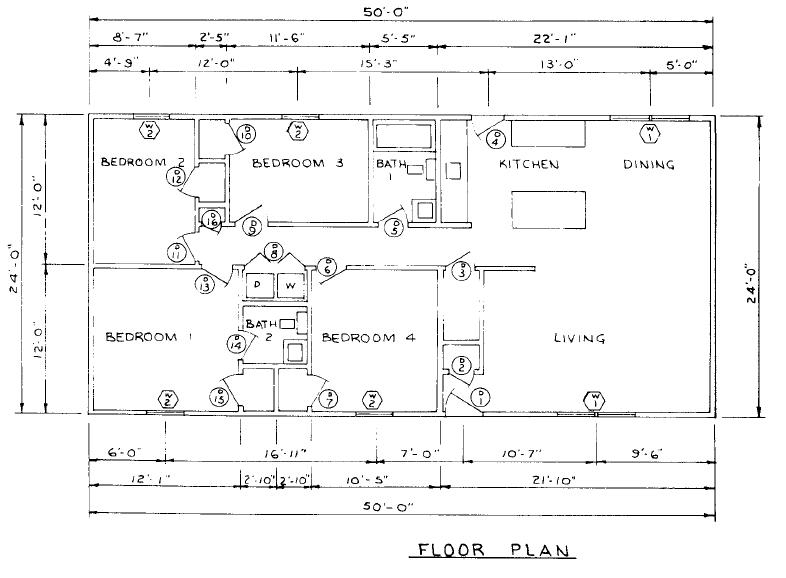
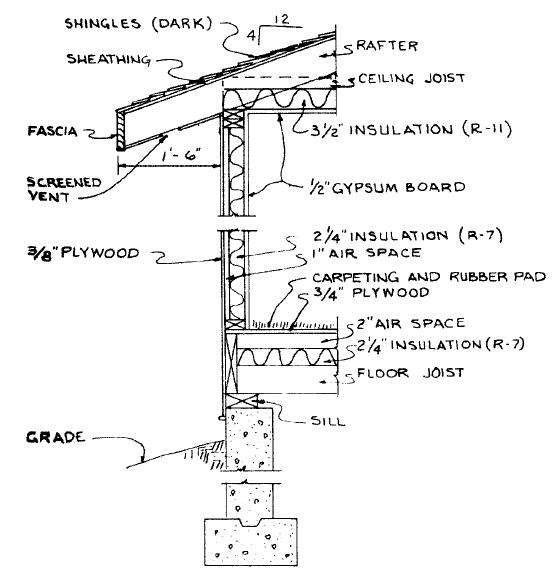
Design the storm drainage system for the residence in Appendix C. Use gutters (1⁄8 in per foot or 10.4 mm per meter slope) and downspouts to the ground, and assume a 4 in (100 mm) per hr rainfall.Appendix C I SBRICK ASPHALT SHINGLES 2. FI BRICKZ NORTHEAST ELEVATION W
Design the storm drainage system serving a 16 ft by 32 ft roof area with two downspouts. Assume a sloped roof with gutters (1⁄4 in per foot slope) and downspouts to the ground and a 5 in per hr rainfall.
Design the storm drainage system serving a 64 ft by 84 ft roof area with four downspouts. Assume a sloped roof with gutters (1⁄8 in per foot slope) and downspouts to the ground and a 5 in per hr rainfall.
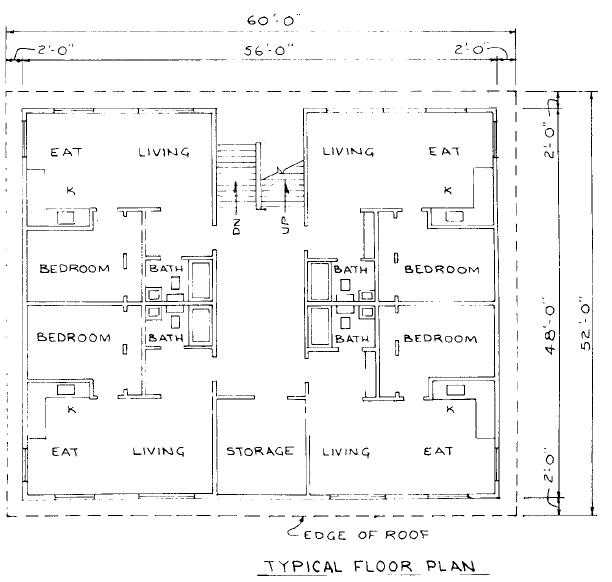
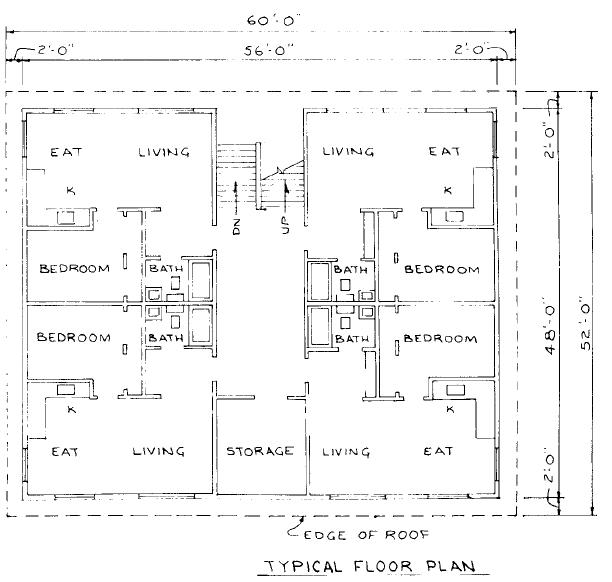
Design the storm drainage system for the apartment building in Appendix B. In this design, assume a sloped roof with gutters (1⁄4 in per foot or 20.8 mm per meter slope) and downspouts to the ground and a 3 in (75 mm) per hr rainfall.Appendix B EAT BEDROOM BEDROOM EAT 0 ܒ: 0 LIVING BATH DD
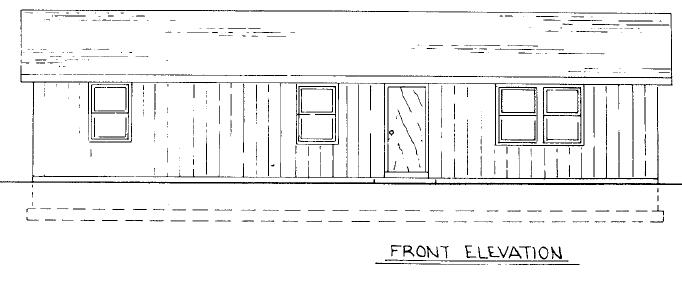
Design the storm drainage system for the residence in Appendix D. Use gutters (1⁄4 in per foot or 20.8 mm per meter slope) and downspouts to the ground, and assume a 3 in (75 mm) per hr rainfall.Appendix D FRONT ELEVATION
Design the storm drainage system serving a 16 ft by 32 ft roof area with two downspouts. Assume a sloped roof with gutters (20.8 mm per meter slope) and downspouts to the ground and a 100 mm per hr rainfall.
Design the storm drainage system for the building in Appendix B. Use three roof drains and size the downspouts and horizontal storm drainage piping (1⁄2 in per foot or 41.6 mm per meter slope) to a community storm drainage system and a 5 in (125 mm) per hr rainfall.Appendix B
What is an insulator?
What is a conductor?
What are voltage, amperage, and resistance?
What is the difference between power and energy?
What are the three components of an electric circuit?
What are open, closed, and short circuits?
How do single-phase AC and three-phase AC differ?
What is a transformer and where is it used?
What is the power factor?
What is a power factor correction?
What is the reason for a utility company charging for demand of electricity?
What is demand limiting?
What is load shedding?
What is the concept of time of use (TOU) rates and why are they needed?
A No. 12 AWG copper conductor has a resistance of 0.162 Ω/100 ft. A No. 10 AWG (thicker than No. 12) conductor has a resistance of 0.102 Ω/100 ft. Approximate the resistance in each conductor for total lengths of 10, 25, and 50 ft.
A No. 10 AWG (thicker than a No. 12) copper conductor has a resistance of 0.531 Ω/100 m. Approximate the resistance in lengths of 10, 25, and 50 meters.
An appliance is designed for use at 120 V and has a current draw of 15 A. Determine the power consumed in watts.
An appliance is designed for use at 36 V and has a current draw of 1.5 A. Determine the power consumed in watts.
A circuit consumes 3200 W of real power when the apparent power is 3800 VA.a. Determine the power factor.b. Determine phase angle ϕ.
A circuit consumes 4800 W of real power when the apparent power is 5600 VA.a. Determine the power factor.b. Determine phase angle ϕ.
An AC circuit is powering an electric heater (i.e., pure resistance, PF = 1.0). Assume the voltage is 120 V and the current draw is 10 A. Compute the apparent power and real power.
An AC circuit is powering an electric heater (i.e., pure resistance, PF = 1.0). Assume the voltage is 240 V and the current draw is 15 A. Compute the apparent power and real power.
An AC circuit is powering a motor (i.e., inductive load, PF < 1.0). Assume the voltage is 240 V and the current draw is 15 A. Compute the real power, assuming a power factor of 0.8.
An AC circuit is powering a motor (i.e., inductive load, PF < 1.0). Assume the voltage is 240 V and the current draw is 30 A. Compute the real power, assuming a power factor of 0.75.
An AC circuit serves inductive and resistive loads. Assume the voltage is 240 V and the current draw is 20 A. Compute the real power, assuming a power factor of 0.9.
A 100 W incandescent lamp remains lit for 24 hr a day during a 30-day billing period.a. Determine the energy consumed over this period.b. Calculate the utility energy charges for this period at a rate of $0.12/kWh.
A 23 W compact fluorescent lamp (equivalent to a 100 W incandescent lamp) remains lit for 24 hr a day during a 30-day billing period.a. Determine the energy consumed over this period.b. Calculate the utility energy charges for this period at a rate of $0.12/kWh.
Ten 100 W incandescent lamps remain lit for 24 hr a day for a one-year period.a. Determine the energy consumed over this period.b. Calculate the utility energy charges for this period at a rate of $0.12/kWh.
A 23 W compact fluorescent lamp (equivalent to a 100 W incandescent lamp) remains lit for 12 hr a day for a one-year period.a. Determine the energy consumed over this period.b. Calculate the utility energy charges for this periodat a rate of $0.12/kWh.
A circulating pump consumes 450 W for 24 hr a day.a. Determine the energy consumed for a one-year period.b. Calculate the utility energy charges for this period at a rate of $0.12/kWh.c. Determine the energy saved for a one-year period, if the pump is switched off 8 hr a day.d. Calculate the energy
Equipment and appliances shown in the following table (see next page) will be used on a 120/240 V AC household circuit. Complete the table. Base analysis on a 120 V circuit and an energy charge of $0.15/kWh.
What are power generation, transmission, and distribution?
What is the service entrance of a building electrical system and what are its components?
What are the functions and differences of switchboards and panelboards?
What is the difference between a wye-connected and delta-connected transformer?
What is the difference between a step-down and stepup transformer?
What is a circuit breaker and where is it used in a building electrical system?
What is a fuse and where is it used in a building electrical system?
Distinguish between the terms appliance and device. Give examples of each.
What types of switching configuration is used to control a lighting installation from two points? What types of switches are used and how are switches arranged in the circuit?
What types of switching configuration is used to control a lighting installation from three points? What types of switches are used and how are switches arranged in the circuit?
What types of switching configuration is used to control a lighting installation from four points? What types of switches are used and how are switches arranged in the circuit?
Describe series and parallel circuit. Which is used in building electrical systems?
What are the types of specialty switches?
What are types of conductor (wire) materials and where are they used in building electrical systems?
What are types of conductor insulation materials and where are they used in building electrical systems?
What is a cable and where is it used in building electrical systems?
What is a cord and where is it used in building electrical systems?
What is a bus (bar)?
What are power loss and voltage drop and how are they related?
What is ampacity?
What factors is the ampacity of a conductor based on?
What are types of raceways used in building electrical systems? Explain each.
What is a busway and where is it used in building electrical systems?
How are electric motors rated?
With regard to electric motors, what are LRA, RLA, and FLA?
What are the types of motors used in building electrical systems?
What does a motor service factor indicate?
What is a motor controller?
What is a variable-frequency drive (VFD) and what is its advantage?
What is a tamper-resistant receptacle?
What is a GFCI, how does it function, and where is it used?
What is an AFCI, how does it function, and where is it used?
What is a surge protection device (SPD), how does it function, and where is it used?
What is GFP, how does it function, and where is it used?
What is lightning protection, how does it function and where is it used?
What is EMF and why is it a potential concern in buildings?
What electrical code is universally used in the United States?
Describe the following branch circuits and where each is used:a. Individualb. General purposec. Appliance
Describe a split wired circuit.
When selecting the panelboard size, what considerations for the future should be taken into account?
On a 208 Y/120 V, three-phase, four-wire system, identify the following:a. Voltage between one grounded conductor and one ungrounded conductorb. Voltage between two ungrounded conductors
Identify five types of equipment that may require voltages higher than 120 V AC.
Identify the type of cable permitted in single- and multifamily dwelling units but that cannot be used underground, nor in buildings that are more than three stories above grade, nor in commercial garages, motion picture studios, theaters, places of assembly, elevator hoist ways, and other
How many circuits are required to accommodate kitchen appliances in an average size home?
How is the general lighting load for a building determined?
How is the minimum service entrance determined?
In selecting the service entrance size, what should be considered?
On a 120/240 V, single-phase, three-wire system, identify the following:a. Voltage between one grounded conductor and one ungrounded conductorb. Voltage between two ungrounded conductors
On a 240 Δ/120 V, three-phase, four-wire system, identify the following:a. Voltage between one grounded conductor and one ungrounded conductorb. Voltage between two ungrounded conductors
On a 480 Y/277 V, three-phase, four-wire system, identify the following:a. Voltage between one grounded conductor and one ungrounded conductorb. Voltage between two ungrounded conductors
Identify three types of equipment that may require three-phase power.
Showing 300 - 400
of 844
1
2
3
4
5
6
7
8
9
Step by Step Answers

 Get 50% OFF
Claim Now
Get 50% OFF
Claim Now