New Semester
Started
Get
50% OFF
Study Help!
--h --m --s
Claim Now
Question Answers
Textbooks
Find textbooks, questions and answers
Oops, something went wrong!
Change your search query and then try again
S
Books
FREE
Study Help
Expert Questions
Accounting
General Management
Mathematics
Finance
Organizational Behaviour
Law
Physics
Operating System
Management Leadership
Sociology
Programming
Marketing
Database
Computer Network
Economics
Textbooks Solutions
Accounting
Managerial Accounting
Management Leadership
Cost Accounting
Statistics
Business Law
Corporate Finance
Finance
Economics
Auditing
Tutors
Online Tutors
Find a Tutor
Hire a Tutor
Become a Tutor
AI Tutor
AI Study Planner
NEW
Sell Books
Search
Search
Sign In
Register
study help
engineering
unit operations of chemical engineering
Unit Operations Of Chemical Engineering 7th Edition Warren McCabe, Julian Smith, Peter Harriott - Solutions
An aqueous solution of a volatile component A containing 7.94 mol % A preheated to its boiling point is to be fed to the top of a continuous stripping column operated at atmospheric pressure. Vapor from the top of the column is to contain 11.25 mol % A. No reflux is to be returned. Two methods are
A tower containing six ideal plates, a reboiler, and a total condenser is used to separate, partially, oxygen from air at 65 lbƒ/in.2 gauge. It is desired to operate at reflux ratio (reflux to product) of 2.6 and to produce a bottom product containing 51 wt% oxygen. The air is fed to the column at
A rectifying column containing the equivalent of three ideal plates is to be supplied continuously with a feed consisting of 0.4 mol % ammonia and 99.6 mol % water Before entering the column, the feed is converted wholly to saturated vapor, and it enters between the second and third plates from the
It is desired to produce an overhead product containing 80 mol % benzene from a feed mixture of 68 mol % benzene and 32 mol % toluene. The following methods are considered for this operation. All are to be conducted at atmospheric pressure. For each method calculate the moles of product per 100
The operation of a fractionating column is circumscribed by two limiting reflux ratios: one corresponding to the use of an infinite number of plates and the other a total reflux, or infinite reflux, ratio. Consider a rectifying column fed at the bottom with a constant flow of a binary vapor having
A laboratory still is charged with 10 L of a methanol-water mixture containing 0.70 mole fraction methanol. This is to be distilled batchwise without reflux at 1 atm pressure until 5 L of liquid remains in the still, that is, 5 L has been boiled off. The rate of heat input is constant at 4 kW. The
A solution containing 10 g/L of a valuable protein and 1 g/L of a protein impurity is extracted in a stirred vessel using an organic solvent. Distribution coefficient K = 8 for the valuable protein and 0.5 for the impurity. The initial volume is 500 L and 400 L of solvent are used for the
To show the effect of particle-size distribution on the rate of extraction, consider an oil-containing solid containing some particles half the average size and some 15 times the average size (say 25 percent 0.5 mm, 50 percent 1.0 mm, and 25 percent 1.5 mm). For an effective diffusion coefficient
An organic solute is to be extracted from a dilute aqueous solution using a solvent with a distribution coefficient of 6.8. For a continuous counterflow extractor, bow many ideal stages are needed if the solvent flow is 0.35 times the solution flow and 99 percent recovery of the solute is required?
Wastewater from a 750-m3 tank flows by gravity through a 150-mm steel pipe 1,000 m long that ends 15 m below the bottom of the tank. If the normal tank depth is 3.5 m, what is the discharge rate, in m3/h?
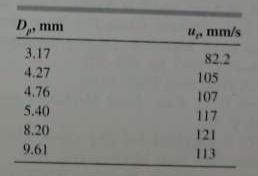
From the following data, calculate the drag coefficients for benzene drops rising through water. Plot the results against the Reynolds number and compare with the drag coefficients for solid spheres. Additional information: Density of water: 998 kg/m³ Density of benzene: 870 kg/m³ Viscosity of
Spherical particles 1 mm in diameter are to be fluidized with water at twice the minimum velocity. The particles have an internal porosity of 40 percent, an average pore diameter of 10 μm, and a particle density of 1.5 g/cm3. Prove that the flow through the internal pores is very small compared to
A 15 percent slurry of 20- to 28-mesh limestone in water is to be kept in suspension in a 20-ft-diameter tank using a six-blade 45° turbine.(a) If Da / Dt = 1/3 and W/Da = 0.2, what stirrer speed is required? (b) Calculate the stirrer speed and power requirement if Da/Dt = 0.4.
A partial oxidation is carried out by bubbling air through an organic solution in a baffled laboratory reactor 12 cm in diameter with a liquid depth of 15 cm. The stirrer is a 6-blade turbine 6 cm in diameter, operating at 1,500 r/min. The solution density is 850 kg/m3; the viscosity is 1.2 cP.(a)
A stirred hydrogenation reactor 1.5 m in diameter with a liquid depth of 1.8 m is equipped with a 0.5-m six-blade turbine. The liquid viscosity is 2.3 cP and the density is 950 kg/m3. The catalyst is Raney nickel with an average particle size of 20 μm. The particles have a porosity of 55
A furnace wall consists of 200 mm of refractory fireclay brick, 100 mm of kaolin brick, and 6 mm of steel plate. The fire side of the refractory is at 1.150°C, and the outside of the steel is at 30°C. An accurate heat balance over the furnace shows the heat loss from the wall to be 300 W/m2. It
A standard 1-in. Schedule 40 steel pipe carries saturated steam at 250°F. The pipe is lagged (insulated) with a 2-in, layer of 85 percent magnesia pipe covering, and out-side this magnesia there is a 1/2-in. layer of cork. The inside temperature of the pipe wall is 249°F, and the outside
Derive the equation for steady-state heat transfer through a spherical shell of inner radius r1 and outer radius r2. Arrange the result for easy comparison with the solution for a thick-walled cylinder.
A very long, wide sheet of plastic 4 mm thick and initially at 20°C is suddenly exposed on both sides to an atmosphere of steam at 102°C. (a) If there is negligible thermal resistance between the steam and the surfaces of the plastic, how long will it take for the temperature at the centerline
A long steel rod 1 in. in diameter is initially at a uniform temperature of 1.200°F. It is suddenly immersed in a quenching bath of oil at 150°F. In 4 min its average temperature drops to 250°F. How long would it take to lower the temperature from 1,200 to 250°F (a) If the rod were 21/2 in. in
Steel spheres 3 in. in diameter heated to 700°F are to be cooled by immersion in an oil bath at 125°F. If there is negligible thermal resistance between the oil and the steel surfaces, (a) Calculate the average temperature of the spheres 10 s and 1 and 6 min after immersion. (b) How long would
For the same initial temperatures Ts and Ta and at the same Fourier number, would the average temperature of a sphere be higher or lower than that of a cylinder or a slab? (See Fig. 10.5.) What are the physical reasons that would lead you to expect this?Fig. 10.5 100000 4967
Under the conditions described in Example 10.6, what is the average rate of heat loss per unit area from the ground to the air during the 12-h period? The thermal conductivity of soil is 0.7 W/m-°C.Example 10.6A flat slab of plastic initially at 70°F (21.1°C) is placed between two platens at
The heat-transfer rate to the jacket of an agitated polymerization kettle is 7.4 kW/m2 when the polymerization temperature is 50°C and the water in the jacket is at 20°C. The kettle is made of stainless steel with a wall 12 mm thick, and there is a thin layerof polymer (k = 0.16 W/m-°C) left on
(a) Compare the thermal conductivities and thermal diffusivities of air and water at 100°F. (b) Calculate the penetration distances in a stagnant mass of air and one of water, at 50°F and 1 atm, each of which is exposed for 10 s to a hot metal surface at 100°F. Comment on the difference.
An oil storage tank has 20-mm steel walls covered with 50 mm of fiberglass insulation. If the oil temperature is kept at 150°C, (a) What is the rate of heat loss when the outside temperature is 20°C and the external air coefficient is 20 W/m-°C? (b) How much would the heat loss be reduced by
An incinerator with 1/2-in. steel walls is lined with 4 in. of firebrick to protect the steel and has 3 in. of magnesia insulation on the outside. When the gas temperature is 1,400°F, the inside wall of the firebrick is at 1,200°F as measured by an optical pyrometer.(a) What is the temperature of
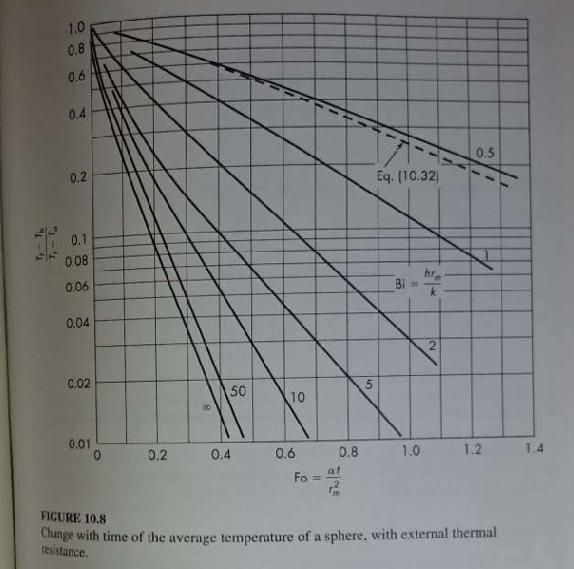
Show that for a given Biot number, the approximate unaccomplished temperature change for a sphere given by Eq. (10.32) can be expressed as a function of Fo and Bi. Compare the values found from the equation for Bi= 0.5 and Bi= 1.0 with the values from Fig. 10.8.Eq. 10.32Fig. 10.8 In T₁ - T T₁ -
Particles of coal about 50 micrometers (μm) in size are injected into a stream of air at 300°C that carries them to a boiler. How long will it take to heat the particles from 25°C to within 5°C of the air temperature? Assume that the external coefficient h is given by hDp/k = 2.0, where Dp is
A slab of polymer 1.6 cm thick, originally at 30°C, is heated between steel plates with a surface temperature of 70°C. The density of the solid is 950 kg/m3, its thermal conductivity is 0.12 W/m · K, and its specific heat is 1,600 J/kg · K. (a) How long will it take for the centerline
A thermopane window has two panes of glass 3 mm thick separated by a space of 1 cm. How much difference would it make in the overall heat transfer coefficient if the space were filled with argon rather than with nitrogen? Assume the internal and external film coefficients are each 10 W/m2 · K and
The temperature of a flowing gas stream is measured using a bare thermocouple. which is a spherical metal bead 1.2 mm in diameter. The properties of the metal are: ρ = 8,000 kg/m3, cp = 450 J/kg · K, and k= 25 W/m · K. The film coefficientbetween the gas and the metal is 310 W/m2 · K. If the
Sketch the temperature gradients in and near a slab being cooled by immersion in a flowing liquid, when the thermal conductivity of the solid is twice that of the liquid. Show typical gradients for a time shortly after the start of the process, and for a time when the sold is about halfway to
Calculate the overall heat-transfer coefficients based on both inside and outside areas for the following cases. Case 1 Water at 10°C flowing in a 3/4-in. 16 BWG condenser tube and saturated steam at 105°C condensing on the outside. hi = 12 kW/m2 · °C. h∘ = 14 kW/m2∙°C. km = 120 W/m
Aniline is to be cooled from 200 to 150°F in a double-pipe heat exchanger having a total outside area of 70 ft2. For cooling, a stream of toluene amounting to 8,600 lb/h at a temperature of 100°F is available. The exchanger consists of 11/4-in. Schedule 40 pipe in 2-in. Schedule 40 pipe. The
In the exchanger described in Prob. 11.3, how much aniline can be cooled if the overall heal-transfer coefficient is 70 Btu/ft2 · h · F?Prob. 11.3Aniline is to be cooled from 200 to 150°F in a double-pipe heat exchanger having a total outside area of 70 ft2. For cooling, a stream of toluene
Carbon tetrachloride flowing at 19.000 kg/h is to be cooled from 85 to 40°C using 13.500 kg/h of cooling water at 20°C. The film coefficient for carbon tetrachloride, outside the tubes, is 1,700 W/m2 · °C. The wall resistance is negligible, but hi on the water side, including fouling factors,
In a double-pipe heat exchanger used to cool a slurry, the overall coefficient Ui is 1.84 kW/m2 · °C. Water flows in the inner pipe, which is 1-in. Schedule 40 steel pipe; the slurry flows in the outer 2-in. pipe. The inside coefficient is estimated to be 4.8 kW/m2 · °C based on a published
A tubular condenser with 120 3/4-in. BWG 16 copper tubes 8 ft long condenses 22,100 lb/h of saturated steam at 120°C using 870 gal/min of cooling water. The measured inlet and exit water temperatures are 20 and 46°C. (a) How good is the heat balance? (b) What is the overall heat-transfer
In a counterflow heat exchanger, the hot stream is cooled from 120 to 30°C while the cold stream temperature changes from 20 to 60°C. If the same exchanger were operated with parallel flow, what would be the exit temperatures of the two streams?
An organic vapor is to be condensed at 80°C and 1.2 atm in a water-cooled condenser, and the condensed organic liquid cooled to 35°C in the same condenser. Cooling water is available at 25°C, and the exit temperature of the water should be about 45°C. Sketch the temperature profiles in the
A hot stream is cooled from 200°C to 60°C in a counterflow exchanger using water that enters at 20°C and leaves at 55°C. The overall coefficient at the warm end of the exchanger is 800 W/m2 · °C and at the cold end it is 600 W/m2 · °C. The heat flow rate is 1.2 x 10⁶ W. Compare the area
A counterflow shell-and-tube exchanger is used to cool 2.500 kg/h of oil from 160°C to a temperature below 80°C. Cooling water enters the tubes at 20°C at a flow rate of 4.000 kg/h. The predicted overall coefficient for a clean exchanger is 960 W/m2 · °C, and the outside area of the tubes is
For the conditions of Problem 11.10, estimate the outlet temperatures allowing for fouling factors of 4.000 W/m2 · °C on both sides of the tubes.Prob. 11.10A counterflow shell-and-tube exchanger is used to cool 2.500 kg/h of oil from 160°C to a temperature below 80°C. Cooling water enters the
An aqueous solution with a boiling point 3°C above that of water is heated and partially vaporized in the tubes of a shell-and-tube exchanger. Steam on the shell side of the exchanger is at 1.70 atm gauge, and the solution enters at 28°C. Assuming an average pressure of 1 atm in the tubes
Benzene vapor at 100°C is cooled and condensed at atmospheric pressure in a shell-and-tube exchanger. The cooling water enters at 20°C and leaves at 45°C. For countercurrent flow, calculate Δ̅T̅L for the cooling and condensing sections of the exchanger. What fraction of the total heat is
Oil at 50°F is heated in a horizontal 2-in. Schedule 40 steel pipe 60 ft long having a surface temperature of 120°F. The oil flow rate is 150 gal/h at inlet temperature. What will be the oil temperature as it leaves the pipe and after mixing? What is the average heat-transfer coefficient?
Repeat Problem 11.14 for parallel flow in the exchanger and discuss the differences between parallel and countercurrent flow.Prob. 11.14Benzene vapor at 100°C is cooled and condensed at atmospheric pressure in a shell-and-tube exchanger. The cooling water enters at 20°C and leaves at 45°C. For
Glycerin is flowing at the rate of 700 kg/h through a 30-mm-ID pipe. It enters a heated section 2.5 m long, the walls of which are at a uniform temperature of 115°C. The temperature of the glycerin at the entrance is 15°C. (a) If the velocity profile is parabolic, what will be the temperature of
Oil is flowing through a 75-mm-ID iron pipe at 1 m/s. It is being heated by steam out-side the pipe, and the steam-film coefficient may be taken as 11 kW/m2 · C. At a particular point along the pipe, the oil is at 50°C, its density is 880 kg/m3, its viscosity is 2.1 cP, its thermal conductivity
Kerosene is heated by hot water in a shell-and-tube heater. The kerosene is inside the tubes, and the water is outside. The flow is countercurrent. The average temperature of the kerosene is 110°F, and the average linear velocity is 8 ft/s. The properties of the kerosene at 110°F are: specific
Assume that the kerosene of Prob. 12.4 is replaced with water at 110ºF and flowing at a velocity of 8 ft/s. What percentage increase in overall coefficient may be expected if the tube surfaces remain clean?Prob. 12.4Kerosene is heated by hot water in a shell-and-tube heater. The kerosene is inside
Both surfaces of the tube of Prob. 12.5 become fouled with deposits from the water. The fouling factors are 330 on the inside and 200 on the outside surfaces, both in Btu/ft2 · h · °F. What percentage decrease in overall coefficient is caused by the fouling of the tube?Prob. 12.5Assume that the
From the Colburn analogy, how much would the heat-transfer coefficient inside a 1-in. Schedule 40 steel pipe differ from that inside a 1-in. BWG 16 copper tube if the same fluid were flowing in each and the Reynolds number in both cases were 4 x 10⁴?
Water must be heated from 15 to 50°C in a simple double-pipe heat exchanger at a rate of 3,500 kg/h. The water is flowing inside the inner tube with steam condensing at 110°C on the outside. The tube wall is so thin that the wall resistance may be neglected. Assume that the steam-film coefficient
Since the Prandtl number and the heat capacity of air are nearly independent of temperature, Eq. (12.34) seems to indicate that hi for air increases with μ0.2(a) Explain this anomaly and determine the approximate dependence of hi on temperature, using hi ∝ Tn.(b) How does hi for air vary with
Air is flowing through a steam-heated tubular heater under such conditions that the steam and wall resistances are negligible in comparison with the air-side resistance. Assuming that each of the following factors is changed in turn but that all other original factors remain constant, calculate the
A sodium-potassium alloy (78 percent K) is to be circulated through 1/2-in.-ID tubes in a reactor core for cooling. The liquid-metal inlet temperature and velocity are to be 580°F and 32 ft/s. If the tubes are 3 ft long and have an inside surface temperature of 720°F, find the coolant temperature
In a catalytic cracking regenerator, catalyst particles at 600°C are injected into air at 700°C in a fluidized bed. Neglecting the chemical reaction, how long will it take for a 50·μm particle to be heated to within 5°C of the air temperature? Assume the heat-transfer coefficient is the same
In a pilot plant, a viscous oil is being cooled from 200 to 110°C in a 1.0-in. jacketed pipe with water flowing in the jacket at an average temperature of 30°C. To get greater cooling of the oil, it has been suggested that the exchanger be replaced with one having a greater inside diameter (1.5
In the manufacture of nitric acid, air containing 10 percent ammonia is passed through a pack of fine-mesh wire screens of Pt/Rh alloy. (a) Calculate the heat- transfer coefficient for air at 500°C flowing at a superficial velocity of 20 ft/s past wires 0.5 mm in diameter. (b) If the surface
Water at 15°C is flowing at right angles across a heated 25-mm-OD cylinder, the surface temperature of which is 120°C. The approach velocity of the water is 1 m/s. (a) What is the heat flux, in kilowatts per square meter, from the surface of the cylinder to the water?(b) What would be the flux
Water is heated from 15 to 65°C in a steam-heated horizontal 50-mm-ID tube. The steam temperature is 120°C. The average Reynolds number of the water is 45. The individual coefficient of the water is controlling. By what percentage would natural convection increase the total rate of heat transfer
A large tank of water is heated by natural convection from submerged horizontal steam pipes. The pipes are 3-in. Schedule 40 steel. When the steam pressure is atmospheric and the water temperature is 80°F, what is the rate of heat transfer to the water in Btu per hour per foot of pipe length?
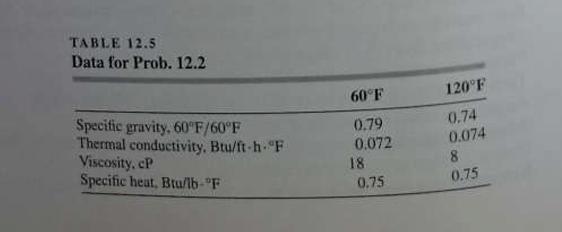
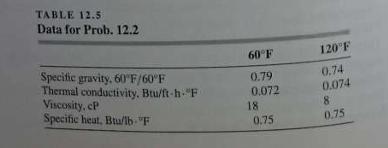
(a) Compare the film coefficients for heat transfer to water and to oil flowing at 1 m/s in a 10-cm pipe at about 50°C. Assume the oil has the properties given in Table 12.5.(b) Show that the ratio hwater/hoil is the product of several factors that are based on physical property ratios.Table 12.5
(a) Calculate the overall coefficient U for heat transfer through a vertical glass window from a room at 70°F to still air at 0°F. Assume that a single pane of glass is 1/8 in. thick and 4 ft high. (b) Calculate U for a thermopane window with a 1/2 in. airspace between the two panes. For this
How does U for a thermopane window depend on the spacing between the panes?
Air at 1 atm and 20°C flows at 10 m/s past a horizontal flat plate which has a surface temperature of 80°C. The length of the plate is 1.6 m. (a) Calculate the average heat flux in W/m2 and the local heat flux at the discharge end of the plate. (b) What is the thickness of the thermal boundary
(a) If the Sieder-Tate equation were used to predict the coefficients for air in turbufent flow at 200°C, how much difference would there be in the coefficients for heating and for cooling if ΔT = 100°C?(b) What properties other than viscosity might be considered in predicting the difference
An organic liquid flows at 25 cm/s through a heated tube 1.5 cm in diameter and 15 cm long. The liquid properties are: ρ 900 kg/m3, μ = 1.7 cP, k = 0.135 W/m·°C, and = Cp 2.0 J/g · °C. (a) Calculate jH using the equation for laminar flow and compare with the value obtained assuming turbulent
A 1-in. BWG 14 copper condenser tube, 3 m long, is to condense ethyl alcohol at atmospheric pressure. Cooling water inside the tube keeps the metal surface at an essentially constant temperature of 25°C. (a) How much vapor, in kilograms per hour, will condense if the tube is vertical? (b) How
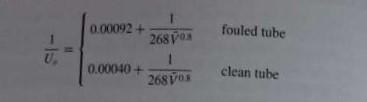
A study of heat transmission from condensing steam to cooling water in a single-tube condenser gave results for both clean and fouled tubes. For each tube the overall co-efficient U was determined at a number of water velocities. The experimental results were represented by the following empirical
A vertical tubular condenser is to be used to condense 2,100 kg/h of ethyl alcohol. which enters at atmospheric pressure. Cooling water is to flow through the tubes at an average temperature of 30°C. The tubes are 31-mm OD and 27-mm ID. The water-side coefficient is 2,800 W/m2·°C. Fouling
A horizontal shell-and-tube condenser is to be used to condense saturated ammonia vapor at 145 lbƒ/in.2 abs (Th = 82°F). The condenser has 19 steel tubes (1.5-in. OD 1.3-in. ID) 14 ft long through which cooling water is flowing. The tubes are arranged , hexagonally on 2-in. centers. The latent
A 25-mm-OD copper tube is to be used to boil water at atmospheric pressure. (a) Estimate the maximum heat flux obtainable as the temperature of the copper surface is increased. (b) If the temperature of the copper surface is 210°C, calculate the boiling film coefficient and the heat flux. The
Steam containing 2 percent air is condensed at atmospheric pressure inside 25-mm tubes in a water-cooled condenser. The vertical tubes are 3 m long; the coefficient and temperature of the cooling water are 2.500 W/m2·°C and 30°C, respectively. Calculate the condensation rate expected if no air
(a) Calculate the heat-transfer coefficient for film boiling of water at 1 atm on submerged horizontal tubes. 1/2, 1, and 2 in. in diameter, with a surface temperature of 180°C. (b) How does the effect of tube diameter compare with the effect of tube diameter for condensing steam? (c) Compare
Benzene vapor is condensed at atmospheric pressure in a shell-and-tube condenser with horizontal 7/8-in. BWG 16 copper tubes, Predict the film coefficient for the top row of tubes and the average coefficient for a stack of 10 tubes.
At a low overall ΔT the boiling heat flux for a tube bundle is about 4 times that for a single tube, but at a high ΔT the flux is much lower than that for a single tube. Give a logical explanation of the difference.
Saturated steam at 1.2 lbƒ/in.2 is condensed on the outside of 3/4-in. horizontal steel tubes. Cooling water enters the tubes at 60°F and leaves at 75°F at a velocity of 6 ft/s. What are the film coefficients and the overall coefficient for the first row of tubes?
A plant uses methyl isobutyl ketone (MIBK) as a solvent and discharges a gas stream containing 0.25 percent MIBK at 70°C and 1 atm. The melting point of MIBK is -85°C. (a) What fraction of the MIBK could be removed if the gas, which is mostly air, is cooled to -10°C? (b) What temperature would
In answering questions such as those in Problem 13.13. why is it important to know the melting point of the condensing substance?Prob. 13.13A plant uses methyl isobutyl ketone (MIBK) as a solvent and discharges a gas stream containing 0.25 percent MIBK at 70°C and 1 atm. The melting point of MIBK
Determine the net heat transfer by radiation between two surfaces A and B. expressed as watts per square meter of area B, if the temperatures of A and B are 500 and 200°C, respectively, and the emissivities of A and B are 0.90 and 0.25, respectively. Both surfaces are gray. (a) Surfaces A and B
The black flat roof of a building has an emissivity of 0.9 and an absorptivity of 0.8 for solar radiation. The sun beats down at midday with an intensity of 300 Btu/ft2·h. (a) If the temperature of the air and of the surroundings is 68°F, if the wind velocity is negligible, and if no heat
The roof of Prob. 14.2 is painted with an aluminum paint, which has an emissivity of 0.9 and an absorptivity for solar radiation of 0.5. What is the equilibrium temperature of the painted roof?Prob. 14.2The black flat roof of a building has an emissivity of 0.9 and an absorptivity of 0.8 for solar
A 3-in. Schedule 40 iron pipeline carries steam at 6 atm gauge. The line is uninsulated and is 70 m long. The surrounding air is at 25°C. The emissivity of the pipe wall is 0.70. How many kilograms of steam will condense per hour? What percentage of the heat loss is from conduction-convection?
A radiant heating system is installed in the plaster ceiling of a room 18 ft long by 18 ft wide by 8 ft high. The temperature of the concrete floor is maintained at 65°F. Assume that no heat flows through the walls, which are coated with a reradiating material. The temperature of the air passing
On a clear night, when the effective blackbody temperature of space is -70°C, the air is at 15°C and contains water vapor at a partial pressure equal to that of ice or liquid water at 0°C. A very thin film of water, initially at 15°C, is placed in a very shallow well-insulated pan, placed in a
Air leaves a heat exchanger at about 300°C and 1.5 atm, and the temperature is measured using a thermocouple inside a 1/2-in.-diameter thermowell mounted normal to the airflow. If the gas velocity is 25 ft/s and the pipe wall temperature is 270°C, what error in temperature measurement does
In an uninsulated house, there is a 90-mm air gap between the plaster wall and the wood siding. When the inside wall is at 18°C and the outer wall at -9°C, what is the heat loss in watts per square meter by radiation and by natural convection? By what factor would the heat loss be reduced by
In boiling water at 1 atm pressure outside a stainless-steel tube with a surface temperature of 410°F, the heat-transfer coefficient h in the absence of radiation is 32 Btu/h·ft2·°F. If the emissivity of the stainless steel is 0.8, will radiation significantly augment the rate of boiling (i.e.,
A greenhouse 20 m long and 15 m wide has a nearly flat roof 3 m above the floor level. When the sun is directly overhead the solar flux is 1,000 W/m2. If the glass roof has an emissivity of 0.9 and the convective losses are 0.8 times the radiation losses, what is the temperature in the greenhouse?
In Problem 14.10, if the sun's rays are at 45° from the vertical, what is the greenhouse temperature?Prob. 14.10A greenhouse 20 m long and 15 m wide has a nearly flat roof 3 m above the floor level. When the sun is directly overhead the solar flux is 1,000 W/m2. If the glass roof has an emissivity
Catalyst particles in the outer layer of a tubular reactor exchange heat with the wall by radiation as well as by convection (a) For 1/4-inch spherical catalyst beads at 390°C and a wall temperature of 380°C, what is the effective coefficient for radiant heat transfer? (b) Estimate the
Two large parallel plates are at temperatures T1 = 500 K and T2= 300 K. Their emissivities are ε1 = 0.85 and ε2 = 0.90. What is the radiant flux between the plates?
A polished aluminum sheet is placed between the plates of Problem 14.12 as a radiation shield. The emissivity of the aluminum is 0.1. How much does the shield lower the flux to plate 2?Prob. 14.12Two large parallel plates are at temperatures T1 = 500 K and T2= 300 K. Their emissivities are ε1 =
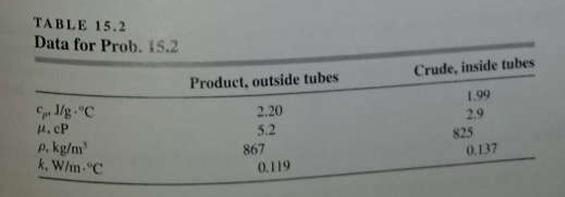
Crude oil at the rate of 150,000 kg/h is to be heated from 20 to 57°C by heat exchange with the bottom product from a distillation unit. The product at 129,000 kg/h is to be cooled from 146 to 107°C. There is available a tubular exchanger with steel tubes with an inside shell diameter of 231/4
Air is blown at a rate of 3 m3/s (measured at 0°C and 1 atm) at right angles to a tube bank 10 pipes and 10 spaces wide and 10 rows deep. The length of each pipe is 3.5 m. The tubes are on triangular centers, and the center-to-center distance is 75 mm. It is desired to heat the air from 20 to
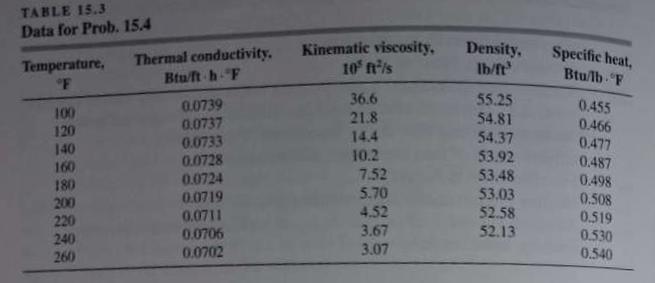
A petroleum oil having the properties given in Table 15.3 is to be heated in a horizontal multipass heater with steam at 60 lbƒ/in.2 gauge. The tubes are to be steel, 3/4-in. OD by BWG 16, and their maximum length is 15 ft. The oil enters at 100°F. leaves at 180°F, and enters the tubes at about
Compare the coefficients predicted by the Donohue equation [Eq. (15.6)] with those found from Eq. (12.63) for flow normal to a single cylinder. Can the difference be reconciled by considering the maximum and average mass velocities in the shell side of the exchanger? 100 usingEq. 15.6Eq. 12.63 The
Showing 200 - 300
of 432
1
2
3
4
5
Step by Step Answers

 Get 50% OFF
Claim Now
Get 50% OFF
Claim Now