



Question: George Brown, a self-employed management consultant, had just settled down to work when he received a call from Ray Sharma, vice president of Software Corporation
George Brown, a self-employed management consultant, had just settled down to work when he received a call from Ray Sharma, vice president of Software Corporation (SC), a software distributing and consulting firm.
Sharma had been through a hectic holiday period and, to some extent, he had let the financial controls slip away. Preoccupied with devoting much of his attention to the customer service side, Sharma had suddenly become aware that cash flow was devastated. In December, three suppliers put him on a C.O.D. basis and three more threatened to stop supplying. At the end of November, the bank line of credit was $260,000 over limit and the bank had refused to honour any cheques except payroll until SC either reduced the outstanding balance to the limit or renegotiated its bank loan. As a condition of refinancing the bank loan, the bank wanted audited financial statements as support for Sharma’s claim that business was great.
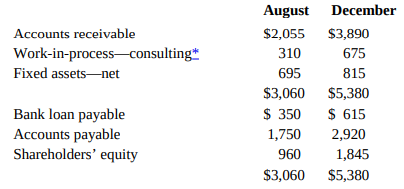
“Business is great,” Sharma had said to Brown. “We just don’t have any cash! George, I was wondering if you could come over here and help me out. I need you to analyze our cash-flow problem. Specifically, I would like you to prepare a statement of cash flow for each of the last four months of 2012 for me so that I can answer any questions that the bank manager may have when I meet with her.” Brown visited SC two days later to analyze the cash-flow problem. Exhibit 11A-4 presents information gathered by Brown in support of his analysis. Exhibit 11A-5 contains a condensed balance sheet of SC as at August 31, 2012, and December 31, 2012.
Required
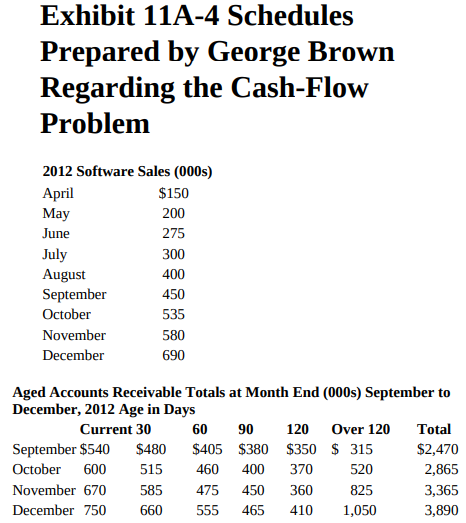
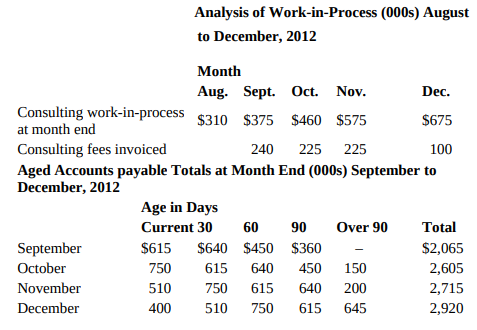
Exhibit 11A-5 Information Collected by George Brown Software Corporation Condensed Balance Sheet as at August 31 and December 31, 2012 (before December adjustments) (in thousands of dollars)
Other information with respect to SC’s cash flows: 1. Bank advances of $80,000 were received in September. 2. Regular operating cash outflows per month are $75,000. 3. Fixed assets of $150,000 were acquired in September for cash. 4. No purchases are paid for in the month in which they are bought. Analyze the cash-flow problem at SC and make recommendations for improvement.
Exhibit 11A-4 Schedules Prepared by George Brown Regarding the Cash-Flow Problem 2012 Software Sales (000s) April May $150 200 June 275 July August September 300 400 450 October 535 580 November December 690 Aged Accounts Receivable Totals at Month End (000s) September to December, 2012 Age in Days Total Current 30 60 90 120 Over 120 September $540 600 $480 $405 $380 $350 $ 315 $2,470 October 515 460 400 370 520 2,865 November 670 585 475 450 360 825 3,365 December 750 660 555 465 410 1,050 3,890 Analysis of Work-in-Process (000s) August to December, 2012 Month Aug. Sept. Oct. Nov. Dec. Consulting work-in-process $310 $375 $460 $575 at month end Consulting fees invoiced $675 240 225 225 100 Aged Accounts payable Totals at Month End (000s) September to December, 2012 Age in Days Current 30 60 90 Over 90 Total September $615 $640 $450 $360 $2,065 October 750 615 640 450 150 2,605 November 510 750 615 640 200 2,715 December 400 510 750 615 645 2,920
Step by Step Solution
3.64 Rating (169 Votes )
There are 3 Steps involved in it
Analysis of Cash Flow Problem Schedule I presents a Statement of Cash Flow for the months of September to December 2012 Based on the data you provided ... View full answer

Get step-by-step solutions from verified subject matter experts